

You may suppose more cores and ray‑tracing GPUs automatically make a laptop “pro‑level,” but the reality’s messier and worth unpacking. You’ll want to weigh raw power against cooling, battery life, and upgrade options, because a well‑balanced machine keeps performance steady during long sessions. Below I’ll compare five strong contenders and the key factors that separate them so you can pick the best fit.
| 15.6″ Chromebook Laptop — 8GB RAM 256GB SSD |
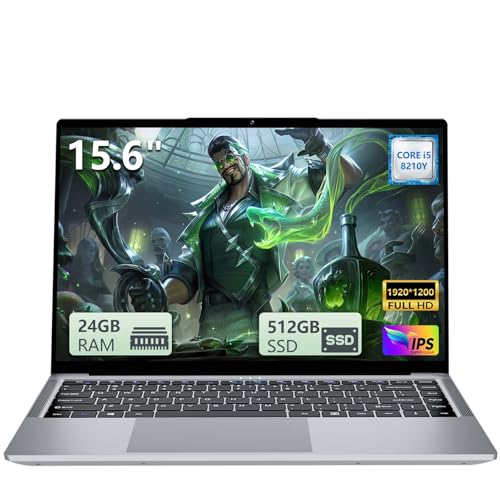
| Everyday Workhorse | Processor: Intel Celeron N4000 | GPU / Graphics: Integrated graphics (CPU iGPU) | Display Size & Resolution: 15.6″ Full HD (1920×1080) | VIEW LATEST PRICE | Read Our Analysis |
| NIMO 15.6″ Gaming Laptop – AMD R7 16GB |

| Portable Powerhouse | Processor: AMD Ryzen 7 7735HS | GPU / Graphics: Integrated Radeon 680M | Display Size & Resolution: 15.6″ Full HD (1920×1080) IPS | VIEW LATEST PRICE | Read Our Analysis |
| Acer Nitro V 16S Gaming Laptop (RTX 5060 Ryzen 7) |
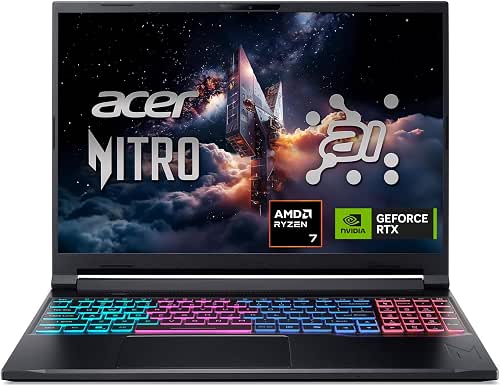
| Ultimate Performance | Processor: AMD Ryzen 7 260 | GPU / Graphics: NVIDIA GeForce RTX 5060 (Laptop) | Display Size & Resolution: 16″ WUXGA (1920×1200) IPS | VIEW LATEST PRICE | Read Our Analysis |
| Acer Nitro V 15.6″ Gaming Laptop (i5 RTX 4050) |
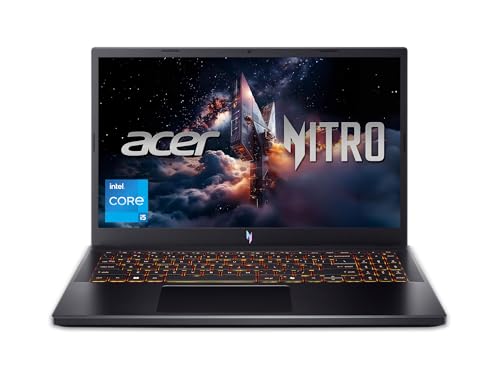
| High-FPS Performer | Processor: Intel Core i5-13420H | GPU / Graphics: NVIDIA GeForce RTX 4050 (Laptop) | Display Size & Resolution: 15.6″ Full HD (1920×1080) IPS | VIEW LATEST PRICE | Read Our Analysis |
| Acer Nitro V 15.6″ Gaming Laptop (i7-13620H RTX 4050) |

| Pro-Level Power | Processor: Intel Core i7-13620H | GPU / Graphics: NVIDIA GeForce RTX 4050 (Laptop) | Display Size & Resolution: 15.6″ Full HD (1920×1080) IPS | VIEW LATEST PRICE | Read Our Analysis |
More Details on Our Top Picks
15.6″ Chromebook Laptop — 8GB RAM 256GB SSD
Should you need a compact, budget-friendly machine for everyday tasks and light multitasking, the 6″ Chromebook with 8GB RAM and a 256GB SSD delivers the essentials—quick app launches, smooth web browsing, and reliable battery-backed portability for students and commuters. You’ll get an Intel Celeron N4000 handling basic workloads, 8GB LPDDR4 for responsive multitasking, and an M.2 256GB SSD for fast boot and file transfers. The 15.6″ Full HD display offers comfortable viewing, while dual-band Wi‑Fi, Bluetooth, USB-A, mini HDMI, and a TF slot keep you connected. It’s lightweight, modestly powered, and supported with a two-year warranty.
- Processor:Intel Celeron N4000
- GPU / Graphics:Integrated graphics (CPU iGPU)
- Display Size & Resolution:15.6″ Full HD (1920×1080)
- Memory (RAM):8 GB LPDDR4
- Primary Storage:256 GB M.2 SATA SSD
- Wireless Connectivity:Dual-band Wi‑Fi (802.11ac) + Bluetooth 4.2
- Additional Feature:Mini HDMI output
- Additional Feature:TF card expansion
- Additional Feature:Two-year warranty
NIMO 15.6″ Gaming Laptop – AMD R7 16GB
Provided you need a portable gaming laptop that handles multitasking and creative work without breaking a sweat, the NIMO 15.6″ with an AMD Ryzen 7 7735HS and 16 GB DDR5 is a sharp pick. You get 8 cores and 16 threads with up to 4.75 GHz surge and Radeon 680M graphics, able to tackle gaming, coding, and editing. The Full HD IPS anti-glare screen, 180° hinge, backlit keyboard, privacy shutter, and fingerprint sensor suit work and play. Dual fans curb throttling, a 256 GB PCIe SSD speeds loads, and 100 W USB-C charging plus slim, lightweight portability finish the package.
- Processor:AMD Ryzen 7 7735HS
- GPU / Graphics:Integrated Radeon 680M
- Display Size & Resolution:15.6″ Full HD (1920×1080) IPS
- Memory (RAM):16 GB DDR5
- Primary Storage:256 GB PCIe SSD
- Wireless Connectivity:Wi‑Fi (unspecified standard) + likely Bluetooth (ports list)
- Additional Feature:Dual-fan cooling
- Additional Feature:Fingerprint sensor
- Additional Feature:180° hinge
Acer Nitro V 16S Gaming Laptop (RTX 5060 Ryzen 7)
Should you want a portable rig that balances serious GPU horsepower with AI-forward features, the Acer Nitro V 16S is a strong pick—its RTX 5060 (Blackwell) delivers 572 AI TOPS and fourth‑gen RT cores for smooth ray tracing while the Ryzen 7 CPU and up to 32GB DDR5 handle multitasking and content work. You’ll get DLSS 4, fifth‑gen Tensor Cores, and 38 AI TOPS across the system for neural rendering and game enhancements. The 16″ WUXGA 180Hz panel covers 100% sRGB, storage is a 1TB PCIe Gen4 SSD with a spare M.2 slot, and connectivity includes USB4, HDMI 2.1, Wi‑Fi 6, Ethernet.
- Processor:AMD Ryzen 7 260
- GPU / Graphics:NVIDIA GeForce RTX 5060 (Laptop)
- Display Size & Resolution:16″ WUXGA (1920×1200) IPS
- Memory (RAM):32 GB DDR5 (2-slot, max 32 GB)
- Primary Storage:1 TB PCIe Gen4 SSD (2x M.2, one slot free)
- Wireless Connectivity:Wi‑Fi 6
- Additional Feature:USB4 40Gbps port
- Additional Feature:Quad-intake/exhaust cooling
- Additional Feature:DLSS 4 support
Acer Nitro V 15.6″ Gaming Laptop (i5 RTX 4050)
Should you want a compact, high-FPS gaming machine that also handles streaming and creative work, the Acer Nitro V 15.6″ with an Intel Core i5-13420H and RTX 4050 is a strong pick. You get a capable CPU for recording, streaming, and multitasking alongside an NVIDIA GeForce RTX 4050 with 194 AI TOPS, DLSS 3.5, and ray tracing for smooth, improved visuals. The 15.6″ FHD IPS panel runs at 165 Hz and offers an 82.64% screen-to-body ratio. It includes 8 GB DDR5 (expandable to 32 GB), 512 GB PCIe Gen4 SSD, Wi‑Fi 6, Killer Ethernet, Thunderbolt 4, and a backlit keyboard.
- Processor:Intel Core i5-13420H
- GPU / Graphics:NVIDIA GeForce RTX 4050 (Laptop)
- Display Size & Resolution:15.6″ Full HD (1920×1080) IPS
- Memory (RAM):8 GB DDR5 (2 slots, up to 32 GB)
- Primary Storage:512 GB PCIe Gen4 SSD
- Wireless Connectivity:Wi‑Fi 6
- Additional Feature:Thunderbolt 4 port
- Additional Feature:Backlit keyboard
- Additional Feature:Killer E2600 Ethernet
Acer Nitro V 15.6″ Gaming Laptop (i7-13620H RTX 4050)
Provided you want a compact, high-FPS rig for gaming, streaming, and content creation, the Acer Nitro V with an Intel Core i7-13620H and RTX 4050 delivers the CPU/GPU balance you’ll appreciate. You’ll get high-frame-rate play and smooth recording thanks to the quad-/hexa-core hybrid CPU and NVIDIA GeForce RTX 4050 with 194 AI TOPS and DLSS 3.5 for improved ray tracing. The 15.6″ FHD IPS panel runs at 165 Hz with reduced ghosting. With 16 GB DDR5 (expandable to 32 GB), a 1 TB PCIe Gen4 SSD, Wi‑Fi 6, Killer Ethernet, Thunderbolt 4, and a backlit keyboard, it’s a versatile, performance-focused choice.
- Processor:Intel Core i7-13620H
- GPU / Graphics:NVIDIA GeForce RTX 4050 (Laptop)
- Display Size & Resolution:15.6″ Full HD (1920×1080) IPS
- Memory (RAM):16 GB DDR5 (2 slots, up to 32 GB)
- Primary Storage:1 TB PCIe Gen4 SSD
- Wireless Connectivity:Wi‑Fi 6
- Additional Feature:1TB PCIe Gen4
- Additional Feature:Thunderbolt 4 support
- Additional Feature:Reduced ghosting display
Factors to Consider When Choosing a Quality Gaming Laptop
Whenever you shop for a quality gaming laptop, focus initially on the processor and core count plus the GPU and ray-tracing capabilities to make certain smooth performance. Also check memory capacity and speed, storage type and size, and the display’s resolution and refresh rate so your games load fast and look great. These factors together determine how well a laptop handles modern titles and future updates.
Processor And Cores
Pick a CPU that balances core count, clock speed, and thermal headroom, because those three factors largely determine how well a gaming laptop handles modern titles, background tasks, and streaming. You should prioritize processors with 6–8+ cores and 12–16+ threads in case you stream, run background apps, or use CPU-heavy physics and simulations. Don’t ignore boost clocks—look for CPUs that reach around 4.0 GHz or higher since many game engines still depend on single-threaded speed. Compare generations: newer designs usually give better IPC, efficiency, and thermals at similar core counts. Also check sustained turbo and cooling: a CPU that maintains higher clocks under load will beat one that throttles. Match core/thread counts to your multitasking and content-creation needs.
Graphics And Ray Tracing
Consider about the GPU as the heart of a gaming laptop: it not only drives high-frame-rate raster rendering but also handles hardware-accelerated ray tracing, which can convert reflections, shadows, and global illumination—usually at a heavy performance cost. You should check RT/core counts and published ray-trace throughput (rays/s or ray-tracing TFLOPS) alongside raster benchmarks to gauge real-world ray-tracing capability. Hardware RT cores deliver far higher frame rates for ray-traced effects than software-only solutions. Expect ray tracing to raise power draw and thermal load, so pick a laptop with a matching power budget and resilient cooling to avoid throttling. Also consider AI upscaling support—temporal or multi-frame reconstruction can keep FPS playable through rendering fewer pixels and reconstructing frames.
Memory Capacity And Speed
Consider about memory like the staging area for everything your games and background apps need—aim for at least 16 GB of DDR5 or DDR4 and prefer dual‑channel kits (two matched modules) to maximize bandwidth and reduce stutter. You’ll see benefits in frame rates and smoother multitasking whenever RAM runs in dual‑channel and at higher clocks—DDR5 at 4800+ MHz or DDR4 at 3200+ MHz helps CPU‑bound and integrated‑GPU scenarios. Check CAS latency and timings too: lower latency plus higher effective bandwidth yields better real‑world performance. Pick a laptop with upgradeable slots and support for 32–64 GB so you can add capacity for streaming, content creation, or heavier multitasking later without replacing the motherboard.
Storage Type And Size
Consider about storage as your game’s long‑term workspace: fast NVMe PCIe SSDs (Gen3/Gen4 and newer) drastically cut load times and improve texture streaming, while larger drives keep your growing library from overflowing. You should prioritize an NVMe boot drive—256–512 GB for OS and key apps—but plan for at least 1 TB total in case you play multiple AAA titles (50–150+ GB each). Whenever possible, choose systems with M.2 slots and extra bays so you can pair a speedy NVMe with a larger secondary SSD or HDD for mass storage and backups. Higher-frequency Gen4/Gen5 SSDs help open‑world asset streaming and reduce stutters, but benefits depend on game engine support; check upgradability and spare connectors prior to buying.
Display Resolution And Refresh
Storage choices shape how quickly games load; your display determines how they look and feel while you play. Pick resolution with GPU capability in mind: 1080p is easier to push to high frame rates, 1440p enhances sharpness and workspace, and 4K delivers detail but demands far more GPU power. Match refresh rate to your goals—60Hz is fine for casual play, but 144Hz or higher (165/240Hz) gives smoother motion and lower perceived input lag for competitive titles. Consider response time, motion blur, and adaptive sync (FreeSync/G‑Sync) to prevent tearing and stutter. Bear in mind higher resolution and refresh rates drain battery and require more performance; balance fidelity, responsiveness, and runtime based on the games you play and the GPU you choose.
Cooling And Thermal Design
In case you push a laptop hard, its cooling design decides whether performance stays high or the system throttles back; look for multi‑fan layouts with separate heat pipes for the CPU and GPU so each component can shed heat independently. Also prioritize higher airflow with multiple intake and exhaust vents—quad‑intake/quad‑exhaust setups lower chassis temps and curb throttling during long sessions. Verify vapor chambers or copper heat‑pipe arrays and count heat pipes: more pipes usually mean better heat spread across fins and fans. Check sustained power/thermal targets (TDP/sustained wattage) and confirm the cooling can maintain full CPU/GPU wattage without frequent clock drops. Finally, pick laptops offering user‑adjustable cooling profiles and software fan control so you can tune noise versus temperature.
Battery Life And Charging
Often you’ll find battery life is the single biggest tradeoff in a gaming laptop: bigger batteries (45–90 Wh) and efficient power management help for light tasks, but under gaming loads high‑performance CPUs and discrete GPUs can drain even large packs in under 1–2 hours. You should balance capacity against weight and expect short runtimes during intensive play. Use power‑saving modes and GPU switching for everyday use — these can stretch runtime 2–4× versus full performance. Manage screen brightness and refresh rate; dropping them can add 30–60% more life in light use. Look for fast charging (USB‑C or proprietary 65–140 W) that tops 50–80% in 30–60 minutes so you can get back to gaming quickly.
Ports And Connectivity
Battery life and fast charging matter, but you’ll also want the right ports so your laptop can power peripherals, external displays, and wired networking during long sessions. Make sure it has at least one high‑bandwidth USB‑C (USB4 or USB‑C Gen2/3) that supports DisplayPort Alt Mode and Power Delivery for monitors and charging. You’ll also want a mix of USB‑A ports (USB 3.2 Gen1/Gen2) and at least one 10 Gbps+ port for external SSDs. Verify HDMI 2.0+—ideally HDMI 2.1—to drive high refresh rates and resolutions without bottlenecks. Prefer a gigabit Ethernet or equivalent wired option for lower latency. Extra conveniences include a microSD/SD reader, 3.5 mm audio jack, and Kensington lock slot for security.
