

Most people don’t realize a thin laptop can match many desktops in real-world gaming thanks to modern chips and power efficiency. You’ll still want different machines for ultra settings, creative work, or long battery life, and the right pick changes how you play and create. Below are five builds—from ultraportable to high‑end towers—to help you pinpoint what actually matters for your setup.
| Apple MacBook Air 13″ (M4 16GB 256GB) |

| Portable Powerhouse | CPU / Chip: Apple M4 (Apple Silicon) | GPU / Graphics: Integrated Apple GPU (supports graphically demanding apps; external displays supported) | Memory (RAM): 16 GB (config shown) | VIEW LATEST PRICE | Read Our Analysis |
| iBUYPOWER Y40 PRO Gaming PC — Ryzen 9 RTX 5070Ti |

| High-End Performance | CPU / Chip: AMD Ryzen 9 7900X | GPU / Graphics: NVIDIA GeForce RTX 5070Ti 16GB | Memory (RAM): 32 GB DDR5 (5200 MHz) | VIEW LATEST PRICE | Read Our Analysis |
| STGAubron Gaming PC Desktop — Ryzen 5 5600G RX 6500 |
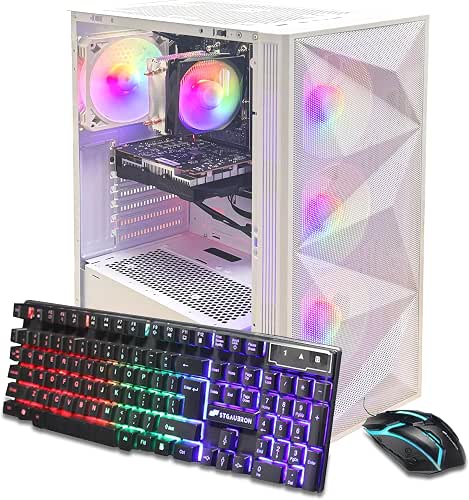
| Entry-Level Gamer | CPU / Chip: AMD Ryzen 5 5600G | GPU / Graphics: AMD Radeon RX 6500 4GB | Memory (RAM): 16 GB DDR4 | VIEW LATEST PRICE | Read Our Analysis |
| Prebuilt Gaming PC Ryzen 7 8700F RTX 5060 |

| Creator’s Workhorse | CPU / Chip: AMD Ryzen 7 8700F | GPU / Graphics: NVIDIA RTX 5060 8GB | Memory (RAM): 32 GB DDR5 (5600 MHz) | VIEW LATEST PRICE | Read Our Analysis |
| STGAubron Gaming PC Ryzen 5 5500 RTX 3060 |

| Best Value Gaming | CPU / Chip: AMD Ryzen 5 5500 | GPU / Graphics: NVIDIA GeForce RTX 3060 12GB | Memory (RAM): 16 GB DDR4 | VIEW LATEST PRICE | Read Our Analysis |
More Details on Our Top Picks
Apple MacBook Air 13″ (M4 16GB 256GB)
Who is this for? You want a thin, silent laptop that handles indie and less demanding AAA titles while doubling as a stellar productivity machine. The M4 chip gives you smoother multitasking, faster video editing, and improved graphics for casual gaming. Apple Intelligence helps write, organize, and protect your personal data. Expect up to 18 hours of battery life and a featherlight design for gaming anywhere. The 13.6″ Liquid Retina screen, 12MP Center Stage camera, three mics, and four-speaker Spatial Audio sharpen immersion. You get two Thunderbolt 4 ports, MagSafe, headphone jack, Wi‑Fi 6E, and tight iPhone continuity.
- CPU / Chip:Apple M4 (Apple Silicon)
- GPU / Graphics:Integrated Apple GPU (supports graphically demanding apps; external displays supported)
- Memory (RAM):16 GB (config shown)
- Storage:256 GB SSD
- Operating System:macOS
- Gaming / Creative Capability:Strong for multitasking, video editing, some gaming; Apple Intelligence features enhance workflows
- Additional Feature:13.6″ Liquid Retina
- Additional Feature:MagSafe charging port
- Additional Feature:12MP Center Stage
iBUYPOWER Y40 PRO Gaming PC — Ryzen 9 RTX 5070Ti
In case you need a ready-to-run rig that handles high-refresh gaming and creative workloads, the iBUYPOWER Y40 PRO pairs a Ryzen 9 7900X with an RTX 5070Ti to deliver strong performance for streamers, content creators, and competitive gamers. You get 32GB DDR5 (5200MHz), a 2TB NVMe SSD, and Windows 11 Home for smooth multitasking and fast load times. The RTX 5070Ti’s 16GB plus NVIDIA Studio support accelerates video editing, 3D work, and AI tasks. A tempered-glass case with 16-color RGB, six USB 3.1 ports, Ethernet, Wi‑Fi ready, and bundled keyboard and RGB mouse round it out.
- CPU / Chip:AMD Ryzen 9 7900X
- GPU / Graphics:NVIDIA GeForce RTX 5070Ti 16GB
- Memory (RAM):32 GB DDR5 (5200 MHz)
- Storage:2 TB NVMe SSD
- Operating System:Windows 11 Home
- Gaming / Creative Capability:High-end gaming and creative workloads with RTX/AI acceleration (NVIDIA Studio)
- Additional Feature:NVIDIA Studio support
- Additional Feature:Tempered glass case
- Additional Feature:Included keyboard & mouse
STGAubron Gaming PC Desktop — Ryzen 5 5600G RX 6500
Should you want a compact, budget-friendly desktop that handles 1080p gaming and everyday multitasking, the STGAubron Gaming PC with a Ryzen 5 5600G and RX 6500 fits the bill. You get a 6-core/12-thread 5600G (3.6–4.6 GHz), 4 GB RX 6500 GDDR6, 16 GB DDR4, and a 1 TB SSD with Windows 11 Home. It includes Wi‑Fi 6, Bluetooth 5.2, HDMI and DisplayPort, plus an RJ‑45 and a serial port. Four RGB fans, keyboard and mouse are bundled. Expect smooth 60+ FPS in many 1080p titles; one‑year warranty and lifetime tech support round it out.
- CPU / Chip:AMD Ryzen 5 5600G
- GPU / Graphics:AMD Radeon RX 6500 4GB
- Memory (RAM):16 GB DDR4
- Storage:1 TB SSD
- Operating System:Windows 11 Home 64-bit
- Gaming / Creative Capability:Capable of 60+ FPS on many titles (midrange gaming)
- Additional Feature:Wi‑Fi 6 + Bluetooth
- Additional Feature:4 × RGB cooling fans
- Additional Feature:Free lifetime tech support
Prebuilt Gaming PC Ryzen 7 8700F RTX 5060
Should you want a prebuilt rig that handles high-refresh gaming, heavy content creation, and smooth multitasking without fiddling with parts, the Ryzen 7 8700F paired with an RTX 5060 delivers that balance: 8 cores/16 threads up to 5.0 GHz, 32 GB of DDR5-5600, and an 8 GB GDDR GPU drive responsive gameplay and fast Blender/Premiere workloads, all from a quiet, RGB-accented white tower with WiFi 6 and a 1 TB NVMe SSD. You’ll get high-frame-rate gaming, efficient Blender renders, and snappy Premiere edits. Intelligent cooling keeps noise low during long sessions, while Sync Lighting customizes aesthetics. It’s ready out of the box.
- CPU / Chip:AMD Ryzen 7 8700F
- GPU / Graphics:NVIDIA RTX 5060 8GB
- Memory (RAM):32 GB DDR5 (5600 MHz)
- Storage:1 TB NVMe SSD
- Operating System:(Implied) Windows 11 (prebuilt gaming PC)
- Gaming / Creative Capability:Targets high-end gaming, Blender rendering, Premiere Pro and pro creator workflows
- Additional Feature:32GB DDR5 5600MHz
- Additional Feature:White tower with RGB
- Additional Feature:Wi‑Fi 6 included
STGAubron Gaming PC Ryzen 5 5500 RTX 3060
Provided that you want a midrange gaming rig that balances strong 1080p/1440p performance with modern connectivity, the STGAubron Gaming PC with a Ryzen 5 5500 and RTX 3060 is a solid pick—its 12 GB VRAM and 16 GB DDR4 make it ready for current AAA titles and streaming without immediate upgrades. You’ll get a 3.6–4.2 GHz CPU, 1 TB SSD, and Windows 11 Home preinstalled. Outputs include HDMI, DisplayPort, and DVI. Built‑in Wi‑Fi 6, Bluetooth 5.2, RJ‑45, and a serial port cover connectivity. Comes with RGB mouse, keyboard, four RGB fans, one‑year warranty, and lifetime tech support.
- CPU / Chip:AMD Ryzen 5 5500
- GPU / Graphics:NVIDIA GeForce RTX 3060 12GB
- Memory (RAM):16 GB DDR4
- Storage:1 TB SSD
- Operating System:Windows 11 Home 64-bit
- Gaming / Creative Capability:Capable of 60+ FPS on modern titles (midrange gaming/streaming)
- Additional Feature:RTX 3060 12GB
- Additional Feature:Multiple display outputs
- Additional Feature:4 × RGB case fans
Factors to Consider When Choosing a Gaming Computer To Buy
As you’re choosing a gaming PC, focus initially on budget and the value you get for CPU, GPU, memory, and storage. Consider how the processor and graphics card will affect frame rates and future-proofing, and balance that against RAM, SSD capacity, and cooling. Don’t forget noise levels and cooling performance, since a quiet, well-cooled system runs better and lasts longer.
Budget And Value
Because your budget dictates trade-offs, set a clear total range (for example, $600–$1,200) before you shop so you can balance CPU/GPU priorities and avoid overspending on nonessential features. Decide how much of that range goes to the GPU (typically 40–60% for 1080p–1440p) unless you’ll be heavy into streaming or content work, in which case shift more toward CPU. Check price-per-performance using benchmarks—FPS and render times per dollar—rather than MSRP alone, since newer or higher-clocked parts can be better value. Invest in a quality motherboard and PSU and extra RAM should upgrade paths extend usable life. Don’t forget non-hardware costs: OS, monitor, peripherals, cooling, and planned future upgrades while calculating total cost of ownership.
CPU And Performance
Once you’ve set your budget and decided how much to spend on GPU versus other components, you should focus on the CPU because it shapes frame pacing, streaming headroom, and upgrade flexibility. Pick a chip with plenty of cores and threads—6–12 cores (12–24 threads) covers modern gaming plus streaming and editing. Favor high peak clocks (around 3.8–5.0+ GHz) for strong single-threaded performance, which many engines still rely on. Check L3 cache and IPC gains; newer designs with larger caches can reduce latency and improve frame consistency. Match CPU tier to your GPU to avoid bottlenecks: stronger, higher-clock CPUs for 1080p high-FPS, midrange CPUs for 1440p/4K. Finally, choose a motherboard that supports faster RAM and PCIe 4.0/5.0 for future upgrades.
GPU And Frame Rates
Pick the GPU initially—it’s the single biggest factor for in-game frame rates, so choose a card that matches your target resolution and refresh rate rather than guessing from model numbers alone. You’ll get the biggest FPS gains through upgrading the GPU, so compare real-world benchmarks for the games and settings you play (1080p high, 1440p ultra, etc.). Match VRAM to resolution: 4–6 GB can bottleneck textures, while 8–12+ GB is safer for 1440p/4K and large mods. Factor target frame-rate: should you want 144 Hz, pick a GPU that reliably delivers 120–144+ FPS at chosen settings; 60 FPS needs much less headroom. In conclusion, plan for future titles and features like ray tracing and upscaling to preserve performance longer.
Memory And Storage
After you’ve locked in a GPU that hits your target frame rates, memory and storage become the next levers that determine how smoothly games run and how quickly you get back into them. Aim for at least 16 GB of RAM for modern AAA gaming and multitasking; choose 32 GB should you stream, run VMs, or edit large media. Favor faster memory your CPU and motherboard support—higher MHz and lower CAS latency can tighten frame pacing in some titles. Use an NVMe SSD (PCIe 3.0/4.0) as your boot drive; 512 GB is a practical minimum, 1 TB+ is ideal for bigger libraries. Keep a secondary 2 TB+ SATA SSD or HDD for bulk installs and backups. Confirm your motherboard has spare RAM slots and extra M.2/SATA connectors for easy upgrades.
Cooling And Noise
Often you’ll overlook cooling and noise until your system throttles or becomes distracting, but they’re central to long-term performance and comfort. Look for cases with dedicated airflow paths—intake front/bottom and exhaust rear/top—and multiple fans to keep CPU and GPU temps stable under sustained loads. Check fan specs and RPM ranges: higher RPM moves more air but raises dB; prefer PWM-controlled fans so idle noise stays low. Match case size and internal clearance to larger heatsinks or AIO radiators (120/240/360 mm) for better dissipation than stock coolers. Verify CPU/GPU TDP and reported operating temps under load to avoid throttling and shortened lifespan. Finally, assess sound in dB(A) at gaming loads and use vibration-damping mounts or rubber grommets.
Ports And Connectivity
A good gaming PC gives you the right mix of high-bandwidth ports and modern wireless standards so your peripherals, displays, and network don’t bottleneck performance or convenience. Make sure you have multiple USB 3.1/3.2 Gen 1 (or higher) ports—aim for 2–4—and at least one USB-C to handle external drives, controllers, and accessories without slowdown. Verify a gigabit Ethernet port for stable, low-latency play; consider 2.5GbE+ when your router and ISP support it. Check video outputs: prefer DisplayPort 1.4 or HDMI 2.1 to drive high-refresh-rate or 4K monitors. Confirm Wi‑Fi 6/6E and Bluetooth 5.x for fast wireless networking and reliable controllers/headsets. For serious audio, look for optical S/PDIF or dedicated line-out and a sturdy front headphone jack.
