

A kitchen ceiling light needs a different level from a bedside lamp, and LED bulbs can make that simple change surprisingly complicated. You need a dimmer that matches your wiring, your bulb type, and the way you actually use each room. This lineup covers wall-mounted controls, plug-in lamp dimmers, and integrated driver-dimmer units for low-voltage strip lighting.
A Closer Look At The Lineup

EMITEVER 60W 24V 5-in-1 Dimmable LED Driver

Leviton Decora Slide LED Dimmer DSL01-LW White

DEWENWILS Plug-in Dimmer Switch LED/CFL

Lutron Ariadni LED+ Toggle Dimmer Single Pole/3-way
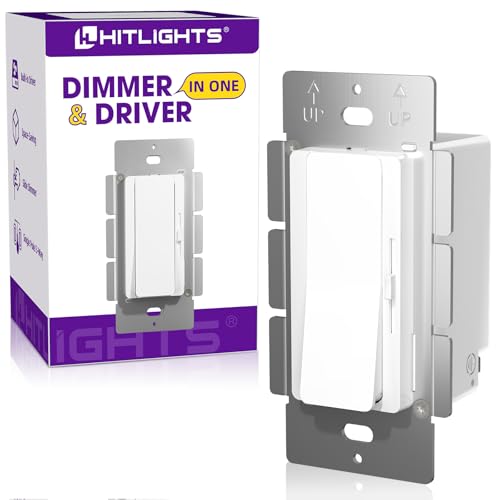
HitLights EZDim Pro 60W 12V Driver Dimmer
HitLights EZDim Pro 100W 24V Driver Dimmer
HitLights EZDim Pro 160W 24V Driver Dimmer

Leviton Toggle Slide LED Dimmer TSL01-W White

DEWENWILS 2-Pack Touch Dimmer Control Pad
More Details On Our Top Picks
You get a purpose-built 24V driver rather than a standard wall dimmer, making this a better match for compatible low-voltage LED strip systems. Its five dimming methods cover phase-cut controls, 0-10V control, PWM control, and potentiometer adjustment, giving your installation more control paths.
Phase-cut dimming changes power delivery to control brightness, while 0-10V uses a separate low-voltage signal for brightness commands. For a cabinet-lighting or architectural-strip project, you may value that flexibility more than the simple wall operation of the Leviton units.
What Earns Its Place
- You can match several dimming control formats to a compatible 24V lighting plan.
- The aluminum enclosure keeps the form low-profile for surface-mounted installations.
- Built-in overload and temperature protection adds useful system-level consideration.
- Mounting feet support a more orderly fixed installation.
Things To Consider
- You need compatible 24V LED lighting and an appropriate dimming control.
- You must plan driver placement rather than replacing a wall switch alone.
Who It Suits Best
You benefit most from this driver when building a 24V strip-light installation with a defined dimming-control plan.
Where Another Pick Suits Better
Leviton Decora Slide LED Dimmer DSL01-LW White suits you better for a normal line-voltage ceiling fixture.
A wide Decora-style paddle and separate slide control give your wall a clean, familiar layout. You can use the rocker for on and off while the slider preserves your preferred brightness level for daily kitchen, bedroom, or living-room use.
Unlike the EMITEVER driver, this model works at the wall with dimmable LED, CFL, incandescent, and halogen lighting. You may find its adjustable low and high brightness settings especially useful with LEDs that dim unevenly near either end of their range.
Notable Gains
- You can fine-tune minimum and maximum light levels for your fixtures.
- You can adjust fade-on behavior and locator-light settings.
- No neutral wire requirement helps in many existing switch boxes.
- You can extend control through supported 3-way and 4-way layouts.
- The slim body leaves more room in a standard wall box.
Worth Noting
- You need dimmable bulbs or fixtures for brightness adjustment.
You can add dimming to a lamp without opening a wall box, which makes this inline control a practical route for rentals or a quick bedside refresh. Its five-foot extension cord brings the slider within reach instead of leaving you to reach behind furniture.
Compared with the wall-mounted Leviton Decora Slide LED Dimmer DSL01-LW White, you trade permanent wiring for plug-in convenience. The set control lets you narrow the dimming range for compatible LED or CFL bulbs, and that may help with low-level flicker.
Strong Points
- You can install it without tools or wall wiring.
- The slider provides gradual brightness adjustment rather than preset steps.
- Anti-slip pads help keep the control in place on a table.
Trade Offs
- You need a plug-in lamp rather than a hardwired ceiling fixture.
- You need to stay within the 100W LED/CFL or 300W incandescent limit.
- The cord needs a clear path between outlet and lamp.
A familiar toggle handles on and off while a narrow side slider controls brightness, making this a natural replacement where you prefer a traditional switch appearance. You can return to the previous dim level after using the toggle, which suits hallways and rooms used throughout the day.
Unlike the plug-in DEWENWILS control, this model is intended for a wired single-pole or 3-way circuit. For mixed bulb types on one circuit, its support for dimmable LED/CFL and incandescent/halogen loads gives you a broader practical range.
Real-World Strengths
- You keep familiar toggle-switch operation in a dimmable setup.
- The side slider leaves your preferred light level ready for return.
- You can use it in single-pole and supported 3-way arrangements.
- It supports up to 150W of dimmable LED/CFL lighting.
- It also supports up to 600W incandescent or halogen lighting.
- You can use the control with several common bulb technologies.
Minor Gripes
- You need wall-switch wiring rather than a plug-in lamp connection.
- You need a separate coordinating wall plate.
Made For
You get the most from this control in a traditional wall-switch layout with dimmable LED or mixed bulb loads.
Consider Something Else When
DEWENWILS 2-Pack Touch Dimmer Control Pad fits you better for a plug-in bedside lamp with reachable touch control.
You get both the 120V-to-12V conversion and dimming control in a single wall-mounted unit. That combination can simplify under-cabinet lighting plans because you do not need a separate driver hidden elsewhere.
Unlike the EMITEVER 24V driver, this EZDim Pro model is designed for solid-color 12V strip tape lights. You may appreciate the straightforward slider in a kitchen or study, especially where cabinet space for separate components is tight.
Reasons It Performs
- You combine the driver and wall dimmer in one installation point.
- You can dim compatible 12V solid-color strip lights across a broad range.
- Single-pole and 3-way use gives you placement flexibility.
- Included wire nuts and mounting hardware support installation preparation.
Room For Improvement
- You need 12V solid-color strip lighting, not 24V strips.
- You need an indoor installation location.
- You need to keep the connected lighting within its 60W rating.
This version moves from 12V to 24V output and raises the rated capacity to 100W, so you can build around compatible 24V solid-color strip tape lights. You still get the driver and dimmer together, which can make a cabinet, shelf, or display-light layout less cluttered.
Compared with the 60W HitLights EZDim Pro, this choice suits a larger compatible lighting plan. The honest read is that your voltage decision comes first, since 12V and 24V strips are not interchangeable.
A Few Strong Suits
- You avoid pairing a separate driver with a separate dimmer.
- You can use a wall slider for compatible 24V strip-light brightness.
Points To Note
- You need 24V solid-color strip tape lights.
- You need indoor placement.
- You need to account for the 100W load limit before installation.
- You need a mechanical companion switch for 3-way use.
Right Fit For
You benefit most from this unit in an indoor 24V strip-light project that needs up to 100W.
Not Your Match When
HitLights EZDim Pro 60W 12V Driver Dimmer suits you better for compatible 12V cabinet lighting.
You get the largest rated output among the integrated HitLights units here, at 160W with 24V DC output. That makes it the practical choice for a larger compatible indoor strip-light installation where the 100W version would leave too little load headroom.
Like the 100W model, this combines power conversion and slider dimming in a wall-box format. For a long run of under-cabinet or display lighting, you may prefer having fewer separate components to place and connect.
Where It Delivers
- You can support compatible 24V lighting loads up to 160W.
- You keep driver and dimmer functions in one wall-mounted unit.
- You can use single-pole or supported 3-way control.
- You can adjust compatible strips from 0.3% to full brightness.
- Included wire nuts and barriers help with installation preparation.
Softer Spots
- You need compatible 24V solid-color strip tape lights.
You get a conventional toggle for power and a separate slider for brightness, a setup that feels especially natural in homes already using toggle switches. The control returns your lighting to the saved brightness setting after you turn it back on.
Compared with the Decora paddle on the Leviton Decora Slide LED Dimmer DSL01-LW White, this version keeps a more traditional switch face. You may prefer it for a hallway or older room where matching the existing switch style matters.
A Favorable Mix
- You get separate power and brightness controls.
- You can adjust low and high dimming limits for compatible lights.
- No neutral wire requirement can simplify many replacement projects.
- You can extend use to supported 3-way and 4-way wiring.
Small Caveats
- You need dimmable LED, CFL, incandescent, or halogen bulbs.
- You need a compatible companion switch for multi-location wiring.
Best Suited To
You will appreciate this switch most where a traditional toggle appearance matters alongside LED dimming control.
Look Elsewhere When
Leviton Decora Slide LED Dimmer DSL01-LW White suits you better for a wide paddle-style wall control.
A tap turns your lamp on or off, while a press and hold adjusts brightness, so you can control a lamp without reaching for a small inline slider. The eight-foot cord gives you more placement freedom than the five-foot DEWENWILS Plug-in Dimmer Switch LED/CFL.
You get two touch pads for separate indoor lamps, with a metal pad and non-slip base that can sit on a nightstand or mount in a convenient spot. For bedside reading, the longer reach can feel like a small but meaningful improvement.
What Pays Off
- You can control compatible lamps through a simple touch pad.
- The eight-foot cord reaches farther from a wall outlet.
- You receive two controls for separate lamp locations.
- The non-slip base helps the pad stay positioned on furniture.
- You can mount the control pad where reaching a lamp switch is awkward.
Areas To Watch
- You need dimmable indoor bulbs and plug-in lighting fixtures.
- You need to stay within the 75W LED or 200W incandescent limit.
- You may need to plan cord routing around a bed or sofa.
What Matters Before You Fit an LED Dimmer
Match Your Lighting Voltage
You need a wall dimmer for standard line-voltage fixtures, while 12V and 24V strip lights need a matching low-voltage driver. A 24V strip needs a 24V output, and a 12V strip needs a 12V output. That single check prevents the most common mismatch.
Check the Load and Bulb Type
You need dimmable LED bulbs or a dimmable LED fixture for LED brightness control. Add the wattage of all connected bulbs, then keep the total within the dimmer’s stated LED capacity. Incandescent capacity does not automatically equal LED capacity.
Plan the Control Location
You can choose a wired wall dimmer for ceiling fixtures, a plug-in unit for lamps, or an integrated driver-dimmer for strip lighting. A 3-way arrangement lets you control one light from two locations, which helps in hallways and rooms with multiple entrances. You also need a compatible companion switch where the dimmer calls for one.
Fine-Tune the Low End
You may see uneven dimming near the lowest setting with certain LED bulbs. Adjustable minimum brightness lets you raise the lowest usable level, while maximum adjustment can limit excess brightness. Those settings matter most in bedrooms, media spaces, and late-night kitchen use.
Details That Prevent Costly Mismatches
Common Shopping Slip Ups
You can avoid trouble by matching voltage first, then bulb type, wattage, and wiring layout. A plug-in lamp dimmer cannot replace a wired wall control, and a 12V driver cannot power 24V strips.
Where the Extra Money Goes
You may pay more for adjustable dimming limits, multi-location wiring, and integrated low-voltage power conversion. Those additions make sense where you need cleaner installation planning or more tailored control.
Frequently Asked Questions
Do LED bulbs need a special dimmer switch?
You need a dimmer designed to work with dimmable LED bulbs or fixtures. You also need bulbs labeled for dimming.
Can you use a dimmer with non-dimmable LED bulbs?
You should not use a dimmer with non-dimmable LED bulbs. You need dimmable bulbs for adjustable brightness.
What does 3-way dimmer compatibility mean?
You can control the same light from two separate locations with a 3-way setup. You need compatible wiring and, in many setups, a compatible companion switch.
Why do LED bulbs flicker at low brightness?
You may see flicker when a bulb and dimmer do not communicate well near the lower dimming range. Adjustable low-end settings can help you set a steadier usable minimum.
Can you dim LED strip lights with a normal wall dimmer?
You need a compatible driver between household power and low-voltage LED strips. An integrated driver-dimmer unit can combine those two roles for compatible 12V or 24V strips.
