

I’ve tested and compared several popular digital thermostats for 2026 to help you pick the right one for your home. I focus on ease of use, compatibility with HVAC systems, and real energy savings. Some models are simple and reliable, others pack smart features and room sensors. I’ll outline the top seven and what makes each stand out so you can decide which fits your needs.
Honeywell Wi‑Fi 9000 Color Touchscreen Programmable Thermostat

Should you want a smart, customizable thermostat that fits both homes and light commercial spaces, the Honeywell Wi‑Fi 9000 is a great choice—its 4.5‑inch color touchscreen and app control let you change backgrounds, adjust schedules, and monitor heating or cooling from anywhere, while hardwiring and Energy Star certification keep it reliable and efficient. You’ll mount the glossy rectangular plastic unit on your wall, hardwire it to 24V with a C wire, and use Wi‑Fi to connect. The LCD touch display responds to taps, you can swap background colors, and the unit supports heating and cooling with a manufacturer warranty.
Best For: Homeowners and light‑commercial users who want a Wi‑Fi‑enabled, energy‑efficient programmable thermostat with a customizable 4.5‑inch color touchscreen and app control.
Pros:
- Hardwired 24V design with C‑wire support and Energy Star certification for reliable, efficient operation.
- 4.5‑inch LCD color touchscreen with changeable backgrounds and full app control for remote scheduling and monitoring.
- Suitable for residential or light commercial use and backed by a manufacturer warranty.
Cons:
- Requires a C wire and hardwiring, so installation may need a technician for some homes.
- Uses a lithium ion/alkaline battery (not included) for backup, adding minor maintenance and ongoing cost.
- Glossy plastic finish can show fingerprints and may not suit all decor preferences.
Honeywell Home RTH2300B1038 5-2 Day Programmable Thermostat, White
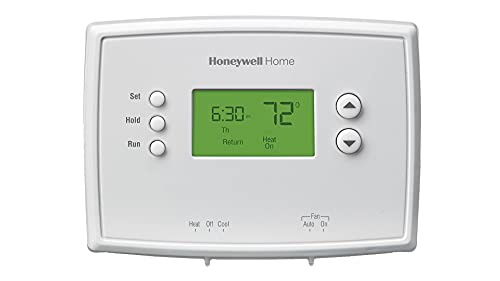
Should you want reliable, budget-friendly scheduling, the Honeywell RTH2300B1038 is ideal for homeowners who need simple weekday/weekend temperature control. You’ll get 5-2 day programming with four periods daily—wake, leave, arrive, sleep—so you can set separate weekday and weekend routines. The backlit digital display and one-touch setpoint access make adjustments quick, and temperature control is precise to ±1°F with adjustable min/max limits. It’s compatible with most furnaces, central AC, hot water and millivolt systems and installs easily yourself. Built-in battery and filter alerts and memory retention during outages keep settings intact and maintenance manageable.
Best For: Homeowners seeking an affordable, easy-to-install programmable thermostat that provides simple weekday/weekend scheduling and precise temperature control.
Pros:
- Simple 5-2 day programming with four daily periods (wake, leave, arrive, sleep) for easy schedule customization.
- Precise temperature control within ±1°F and adjustable min/max limits.
- Backlit display, one-touch setpoint access, battery/filter reminders, and memory retention during outages.
Cons:
- Not compatible with heat pumps that have auxiliary/backup heat, multistage systems, radiant, or line-voltage systems.
- Lacks advanced smart features (Wi‑Fi connectivity, remote app control, or learning algorithms).
- Basic interface and programming may feel limited for users wanting more granular daily schedules or modern integrations.
Non-Programmable Single-Stage Thermostat with Temp & Humidity Display

Should you want a simple, no-frills controller for a conventional gas, oil, or electric furnace, the Mroinge M701 gives you clear temperature and humidity readouts with easy push-button controls and no programming required. You’ll get a large 3-inch blue backlit LCD showing room temp and humidity, manual push-button and touch controls, and separate heat/cool swing settings. It fits single-stage 1H/1C systems only, isn’t compatible with heat pumps, multi-stage systems, RVs, or line-voltage baseboards, and runs on 24VAC or two AAA batteries. Features include temperature calibration, compressor delay protection, compact metal/plastic housing, and a two-year warranty.
Best For: homeowners with a conventional single-stage gas, oil, or electric furnace who want a simple, non-programmable thermostat that displays temperature and humidity.
Pros:
- Large 3-inch blue backlit LCD showing temperature and humidity for easy reading.
- Dual power options (24VAC or 2 AAA batteries) with no C-wire required and built-in compressor delay protection.
- Simple push-button and touch controls with temperature calibration and compact modern design.
Cons:
- Only compatible with single-stage 1H/1C systems; not suitable for heat pumps, multi-stage systems, RVs, or line-voltage baseboard heaters.
- Lacks programming/scheduling features for energy-saving automation.
- Limited to basic controls and functionality compared with smart or Wi‑Fi thermostats.
Honeywell Home T9 WiFi Smart Thermostat (with Sensor)

Should you want room-by-room comfort without rewiring your house, the Honeywell Home T9 WiFi Smart Thermostat is ideal — it pairs with battery-powered Smart Room Sensors to detect occupancy and automatically focus heating or cooling where people actually are. You’ll save energy with ENERGY STAR certification, Auto Home/Away Scheduling, and eligibility for some utility Demand Response programs or rebates. The T9 works with most forced-air systems, heat pumps, and hydronic systems but not electric baseboard heat; it typically needs a C-wire, though a supplied power adapter simplifies installation. Control it via the Resideo app or voice assistants like Alexa, HomeKit, and Google.
Best For: homeowners who want room-by-room smart temperature control and energy savings without rewiring, using wireless sensors and app or voice control.
Pros:
- Compatible with most forced-air, heat pump, and hydronic systems and supports multi-room control with battery-powered sensors.
- ENERGY STAR certified with Auto Home/Away Scheduling and eligibility for utility demand-response programs and rebates.
- Easy DIY installation aided by a supplied power adapter and control via Resideo app and major voice assistants (Alexa, HomeKit, Google).
Cons:
- Not compatible with electric baseboard heat (120–240V) and won’t work with some heating-only oil furnace setups without a C-wire.
- Typically requires a C-wire for power; the adapter may not cover every home wiring scenario.
- Proprietary sensors and ecosystem may limit cross-brand integrations or require additional sensor purchases for full multi-room coverage.
ecobee Smart Thermostat Enhanced – Wi‑Fi, Voice Control
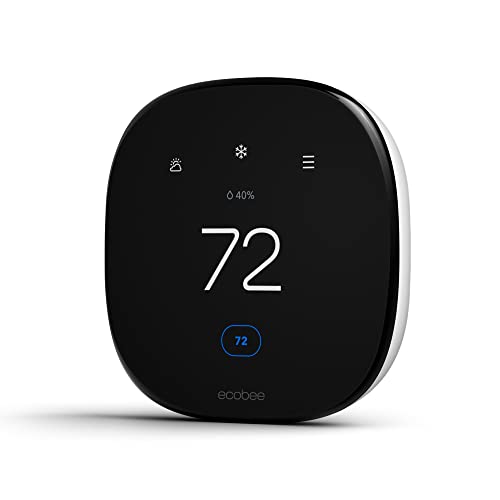
Should you want a wired smart thermostat that prioritizes energy savings and hands‑free convenience, the ecobee Smart Thermostat Improved is a strong pick— you’ll save up to 26% annually as it learns schedules, occupancy and humidity, and uses eco+ to lower temps whenever away or asleep. Built‑in radar preheats/precools before you arrive, and additional SmartSensors refine comfort in each room. It’s compatible with ~90% of HVAC systems; PEK and trim kit simplify DIY installs without a C‑wire. Control it via Siri, Alexa, Google Assistant, HomeKit, SmartThings or the ecobee app. Made in the USA with a 3‑year warranty.
Best For: homeowners who want a wired smart thermostat that maximizes energy savings and hands‑free convenience through occupancy sensing, voice and app control, and broad HVAC compatibility.
Pros:
- Saves up to 26% annually by learning schedules, occupancy and humidity and using eco+ automation.
- Built‑in radar and support for SmartSensors provide preheating/precooling and room‑by‑room comfort.
- Broad compatibility (~90% of HVAC systems) with included PEK/trim kit for easier DIY installs without a C‑wire.
Cons:
- Hardwired design requires installation effort (though PEK is included) and may not suit renters without wiring access.
- Higher upfront cost compared with basic thermostats and may require SmartSensors for optimal multiroom performance.
- Glossy black finish may show fingerprints and might not match all decor preferences.
Non-Programmable Digital Thermostat for Single-Stage HVAC

Should you want a simple, reliable thermostat for a basic 1 heat/1 cool system, this non-programmable digital model is a great choice—who needs complicated scheduling once you just want accurate, easy control? You’ll get ±1°F accuracy, separate heat/cool swing adjustment, and a clear backlit LCD with push and touch controls. It fits most single-stage systems (gas/oil/electric furnace, boiler radiant, cooling only) and mounts in under 30 minutes with 2–5 wires; no C-wire needed for many installs, powered through 24VAC or two AA batteries. Take into account exclusions (heat pumps, multistage, mini‑splits). Includes screws, manual, two‑year warranty.
Best For: Homeowners with a basic single-stage (1 heat/1 cool) HVAC system who want a simple, accurate, non-programmable thermostat without complex scheduling.
Pros:
- Accurate ±1°F control with separate heat/cool swing adjustment for comfort and efficiency.
- Easy installation for typical single-stage systems (2–5 wires), battery or 24VAC powered—no C-wire usually required.
- Clear backlit LCD with push and touch controls, compact design, and includes screws, manual, and a 2-year warranty.
Cons:
- Not compatible with heat pumps, multistage systems, mini-splits, dual-fuel setups, or electric baseboard heat.
- Base supports only 2–5 wires (not suitable for 6–8 wire hookups) and may require experienced installation to avoid errors.
- Lacks programmable scheduling and advanced smart features (remote control, learning, or Wi-Fi connectivity).
Smart WiFi Touchscreen Thermostat with App & Voice
Should you want a user-friendly smart thermostat that’s built to last, this Wi‑Fi touchscreen model with app and voice control is a great pick—its ABS construction resists abrasions and temperature swings, so it holds up in homes, RVs, or commercial spaces while offering remote, hands‑free operation. You’ll get double heating and cooling modes, programmable schedules, and touchscreen plus app and voice commands for convenient automation. It connects over Wi‑Fi, supports smart home systems, and mounts on the wall with tool-free setup using included screws. Battery powered with optional USB, model YV3MMYZJY37BK1AL balances versatility, durability, and dependable remote control.
Best For: homeowners, RV owners, and small commercial spaces seeking an affordable, durable, and easy-to-control smart thermostat with app and voice integration.
Pros:
- Durable ABS construction resists abrasions and temperature swings for long-lasting indoor use.
- Wi‑Fi, app, and voice control with programmable schedules provide convenient remote and hands‑free operation.
- Easy wall mounting with tool-free setup and included screws, plus battery or optional USB power options.
Cons:
- Generic brand and model may offer limited warranty or less brand-specific support.
- Wi‑Fi–only connectivity may not integrate with non‑Wi‑Fi smart home protocols.
- May lack advanced energy‑saving analytics and professional HVAC features found in premium thermostats.
Factors to Consider When Choosing a Digital Thermostat for Home
Before you pick a model, I’ll walk you through the key factors that actually affect performance and convenience. Check system compatibility and power requirements, decide whether you want programmable features or a simpler nonprogrammable unit, and consider connectivity and integration with your smart home. Also weigh display clarity and control layout so daily use is intuitive.
Compatibility With Systems
During the moment I pick a digital thermostat, I initially confirm it actually works with my HVAC setup—single- or multi-stage systems, heat pumps, or boilers—because mismatch can cause poor performance or damage. I check whether it supports my heating fuel—gas, oil, electric, or hybrid—since control logic can differ. I verify wiring needs, especially whether a C-wire is required, or whether the thermostat offers alternative power solutions for homes without one. I make sure it handles auxiliary/backup heat, multistage operation, and radiant systems to avoid malfunctioning controls. Finally, I confirm voltage compatibility—most low-voltage systems use 24V—so installation goes smoothly and the thermostat communicates properly with my equipment.
Power Requirements Needed
Because a thermostat’s power source determines what features it can run and how you install it, I always start through checking the unit’s power requirements against my HVAC wiring. Most digital thermostats run on 24V AC supplied via a common (C) wire—especially smart or Wi‑Fi models that need continuous power. Some units let you choose: hardwired 24V or battery backup (lithium‑ion, alkaline, AA/AAA). Battery‑only models give installation flexibility whenever a C wire’s absent, but they can’t reliably support advanced features that require constant power and need periodic battery changes. Before buying, I verify my system’s wiring and confirm voltage compatibility alongside gas, oil, electric furnaces, or central AC. Matching power requirements upfront avoids functionality issues and complex retrofits.
Programmable Vs Nonprogrammable
At the moment I’m choosing a digital thermostat, the initial decision I make is whether I want programmable automation or the simplicity of a manual unit, since that choice shapes daily convenience and energy use. I prefer programmable models whenever I want schedules—wake, leave, arrive, sleep—that automatically lower costs and keep comfort without constant tweaks. They give finer control over heating and cooling cycles but need an initial setup and occasional changes provided that my routine shifts. In case I value straightforward operation, a nonprogrammable thermostat wins: no menus, just manual adjustments whenever I want them. Ultimately I weigh my willingness to program schedules against the convenience of hands-on control to pick the right balance for my home.
Connectivity And Integration
How will your thermostat fit into the rest of your home? I look for reliable connectivity primarily: Wi‑Fi lets me adjust temps remotely and track usage via an app, but it must play nicely with my home network. I also prioritize integration with voice assistants and smart platforms so I can use hands‑free commands and build automations. Compatibility with smart sensors matters — they let the thermostat respond to occupancy and multi‑room conditions for better comfort and efficiency. I check whether the app offers scheduling and demand‑response participation to save energy and earn utility incentives. Before buying, I confirm supported protocols and platform partnerships so the device actually works with my existing smart devices and routines.
Display And Controls
Connectivity makes daily use and automation simple, but you’ll still interact with the thermostat physically, so the display and controls matter a lot. I look for a clear 3–4.5 inch LCD or touchscreen so temperature and settings are readable at a glance. Backlit screens are a must for nighttime checks without turning on lights. I prefer intuitive controls: one-touch access or programmable touchscreens let me change setpoints and schedules quickly. In the event that buttons are present, they should be tactile and well labeled. I also value display customization—adjusting background colors or choosing modes helps the thermostat blend with my decor and reduces confusion for other household members. Finally, balance simplicity with enough on-device functionality so I’m not forced to use an app every time.
Energy Saving Features
During the period I’m choosing a thermostat, energy-saving features are near the top of my checklist because they cut bills without sacrificing comfort. I look for programmable schedules that match my occupancy patterns so heating or cooling only runs in the case that needed. Occupancy sensors and app-based remote control let me drop setpoints while rooms are empty or I’m away. I value models that join utility Demand Response Programs to trim usage during peak periods, lowering bills and my carbon footprint. Learning algorithms that adapt to my habits and home conditions help maintain comfort while optimizing efficiency. Finally, I prefer Energy Star–certified units because that label confirms stricter energy-saving performance versus non-certified options.
Installation And Wiring
Because a thermostat has to talk directly to your HVAC, I always start through checking wiring and installation requirements before anything else. I look for a C wire initially—most smart or Wi‑Fi models need continuous power, while simpler models can run on batteries. I verify compatibility with your system type (single‑stage, multi‑stage, or heat pump) to avoid control issues or damage. Installation typically means mounting, matching R, W, Y, G terminals to labeled wires, and using proper tools; should you be unsure, get professional help. Some manufacturers include power adapter or extender kits to bypass adding a C wire, which can save effort. Clear wire labeling and following the manual reduce wiring errors and guarantee reliable operation.
Sensor And Room Coverage
At that moment I evaluate thermostats, sensor capability and room coverage are among the initial things I check because they determine how evenly your home will be heated or cooled. I look for units with multiple built-in sensors or support for additional smart sensors so temperature and occupancy are tracked in different rooms. Proper placement matters—signal range can reach about 200 feet but varies with walls and interference—so I map sensor locations prior to buying. Occupancy sensing saves energy through shifting setpoints when rooms are vacant, and broader coverage helps avoid hot or cold spots. During a thermostat supports multi-room sensors, I can set personalized temperatures per zone, which improves comfort and general efficiency across the house.
