

Like a bridge over old wiring, I’ll walk you through the top Wi‑Fi thermostats that don’t need a C‑wire so your upgrade won’t topple your system. I’ve tested and compared budget and smart options for 2026, from simple battery models to Matter‑ready units and power‑bridge solutions. In case you want an easier install without losing features, keep going—I’ll point out which choices fit different systems and budgets.
24V C-Wire Power Adapter for Smart Thermostats

In case you don’t have a C-wire and want to power a smart thermostat (or Ring Doorbell) dependably, the 24V C-Wire Power Adapter/Transformer from WUYELIN provides you a simple plug-and-play solution: you’ll get a compact 24-volt adapter (model MYT240300) that fits Ecobee, Sensi, Honeywell thermostats as well as all Ring Doorbell versions. It weighs 0.48 ounces, measures 1.8 x 2.3 x 2.5 inches, and includes a 25-foot cable for flexible placement. No batteries are required. Customers rate it 4.5/5 from 2,916 reviews. It’s available now, covered under a 30-day Amazon return and manufacturer warranty link.
Best For: homeowners or renters who lack a thermostat C-wire and need an easy plug-and-play 24V power solution for smart thermostats (Ecobee, Sensi, Honeywell) or Ring Doorbells.
Pros:
- Compact, lightweight 24V adapter (model MYT240300) with a 25-foot cable for flexible placement.
- Broad compatibility with all Ring Doorbell versions and major smart thermostat brands.
- High customer satisfaction (4.5/5 from 2,916 reviews) and 30-day Amazon return plus manufacturer warranty.
Cons:
- Requires a nearby outlet for the plug-in transformer, which may limit placement options despite the 25-foot cable.
- No batteries or backup power included—loss of outlet power will disable the device.
- Limited product information beyond basic specs; users may need to verify installation details for specific thermostat models.
Google Nest Thermostat (Renewed) – Snow

Should you want a budget-friendly smart thermostat that skips the C wire in most homes, the renewed Google Nest Thermostat in Snow is a strong choice—especially in case you already use Google Home or want automatic energy savings without fuss. You’ll check compatibility before buying because some setups (heat-only, cool-only, zone control, heat pump) might still need a C wire or power accessory. Installation is usually under 30 minutes, and you can control it manually without internet. With ENERGY STAR certification, Nest schedules and Nest Renew prioritize clean, cheaper energy. Remote control and voice assistants function whenever Wi‑Fi is available.
Best For: Budget-conscious smart-home users who want easy installation and automatic energy savings without a C wire in most homes, especially those already using Google Home.
Pros:
- ENERGY STAR certified and integrates Nest Renew for cleaner, cheaper energy usage.
- Simple self-installation (typically under 30 minutes) and can run without internet for manual control.
- Works without a C wire in most homes and supports remote control and voice assistants when on Wi‑Fi.
Cons:
- Not compatible with all HVAC systems; heat-only, cool-only, zone-controlled, and some heat pump setups may require a C wire or power accessory.
- Renewed (refurbished) unit may have limited warranty or be cosmetically different from new models.
- Full remote features and app management require working internet and Wi‑Fi.
meross Matter Smart Thermostat for Electric Baseboard Heaters
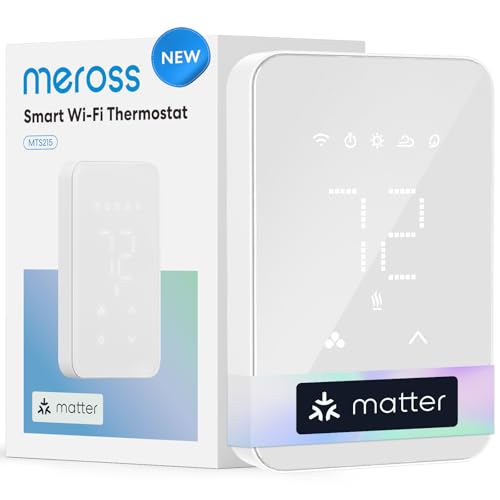
In case you’re upgrading electric baseboard or convector heaters and don’t have a C-wire, the meross Matter Smart Thermostat (MTS215/MTS200) is a top pick because it’s built for high-line 120–240 VAC systems and works with Matter, HomeKit, Alexa, Google, and SmartThings so you won’t get locked into one ecosystem. You’ll install a wall-mounted ABS unit that needs no batteries and connects via Matter and Wi‑Fi for voice or app control. Smart scheduling, energy monitoring, open-window detection, child lock, and offline control help cut waste. Keep in mind it’s not for 24V HVAC systems like heat pumps or central AC.
Best For: homeowners or renters with high-line (120–240 VAC) electric baseboard, convector, or fan-forced heaters who want a Matter-compatible smart thermostat that works across HomeKit, Alexa, Google, and SmartThings without needing a C‑wire.
Pros:
- Built for high-line electric heating (120–240 VAC) so no C‑wire required and compatible with baseboard and convector heaters.
- Universal Matter support plus Wi‑Fi enables seamless multi-ecosystem control (HomeKit, Alexa, Google, SmartThings) and voice/app operation.
- Smart scheduling, energy monitoring, open‑window detection, and child lock enhance convenience and energy savings.
Cons:
- Not compatible with 24V HVAC systems (heat pumps or central air), limiting use to electric heating only.
- Wall-mounted unit requires hardwiring; installation may be more complex than plug‑in options and may need an electrician.
- No backlight on display and limited physical controls compared with some thermostats, potentially making viewing or configuring in low light less convenient.
Amazon Smart Thermostat — Works with Alexa and Ring

Should you want an Alexa-first thermostat that simplifies hands-free control and works smoothly with Ring devices, the Amazon Smart Thermostat is a strong pick; you’ll get ENERGY STAR savings, Alexa routines, and Ring integration. It creates comfort zones using temperature or presence detection from select Echo devices or the Amazon Smart Air Quality Monitor, and Amazon points you to possible local rebates. You control settings via voice or the Alexa app, and Alexa+ lets you automate multiple devices. Installation is guided in the Alexa app and requires a C‑wire. Honeywell Home technology underpins its reliability, and customer support is available.
Best For: homeowners and renters who want an Alexa-first, energy-saving thermostat that integrates with Ring and Echo devices for hands-free control and automated routines.
Pros:
- ENERGY STAR certified for potential energy and cost savings, with information on local rebates.
- Deep Alexa integration (voice control, Alexa+ routines, remote app control) and presence-based comfort zones using Echo devices or the Smart Air Quality Monitor.
- Built on Honeywell Home technology with guided Alexa app installation and available customer support.
Cons:
- Requires a C-wire for installation, which may need professional wiring in some homes.
- Functionality is Alexa-centric, so users of other ecosystems may find limited compatibility.
- Advanced features (presence detection, Ring integration) depend on having compatible Echo or Ring devices.
Google Nest Thermostat Smart Wi‑Fi Thermostat (Charcoal)
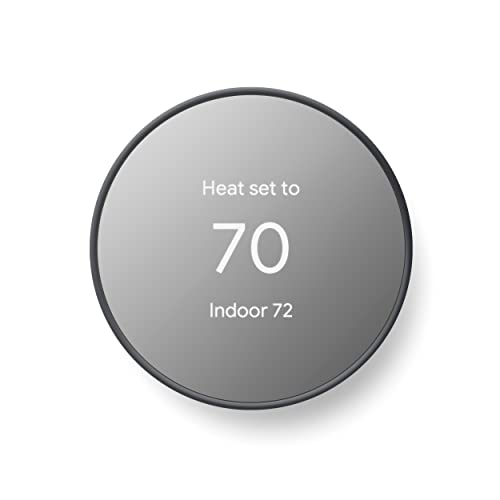
The Google Nest Thermostat in charcoal is a great pick should you want an energy‑saving, app‑driven thermostat that often installs without a C‑wire and learns to cut wasted heating and cooling. You’ll get ENERGY STAR efficiency, a 2-inch backlit LCD, and a compact 3.3″ square profile that fits most homes. Setup takes about 30 minutes; some systems need a C‑wire or power accessory, so check compatibility online initially. Use the Google Home app to set schedules, control remotely, and receive HVAC alerts and Savings Finder tips. It supports Wi‑Fi, BLE, Matter, Google Assistant, Alexa, and offers a one‑year warranty.
Best For: Tech-savvy homeowners or renters who want an energy-efficient, app-controlled thermostat with smart assistant and remote control integration.
Pros:
- ENERGY STAR certified with Savings Finder and HVAC alerts to help reduce energy use and detect issues.
- Supports Wi‑Fi (2.4/5 GHz), BLE, Matter, Google Assistant and Alexa for broad smart-home integration and remote control via Google Home.
- Compact 3.3″ square design, quick ~30-minute install for many systems and includes mounting hardware and batteries.
Cons:
- Some HVAC systems require a C‑wire or a separate power accessory, adding potential installation complexity or extra cost.
- Only a 1-year manufacturer warranty, which may be shorter than some competitors.
- HVAC monitoring alerts are informative but not a substitute for professional diagnostics or repairs.
T21 Programmable Digital Thermostat (1 Heat/1 Cool)

In case you want a simple, budget-friendly thermostat that runs without a C-wire, the T21 Programmable Digital Thermostat is a solid choice—especially for homes with single-stage heating and cooling or 24V gas furnaces. You’ll find it supports single-stage heat/cool, hydronic systems, boilers, 24V gas fireplaces, and 750 mV systems, and works with gas, electric, and oil furnaces. It won’t suit heat pumps with aux heat, line-voltage or mini-split systems, or electric baseboard heat. Battery or 24VAC power options let you skip a C-wire, while an optional C-wire improves stability. The backlit LCD, 5+2 schedule, concealed controls, and retained memory make DIY setup straightforward.
Best For: homeowners with single-stage heating/cooling systems (including 24VAC gas furnaces, boilers, and hydronic systems) who want a simple, budget-friendly, battery-powered thermostat without needing a C-wire.
Pros:
- Affordable, easy DIY installation with a clear backlit LCD and concealed controls for safety.
- Dual power options (2 AA batteries or 24VAC) allow operation without a C-wire; memory retains settings through outages.
- 5+2 day programmability supports weekday/weekend schedules for energy savings.
Cons:
- Not compatible with heat pumps with auxiliary/emergency heat, dual-fuel systems, mini-splits, or line-voltage/electric baseboard heat.
- Limited to single-stage systems only (1 heat/1 cool), so unsuitable for multi-stage HVAC setups.
- Battery mode can require frequent changes without a connected C-wire for stable power.
Lux TQ1 Smart Wi‑Fi Thermostat (Matter, Apple/Google)

Looking for a smart thermostat that works seamlessly with your existing Matter smart‑home setup? The Lux TQ1 is a compact, square Wi‑Fi thermostat that connects via Matter-enabled speakers or controllers, letting you set up and control it from Apple Home, Google Home, Alexa, or SmartThings without extra apps or accounts. It supports conventional, heat pump, PTAC, fan coil, and millivolt systems but not 120/240V line voltage. It needs a C‑wire or optional Power Bridge (sold separately) and runs on 24V DC. Features include auto changeover, programmable schedules, touch controls, fan control, lockable settings, and a graphical temp display.
Best For: Homeowners with Matter-based smart-home ecosystems who want a compact, no-extra-app smart thermostat that integrates with Apple Home, Google Home, Alexa, or SmartThings.
Pros:
- Works natively with Matter for easy setup and control through existing smart-home hubs and apps—no new account or app required.
- Supports a wide range of HVAC systems (conventional, heat pump, PTAC, fan coil, millivolt) and offers features like auto changeover, programmable schedules, and lockable settings.
- Compact, modern touch interface with graphical temperature display and broad voice-assistant compatibility.
Cons:
- Requires a C‑wire or separately sold Power Bridge for installation, adding potential extra cost or wiring work.
- Not compatible with 120V/240V line-voltage systems, excluding many baseboard or high-voltage heating setups.
- Remote connectivity depends on a Matter-enabled smart speaker/controller; no direct cloud setup without a Matter controller.
Factors to Consider When Choosing a WiFi Thermostat: No C Wire
At the time I pick a no‑C‑wire Wi‑Fi thermostat I check system compatibility initially so it’ll work with my furnace, heat pump, or boiler. I also weigh power options, installation complexity, and how well it hooks into my smart home while looking for energy‑saving features that actually cut bills. Those factors tell me whether a thermostat will be reliable, easy to set up, and worth the cost.
Compatibility With Systems
Although you could be tempted to pick the prettiest smart thermostat, I’ll initially make certain it actually works with your HVAC setup—single-stage or multi-stage systems, heat pumps (including auxiliary/emergency heat), and voltage type (24V vs 120–240V) all matter. I check whether the model supports single-stage heating/cooling, multi-stage systems, or heat pumps; some thermostats only handle simple setups. I verify whether it needs a C-wire or specifically supports no C-wire operation via alternative power modes or an adapter. I confirm voltage compatibility—most common units are for low-voltage 24V systems, while electric baseboard heaters use 120–240V and require different thermostats. Finally, I confirm support for auxiliary/emergency heat and any other advanced controls my system uses.
Power Options Available
Now that we’ve confirmed system compatibility, I check how the thermostat will actually be powered in homes without a C-wire. I look at three common approaches: battery-only units, power-stealing models, and external adapters or dual-power designs. Battery-only thermostats are simple but need periodic replacements; I favor models with low consumption and power-saving modes to stretch life. Power-stealing thermostats can avoid batteries by siphoning small current from control wires, but they aren’t compatible with every HVAC setup and can introduce quirks or failures. Dual-power units accept batteries or 24VAC once a C-wire appears, offering flexibility. Finally, C-wire or external adapters provide steady 24V power whenever reliability matters most, so I weigh that against cost.
Installation Complexity Level
Because your home’s wiring and HVAC type determine how easy installation will be, I always start checking whether the thermostat needs a C‑wire or supports battery/power‑stealing options. Installation complexity hinges on that choice: units built for no C‑wire often make installs simpler in older homes, but some systems still require compatible power accessories. Expect a DIY job to take roughly 20–30 minutes for straightforward setups; allow more time should your HVAC be complex or you need an adapter. App‑guided installers reduce wiring errors and walk you through configuration, which I find helpful. Before you begin, I confirm compatibility with existing wiring and system type so as to avoid surprise rewiring or having to call a pro mid‑project.
Smart Home Integration
Having confirmed wiring compatibility and whether you need a power accessory, I next look at how a no‑C‑wire thermostat will fit into my smart‑home setup. I prioritize models that work with Alexa, Google Assistant, HomeKit, or Matter so I get consistent voice control and automation. Because many no‑C‑wire units depend on hubs or proprietary power adapters, I check whether I need extra hardware and whether that hardware plays nicely with my existing ecosystem. I also verify app integration: some thermostats join my system without forcing new accounts or extra apps, which I prefer. Finally, I confirm the required Wi‑Fi band (2.4 GHz vs 5 GHz) and guarantee stable internet to avoid dropped connections or delayed responses.
Energy Saving Features
Should I evaluate energy-saving features, I focus on how a no‑C‑wire Wi‑Fi thermostat helps cut waste without adding hassle. I prioritize programmable schedules that match daily routines to avoid heating or cooling empty rooms. Auto‑away or presence detection is next; it trims runtime whenever nobody’s home without me having to recall to set anything. I look for smart‑home integration so the thermostat can use occupancy, weather, and adaptive energy pricing to make smarter adjustments. Clean‑energy scheduling that shifts heavy loads to off‑peak or greener generation times is a meaningful bonus for both cost and carbon. Finally, real‑time and historical energy monitoring lets me spot wasteful patterns and fine‑tune settings for consistent savings over time.
Remote Control Reliability
While I want the convenience of adjusting my thermostat from anywhere, remote control reliability for no‑C‑wire Wi‑Fi thermostats hinges on two things: steady Wi‑Fi and uninterrupted power from batteries or power‑stealing circuitry. I watch battery levels because low cells often cause connectivity drops or delayed responses, undermining remote control performance. I also consider models with power‑stealing designs that keep the unit online without frequent battery changes. Because app control needs internet access, I plan for occasional outages and check whether the thermostat supports local manual control or offline modes so I can still set temperature directly. Finally, I favor devices that work with multiple smart home platforms—voice assistants or hubs can offer alternative control paths whenever the primary app or network falters.
Display And Controls
Because I check my thermostat dozens of times a day, the display and controls are one of the initial features I evaluate as soon as selecting a no‑C‑wire Wi‑Fi model. I look for clear, appropriately sized screens — from simple LCDs to color graphical interfaces — because readability affects how fast I get info. Backlighting matters for late‑night tweaks, and touchscreens feel modern and streamlined whenever they’re responsive. Still, I sometimes prefer physical buttons for tactile feedback and precise adjustments. I also appreciate models that hide controls or lock settings to prevent accidental changes, especially with kids around. In general, display clarity, size, and the balance between touch and buttons determine how comfortably I use and program the thermostat.
Price And Warranty
After checking display clarity and controls, I next look at price and warranty since they determine long‑term value. I compare initial purchase price to my budget because no‑C‑wire models range widely; a higher price can be worth it provided the warranty and features match. I read the fine print on warranty length and coverage — one‑year limited plans differ from extended warranties or optional protection plans that improve long‑term value. I verify whether labor is included or whether coverage is parts‑only, since labor costs can surprise you. I also check for a seller return policy like a 30‑day trial so I can test compatibility risk‑free. Balancing upfront cost with solid warranty and return terms guides my final pick.
