

Like picking a reliable compass in stormy seas, you’ll want a smart AC controller that actually keeps the room comfortable without fuss. You’ll need to weigh compatibility, sensors, power options, and privacy, and I’ll point out seven solid 2026 choices that span hubless IR remotes to sensor‑loaded Wi‑Fi hubs. Keep going to match the right model to your setup and priorities.
| 30A High-Power WiFi Smart Switch Module (eWeLink) |

| High-Power Solution | Connectivity: Wi‑Fi (2.4 GHz) | IR Control Capability: Indirect (controls AC-powered equipment; not an IR hub) | App Control: eWeLink app (iOS/Android) | VIEW LATEST PRICE | Read Our Analysis |
| MOES WiFi Smart IR Remote Controller (No Hub) |

| All‑In‑One Remote | Connectivity: Wi‑Fi (2.4 GHz) + USB power (IR output) | IR Control Capability: IR (38 kHz) remote control | App Control: Smart Life / Tuya app (iOS/Android) | VIEW LATEST PRICE | Read Our Analysis |
| AC Infinity AI Smart WiFi Outlet Power Strip |

| AI Climate Control | Connectivity: Wi‑Fi | IR Control Capability: Controls via smart outlets (not IR hub) | App Control: Manufacturer Wi‑Fi app (AI climate app; iOS/Android) | VIEW LATEST PRICE | Read Our Analysis |
| BroadLink RM4mini Smart Wi‑Fi IR Remote Hub |

| Compact IR Hub | Connectivity: Wi‑Fi (2.4 GHz) | IR Control Capability: IR (38 kHz) blaster / remote hub | App Control: BroadLink app (iOS/Android) | VIEW LATEST PRICE | Read Our Analysis |
| Smart WiFi Air Conditioner Controller with Temp/Humidity |

| Precision Thermostat | Connectivity: Wi‑Fi (2.4 GHz) | IR Control Capability: IR AC control (smart IR controller) | App Control: Tuya/Smart Life compatible app (Smart Life/Tuya) | VIEW LATEST PRICE | Read Our Analysis |
| MoesGo WiFi IR Smart Hub (Tuya/Smart Life) |
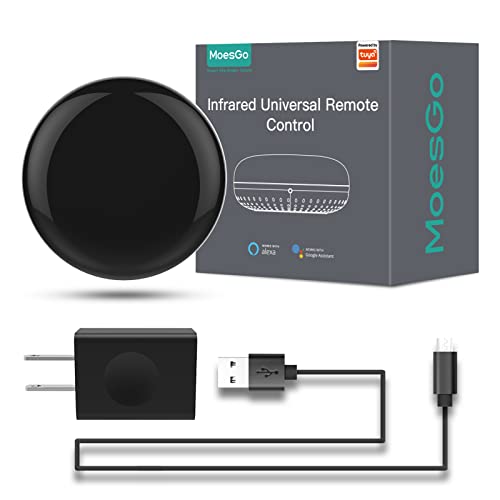
| Family‑Friendly Hub | Connectivity: Wi‑Fi (2.4 GHz) | IR Control Capability: IR (38 kHz) smart hub | App Control: Smart Life / Tuya app | VIEW LATEST PRICE | Read Our Analysis |
| WiFi Smart IR AC Controller with Temp & Humidity Sensor |
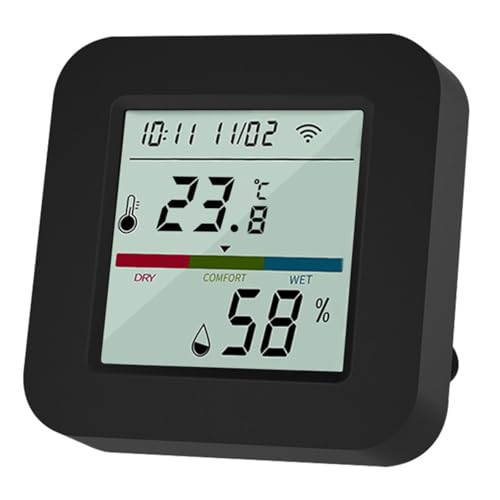
| Sensor‑Driven Controller | Connectivity: Wi‑Fi (2.4 GHz) + Bluetooth used during setup | IR Control Capability: IR controller (3‑in‑1 with sensors) | App Control: Smart Life (Tuya) app | VIEW LATEST PRICE | Read Our Analysis |
More Details on Our Top Picks
30A High-Power WiFi Smart Switch Module (eWeLink)
Should you need to control high-draw AC appliances—like air compressors, water pumps, or hot water heaters—the 30A eWeLink WiFi smart switch is built for that job; it handles up to 30 amps, gives you remote on/off and real-time status via the eWeLink app, and supports scheduling, scenes, and voice control so you can automate heavy-duty equipment safely and conveniently. You’ll use the eWeLink iOS/Android app to toggle devices, track status, and set scheduled, countdown, or loop timers. Grouping and smart scenes let one trigger run multiple devices. Reminder: it needs a 2.4 GHz WiFi and power-off during installation.
- Connectivity:Wi‑Fi (2.4 GHz)
- IR Control Capability:Indirect (controls AC-powered equipment; not an IR hub)
- App Control:eWeLink app (iOS/Android)
- Voice Assistant Compatibility:Amazon Alexa, Google Home
- Scheduling / Automation:Scheduled timing, countdown, loop timing, scenes
- Temperature / Environmental Sensing (built‑in or supported):Device status monitoring (no built‑in temp sensor)
- Additional Feature:Supports up to 30A
- Additional Feature:High-power appliance compatible
- Additional Feature:Chinese/English manual
MOES WiFi Smart IR Remote Controller (No Hub)
Should you want a simple, budget‑friendly way to control IR‑based air conditioners and other devices from your phone or voice assistant, the MOES WiFi Smart IR Remote Controller is a solid pick because it connects directly to 2.4 GHz Wi‑Fi (no hub needed) and can learn commands from your original remotes. You plug the UL‑certified adapter or USB cable into a socket or port, pair it with Smart Life/Tuya, then control IR devices—A/Cs, TVs, fans, heaters, set‑top boxes, and more—from anywhere. It uses 38 kHz IR only (no RF) and needs one unit per room since IR won’t pass through walls.
- Connectivity:Wi‑Fi (2.4 GHz) + USB power (IR output)
- IR Control Capability:IR (38 kHz) remote control
- App Control:Smart Life / Tuya app (iOS/Android)
- Voice Assistant Compatibility:Alexa, Google Assistant
- Scheduling / Automation:Remote scheduling via app (scenes/automation in Smart Life)
- Temperature / Environmental Sensing (built‑in or supported):No built‑in temp sensor (IR only)
- Additional Feature:UL certified adapter included
- Additional Feature:DIY IR learning
- Additional Feature:USB-powered portability
AC Infinity AI Smart WiFi Outlet Power Strip
Should you want centralized, AI-driven control for a grow room, aquarium, or terrarium, the AC Infinity AI Smart WiFi Outlet Power Strip puts independent, programmable outlets and dual-zone temp/humidity monitoring at your fingertips. You’ll get AI climate targeting that syncs heaters, lights, fans, CO₂ systems, and pumps to hold one target environment. Program individual outlets with triggers, schedules, and timers; add optional CO₂, hydro, or soil sensors. Monitor dual-zone VPD and precision metrics, view data charts, and receive real-time alerts via WiFi app control. It supports up to 1800W and includes built-in surge protection for safety.
- Connectivity:Wi‑Fi
- IR Control Capability:Controls via smart outlets (not IR hub)
- App Control:Manufacturer Wi‑Fi app (AI climate app; iOS/Android)
- Voice Assistant Compatibility:Works with smart assistants (Alexa/Google implied)
- Scheduling / Automation:Individual outlet schedules, climate‑triggered automation, AI scenes
- Temperature / Environmental Sensing (built‑in or supported):Dual‑zone temperature & humidity monitoring (built‑in)
- Additional Feature:Dual-zone climate targeting
- Additional Feature:1800W surge protection
- Additional Feature:AI VPD tracking
BroadLink RM4mini Smart Wi‑Fi IR Remote Hub
Should you want a compact, budget-friendly way to bring IR‑controlled air conditioners and other home electronics into smart routines, the BroadLink RM4mini is a strong choice—its cloud‑backed library of 50,000+ IR codes and app‑based automation make it ideal for renters or anyone who needs a no-fuss IR bridge without RF or Bluetooth support. You’ll get a tiny IR blaster (1.85 x 1.85 x 1.65 inches) that requires 2.4 GHz Wi‑Fi and two AAA batteries, includes a USB sensor cable, and supports Alexa, Google Assistant, IFTTT and Siri. Caution: it’s IR‑only, needs line of sight, and lacks a power adapter.
- Connectivity:Wi‑Fi (2.4 GHz)
- IR Control Capability:IR (38 kHz) blaster / remote hub
- App Control:BroadLink app (iOS/Android)
- Voice Assistant Compatibility:Alexa, Google Assistant (plus Siri via iPhone)
- Scheduling / Automation:Multiple timers, custom scenes, automations (IFTTT)
- Temperature / Environmental Sensing (built‑in or supported):External temp/humidity sensor support via cable (sensor included)
- Additional Feature:50,000+ IR codes
- Additional Feature:External sensor cable
- Additional Feature:Cloud IR library updates
Smart WiFi Air Conditioner Controller with Temp/Humidity
Provided that you want a compact, budget-friendly way to add smart control and onboard temperature/humidity sensing to a window or portable AC, the SENCKIT Smart WiFi Air Conditioner Controller is a strong fit. You’ll pair it with 229+ brands and 8,000+ models, including window, mini‑split, portable units and heat pumps. Use the Tuya/Smart Life app or Alexa/Google for remote and voice control, schedules, scenes and group automation. The unit has a touch LCD showing temp (−10–60°C, ±0.3°C/±0.5°C listed) and humidity (0–90% RH, ±5%), 2.4 GHz Wi‑Fi, 45 m range, and a 5V power input.
- Connectivity:Wi‑Fi (2.4 GHz)
- IR Control Capability:IR AC control (smart IR controller)
- App Control:Tuya/Smart Life compatible app (Smart Life/Tuya)
- Voice Assistant Compatibility:Alexa, Google Home
- Scheduling / Automation:Daily schedules, pre‑cool/pre‑heat, away/off automation
- Temperature / Environmental Sensing (built‑in or supported):Built‑in temperature and humidity sensors (LCD display)
- Additional Feature:Large LCD touch screen
- Additional Feature:Built-in temp accuracy ±0.3°C
- Additional Feature:DC 5V/1A power
MoesGo WiFi IR Smart Hub (Tuya/Smart Life)
Should you want a simple, budget-friendly way to bring IR appliances into your smart home, the MoesGo WiFi IR Smart Hub (Tuya/Smart Life) is a great pick — it turns your phone, Echo, or Google Home into a universal IR remote for A/Cs, TVs, fans, and other IR-only devices. You’ll control devices via the Smart Life/Tuya app, share access with family, and use voice commands through Alexa or Google Assistant. It supports 38 kHz IR only, works best in a single room, and connects to 2.4 GHz Wi‑Fi. DIY learning expands compatibility; package includes USB cable, US adapter, two-year warranty.
- Connectivity:Wi‑Fi (2.4 GHz)
- IR Control Capability:IR (38 kHz) smart hub
- App Control:Smart Life / Tuya app
- Voice Assistant Compatibility:Amazon Echo (Alexa), Google Home
- Scheduling / Automation:Smart Life automations, scenes, shared schedules
- Temperature / Environmental Sensing (built‑in or supported):No built‑in temp sensor (IR hub; sensor not specified)
- Additional Feature:2-year warranty
- Additional Feature:UL power adapter included
- Additional Feature:Family device sharing
WiFi Smart IR AC Controller with Temp & Humidity Sensor
Were you to need precise, automated climate control for spaces with IR appliances—like bedrooms, basements, or a wine cellar—this WiFi Smart IR AC Controller with built‑in temp and humidity sensors is a solid choice. You’ll get real‑time temp and humidity monitoring shown on a clear LCD with time and date, plus IR control for ACs, heaters, fans, humidifiers. It runs on continuous Type‑C USB power and uses 2.4 GHz Wi‑Fi (Bluetooth for setup). Use the Smart Life/Tuya app for remote control, voice commands via Alexa/Google, create automation rules linking sensor thresholds to IR actions, and capture custom IR codes for unsupported appliances.
- Connectivity:Wi‑Fi (2.4 GHz) + Bluetooth used during setup
- IR Control Capability:IR controller (3‑in‑1 with sensors)
- App Control:Smart Life (Tuya) app
- Voice Assistant Compatibility:Alexa, Google Home
- Scheduling / Automation:Automation rules linking sensor readings to IR actions, schedules
- Temperature / Environmental Sensing (built‑in or supported):Built‑in temperature and humidity sensors (LCD display)
- Additional Feature:Type-C continuous power
- Additional Feature:Built-in LCD time/date
- Additional Feature:Bluetooth-assisted setup
Factors to Consider When Choosing a Smart AC Controller
Upon choosing a smart AC controller, you’ll want to check compatibility with your specific unit and whether it includes temperature and humidity sensing for accurate comfort control. Make sure the infrared range and line-of-sight suit your room layout, and that it supports the voice assistant you use. Also prioritize scheduling and automation features so your system can run efficiently without constant input.
Compatibility With AC Units
Because smart controllers talk to ACs in different ways, you’ll want to confirm the communication method (IR, Wi‑Fi, or proprietary RF/serial) and whether it matches your unit—remember IR needs line‑of‑sight and won’t work through walls. Check the controller’s compatibility list or database for your brand and model, or pick one with a DIY “learn” function to copy your remote’s codes should yours not be listed. Verify it controls all required functions: mode, temperature setpoint, fan speed, swing/louvers and special features like sleep or eco modes. When the device acts as a thermostat, make certain its temperature range and resolution match your AC (for example ±0.5°C or 0.5°C/1°F steps). For voice/cloud, double‑check ecosystem and 2.4 GHz Wi‑Fi support.
Temperature & Humidity Sensing
Having accurate temperature and humidity sensing lets your smart AC controller make smarter, more comfortable decisions—so pick a unit that measures both, reports reliable numbers, and places its sensor where it won’t be biased against heat sources or direct sun. Choose controllers with combined sensors so automations can cool and dehumidify based on both readings, not just temperature. Check accuracy specs: aim for ±0.3–0.5°C and ±3–5% RH. Prefer built-in sensors located near main conditioned airflow or models offering external probes. Verify real-time monitoring and timestamped logging to spot trends, tune setpoints, and validate performance. Finally, confirm sampling rate and response time suit your space—updates every 1–5 minutes prevent overshoot in small or tightly coupled rooms.
IR Range And Line‑Of‑Sight
Good temperature and humidity sensing only helps provided your controller can actually talk to the AC unit — and that depends on IR range and line‑of‑sight. IR is a line‑of‑sight technology: walls, furniture, and glass can block or weaken the beam, so plan placement carefully. Typical consumer IR runs around 38 kHz with an open‑space range of about 5–10 meters, but obstacles and reflections cut that dramatically. Mount the controller centrally with clear sightlines or use multiple units in rooms where cabinets or partitions shadow the unit. Recall IR won’t pass through walls, so treat each room or distinct sightline as its own control zone. Reflections off light surfaces can extend reach but create inconsistent reception—test positioning in real conditions.
Voice Assistant Integration
Upon choosing a smart AC controller, make certain it works with your preferred voice assistant (Alexa, Google Assistant, Siri) and actually exposes the commands you need—power, mode, setpoint, fan speed, and swing— so you can control the unit hands‑free. Confirm compatibility and test that routines recognize full functionality rather than just on/off. Verify whether voice processing is local or cloud‑based: local gives lower latency and keeps controls working during internet outages, while cloud requires connectivity and might delay responses. Look for natural‑language temperature support and numeric setpoint control in case you want precise adjustments (for example, “set bedroom to 72°F/22°C”). Finally, make certain the controller can join multi‑device scenes via your assistant so voice commands adjust AC alongside lights and locks.
Scheduling And Automation
Beyond voice control, you’ll want a controller that automates your comfort so you don’t have to micromanage settings. Make sure it supports multiple scheduling types—daily/weekly recurring schedules, countdown timers, and loop/repeat schedules—so routine and special cases are covered. Choose a system that can trigger on temperature or humidity thresholds so the AC starts or stops automatically to save energy and maintain comfort. Look for scene and group automation so one action like “Goodnight” or “Away” adjusts the AC and other devices together. Verify remote cloud scheduling with a reliable local fallback so timers run in case the internet drops, and that it handles time‑zone and daylight‑saving changes. Confirm multiuser schedules and permissioned device sharing.
Power And Connectivity Requirements
As you’re picking a smart AC controller, make sure its power and connectivity match both your air conditioner and your home network so the device works reliably without surprises. Check that the controller and your AC use the same IR frequency (typically 38 kHz) or that the controller supports your AC’s protocol (IR, Wi‑Fi, or proprietary), otherwise remote functions can fail. Confirm the controller uses 2.4 GHz Wi‑Fi and that your router broadcasts a compatible SSID with WPA/WPA2 and a password under 32 characters. Match power input and supply—USB‑C/USB‑A 5V/1A adapters or batteries—based on outlet availability and continuous operation needs. For units with relays, verify voltage and load limits. For placement, allow IR line‑of‑sight or guarantee Wi‑Fi RSSI is better than −70 dBm.
Security And Data Privacy
Whenever you’re choosing a smart AC controller, prioritize devices that protect your home and data through design: insist on end‑to‑end encryption (TLS 1.2+), strong authentication (unique device credentials, token/OAuth and optional 2FA), clear telemetry policies (what’s collected, retention, anonymization, sharing), and a transparent update cadence with prompt security patches — and favor controllers that let you control functions locally or disable cloud access to minimize external exposure. Beyond that, verify the vendor uses TLS 1.2+ for all app and cloud traffic to block eavesdropping and MITM attacks. Require OAuth/token-based logins and optional two‑factor authentication. Inspect the privacy policy for telemetry scope, retention, anonymization, and third‑party sharing. Prefer vendors with regular firmware updates, disclosed CVE responses, and explicit local‑control or cloud‑disable options.
Frequently Asked Questions
Do Smart AC Controllers Work With Multi-Split Systems?
Yes — they can work, but compatibility varies. You’ll need a controller that supports multi-split protocols or each indoor unit’s IR/serial signals; some hubs manage multiple zones, while others only handle single-unit setups, so check specs carefully.
Can I Set Geofencing-Based AC Schedules?
Yes—you can set geofencing-based AC schedules; it’ll automatically adjust temperatures as you enter or leave, saving energy and comfort. You’ll create zones, define radii, and set temperature or mode triggers tied to your phone’s location.
Are Firmware Updates Automatic and Secure?
Yes — many controllers offer automatic, secure firmware updates; you’ll get encrypted downloads, signed packages, and verified installs, but you should enable auto-update, keep strong credentials, and confirm vendor reputation to minimize supply-chain or rollback risks.
Do These Controllers Affect HVAC Warranty Status?
Like adding a bolt, you may void warranty when controller alters wiring or compressor controls. You should check manufacturer terms and keep original parts; installers’ unauthorized changes often trigger denial, so obtain written approval initially.
Can I Integrate With Apple Homekit Natively?
Yes — some smart AC controllers integrate natively with Apple HomeKit. You’ll want to check each model’s specs and labeling for HomeKit support, firmware updates, and secure pairing to make certain seamless, local control via the Home app.
