

You want ultralight gear but also water you can trust, no compromises. You’ll need a purifier that survives mud, drops, and long days while staying light and fast to use. I’ll run through five top choices—each balances weight, flow, and cleanability—so you can pick what actually fits your trip and style.
| Waterdrop Gravity Water Filter Straw – 5-Stage Purifier |
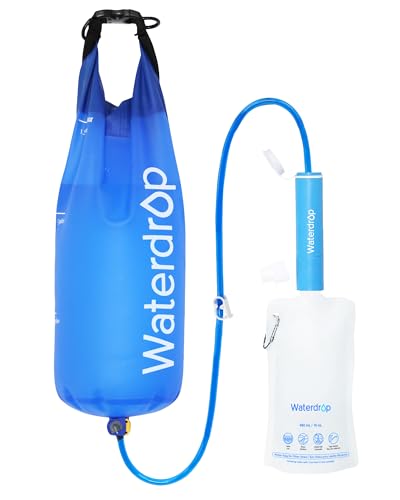
| Best for Groups | Filtration pore size / tech: 0.1 µm ultrafiltration membrane + activated carbon (5-stage) | Removes pathogens/contaminants: Reduces chlorine, particulates, sediment, bad taste/odor (microbes implied by 0.1 µm) | Reusable / cleanable: Backwashable/recyclable via removable mouthpiece (flush with clean water) | VIEW LATEST PRICE | Read Our Analysis |
| Sawyer Products Mini Water Filtration System |

| Ultralight Solo Pick | Filtration pore size / tech: 0.1 micron absolute hollow‑fiber membrane | Removes pathogens/contaminants: Removes bacteria (7‑log), protozoa (6‑log), microplastics | Reusable / cleanable: Reusable and cleanable; includes cleaning plunger/syringe | VIEW LATEST PRICE | Read Our Analysis |
| Sawyer Products SP129 Squeeze Water |

| Best Versatile Squeeze | Filtration pore size / tech: Hollow‑fiber membrane (microfiltration; removes bacteria/protozoa) | Removes pathogens/contaminants: Removes bacteria, protozoa, cysts, sediment, microplastics | Reusable / cleanable: Reusable; designed to withstand rigorous backwashing; includes cleaning plunger/coupling | VIEW LATEST PRICE | Read Our Analysis |
| Waterdrop Gravity Water Filter Straw (0.1 Micron) |
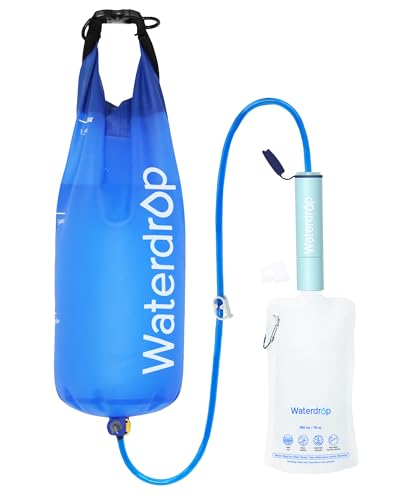
| Best Capacity Filter | Filtration pore size / tech: 0.1 micron ultrafiltration membrane | Removes pathogens/contaminants: Reduces chlorine, particulates, sediment, bad taste/odor (microbes implied by 0.1 µm) | Reusable / cleanable: Backwash purifier function; disassembles for cleaning/backwashing | VIEW LATEST PRICE | Read Our Analysis |
| Katadyn Hiker Pro Hand Pump Water Filter |

| Best For Reliability | Filtration pore size / tech: 0.2 micron glass‑fiber filter | Removes pathogens/contaminants: Removes bacteria (99.9999%), protozoa (99.9%), cysts, sediments; activated carbon reduces taste/odor | Reusable / cleanable: Removable filter for field cleaning (swish in clear water); AntiClog design | VIEW LATEST PRICE | Read Our Analysis |
More Details on Our Top Picks
Waterdrop Gravity Water Filter Straw – 5-Stage Purifier
Should you want a lightweight, no-power purifier that handles group or solo trips, the Waterdrop Gravity Water Filter Straw is a smart choice — its 5-stage filtration (including a 0.1 µm ultrafiltration membrane and coconut-shell activated carbon) removes particulates, chlorine, bad taste and odors, and lets you gravity-feed up to a 1.5‑gal bag so you can hang it and forget about pumping while your water flows at up to 700 ml/min. You’ll connect it to bags or 27.5 mm‑thread bottles, backwash via the removable mouthpiece, and expect up to 1,400 gallons (5,300 L) of service from this 4.6 oz unit.
- Filtration pore size / tech:0.1 µm ultrafiltration membrane + activated carbon (5-stage)
- Removes pathogens/contaminants:Reduces chlorine, particulates, sediment, bad taste/odor (microbes implied by 0.1 µm)
- Reusable / cleanable:Backwashable/recyclable via removable mouthpiece (flush with clean water)
- Portability / lightweight:Compact gravity straw system with 1.5 gal bag; item weight 4.6 oz
- Use cases / intended activities:Camping, backpacking, travel, emergency preparedness
- Connection / delivery method:Gravity‑fed straw connects to 1.5 gal bag or bottles (27.5 mm thread)
- Additional Feature:Includes 1.5 gal bag
- Additional Feature:Backwashable via mouthpiece
- Additional Feature:Bottle thread compatibility (27.5mm)
Sawyer Products Mini Water Filtration System
Should you want an ultra-light, reliable personal filter for solo hikes, the Sawyer MINI delivers — it weighs about 2 ounces, fits in your palm, and removes bacteria, protozoa, and microplastics down to 0.1 microns. You’ll use it on day hikes, extended treks, travel, or emergencies: screw it onto a 28 mm bottle, attach hydration tubing, drink with the straw, or connect to a pouch. The hollow-fiber 0.1µm membrane removes 7-log bacteria and 6-log protozoa, and independent testing confirms performance. It’s rated to 100,000 gallons, is backflush-cleanable with the included syringe, and carries a lifetime filter warranty.
- Filtration pore size / tech:0.1 micron absolute hollow‑fiber membrane
- Removes pathogens/contaminants:Removes bacteria (7‑log), protozoa (6‑log), microplastics
- Reusable / cleanable:Reusable and cleanable; includes cleaning plunger/syringe
- Portability / lightweight:Ultra‑light palm‑size filter; total field weight 2 oz
- Use cases / intended activities:Hiking, camping, travel, scouting, emergency preparedness
- Connection / delivery method:Attach to drinking pouches, 28 mm bottles, hydration tubing, or used as straw
- Additional Feature:Lifetime manufacturing warranty
- Additional Feature:Includes cleaning syringe
- Additional Feature:Fits 28mm bottles/hydration
Sawyer Products SP129 Squeeze Water
Suppose you want a nearly weightless, high-capacity purifier for backpacking or emergencies, the Sawyer SP129 Squeeze delivers—under 5 ounces with a Cnoc 1 L TPU bottle included. You’ll remove bacteria, protozoa, cysts, sediment, and 100% of microplastics with its hollow-fiber membrane, which uses thicker walls for extra strength. The system’s reusable and built for rigorous backwashing; each unit is tested three times and rated up to 100,000 gallons. The soft, collapsible TPU bottle packs small, stands when full, and is BPA- and PVC-free. It’s ideal for outdoor excursions, travel, and emergency preparedness—simple, light, reliable.
- Filtration pore size / tech:Hollow‑fiber membrane (microfiltration; removes bacteria/protozoa)
- Removes pathogens/contaminants:Removes bacteria, protozoa, cysts, sediment, microplastics
- Reusable / cleanable:Reusable; designed to withstand rigorous backwashing; includes cleaning plunger/coupling
- Portability / lightweight:System weight <5 oz; includes collapsible bottle
- Use cases / intended activities:Outdoor adventures, travel, emergency preparedness
- Connection / delivery method:Squeeze system uses included collapsible bottle (Cnoc 1 L) and coupling
- Additional Feature:Includes Cnoc 1L bottle
- Additional Feature:Thicker fiber walls
- Additional Feature:Packs extremely small
Waterdrop Gravity Water Filter Straw (0.1 Micron)
Should you need a lightweight, high-capacity purifier for multi-day trips, the Waterdrop Gravity Water Filter Straw (0.1 micron) lets you reliably convert river or lake water into safe drinking water while freeing your hands—its ultrafiltration membrane removes bacteria and particulates, delivers up to 1,400 gallons of treated water, and pairs with a 1.5‑gal gravity bag so you can sip or refill without pumping. You’ll get 0.1µ filtration, up to 700 ml/min flow, and reduced chlorine, sediment, taste and odor. It connects to bottles or the gravity bag, backwashes for cleaning, and uses recyclable, pollution‑free materials—ideal for hiking, travel, and emergencies.
- Filtration pore size / tech:0.1 micron ultrafiltration membrane
- Removes pathogens/contaminants:Reduces chlorine, particulates, sediment, bad taste/odor (microbes implied by 0.1 µm)
- Reusable / cleanable:Backwash purifier function; disassembles for cleaning/backwashing
- Portability / lightweight:Gravity straw with 1.5 gal bag; designed for backpacking/travel (compact)
- Use cases / intended activities:Hiking, camping, travel, emergency preparedness (disaster scenarios listed)
- Connection / delivery method:Gravity bag or standard/pop bottle connection; disassemblable ends for different connections
- Additional Feature:Large 1.5 gal capacity
- Additional Feature:Air-bleed hose tip (usage tip)
- Additional Feature:Both ends disassemble
Katadyn Hiker Pro Hand Pump Water Filter
Provided that you want a reliable, fast hand pump that’s great for solo hikers or pairs, the Katadyn Hiker Pro delivers with its 0.2‑micron glass fiber element and 1 L/min flow—so you’ll get bacteria- and protozoa‑free water quickly without wasting time pumping for ages. You’ll remove 99.9999% of bacteria and 99.9% of protozoa, while an activated carbon core improves taste. The large 271 cm² surface plus AntiClog™ design keeps flow high; swish the removable filter to clear clogs. Tipping the scales at 11 ounces with ergonomic handle, quick‑connect hoses and bottle adaptor, it’s compact, durable, and ideal for 1–2 people.
- Filtration pore size / tech:0.2 micron glass‑fiber filter
- Removes pathogens/contaminants:Removes bacteria (99.9999%), protozoa (99.9%), cysts, sediments; activated carbon reduces taste/odor
- Reusable / cleanable:Removable filter for field cleaning (swish in clear water); AntiClog design
- Portability / lightweight:Hand‑pump design, weight 11 oz; intended for hiking/backpacking
- Use cases / intended activities:Hiking, camping, ultralight backpacking, emergency/survival use
- Connection / delivery method:Hand pump with quick‑connect hoses; bottle adaptor for most bottles and bladders
- Additional Feature:Manual pump operation
- Additional Feature:High flow (~1 L/min)
- Additional Feature:AntiClog™ large surface filter
Factors to Consider When Choosing a Water Filter Purifier For Backpacking
Upon selecting a water filter for backpacking, you’ll want to balance weight and packability against filtration performance ratings so you’re not carrying more than you need for the trip. Consider flow rate and speed, plus how easy the unit is to maintain and clean in the field. Also check compatibility with the bottles or reservoirs you already use so you don’t end up buying adapters.
Weight And Packability
You’ll usually want a filter system that stays light and packs small—aim for roughly 5–12 ounces (140–340 g) all-in for true multi-day backpacking—and remember that hoses, bottles, and reservoirs can double or triple that number should you not account for them. Focus on total packed weight, not just the filter body: hoses, bottles, and reservoirs add real pounds. Choose collapsible or compressible components—soft water bags and foldable bottles save volume and stow flat whenever empty. Check packed dimensions and shape; long rigid pumps are awkward, while palm-sized filters or sachets nest in pockets. Finally, balance weight savings against durability and maintenance needs, since ultralight materials might force you to carry spare parts or cleaning tools.
Filtration Performance Rating
Because water safety is the point of carrying a filter, focus initially on measurable performance: pore size, log-reduction ratings, and real-world capacity tell you what hazards a system will reliably remove and how long it will last. Choose a 0.1–0.2 micron filter to block bacteria, protozoa, and most microplastics. Compare log-reduction or percentage removal—6–7 log means about 99.9999–99.99999% elimination of microbes—so you can objectively judge microbial protection. Confirm rated capacity in gallons or liters to plan resupply or replacement on longer trips. Check whether the element is backwashable or cleanable and whether cleaning restores original performance. Finally, observe the manufacturer’s limits for TDS and turbidity so you don’t overload a filter with overly dirty source water.
Flow Rate And Speed
Performance ratings tell you what a filter removes and how long it will last, but flow rate determines how quickly you actually get treated water on the trail. Flow rate, measured in ml/min or L/min, dictates how fast you fill a bottle or take a sip—higher rates (hundreds of ml/min) cut wait time. Match speed to use: solo hikers often tolerate slower filters for lower weight, while groups or basecamp need higher throughput. Expect turbidity and high TDS to slow output; muddy sources might require pre-filtering. Pump and gravity systems give better sustained flow for bulk needs; straw and squeeze options excel at on-demand sipping but fill slowly. Since flow can decline in the field, choose a design whose flow you can reasonably restore.
Maintenance And Cleanability
Upon choosing a backpacking filter, consider how easy it is to clean and maintain in the field, since simple upkeep keeps flow high and prevents contamination. Pick models with backwashable or flushable membranes and follow the manufacturer-recommended backwashing frequency, especially after heavy sediment exposure, to restore flow and extend life. Carry the cleaning tool or syringe supplied for hollow-fiber filters and perform syringe-backflushing until effluent runs clear to maintain peak performance. Inspect removable seals, O-rings, and mouthpieces for cracks or warping and replace them as required; keep spare parts to avoid leaks and contamination. After using suspect water, disinfect internals with clean water and a brief dilute-bleach or potable-disinfectant rinse per guidelines, then rinse thoroughly. Store filters dry and disassembled away from freezing and sunlight.
Compatibility With Containers
Good maintenance won’t matter much unless your filter won’t attach to the containers you carry, so check compatibility before you buy. Match thread and connector sizes (common disposable bottle threads are ~28 mm) or confirm fit for hydration bladder tubing so you don’t need adapters. Look at inlet/outlet fittings to make certain they accept bottles, soft water bags, or rigid containers—some filters demand specific thread diameters or quick-connect hoses. Verify support for gravity-fed bags or bottle-squeeze operation provided you prefer larger reservoirs over drinking directly. Make sure container material and opening design (rigid plastic, TPU collapsible, vinyl) allow a secure, leak-free seal to prevent contamination and maintain flow. Finally, confirm the container can handle backwashing or flushing procedures to keep the filter clean.
Lifespan And Durability
Consider how long a filter will actually serve you on the trail: check rated lifespan in gallons or liters and match it to your trip frequency, favoring models that let you backwash or clean cartridges to restore flow, and look for rugged housings, corrosion‑resistant fittings, and thicker membrane or glass‑fiber elements that resist damage and clogging. You’ll want a unit rated from hundreds to 100,000+ gallons depending on intended use. Prefer cleanable or backwashable designs and included maintenance tools so you can restore flow in the field. Inspect construction and weight—robust housings and quality fittings survive drops and moisture better. Review warranty coverage and documented longevity testing; long-term warranties often mean replaceable parts. Finally, evaluate clog resistance and flow retention so performance stays reliable across trips.
