

Like a silent guardian, the right smoke alarm can change the result of a night you never expect. You need devices that spot smoldering fires fast, resist false alerts, and keep working for a decade. I’ll walk you through five dependable options and the key factors to place and maintain them so your home—and the people in it—stay safer.
| Photoelectric Smoke Alarm 10-Year Battery (3-Pack) | Longest-Life Protection | Sensor Type: Photoelectric | Power Source / Battery: CR123A lithium (sealed/10-year battery) | Alarm Loudness: >85 dB | VIEW LATEST PRICE | Read Our Analysis | |
| First Alert SMI100 Battery-Operated Smoke Alarm 2-Pack |

| Kitchen-Friendly Sensor | Sensor Type: Precision Detection (advanced photoelectric-style sensing) | Power Source / Battery: Battery-operated (user-replaceable batteries) | Alarm Loudness: (Not specified numerically) standard household alarm level (complies with standards) | VIEW LATEST PRICE | Read Our Analysis |
| Battery-Powered Smoke Detector 2-Pack (MY-S05) | Fast-Response Pick | Sensor Type: Photoelectric (external photoelectric sensor) | Power Source / Battery: 3 × AAA batteries (user-supplied) | Alarm Loudness: 85 dB | VIEW LATEST PRICE | Read Our Analysis | |
| Kidde 10-Year Battery Smoke Detector with Test-Reset |
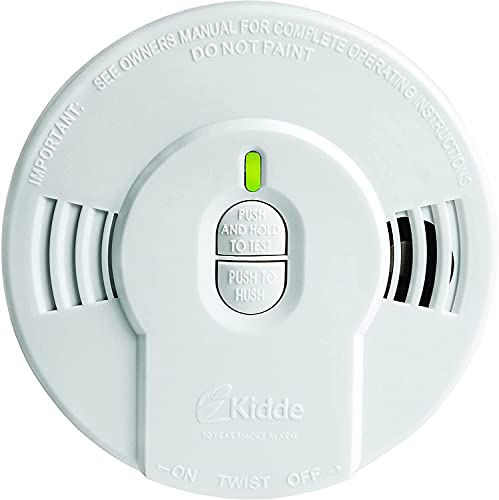
| Tamper-Resistant Choice | Sensor Type: Ionization | Power Source / Battery: Sealed 10-year lithium (no replacement) | Alarm Loudness: 85 dB | VIEW LATEST PRICE | Read Our Analysis |
| Kidde Smoke & Carbon Monoxide Detector 3-Pack |

| Multi-Hazard Protection | Sensor Type: Advanced smoke sensing (photoelectric-based / dual-function sensing) | Power Source / Battery: 2 × AA batteries (included) | Alarm Loudness: 85 dB | VIEW LATEST PRICE | Read Our Analysis |
More Details on Our Top Picks
Photoelectric Smoke Alarm 10-Year Battery (3-Pack)
Longest-Life Protection
View Latest PriceIn case you want low-maintenance, reliable home protection, this 3-pack of photoelectric smoke alarms is a smart choice: each unit uses a long-life CR123A lithium cell that powers the sensor for up to 10 years, delivers fast photoelectric smoke detection with >85 dB alerts, and resists dust and interference so you can trust it to warn you without constant fiddling. You’ll get 24/7 uninterrupted protection in a compact 3.34″ × 0.93″ housing made from flame-retardant, high-temperature, corrosion-resistant ABS. Install quickly with included materials, use the test/silent button to check or mute false alarms, and enjoy energy-saving, eco-friendly operation.
- Sensor Type:Photoelectric
- Power Source / Battery:CR123A lithium (sealed/10-year battery)
- Alarm Loudness:>85 dB
- Test / Silence Control:Test/silent button (press/hold 3s)
- Installation Type:Surface-mounted, includes installation materials (screws/adhesive)
- End-of-Life / Replacement Indicator:Replacement guidance implied by 10-year battery/service life
- Additional Feature:Dust-proof isolation board
- Additional Feature:Flame-retardant ABS housing
- Additional Feature:Ultra-slim compact size
First Alert SMI100 Battery-Operated Smoke Alarm 2-Pack
Should you want a straightforward, low-maintenance smoke alarm for kitchens and inhabited areas, the Premier Alert SMI100 2-pack is a solid choice. You’ll get battery-powered units with Precision Detection advanced sensing technology that meet new industry standards, cut down on cooking nuisance alarms, and provide prompt warning for home fires. Installation’s simple thanks to front-access battery compartments, and routine upkeep is easy with the test/silence button. An end-of-life warning tells you when to replace the alarm, keeping protection current. Overall, these First Alert SMI100s suit anyone seeking reliable, easy-to-manage smoke detection for everyday home use.
- Sensor Type:Precision Detection (advanced photoelectric-style sensing)
- Power Source / Battery:Battery-operated (user-replaceable batteries)
- Alarm Loudness:(Not specified numerically) standard household alarm level (complies with standards)
- Test / Silence Control:Test/silence button (front access)
- Installation Type:Battery-operated — easy/no-wiring installation
- End-of-Life / Replacement Indicator:End-of-life warning for replacement
- Additional Feature:Precision Detection technology
- Additional Feature:Front-access battery compartment
- Additional Feature:Reduces cooking nuisance alarms
Battery-Powered Smoke Detector 2-Pack (MY-S05)
Fast-Response Pick
View Latest PriceShould you want a simple, portable smoke alarm that’s ready to go without any wiring, the Battery-Powered Smoke Detector 2-Pack (MY-S05) is a strong choice—it’s ideal for renters, vacation homes, or rooms where hardwiring isn’t practical. You get photoelectric detection that lets smoke reach the core directly, triggering at 0.25 dB/m and responding 30% faster than older models. Each unit covers 215–430 ft² and sounds an 85 dB siren with a rapid red LED flash. It runs on three AAA batteries (not included), draws <10 μA standby, and offers a self-test button plus screw or adhesive mounting.
- Sensor Type:Photoelectric (external photoelectric sensor)
- Power Source / Battery:3 × AAA batteries (user-supplied)
- Alarm Loudness:85 dB
- Test / Silence Control:Test button (self-test on power-up)
- Installation Type:No hardwiring; screws or adhesive included
- End-of-Life / Replacement Indicator:Low-battery continuous red flash; standard lifecycle implied
- Additional Feature:Faster 30% response
- Additional Feature:215–430 ft² coverage
- Additional Feature:Multiple mounting options
Kidde 10-Year Battery Smoke Detector with Test-Reset
Choose the Kidde 10-Year Battery Smoke Detector should you want a low-maintenance alarm that keeps protecting your home for a decade without battery changes. You get ionization sensing for invisible fire particles, a red LED that signals detection, and an 85-decibel alarm that wakes you. The sealed 10-year lithium battery powers the unit through outages; a green LED shows power. Installation’s easy—no wiring—and tamper-resistant tech deters removal. Use the Test-Hush (Test-Reset) button to check function or silence nuisances like cooking smoke. A replacement alert warns end-of-life, it’s UL Listed, and carries a 10-year limited warranty.
- Sensor Type:Ionization
- Power Source / Battery:Sealed 10-year lithium (no replacement)
- Alarm Loudness:85 dB
- Test / Silence Control:Test-Hush (Test-Reset) button
- Installation Type:No wiring needed; easy installation
- End-of-Life / Replacement Indicator:Replacement Alert / 10-year limited warranty note
- Additional Feature:Tamper-resistant technology
- Additional Feature:Sealed 10-year lithium
- Additional Feature:UL Listed certification
Kidde Smoke & Carbon Monoxide Detector 3-Pack
Should you want reliable, dual-threat protection without rewiring, the Kidde 3-pack delivers: each 2-in-1 unit combines fast, advanced smoke sensing (over 25% quicker) with carbon monoxide detection, runs on included AA batteries, and cuts down false alarms from cooking or steam—making it a smart fit for homeowners, landlords, and contractors who need code-compliant, long-term home safety. You’ll get 85 dB alarms with red LED visual warnings, simple no-wiring installation, and a compact 5-inch footprint. Units meet UL 217/2034 and FCC standards, include a 10-year limited warranty from initial power-on, and come packaged as a convenient three-pack.
- Sensor Type:Advanced smoke sensing (photoelectric-based / dual-function sensing)
- Power Source / Battery:2 × AA batteries (included)
- Alarm Loudness:85 dB
- Test / Silence Control:Test (and hush) functionality implied for maintenance
- Installation Type:No-wiring setup (battery-powered), 3-pack
- End-of-Life / Replacement Indicator:10-year limited warranty and compliance testing implies lifecycle guidance
- Additional Feature:Dual smoke+CO sensing
- Additional Feature:Meets UL217/2034 standards
- Additional Feature:3-pack for coverage
Factors to Consider When Choosing Smoke Alarms for House
Upon selecting smoke alarms for your house, you’ll want to compare detection technology, power source options, and alarm loudness to match your home’s layout and needs. Consider sensor placement strategy—where to install alarms for bedrooms, kitchens, and hallways—and how easy each unit is to test and maintain. Regular testing and simple maintenance routines will keep the system reliable over time.
Detection Technology Type
Match the sensor to the risk: photoelectric detectors catch the larger particles from smoldering fires (like in upholstery or bedding) and cut down on nuisance alarms from brief cooking smoke, while ionization units react faster to fast‑flaming fires that produce smaller, less visible particles—so many homeowners prefer dual‑sensor alarms (or photoelectric plus CO) to cover both scenarios. You should weigh detection sensitivity and response times: photoelectric gives earlier warning for slow, smoldering blazes, ionization trips sooner for rapidly developing flames. Pick sensor types for location: put photoelectric units near bedrooms and living areas where smoldering risks are higher, and keep sensors away from kitchens and bathrooms to reduce false alarms. Dual or combined detectors offer the broadest protection.
Power Source Options
Because power source affects reliability, maintenance, and placement, pick the type of smoke alarm with your home’s wiring, budget, and willingness to do upkeep in mind. Hardwired units with battery backup give continuous power and code-compliant installation but need wiring and often a pro to install. Battery-only alarms are simple to place and install—useful in rentals or additions—but you’ll need to check or change batteries regularly. Sealed 10-year lithium models remove routine replacement and eliminate low-battery chirps, though you must replace the whole unit at end-of-life. Interconnected alarms (hardwired or wireless) make sure one trigger alerts the whole house; wireless avoids new wiring. Finally, consider standby current and battery chemistry—low current and lithium cells extend reliable performance, especially in extreme temperatures.
Alarm Loudness Level
Loudness matters—most alarms produce at least 85 dB at 10 feet, the generally recommended minimum to wake sleeping adults—so pick units that meet or exceed that level while keeping in mind that small dB changes noticeably affect perceived volume. You should favor alarms with clear, strong output; every 10 dB roughly doubles perceived loudness, so a 95 dB unit sounds much louder than an 85 dB one. Don’t rely on loudness alone: timely detection and proper placement maximize effectiveness. Choose alarms offering distinct temporal patterns or voice alerts to improve recognition for children and guests. In larger or multi-room homes, overlapping coverage helps counteract sound attenuation through distance and walls, ensuring occupants actually hear the alarm and can respond promptly.
Sensor Placement Strategy
Start by mapping where people sleep and how smoke could move through your home so you can place alarms where they’ll detect smoke quickly. Put alarms inside each bedroom, outside every sleeping area (hallway ceilings), and on every level including basements. Mount them on ceilings at least 4 inches from walls or on walls 4–12 inches below the ceiling to avoid dead-air spaces. In multi-story houses, install an alarm near stairways so smoke rising between levels is caught promptly. Don’t place detectors within 3 feet of bathrooms or within 10 feet of cooking appliances, and avoid windows, doors, or ducts where drafts can prevent smoke reaching the sensor. For large open-plan or high-ceiling spaces, add extra or combined/photoelectric alarms per manufacturer spacing guidelines.
Maintenance And Testing
Now that you’ve mapped sleeping areas and placed detectors where smoke will reach them quickly, keeping those alarms working is just as vital. Test each alarm monthly through pressing the test button until it sounds to verify sensor, battery, and electronics. Replace batteries per the manufacturer or immediately once the low-battery chirp starts; note sealed 10-year battery units still require full alarm replacement after their service life. Clean alarms every six months—gently vacuum vents or use a soft brush to remove dust and insects that reduce sensitivity. Keep a log of test dates, battery changes, and replacement dates so you replace units at ten years (or per guidance) and act on end-of-life alerts. After any activation, investigate the cause, reset, retest, and reposition units should nuisance sources have caused the trigger.
False Alarm Resistance
Reduce nuisance alarms through choosing detectors designed to ignore common non-fire sources like cooking and steam. Pick photoelectric sensors or units with advanced dual-sensor algorithms; they’re less likely to trip from frying or shower steam than ionization-only alarms. Look for models that advertise reduced nuisance or cooking immunity—these use signal processing or delayed thresholds to filter transient non-fire aerosols. Choose alarms with a hush/test button so you can silence a false alarm temporarily without disabling protection. Install according to manufacturer guidance: don’t mount directly above stoves, bathrooms, or HVAC vents where cooking smoke, steam, or dust can trigger false alarms. Finally, clean sensing chambers and replace batteries or units on schedule—dust buildup and weak power raise false alarm risk.
Regulatory Compliance
While choosing smoke alarms, make sure they meet required standards and local codes so your system actually provides legal, tested protection. Check for UL 217 for smoke and, where needed, UL 2034 for CO or equivalent national standards to confirm tested performance. Look for certification marks like UL or ETL on the label and in the instructions prior to buying. Follow local building codes that dictate alarm type, quantity, and placement—inside each bedroom, outside sleeping areas, and on every level including basements. Comply with ceiling and mounting-height rules (or specified distances on pitched ceilings) and meet interconnection requirements for new or renovated homes. Finally, adhere to mandated testing, maintenance, and replacement timelines—many jurisdictions require following manufacturer guidance or replacing units within ten years.
