

Like choosing Excalibur, picking a CAD workstation is about matching tools to the task, not flash. You’ll want a CPU that balances single‑thread punch with multicore throughput, pro GPUs with ample VRAM, and fast NVMe storage plus plenty of DDR5 RAM. I’ll compare compact options like the GMKtec Mini PC i9 and a 23.8″ all‑in‑one, explain what matters for processors, graphics, memory, storage, displays and ports — so you can decide which setup fits your workflow.
| GMKtec Mini PC Workstation i9-13900HK 32GB/1TB |

| Professional Powerhouse | CPU: Intel Core i9-13900HK (13th Gen, 14 cores, 20 threads) | RAM: 32 GB DDR5 dual-channel (5600 MHz) | Storage: 1 TB PCIe x4 NVMe M.2 (expandable up to 3 × M.2/12 TB) | VIEW LATEST PRICE | Read Our Analysis |
| 23.8″ Full HD All-in-One PC — 16GB/512GB |
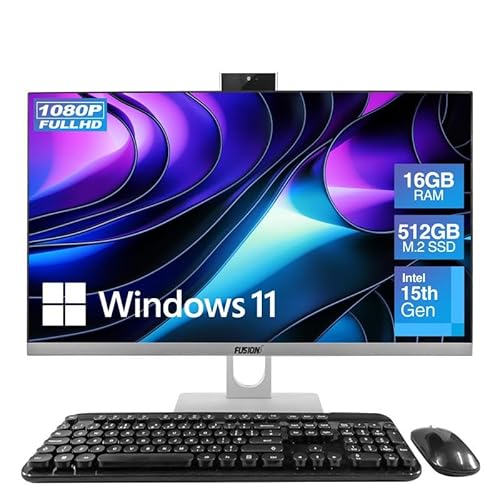
| Budget CAD Starter | CPU: Intel N150 (15th Gen, quad-core, up to 3.60 GHz) | RAM: 16 GB LPDDR4 | Storage: 512 GB SATA SSD | VIEW LATEST PRICE | Read Our Analysis |
More Details on Our Top Picks
GMKtec Mini PC Workstation i9-13900HK 32GB/1TB
Should you need a compact CAD workstation that packs desktop-class power, the GMKtec Mini PC with an Intel Core i9-13900HK delivers—its 14-core/20-thread chip and 32 GB of DDR5 let you handle large assemblies and simultaneous simulations without stalling, while multiple 4K/8K display outputs keep your viewport and reference screens crisp. You’ll get up to 5.4 GHz turbo, 24 MB cache, and a 1 TB PCIe x4 NVMe SSD, plus expansion for up to three M.2 drives. Connect quad displays via HDMI, DisplayPort, and USB-C, use 2.5G Ethernet or Wi‑Fi 6, and rely on a one‑year warranty.
- CPU:Intel Core i9-13900HK (13th Gen, 14 cores, 20 threads)
- RAM:32 GB DDR5 dual-channel (5600 MHz)
- Storage:1 TB PCIe x4 NVMe M.2 (expandable up to 3 × M.2/12 TB)
- Graphics Output / Display Support:Multiple outputs (2× HDMI 2.0, 1× DisplayPort 1.4, 1× USB-C DP) — quad-screen, up to 8K@60Hz
- Wireless Connectivity:Wi‑Fi 6 and Bluetooth 5.2
- USB Ports:Multiple USBs — 4× USB 3.2 (10 Gbps), 4× USB 2.0, 1× USB 3.2 Gen2 Type‑C (10 Gbps)
- Additional Feature:COM port (serial)
- Additional Feature:Realtek 2.5G Ethernet
- Additional Feature:Triple M.2 expansion
23.8″ Full HD All-in-One PC — 16GB/512GB
Should you need a compact, all-in-one PC that handles everyday CAD review, light modeling, and multitasking without a bulky tower, this 8″ Full HD AIO — with 16 GB RAM and a 512 GB SSD — fits the bill. You get an Intel 15th Gen N150 quad-core CPU (up to 3.60 GHz) and integrated Intel UHD Graphics running Windows 11 Home, providing responsive performance for smaller CAD tasks. The 23.8″ Full HD IPS display offers vivid colors and sharp detail, and a 3 MP pop-up webcam helps with remote meetings. It includes AC Wi‑Fi, Bluetooth, multiple USB ports, HDMI out, Kensington lock, and a wireless keyboard and mouse.
- CPU:Intel N150 (15th Gen, quad-core, up to 3.60 GHz)
- RAM:16 GB LPDDR4
- Storage:512 GB SATA SSD
- Graphics Output / Display Support:Built-in 23.8″ Full HD IPS display (1920×1080) + HDMI output
- Wireless Connectivity:AC Wi‑Fi and Bluetooth
- USB Ports:2× USB 3.0 and 4× USB 2.0
- Additional Feature:3 MP pop-up webcam
- Additional Feature:Edge-to-edge IPS display
- Additional Feature:Wireless keyboard & mouse
Factors to Consider When Choosing a Desktop PC for CAD
Upon choosing a desktop for CAD, you’ll want a fast multi-core processor and a workstation-grade GPU to handle complex models and rendering. Make sure you’ve got plenty of RAM running at high speed, NVMe SSD storage for snappy file access, and enough capacity for large projects. Finally, pick a high-resolution, color-accurate display that gives you the workspace and detail your designs need.
Processor And Cores
Pick a CPU that matches the mix of interactive modeling and background heavy-duty jobs you run: CAD benefits from high single-core clock speeds (ideally above 3.5–4.0 GHz) for snappy viewport and modeling operations, while multi-threaded tasks like rendering or simulation gain from 6–16 physical cores. Prioritize modern designs with higher IPC to get more work per clock, which keeps large assemblies responsive. Choose CPUs with SMT/hyperthreading to help multitasking and background jobs, but favor physical cores since many CAD engines scale better with them. Balance core count against TDP and cooling: high-frequency or high-core CPUs need resilient power delivery and cooling to avoid throttling. Match core strategy to your workload mix for consistent, sustained CAD performance.
Graphics Capability
Match your graphics capability to the complexity of your CAD projects: choose a professional GPU (NVIDIA Quadro/RTX A-series or AMD Radeon Pro) or a certified high-end consumer card to get the precision, stability, and driver optimizations CAD apps rely on. Pick sufficient VRAM—4–8 GB for 2D/entry-level 3D, 8–16+ GB for large assemblies, complex models, or high-resolution textures—to avoid slowdowns and out-of-memory errors. Verify support for required APIs and features such as OpenGL core profile, DirectX, Vulkan, and hardware-accelerated tessellation or ray tracing in case your software uses them. Make certain multi-monitor and 4K output via DisplayPort 1.4/HDMI 2.1 for clear viewports. Finally, balance compute (FP32/FP64) against TDP, cooling, and PSU capacity so sustained performance stays reliable.
Memory And Speed
Plan your memory and system speed around the size and complexity of your CAD projects: aim for at least 32 GB for large assemblies and heavy multitasking, with 16 GB acceptable only for smaller jobs. Choose fast RAM—DDR5 or high-frequency DDR4—to increase memory bandwidth and cut model loading and viewport lag during complex edits. Prefer lower-latency modules and run them in dual- or quad-channel configurations to maximize throughput for geometry processing and simulations. Verify your motherboard has spare DIMM slots so you can upgrade to 64 GB or more as datasets grow. Finally, balance RAM size with system responsiveness: fast memory paired with quick NVMe drives for active project files minimizes disk swapping and keeps interactions snappy.
Storage Type And Capacity
Memory and system speed matter, but storage type and capacity determine how quickly those projects actually load, save, and stream during modeling and simulation. Choose NVMe PCIe SSDs over SATA SSDs because NVMe delivers 3–6× faster sequential and random read/write speeds, noticeably reducing load times for large models and textures. Aim for at least 1 TB primary NVMe SSD; 2–4 TB is better when you keep many active assemblies or simulation results locally. Add a secondary 2–8 TB SATA SSD or HDD for archival storage and backups—HDDs give lower cost per TB despite slower access. Make certain your motherboard supports multiple M.2 slots or extra SATA ports so you can add dedicated scratch/workspace SSDs. Consider RAID (RAID 0, 1, 10) or hardware controllers for speed or redundancy, but still keep regular backups.
Display And Resolution
How clear do your models need to be on screen? For CAD you’ll want at least 2560×1440, but 4K (3840×2160) is preferable to inspect fine geometry and UI elements without constant zooming. Pick an IPS or VA panel with strong color accuracy (ΔE < 2 desirable) and wide gamut — sRGB 100% minimum, Adobe RGB or Display P3 whenever material fidelity matters. Choose size and pixel density to match workflow: 27–32" at 1440p gives good workspace; the same sizes at 4K give sharper detail and more onscreen real estate. Consider multi-monitor or ≥34" ultrawide setups for extended viewports and reference windows. Finally, confirm your GPU, OS, and CAD apps properly support the resolution and scaling to avoid UI issues.
Ports And Connectivity
A great display and the right resolution only work provided your PC can actually feed them data, so check the machine’s ports and connectivity before you buy. You’ll want multiple high-bandwidth video outputs — DisplayPort 1.4 or HDMI 2.0/2.1 — to drive multi-monitor CAD setups and 4K@60Hz or 8K@60Hz panels. Prefer USB-C with DisplayPort Alt Mode and at least 10 Gbps (USB 3.2 Gen 2) for fast external displays, docks, and peripherals. Make sure there are four or more high-speed USB 3.2 ports plus some USB 2.0 for legacy dongles. Include wired Gigabit or 2.5 Gigabit Ethernet, Wi‑Fi 6/6E, and Bluetooth. For industry integration, guarantee a serial (COM) port or GPIO and a 3.5 mm combo audio jack.
