

I’ve tested and compared the top 3-way dimmer smart switches for 2026 so you don’t have to, focusing on reliability, wiring needs, and voice control. I’ll cover options that work with or without a neutral, mesh well with Alexa/Google, and suit retrofit or new installs. Stick around—I’ll point out the practical differences that matter as you’re picking the right switch.
MOES Triple Wi‑Fi Dimmer Light Switch (Black)

Should you need compact, multi‑zone dimming without a hub, the MOES Triple Wi‑Fi Dimmer is a great fit: its three touch buttons let you set 0–100% brightness independently for two fixtures, and it fits a single‑gang box. You’ll control incandescent loads to 300W and LED/CFL to 75W at 110V via 2.4GHz Wi‑Fi, using Tuya Smart or Smart Life and voice with Alexa or Google. It needs neutral, live, and load wires, isn’t compatible with 3‑way circuits, smart bulbs, or fans, and features a durable tempered glass, moisture‑resistant panel suited for tight residential or commercial spaces.
Best For: homeowners or small-business users who need a compact, no-hub Wi‑Fi dimmer to independently control multiple hardwired fixtures in a single‑gang space.
Pros:
- Supports full-range (0–100%) dimming for two fixtures with three touch buttons and individual voice control via Alexa/Google.
- Works over 2.4GHz Wi‑Fi with Tuya Smart/Smart Life apps—no hub required—and offers scheduling and scene automation.
- Durable tempered glass, moisture‑resistant panel in a space-saving single‑gang design suitable for tight residential or commercial installs.
Cons:
- Requires neutral, live, and load wires and is not compatible with 3‑way circuits, smart bulbs, or fans.
- Lower LED/CFL capacity (75W) limits total LED load compared with incandescent rating (300W).
- Only supports 2.4GHz Wi‑Fi and cannot be used in 3‑gang boxes, reducing installation flexibility.
Feit Electric Smart WiFi Dimmer Switch (Voice)

Should you want flexible, voice‑enabled control across single‑pole and multi‑switch setups, the Feit Electric Smart WiFi Dimmer Switch (Voice) is a solid pick—its support for single‑pole, 3‑way, and 4‑way configurations plus a wireless, mountable remote means you can upgrade complex lighting circuits without rewiring. You’ll enjoy app, manual, or voice control via Alexa and Google Assistant, plus scheduling and timers for energy savings. Installation requires a neutral wire and fits standard wall plates. Feit’s 45‑year lighting experience backs live chat support, and a 1‑year limited warranty covers quality components for reliable performance and efficiency.
Best For: Homeowners or installers who want voice-enabled, flexible dimming control for single‑pole and multi‑switch lighting circuits without rewiring.
Pros:
- Supports single‑pole, 3‑way, and 4‑way setups plus a wireless mountable remote for easy multi‑switch upgrades.
- Works with Amazon Alexa and Google Assistant and offers app scheduling/timers for remote control and energy savings.
- Backed by Feit Electric’s long history and live chat support, with a 1‑year limited warranty.
Cons:
- Requires a neutral wire, which may complicate installation in older homes.
- Only a 1‑year limited warranty, shorter than some competitors’ coverage.
- Reliance on WiFi and cloud services may introduce connectivity or privacy concerns.
Kasa Smart HS210 3-Way Wi‑Fi Light Switch (2-Pack)

Should you want reliable multi-location control without a hub, the Kasa Smart HS210 3‑Way Wi‑Fi Light Switch (2‑Pack) is a great choice — it lets you operate a light from two locations, works on 2.4 GHz Wi‑Fi with neutral wiring, and supports Alexa and Google Assistant. You’ll get two switches for 1‑way or 3‑way setups, UL certification, and app-guided installation via the Kasa app (Android 5.0+/iOS 10+). Features include remote on/off, scheduling, countdowns, away mode, fade lighting, and IFTTT support. It’s rated 15A/120V, IP54, built with copper/brass contacts; consult an electrician should you be unsure.
Best For: Homeowners or renters who want reliable multi-location smart lighting control without a hub and have neutral wiring and a 2.4 GHz Wi‑Fi network.
Pros:
- Supports 3‑way and 1‑way setups with two switches included, enabling control from multiple locations.
- Works with Alexa, Google Assistant, IFTTT, and offers app-guided setup, scheduling, away mode, and fade lighting.
- UL certified, rated 15A/120V, and no hub required (Kasa/Tapo app on Android 5.0+/iOS 10+).
Cons:
- Requires a neutral wire, which may not be present in older homes.
- Only compatible with 2.4 GHz Wi‑Fi (no 5 GHz support).
- Installation of 3‑way circuits can be complex—may need an electrician if you’re unfamiliar with wiring.
TREATLIFE 3-Way Smart Dimmer Switch (Alexa, Google)
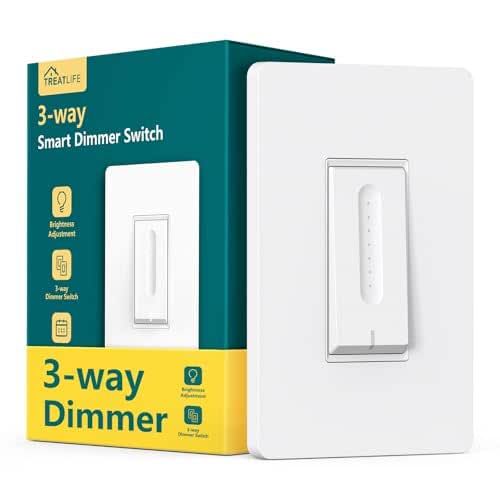
Should you need a straightforward, hub-free smart dimmer that works with Alexa and Google, the TREATLIFE 3-Way Smart Dimmer Switch is a solid pick—especially in case your home already has a neutral wire and a 2.4GHz Wi‑Fi network. You’ll install the smart unit on the line side and leave the other 3-way switch as-is. It handles dimmable LEDs (up to 150W), CFLs (150W) and incandescents/halogen (400W), but not smart or remote-controlled bulbs. You get silent slide dimming (1–100%), last-level memory, app control, scheduling, FCC certification, overheat protection, and Treatlife support. Not HomeKit compatible.
Best For: homeowners with a neutral wire and a 2.4GHz Wi‑Fi network who want a hub‑free, Alexa/Google‑compatible 3‑way dimmer.
Pros:
- Hub‑free Wi‑Fi operation with Alexa and Google Home compatibility for easy voice and app control.
- Silent 1–100% slide dimming with last‑level memory plus scheduling and remote control for convenience and security.
- Broad bulb support for dimmable LEDs, CFLs, and incandescent/halogen (with built‑in overheat protection and FCC certification).
Cons:
- Requires a neutral wire and 2.4GHz Wi‑Fi only, limiting compatibility in older homes or 5GHz‑only networks.
- Not compatible with Apple HomeKit, smart bulbs, or bulbs with remote controls.
- Must be installed on the line side in 3‑way setups and replaces only one switch, which may complicate installation for some users.
MOES Triple WiFi Dimmer Switch for LED Lights

Should you want precise, app-driven control over three separate LED circuits from a single-gang box, the MOES Triple WiFi Dimmer Switch is a compact, budget-friendly choice — especially suited for home theaters, showrooms, or offices where space is tight and smooth 0–100% dimming matters. You get three touch buttons (two separate lights per button), tempered glass panel, IP65 dust/water resistance, and Wi‑Fi 2.4GHz compatibility with Alexa, Google Assistant, Tuya, and Smart Life. It needs neutral, live, and load wires, supports up to 75W LED per circuit, and isn’t for 3‑way setups, smart bulbs, or fans.
Best For: Homeowners or small business users who need compact, app- and voice-controlled 0–100% dimming for multiple LED circuits from a single-gang location (e.g., home theaters, showrooms, offices).
Pros:
- Compact single-gang design with tempered glass panel and IP65 rating—durable, moisture- and dust-resistant.
- Full-range 0–100% dimming with individual touch buttons and app/voice control (Alexa, Google Assistant, Tuya, Smart Life) over 2.4GHz Wi‑Fi.
- Scheduling, scene support, and per-button naming for precise, automated control and convenient voice commands.
Cons:
- Requires neutral wire and is limited to single-pole use—no 3-way switch compatibility.
- Not compatible with smart bulbs or fans; maximum 75W LED/CFL per circuit may be low for some loads.
- Occupies a single-gang box only (not for 3-gang installations) and depends on 2.4GHz Wi‑Fi (no 5GHz).
Lutron Diva Smart Dimmer Switch 3-Pack (White)

Should you want reliable, no-neutral-wire smart dimming for older homes, the Lutron Diva Smart Dimmer 3-pack delivers—its ability to work in single‑pole or 3‑way setups without a neutral makes it ideal for retrofit projects where rewiring isn’t an option. You’ll get precise control via a soft‑glow light bar and slider, plus presets and Smart Away whenever paired with the Lutron Smart Hub. It supports up to 150W dimmable LEDs or 600W incandescent/halogen, isn’t for low‑voltage fixtures, and one dimmer can control multiple bulbs. Use voice, the Lutron app, Pico remote mounting, and coordinating wallplates sold separately.
Best For: Homeowners with older or retrofit homes who want smart dimming without running a neutral wire and prefer reliable app/voice control and remote-mounted 3‑way capability.
Pros:
- Works without a neutral wire, ideal for older homes and retrofit installations.
- Precise dimming with soft‑glow light bar/slider, presets, and Smart Away when paired with the Lutron Smart Hub.
- Multiple control options—Lutron app, voice assistants, and Pico remote for flexible placement and 3‑way setups.
Cons:
- Requires Lutron Smart Hub for full smart features (scheduling, Smart Away, HomeKit/Alexa/Google integration).
- Not compatible with low‑voltage lighting (track, landscape) and limited to 150W for dimmable LEDs.
- Coordinating wallplates and Pico wall mount bracket sold separately, adding to total cost.
ELEGRP Smart Wi‑Fi Touch Dimmer Switch (Matte Black)
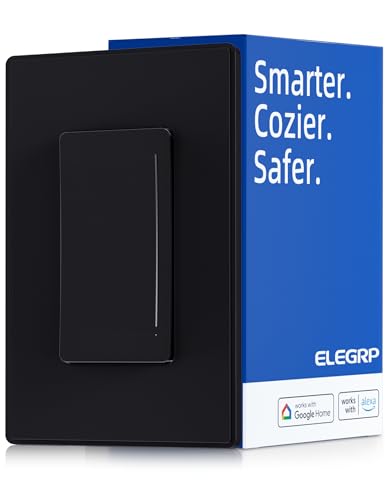
Should you want a sleek, voice‑enabled dimmer that’s easy to control from anywhere, the ELEGRP Smart Wi‑Fi Touch Dimmer Switch (Matte Black) is a strong choice—its responsive touch slider and Alexa/Google compatibility let you fine‑tune lighting through fingertip, phone, or voice while the matte finish keeps a low‑profile look. You’ll get a sensitive touch panel, vanishing brightness indicator, and quiet rocker in an ultra‑slim plate. It supports incandescent up to 450W and dimmable LEDs to 150W, requires a neutral wire, and works on 2.4GHz Wi‑Fi without a hub. Use one smart unit in a 3‑way circuit; setup is straightforward.
Best For: homeowners and renters who want a sleek, voice- and app-controlled dimmer for living spaces that supports fingertip adjustments and remote control.
Pros:
- Sensitive touch slider, vanishing brightness indicator, and quiet rocker for precise, elegant control.
- Works with Alexa and Google Assistant and remote control via ELEGRP HOME app without a hub.
- High load capacity for incandescent (450W) and dimmable LEDs (150W), UL and FCC certified.
Cons:
- Requires a neutral wire and supports only single-pole setups (only one smart switch in 3-way circuits).
- Operates on 2.4GHz Wi‑Fi only (no 5GHz support).
- May not be compatible with non-dimmable bulbs or certain LED drivers, and installation requires basic wiring knowledge.
Factors to Consider When Choosing 3 Way Dimmer Smart Switch
Before you buy, I check a few key factors to make sure a 3‑way dimmer smart switch will work in my home. I look at wiring requirements and 3‑way compatibility, confirm the bulb types and load capacity it supports, and verify voice assistant integration. These points will help you avoid installation headaches and performance issues.
Wiring Requirements
Before I’m picking a 3-way smart dimmer, I always check the wiring initially because the switch needs the right connections to work reliably—most models require a neutral for continuous power, some must be installed on the line side only, and many setups use a smart dimmer paired with a standard switch for compatibility. I confirm whether the circuit has a neutral; older homes often don’t, and that can rule out many models. I also identify which box is the line side, since some smart dimmers only function there. I verify whether the circuit is single-pole, 3-way, or 4-way so I choose a compatible device. In case of doubt, I consult the wiring diagram or an electrician before buying.
3‑Way Compatibility
Now that you’ve checked wiring and identified the line and neutral, I’ll look at way compatibility—how the smart dimmer will actually cooperate with another switch in a multi-location setup. You must pick a dimmer explicitly rated for 3‑way or multi‑location use; generic smart dimmers often won’t work. Check whether the model expects to pair with a companion or remote switch, or in case it can function with one smart and one standard switch. Recall many installs require the smart unit on the line side and a neutral present for reliable power. Read specs carefully for phrases like “3‑way compatible,” “multi‑location,” or “requires companion.” Confirm whether a hub is needed, since some systems rely on a bridge to coordinate both ends of the circuit.
Bulb Type Support
At the moment I’m picking a 3‑way smart dimmer, I always initially confirm which bulb types it actually supports—dimmable LEDs, incandescent, halogen, or CFLs—because compatibility varies and wrong pairings can cause flicker, noise, or reduced lifespan. I check the dimmer’s maximum wattage rating for each bulb type so I don’t overload a circuit and to keep operation safe. I also verify whether it supports smart bulbs or bulbs with built‑in remotes—many don’t, which can limit functionality. Full‑range dimming (0%–100%) matters for smooth low‑end control, especially with LEDs and CFLs. Finally, in the event my fixture mixes bulb types in a 3‑way circuit, I confirm the dimmer explicitly supports mixed‑type installations to avoid issues.
Load Capacity
Since you already checked which bulb types a 3-way dimmer supports, the next thing I look at is load capacity — the maximum wattage the switch can safely handle for each bulb type. I compare the dimmer’s ratings for incandescent, LED, CFL, and halogen against the combined wattage of all fixtures on that circuit. In the event the total exceeds the dimmer’s limit, you risk overheating, failure, or poor dimming performance. Low-capacity dimmers can restrict how many bulbs you use or force you to choose lower-wattage LEDs. Always add the wattages rather than estimating, and factor in any future changes. Choosing a dimmer with appropriate headroom keeps the switch safe and guarantees consistent dimming behavior.
Voice Assistant Integration
While I check bulb compatibility and load limits, I also make voice assistant integration a priority because hands-free control can revolutionize daily use. I look for compatibility with Amazon Alexa and Google Assistant initially — that guarantees seamless interaction across most homes. I prefer switches that let me name each unit or button individually so I can summon precise actions like “kitchen dimmer to 30%.” Direct Wi‑Fi integration is a plus; avoiding a central hub simplifies setup and reduces points of failure. I value support for advanced voice commands too — setting exact brightness percentages, invoking schedules, or triggering preset scenes makes routines effortless. Ultimately, reliable voice responses and clear naming options are dealbreakers for me.
App And Hub Needs
Because setup and daily use hinge on connectivity, I start through confirming whether a 3‑way dimmer needs a dedicated hub or can run hub‑free over Wi‑Fi — that choice shapes installation time, cost, and points of failure. I check app compatibility with my phone OS and verify the app supports full features like dimming, scheduling, and scenes; limited apps cripple smart functionality. Remote access is essential in case I’ll control lights whenever away, so I prefer switches with cloud access or secure remote APIs. I also confirm integration with my preferred voice assistant and whether that needs extra hub setup. Finally, I evaluate the app’s reliability and user interface—clear setup guidance, stable connectivity, and responsive troubleshooting matter more than flashy extras.
Physical Size Fit
A tight fit can turn a straightforward dimmer swap into a frustrating project, so I always measure the switch and wall box before buying. I check that the dimmer is sized for the correct gang box—single-gang parts won’t sit properly in a three-gang opening. I also verify the depth and profile so wiring isn’t cramped; insufficient space can complicate installation and affect connections. I match faceplate dimensions and style to existing plates to avoid gaps or awkward overlaps. Should the dimmer include remote modules or add-on units, I plan for their mounting or extra box space. Finally, I confirm the design allows side-by-side installation with standard switches in multi-gang or 3-way setups without modifying the wall box.
Safety Certifications
Safety certifications matter whenever you’re choosing a 3-way dimmer smart switch, and I always check for marks like UL and FCC prior to buying. These labels mean the switch met electrical safety and electromagnetic compatibility standards after rigorous testing. Certified units protect against short circuits, overcurrent, and overheating, lowering fire and shock risk during installation and everyday use. I treat certification as proof the product complies with regional codes and that the manufacturer took safety seriously. That compliance also correlates with more reliable long-term performance and better customer protection. Before purchase I verify recognized marks on the device or packaging and confirm documentation; should a switch lack certification, I walk away to avoid unnecessary hazards.
