

I’ve been testing the top internet-connected thermostats for 2026, and I want to walk you through six models that balance smart features, energy savings, and real-world reliability. Each one brings something different—Matter compatibility, room sensors, self‑learning or rugged programmability—so you can match tech to your HVAC setup and habits. Keep going and I’ll explain which fits your home best.
Honeywell Home X8S WiFi Smart Thermostat (Black)

Should you want a smart thermostat that doubles as a home hub for doorbell video and broad smart-home compatibility, the Honeywell Home X8S is a strong pick: it’s Matter-certified for Alexa, Google, and Apple ecosystems, links with Initial Alert VX1 and Ring doorbells for on-thermostat video and intercom, and offers a customizable 5″ touchscreen so you can control comfort and view feeds without leaving the wall. You’ll get precise temperature control, ventilation and humidity management for better IAQ, ENERGY STAR efficiency, occupancy-aware savings, and remote access via the First Alert app. It needs a C-wire and supports common HVAC setups.
Best For: homeowners who want a smart thermostat that doubles as a smart-home hub with on-thermostat doorbell video/intercom, broad Matter-compatible ecosystem support, and advanced IAQ and energy-saving features.
Pros:
- Matter-certified compatibility with Alexa, Google Assistant, and Apple Home for wide smart-home interoperability.
- Integrates with First Alert VX1 and Ring doorbells to view video and use intercom directly on the 5″ customizable touchscreen.
- ENERGY STAR-rated with occupancy detection, humidity/ventilation control, and remote access via the First Alert app for comfort, IAQ management, and energy savings.
Cons:
- Requires a C-wire (though a voucher for a C-Wire Adapter is provided), which may complicate installation in some older homes.
- Not compatible with electric baseboard heating (120–240V), limiting use in certain heating setups.
- Some IAQ/ventilation features may require additional HVAC equipment or accessories to function fully.
Nest T4000ES E Hubless Smart Thermostat

Should you want a straightforward, energy‑focused smart thermostat that programs itself and saves on heating and cooling without constant tinkering, the Nest T4000ES E Hubless Smart Thermostat is a strong pick. It learns your preferred temperatures, creates simple schedules in the Nest app, and shows a Leaf whenever you choose energy‑saving settings. Home/Away Assist shifts to Eco whenever you leave, and Energy History helps you find more savings. You’ll need Wi‑Fi and the Nest app (iOS/Android) for remote control and voice via Alexa or Google Assistant. HVAC monitoring alerts you to issues; installation fits most systems and takes about an hour.
Best For: homeowners or renters who want an easy-to-use, energy-focused smart thermostat that learns preferences and automates savings with minimal setup.
Pros:
- Learns your schedule and programs itself to save energy while maintaining comfort.
- Remote control and voice integration via Wi‑Fi with Nest app, Alexa, and Google Assistant.
- HVAC monitoring and maintenance alerts help detect system issues early.
Cons:
- Requires a smartphone/tablet and Wi‑Fi to access full features and remote control.
- Some advanced room-specific control requires additional Nest Temperature Sensor (sold separately).
- May not support the small minority of HVAC systems (about 5%) without additional compatibility checks.
Honeywell Home T9 Wi-Fi Smart Thermostat with Sensor

Should you want a smart thermostat that prioritizes room-by-room comfort, the Honeywell Home T9 Wi‑Fi is a great pick because its Smart Room Sensors detect occupancy and temperature to shift focus where you actually spend time. You’ll control it via the Resideo app or voice assistants like Alexa, Google Assistant and Apple HomeKit. ENERGY STAR certification, Auto Home/Away Scheduling and utility rebate or demand response participation can cut energy use. Installation’s DIY-friendly with a low-voltage adapter should you lack a C-wire, though some systems still require one. It supports most forced-air and heat-pump setups, shows settings on a touchscreen, and comes in white.
Best For: homeowners who want room-by-room comfort control with smart sensors and remote/voice operation while keeping installation DIY-friendly and energy-saving features.
Pros:
- Smart Room Sensors optimize temperature and occupancy focus for multi-room comfort.
- ENERGY STAR certified with Auto Home/Away Scheduling and compatibility with utility rebates/demand response programs to reduce energy use.
- Wide smart-home integration (Resideo app, Alexa, Google Assistant, Apple HomeKit) and includes a low-voltage adapter for C-wire-lacking homes.
Cons:
- Some HVAC systems (and certain setups like heating-only oil furnaces) still require a C-wire despite the adapter.
- Not compatible with electric baseboard heating (120–240V).
- Multiple sensors are required for full multi-room functionality, adding to cost.
Honeywell Redlink Wireless Programmable FocusPRO Thermostat Kit

Should you need a dependable whole-home wireless solution, the Honeywell RedLINK FocusPRO kit is built for connected households that want centralized control without running new wiring. You get an Equipment Interface Module that wires to all HVAC components and talks wirelessly to the thermostat, plus a return air sensor that keeps indoor temps safe—62°F for heat and 82°F for cooling—if thermostat power is lost. RedLINK wireless tech delivers reliable, interference-resistant communication. The kit includes a programmable wireless thermostat and interface components for straightforward installation and dependable HVAC operation, plus a clear temperature and humidity display for quick monitoring.
Best For: Homeowners who want a reliable whole-home wireless thermostat solution that avoids new wiring and provides centralized control with safety backup via a return air sensor.
Pros:
- Enables centralized, wireless control of all HVAC equipment through the Equipment Interface Module, eliminating the need for new thermostat wiring.
- Return air sensor maintains safe indoor temperatures (62°F heating / 82°F cooling) if thermostat power is lost.
- RedLINK wireless technology offers reliable, interference-resistant communication and a clear temperature/humidity display for quick monitoring.
Cons:
- Requires installation of the Equipment Interface Module and wiring to HVAC equipment, which may need professional setup.
- Wireless communication may still be limited by extreme distances or structural obstacles in very large or complex homes.
- Programmable thermostat features may be less advanced than some smart thermostats with cloud-based apps and remote integrations.
Honeywell Home RTH9600WF Smart Wi‑Fi Color Thermostat
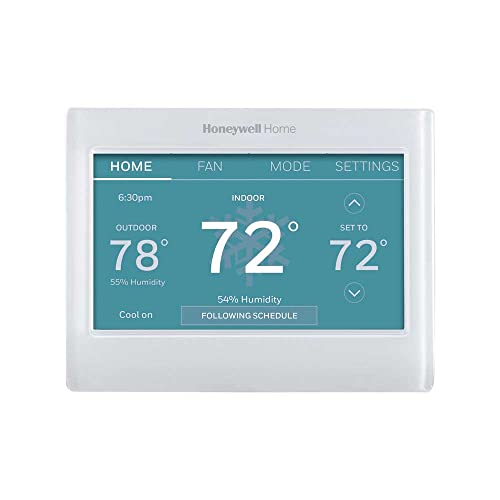
Should you want a color touchscreen thermostat that blends smart-home compatibility with energy-saving features, the Honeywell Home RTH9600WF is a solid pick — it’s ENERGY STAR certified, connects with Alexa, Google Assistant, and Cortana, and sends personalized tips to cut heating and cooling use. You’ll control it remotely via the app, view indoor/outdoor temps, humidity, and a daily forecast on a customizable HD touchscreen, and choose flexible programming for automatic savings. It supports forced-air systems, hot water/steam, and heat pumps with electric backup but not electric baseboard heat. A C‑wire is required; check for rebates and included installation hardware.
Best For: homeowners with central forced-air, hot water/steam, or heat pump HVAC systems who want a customizable color touchscreen thermostat with smart-home integration and ENERGY STAR energy-saving features.
Pros:
- ENERGY STAR certified and provides personalized tips to reduce heating/cooling usage.
- Works with Alexa, Google Assistant, Cortana, and offers remote app control and flexible programming.
- Customizable HD color touchscreen shows indoor/outdoor temps, humidity, and daily forecast; includes installation hardware.
Cons:
- Requires a C‑wire (or adapter) for installation, which may complicate setups without a common wire.
- Not compatible with electric baseboard heating (120–240V) systems.
- May need verification for compatibility with certain heating-only oil furnaces and possible extra setup steps for rebates or integrations.
Honeywell Home RTH7600D 7-Day Programmable Touchscreen Thermostat, White

In case you want a reliable, easy-to-program touchscreen thermostat for a predictable weekly schedule, the Honeywell Home RTH7600D is a solid choice. You’ll get a large backlit touchscreen that shows room and set temperatures simultaneously and a 7-day menu-driven program with four periods per day. It’s simple to install, auto-adjusts for Daylight Savings, and offers temporary or permanent holds. Smart Response Technology learns system run-times to meet your setpoints on schedule. Energy features include home/away settings, filter and battery alerts, and compressor protection. It supports single- and multi-stage systems, heat pumps, boilers, and gas fireplaces.
Best For: homeowners or renters seeking a straightforward, programmable touchscreen thermostat with weekly scheduling and energy-saving features for typical single- or multi-stage HVAC systems.
Pros:
- Large backlit touchscreen that displays current and set temperatures simultaneously for easy monitoring.
- 7-day programming with four periods per day and Smart Response Technology to reach setpoints on schedule.
- Energy-saving features and alerts (home/away settings, filter and battery reminders, compressor protection).
Cons:
- Menu-driven programming may be less intuitive than modern app-connected smart thermostats.
- Lacks Wi‑Fi or remote control capabilities found in smart thermostats.
- Limited customization compared with higher-end models (fewer integration and advanced learning features).
Factors to Consider When Choosing an Internet-Connected Thermostat
Before you pick a smart thermostat, I check for HVAC compatibility and whether it will play nicely with my existing smart home setup. I also consider power and wiring requirements, energy-saving features, and the kinds of remote control and scheduling options I need. Those factors together tell me which model will actually save energy and fit my home.
Compatibility With HVAC
How will your HVAC setup shape the thermostat you pick? I always start upon matching the thermostat to my system: forced air, heat pump with electric backup, hot water, or steam all need specific support. I check whether the thermostat needs a C-wire and whether my system provides one—or in case I’ll need an adapter. In the event my system has multistage heating or cooling, I confirm the thermostat handles multiple stages for proper control. I also make sure it isn’t incompatible with electric baseboard heat (120–240V) whenever applicable. Finally, I look for the ability to interface with accessories like ventilation, humidity control, or extra sensors so the thermostat can actually manage comfort and air quality the way I expect.
Smart Home Integration
My HVAC choices set the baseline for what the thermostat must handle, and now I look at how it will fit into the rest of my smart home. I prioritize models that work with Amazon Alexa, Google Assistant, and Apple Home so voice control and routines are seamless. Matter certification is a must for me — it future-proofs interoperability across brands. I also want integration with security gear like video doorbells or intercoms so heating and occupancy routines respond to real events. Remote app control is non-negotiable; I expect reliable smartphone and tablet access from anywhere. Finally, I prefer multi-platform connectivity so family members can use their preferred apps or assistants without extra setup or compromise.
Power And Wiring Needs
Since my HVAC wiring dictates what a smart thermostat can and can’t do, I always check power requirements initially: most models need a C-wire for continuous power, and in case my system lacks one I either plan to install a C-wire, use the manufacturer’s adapter or a power extender kit, or pick a battery-backed model that supports my equipment. I also confirm compatibility with my HVAC type—many thermostats work with low-voltage systems like forced air, heat pumps, hot water, and steam, but not high-voltage electric baseboard heaters. Some setups use direct wiring to the control board; others rely on rechargeable batteries or wireless modules with separate interface equipment. Before buying, I verify wiring diagrams and installation instructions so the unit supports my system and power infrastructure.
Energy Savings Features
At the moment I shop for an internet-connected thermostat, the energy-saving features are a top priority because they directly affect my bills and comfort without extra effort. I look for programmable scheduling that adapts heating and cooling based on occupancy and time of day so the system isn’t running while nobody’s home. Home-and-away detection that automatically shifts setpoints adds savings without manual input. Real-time energy tracking and personalized tips help me spot wasteful patterns and tweak habits. I prefer units with ENERGY STAR certification for proven efficiency and possible rebates. Finally, integration with utility demand-response programs is a plus, letting the thermostat accept small adjustments during peak periods to lower total energy demand and my costs.
Remote Control Options
Saving energy is essential, but I also want a thermostat I can control from anywhere, so remote options matter just as much whenever choosing a model. I look for sturdy mobile apps on iOS and Android that let me change schedules and setpoints remotely. Voice-control compatibility with assistants like Alexa, Google Assistant, or Siri makes hands-free adjustments effortless. Remote access should include live climate monitoring, push alerts for temperature anomalies, and maintenance reminders so I don’t miss issues. Multi-user support matters in case family members need control from their own devices. Finally, dependable Wi‑Fi support—ideally both 2.4 GHz and 5 GHz—ensures commands and notifications arrive quickly. Those features make a thermostat truly convenient and reliable.
