

I’ve tested and compared the top SmartThings-compatible light switches for 2026 so you can pick what fits your setup and budget. I focus on reliable connectivity, neutral-wire needs, voice assistant support, and real-world installation ease. I’ll highlight standout models, their pros and cons, and what to watch for in multi-location or fan setups—so you’ll know which switch makes sense for your home next.
Kasa Smart HS210 3-Way Wi‑Fi Light Switch
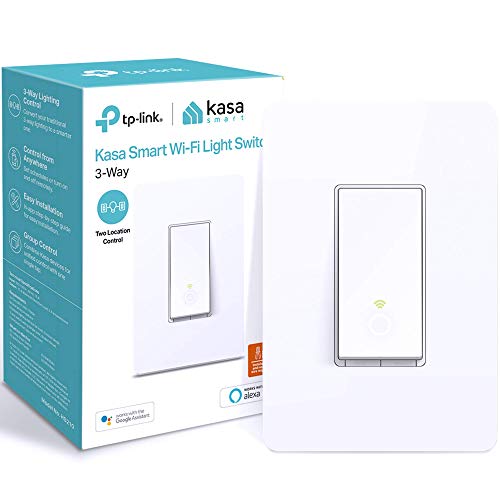
Should you want a dependable, budget-friendly smart switch that handles multi-location setups, the Kasa Smart HS210 3‑Way Wi‑Fi Light Switch is a solid pick—especially for homes with neutral wiring and 2.4 GHz Wi‑Fi. You’ll install it with step-by-step guidance in the Kasa or Tapo app, and you should call an electrician in case wiring’s unfamiliar. It works as a 3‑way or single‑pole switch, letting you control lights from one or two locations—useful on stairs or between house and garage. You’ll get remote control, Alexa/Google voice support, scheduling, Away mode, UL safety, and Silicon Valley design.
Best For: homeowners with neutral-wired, 2.4 GHz Wi‑Fi setups who want an affordable, reliable smart switch for controlling lights from one or two locations.
Pros:
- Budget-friendly smart switch that supports both 3‑way and single‑pole installations.
- Remote control, scheduling, Away mode, and Alexa/Google voice assistant compatibility.
- UL certified and backed by user trust and Silicon Valley design; guided setup via Kasa/Tapo app.
Cons:
- Requires neutral wiring and 2.4 GHz Wi‑Fi, so not compatible with all homes.
- Installation can be tricky for those unfamiliar with electrical work—may need an electrician.
- No support for 5 GHz Wi‑Fi networks.
meross Smart Light Switch 4-Pack (HomeKit, Wi‑Fi)

In case you want reliable, fast local control and HomeKit compatibility in a compact bundle, the meross Smart Light Switch 4-Pack is a great fit—especially for homeowners who need a neutral-wire installation and prefer Wi‑Fi-only devices. You’ll install in standard wall plates and connect to 2.4GHz Wi‑Fi; the Meross app walks you through setup and supports remote control. Enjoy local offline operation, millisecond response times, and schedules that run during internet outages. Create timers, countdowns, sunrise/sunset automations, and scenes. Voice control works with Siri, Alexa, Google Assistant, and SmartThings, making hands-free lighting effortless.
Best For: Homeowners and renters who want HomeKit-compatible, Wi‑Fi-only smart switches with fast local/offline control and who can accommodate a neutral‑wire installation.
Pros:
- Offers fast local control with millisecond response times and continued operation during internet outages.
- Compatible with HomeKit, Siri, Alexa, Google Assistant, and SmartThings for flexible voice and app control.
- Includes scheduling, timers, countdowns, sunrise/sunset automations, and scene creation via the Meross app.
Cons:
- Requires a neutral wire, which may not be available in older homes or some switch locations.
- Operates only on 2.4GHz Wi‑Fi, so no 5GHz support for environments using that band exclusively.
- May require multiple devices or additional wiring for multi‑way switch setups (not ideal for complex installations).
Kasa Smart Ceiling Fan & Dimmer Switch (KS240)

Should you want precise control over both ceiling fans and lights from a single wall unit, the Kasa KS240 is a smart pick because it combines four adjustable fan speeds with dimmable lighting and broad smart-home support. You’ll set fan speed and brightness remotely via the Kasa app or Apple HomeKit, and use Alexa or Google Assistant for voice control. Schedule fan and light actions for comfort or security, and automate scenes with other devices. Installation needs a neutral wire and standard single‑pole plate, but the app guides you. Reminder: the KS240 works only on 2.4GHz Wi‑Fi.
Best For: Homeowners or renters who want unified, app- and voice-controlled management of a ceiling fan and light with adjustable speeds and dimming in a HomeKit/Alexa/Google setup.
Pros:
- Combines four adjustable fan speeds and a dimmable light in a single wall switch for consolidated control.
- Works with Apple HomeKit, Amazon Alexa, and Google Assistant for voice control and broader smart‑home integration.
- Supports scheduling and automation via the Kasa app (or HomeKit) to enhance comfort and security.
Cons:
- Requires a neutral wire and standard single‑pole plate, which may complicate installation in older homes.
- Operates on 2.4 GHz Wi‑Fi only, so it won’t connect to 5 GHz networks.
- May require careful wiring and compatibility checks with certain multi‑switch or fan configurations despite app guidance.
meross 3-Way Smart Dimmer Switch Kit
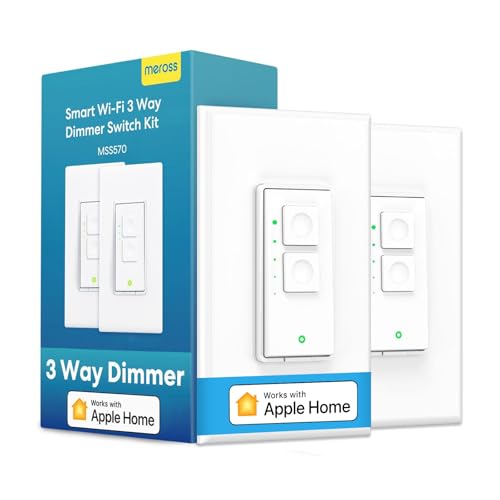
Should you need reliable 3‑way control that works alongside SmartThings and HomeKit, the meross 3‑Way Smart Dimmer Switch Kit is a solid pick—especially for homes that already have a neutral wire in the box. You get a Main and Secondary switch designed for 3‑way setups; the Main won’t work with standard 3‑way switches. It fits 1/2/3/4‑gang Decora/GFCI faceplates and installs in about 15 minutes. Control lights from two locations, schedule based on sunrise/sunset, and use voice commands via Siri, Alexa, Google Assistant, CarPlay, and SmartThings. It runs on 2.4 GHz Wi‑Fi only and needs no hub.
Best For: Homeowners with existing neutral wiring who want reliable 3-way dimmer control integrated with HomeKit and SmartThings without adding a hub.
Pros:
- Supports HomeKit, SmartThings, Alexa, Google Assistant, CarPlay and remote scheduling (including sunrise/sunset) for flexible smart control.
- Includes Main and Secondary switches designed specifically for 3‑way setups and fits standard 1/2/3/4‑gang Decora/GFCI faceplates.
- No hub required and relatively quick installation (about 15 minutes).
Cons:
- Main switch is incompatible with standard 3‑way switches, requiring use of the included Secondary.
- Requires a neutral (white) wire in the electrical box, which some older homes may lack.
- Operates on 2.4 GHz Wi‑Fi only (no 5 GHz support) and HomeKit remote access needs a powered HomePod or Apple TV bridge.
Kasa HS200P3 Smart Wi‑Fi Light Switch (3-Pack)

Should you be upgrading multiple rooms at once, the Kasa HS200P3 (3‑pack) is the practical choice, giving you three reliable, neutral‑wire smart switches that work over 2.4 GHz Wi‑Fi and pair with the Kasa app for guided setup. You’ll need neutral wiring, Android 5.0+/iOS 10+, and 100–120 VAC, 15 A supply; consult an electrician in case you’re unsure. From anywhere, monitor and toggle lights via the Kasa app, set timers, countdowns, and an Away Mode to simulate occupancy. Hands‑free voice control works with Alexa and Google Assistant. Silicon Valley design, UL certification, and over 4 million users highlight its safety and reliability.
Best For: Homeowners or renters with neutral‑wire wiring who want to upgrade multiple rooms at once to reliable, app‑controlled smart switches compatible with Alexa and Google Assistant.
Pros:
- Works with 2.4 GHz Wi‑Fi and app‑guided setup (Kasa/Tapo) for easy remote control and monitoring.
- Supports schedules, timers, countdowns, and Away Mode for automation and security.
- UL certified, Silicon Valley design, and used by over 4 million users for proven safety and reliability.
Cons:
- Requires neutral wiring, so not compatible with older homes lacking a neutral in the switch box.
- Only supports 2.4 GHz Wi‑Fi (no 5 GHz), which may limit network options.
- Installation may require an electrician for those unfamiliar with electrical work.
Kasa Matter Smart Dimmer Switch KS225

Should you want a Matter-ready dimmer that plays nicely with every major smart platform, the Kasa Matter Smart Dimmer KS225 is a strong pick — especially for multi-admin households that use Apple Home, Alexa, Google Home, and SmartThings. You’ll get Matter compatibility, LAN offline operation, and Multi-Admin control so everyone can adjust lights from their preferred ecosystem. Dim from 1–100% via touch, app, or voice (Siri, Alexa, Google Assistant). Remote access, scheduling, timers, countdowns, and Away Mode add convenience and security. It needs a neutral wire, fits standard wall plates, uses 2.4GHz Wi‑Fi, and is UL certified.
Best For: households and multi-user homes wanting a Matter-ready, voice- and app-controlled dimmer that works across Apple Home, Alexa, Google Home, and SmartThings.
Pros:
- Matter and Multi-Admin support lets multiple platforms and users control the same switch seamlessly.
- Smooth dimming from 1–100% with touch, app, or voice control (Siri, Alexa, Google Assistant) plus LAN offline operation.
- Remote access, scheduling, timers, Away Mode, and UL certification for convenience and safety.
Cons:
- Requires a neutral wire, which may complicate installation in older homes without neutral wiring.
- Only supports 2.4GHz Wi‑Fi, so it won’t connect to 5GHz-only networks.
- Single-pole compatibility means additional wiring or different models may be needed for 3-way/multi-switch setups.
Factors to Consider When Choosing a Smartthings Light Switch
Before you pick a SmartThings-compatible switch, I look at practical wiring and neutral requirements initially since many homes need a neutral in the switch box. I also check compatibility with your smart home ecosystem, voice assistants, and whether the switch needs a hub or uses Zigbee/Z-Wave/Wi‑Fi. Finally, I consider installation difficulty so you know whether it’s a DIY job or needs an electrician.
Wiring And Neutral Needs
In case I pick a SmartThings-compatible switch, I always check whether the wall box has a neutral wire, because most smart switches require that white neutral to power their radios and keep features working even while the lights are off. I verify that neutral is present and identifiable (usually white) before buying; it completes the circuit so the switch can draw standby power for connectivity and features. In older homes neutrals might be missing, which forces either rewiring or choosing a no-neutral model designed for that scenario. Should the neutral isn’t obvious or I’m unsure, I don’t guess — I call a licensed electrician. Proper connection guarantees safe, reliable operation and avoids installation headaches later.
Smart Home Compatibility
Having confirmed the wiring and neutral situation, I next look at how well a smart switch will fit into my existing smart home setup. I make sure it’s officially compatible with SmartThings so scenes, automations, and device status work without hacks. I also verify app-based remote control so I can manage lights away from home, and confirm the switch uses my home’s Wi‑Fi band—most require 2.4 GHz—for stable connectivity. I prefer switches that support Matter or local LAN control for faster, more reliable responses and easier cross-platform management. Finally, I consider multi-platform compatibility: even though voice assistants matter separately, broad ecosystem support reduces lock‑in and keeps options open as my smart home evolves.
Voice Assistant Support
While I’m checking compatibility, I also make sure the switch supports voice control with the assistants I actually use—Amazon Alexa, Google Assistant, and Siri—so I can operate lights hands‑free. I favor switches that let me issue simple commands for on/off, dimming, and scheduling tweaks without opening an app. Multi-platform support matters whenever family members prefer different ecosystems; it keeps control unified. I also verify advanced voice features like group commands to control multiple lights at once and multi-admin access so everyone in the household can use voice control. Before buying, I test or confirm that these voice functions work reliably in real conditions, since responsiveness and correct execution of routines are what make voice control genuinely useful.
Hub And Protocol Requirements
Because a switch’s protocol and hub needs determine how it joins your SmartThings setup, I always check compatibility initially: look for Zigbee, Z‑Wave, or SmartThings‑integrated Wi‑Fi support, and confirm whether the model needs a dedicated hub or bridge. I verify 2.4 GHz Wi‑Fi for Wi‑Fi models since that band gives more stable range than 5 GHz. I also confirm whether the switch supports local control via the hub—devices that work offline through SmartThings reduce reliance on cloud services. Check multi-admin capabilities and platform integration so switches behave consistently across accounts and automations. Finally, I make certain the protocol matches your existing devices to avoid adding unnecessary hubs or compatibility gaps.
Installation Difficulty Level
Upon evaluating installation difficulty for a SmartThings light switch, I focus on a few practical factors that determine how hands-on the job will be and whether you’ll need professional help. Initially, check for a neutral wire in the electrical box—most smart switches need it to power the device. In case you’re not comfortable with wiring, plan to consult a licensed electrician; familiarity with electrical work is strongly recommended. Three-way setups add complexity since they can require replacing auxiliary switches and reconfiguring wiring. Many brands offer step-by-step, app-guided installation that simplifies setup, but you’ll still handle basic wiring and adjustments. Finally, verify compatibility with standard wall plate sizes so the new switch fits your existing box without modification.
Scheduling And Automation
During the moment I evaluate scheduling and automation for a SmartThings light switch, I look for flexible timers, sunrise/sunset triggers, and scene support so I can automate daily routines and set moods with a single command. I prioritize switches with timers, countdowns, and event-based triggers to handle comings and goings and save energy without manual intervention. Scene creation matters because I often want multiple lights and devices to change together for movie night or dinner. Away or presence-simulation modes are a useful security layer whenever I’m traveling. While I value features that integrate with SmartThings scenes and routines, I also check whether schedules persist through outages so my automations remain dependable even in case connectivity falters.
Local Control And Reliability
While I want fancy features, I prioritize local control and reliability primarily because a switch that responds instantly in my home network keeps daily life smooth even in case the internet drops. I choose switches that support local processing over cloud dependency so commands and automations run fast and securely. I favor 2.4 GHz Wi‑Fi models for stable connectivity and minimal packet loss, and I check specs for millisecond response times to avoid noticeable lag. Offline scheduling is a must—timers and scenes should execute without cloud access. That reduces reliance on external servers and keeps lights working during outages. In short, I pick switches built for dependable local behavior initially, then layer on remote features.
Safety Certifications And Specs
Because safety affects both your home and the people in it, I always check certifications and electrical specs before buying a SmartThings switch. I make sure the device is UL certified so it’s passed rigorous safety and quality tests. I confirm whether a neutral wire is required, since that determines safe installation and compatibility with my home’s wiring. I also verify the supported input voltage—typically 100–120 VAC, 50/60 Hz—to avoid mismatches that could cause malfunctions or hazards. Compliance with local electrical codes matters to prevent fire risks and failed inspections. Finally, I favor switches with clear installation instructions and app-guided setup; they reduce the chance of wiring errors and make safe installation straightforward.
