

Most consumer security cameras now use H.265 to cut storage and bandwidth away up to half, yet many homeowners still run older systems that waste space. You’ll want a setup that balances true 2K–5MP clarity, reliable weatherproofing, and smart alerts without constant cloud fees. I’ll outline four top picks—each with different strengths—so you can pick the best fit for your home and routines.
| 360° Panoramic Home Security Camera with Spotlight Night Vision |
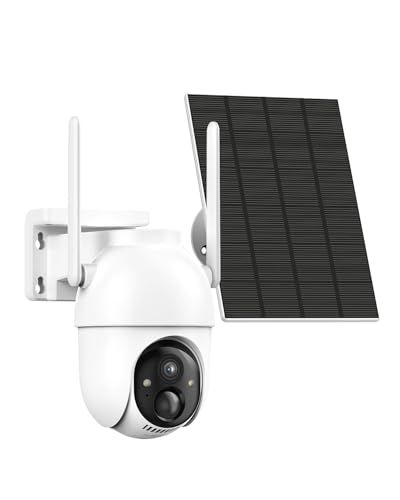
| Best for Panoramic Coverage | Power Source: Solar panel (with internal battery) — wire-free capable | Night Vision: Color and infrared night vision; built-in spotlight for color night footage | Weather Resistance: IP65 waterproof/dustproof | VIEW LATEST PRICE | Read Our Analysis |
| 5MP 8CH NVR Security Camera System with 3TB |

| Best for Continuous Recording | Power Source: Mains-powered cameras (power cables required) — NVR-powered system | Night Vision: Infrared night vision up to 65 ft (8 IR LEDs) | Weather Resistance: IP66-rated metal housing (indoor/outdoor) | VIEW LATEST PRICE | Read Our Analysis |
| 3K/4MP Solar Wireless Outdoor Security Cameras |

| Best for Solar Reliability | Power Source: Solar-powered (built-in battery) — wire-free | Night Vision: Color night vision (clear images in darkness) + IR capability | Weather Resistance: IP65 waterproof | VIEW LATEST PRICE | Read Our Analysis |
| Wireless Solar 4-Camera 4MP Home Security System | Best Wire-Free Kit | Power Source: Solar-powered kit (batteries included) — 100% wire-free | Night Vision: Two modes — infrared and color night vision; Night Color tech up to ~33 ft | Weather Resistance: IP66 waterproof | VIEW LATEST PRICE | Read Our Analysis |
More Details on Our Top Picks
360° Panoramic Home Security Camera with Spotlight Night Vision
In case you need full, blind-spot-free coverage for a home or small property, this panoramic security camera is a smart pick: it pans 355° horizontally and 90° vertically for true 360° monitoring. You’ll get 2K HD clarity—about 80% sharper than typical 3MP—using H.265 to save bandwidth. The built-in spotlight delivers color night footage with infrared backup, while PIR smart tracking triggers instant alerts and recording. You can run it via an Aume hub or standalone on 2.4 GHz Wi‑Fi with Alexa and EseeCloud app control, two-way audio, 32 GB local storage, optional cloud, solar power, and IP65 durability.
- Power Source:Solar panel (with internal battery) — wire-free capable
- Night Vision:Color and infrared night vision; built-in spotlight for color night footage
- Weather Resistance:IP65 waterproof/dustproof
- Two-way Audio:Built-in two-way audio
- Local Storage:32 GB local storage (supports continuous recording)
- App / Remote Access:EseeCloud app with multi-user sharing; Alexa compatible
- Additional Feature:355° horizontal rotation
- Additional Feature:Built-in spotlight
- Additional Feature:PIR smart tracking
5MP 8CH NVR Security Camera System with 3TB
Should you need a plug-and-play, high-resolution system that keeps months of continuous footage without recurring cloud fees, this 5MP 8CH NVR with a preinstalled 3TB drive is a smart choice. You get eight 5MP cameras pre-paired to an 8-channel NVR supporting wireless video transmission and H.265+ compression to halve bandwidth and storage needs. The 3TB drive holds over 20 days of 24/7 recording for all cameras. Features include 65 ft IR, two-way audio, AI human detection, configurable motion zones, and app or email alerts. IP66 metal housings suit -20°C to 55°C; cameras need mains power.
- Power Source:Mains-powered cameras (power cables required) — NVR-powered system
- Night Vision:Infrared night vision up to 65 ft (8 IR LEDs)
- Weather Resistance:IP66-rated metal housing (indoor/outdoor)
- Two-way Audio:Two-way audio communication supported
- Local Storage:Preinstalled 3TB hard drive on NVR (local storage)
- App / Remote Access:XMeye Pro mobile app (iOS/Android) and optional PC VMS
- Additional Feature:Preinstalled 3TB HDD
- Additional Feature:8‑channel NVR
- Additional Feature:AI human detection
3K/4MP Solar Wireless Outdoor Security Cameras
Should you want reliable, low-maintenance surveillance for remote porches, driveways, or large yards, these 4MP solar wireless cameras are a strong choice. You’ll get 4MP HD footage with color night vision and AI human detection to cut false alerts. Solar power runs continuously with just four hours of direct sun, and IP65 weatherproofing keeps them working year-round. A built-in 32GB TF card stores locally, with support up to 256GB SD or 2TB drives and offline TV monitoring during outages. Dual-band Wi‑Fi and centralized management support up to ten cams, plug-and-play setup, and two-way talk for visitors.
- Power Source:Solar-powered (built-in battery) — wire-free
- Night Vision:Color night vision (clear images in darkness) + IR capability
- Weather Resistance:IP65 waterproof
- Two-way Audio:Built-in two-way talk
- Local Storage:Built-in 32 GB TF card; supports up to 256 GB (or 2 TB HDD)
- App / Remote Access:Centralized management app for multi-camera viewing and remote access
- Additional Feature:Dual-band Wi‑Fi support
- Additional Feature:Supports up to 10 cameras
- Additional Feature:Offline TV/monitor viewing
Wireless Solar 4-Camera 4MP Home Security System
Best Wire-Free Kit
View Latest PriceAssuming you want a truly wire-free outdoor system that keeps recording without monthly fees, the Solar Security Cameras Wireless Outdoor 4‑Cam Kit is built for you: four 4MP cameras with solar charging, a preinstalled 64GB base station (expandable), and local encrypted storage deliver 120 days of loop recording and app-based control for family sharing, two‑way audio, motion alerts, and both IR and color night vision up to about 33 feet. You’ll mount weatherproof IP66 cameras anywhere, use dual‑band Wi‑Fi for reliable streaming, and rely on 30fps MP4 recording with 8× digital zoom. It’s handy, expandable, and subscription‑free.
- Power Source:Solar-powered kit (batteries included) — 100% wire-free
- Night Vision:Two modes — infrared and color night vision; Night Color tech up to ~33 ft
- Weather Resistance:IP66 waterproof
- Two-way Audio:Built-in microphone and speaker for two-way audio
- Local Storage:Base station with 64 GB installed; expandable (specs reference up to 256/512 GB)
- App / Remote Access:App-based control and live streaming; multi-user sharing
- Additional Feature:Base station with 64GB
- Additional Feature:8× digital zoom
- Additional Feature:120‑day loop recording
Factors to Consider When Choosing Security Camera Systems
Upon choosing a security camera system, you’ll want to prioritize video quality and resolution so you can clearly identify people and incidents. Check power and backup options, weatherproofing and durability, and storage/data choices to make sure the system stays online and retains footage whenever you need it. Also evaluate smart detection and alert features so you get useful notifications without constant false alarms.
Video Quality And Resolution
Image clarity matters most whilst you’re choosing a security camera: higher resolutions like 4MP/3K or 5MP give you finer detail for identifying faces and plates, although frame rate, sensor quality, lens field of view, bit rate, and night-vision capabilities all shape the real-world usefulness of that resolution. Choose higher megapixels provided you need digital zoom and plate reading; 2–3MP could suffice for general monitoring. Prefer cameras that offer 30 fps for smoother motion during incidents. Look for H.265/H.265+ compression to cut bandwidth and storage approximately 30–50% without losing much image quality. Check sensor quality and bit rate—higher rates preserve detail. Decide on lens FOV: wide-angle covers more yet reduces per-pixel detail. Confirm night mode: color at night is preferable to infrared monochrome whenever needed.
Power And Backup Options
Plan your power carefully because it determines whether a camera keeps recording during normal use and outages. Choose mains-powered cameras when you want continuous 24/7 recording without frequent recharging, or go battery/solar for wire-free placement. Should you pick solar or battery, verify sunlight and recharge cycles—typical solar setups need about 3–4 hours of direct sun daily to stay topped up. Make certain backups: use a UPS for NVR/DVR units and auxiliary battery packs for cameras so recording and remote access persist during grid failures. Account for power-cable lengths and whether extensions or professional wiring are required; many wired cameras need mains within a few meters. Do not forget storage behavior: local SD or NVR can buffer during outages, while cloud-only systems might lose footage when devices lose power.
Weatherproofing And Durability
Because outdoor cameras face wind, rain, dust, and temperature swings, you’ll want units rated at least IP65/IP66 and specified for your local temperature extremes (for example −20°C to +55°C) so electronics and batteries keep working, and you should prefer metal or UV-resistant housings, waterproof gaskets, and secure mounts to resist corrosion, impact, and tampering. Check operating temperature specs to match your climate and avoid failures in heat or cold. For solar- or battery-powered models, confirm required daily sunlight (roughly 3–4 hours) and battery capacity so they run through cloudy spells. Verify seals, cable gaskets, and connectors are waterproof, and use conduit or protective covers on long runs and exposed junctions to prevent water ingress and rodent or mechanical damage.
Storage And Data Options
Weatherproofing and reliable mounts keep your cameras recording through storms and temperature swings, but you also need a storage strategy that preserves and gives you access to that footage. Decide between local storage (microSD, NVR/DVR, or on-site HDD) and cloud—local can offer continuous recording without monthly fees, cloud gives off-site backup and easier remote access but might require a subscription. Check video codecs: H.265 or H.265+ will cut bandwidth and storage roughly in half versus H.264. Confirm maximum storage capacity (microSD limits like 256–512 GB, NVRs sized in TB) to estimate retention, especially for 24/7 high-res streams. Pick recording modes—continuous or motion-triggered—to balance retention goals. Finally, verify encryption, local backup options, and cloud subscription terms for security and recoverability.
Smart Detection And Alerts
While you’re choosing cameras, prioritize AI-based human detection over basic motion sensing so you don’t get flooded with false alerts from animals, cars, or swaying branches. Pick systems that let you define monitoring zones and tweak PIR sensitivity to focus alerts on high-priority areas. Check alert latency and instant-recording triggers—PIR-triggered recording plus immediate push notifications guarantee events are captured and delivered in real time. Prefer multi-tier alerts (motion, human, vehicle) and customizable notification methods like push, email, or alarm outputs so your response matches severity. Also verify alerts include rich event data—short clips, snapshot previews, or AI tags—to speed verification and cut review time. Together these features keep alerts useful, timely, and manageable.
Installation And Connectivity
During planning installation and connectivity, weigh power options (wired vs. battery/solar), network compatibility (2.4 GHz vs. 5 GHz), and whether cameras will talk to a local hub/NVR or directly to the cloud—these choices determine cabling, placement, range, and whether you can store footage locally or need constant internet access. Check whether models need mains power or can operate on battery/solar; wired gives continuous uptime but requires cabling, while battery/solar is wire‑free but needs sunlight and recharge planning. Confirm Wi‑Fi band and range—use 2.4 GHz for distance and wall penetration, 5 GHz for higher throughput. Decide hub/NVR versus standalone cloud for local encrypted storage and easier pairing. Plan bandwidth, H.265 compression, mounting locations, cable lengths, obstructions, and multi‑camera management.
