

Selecting the five best grow light bulbs for indoor plants requires balancing range, intensity, and practical features that reliably support growth. The list that follows highlights proven A19/A21 full‑range LEDs, hanging fixtures, and compact options with timers and dimming. Each choice is judged by measured light output, heat management, and real‑world usability — enough information to help make a confident pick, but significant trade‑offs remain worth weighing.
| Smart LED Full-Spectrum Grow Bulbs (2-Pack) |

| Best Smart Pick | Spectrum: Full spectrum 380–800 nm (4500K) | Base / Socket: E26 (E27 compatible) | Intended Use: Indoor plant growing | VIEW LATEST PRICE | Read Our Analysis |
| Lonwon Full-Spectrum LED Grow Light for Indoor Plants |
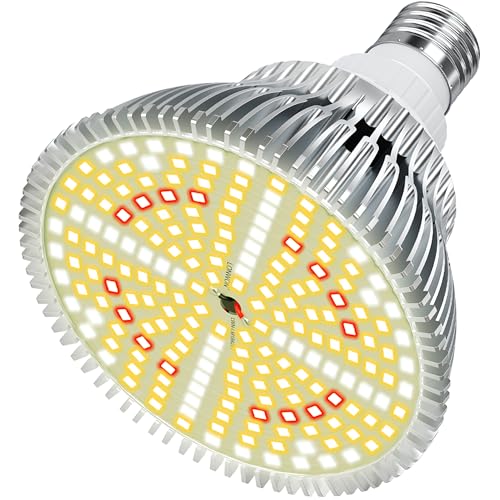
| High-Power Performer | Spectrum: Full spectrum 380–780 nm (includes 660 nm & 730 nm peaks) | Base / Socket: E26 screw-in base | Intended Use: Indoor plants (all growth stages) | VIEW LATEST PRICE | Read Our Analysis |
| LED 25W Full-Spectrum Hanging Grow Light with Timer |

| Best for Large Setups | Spectrum: Full spectrum 320–780 nm (white full-spectrum) | Base / Socket: (Bulb) standard screw-in style with included hanging cord (fits standard fixtures) | Intended Use: Indoor plants (seed to fruiting) | VIEW LATEST PRICE | Read Our Analysis |
| SANSI Full Spectrum 10W LED Grow Light Bulbs (2-Pack) |

| Best Build Quality | Spectrum: Full life-cycle full spectrum 400–780 nm (4000K) | Base / Socket: (Standard) screw-in bulb (E26/E27 implied by bulb form) | Intended Use: Indoor plant/crop growth (full life-cycle) | VIEW LATEST PRICE | Read Our Analysis |
| 2-Pack A19 Full Spectrum 9W LED Grow Bulbs |

| Budget Friendly | Spectrum: Full spectrum 400–740 nm (marketed as full spectrum) | Base / Socket: E26 base | Intended Use: Indoor plants, seedlings, herbs, vegetables, greenhouse/hydroponics | VIEW LATEST PRICE | Read Our Analysis |
More Details on Our Top Picks
Smart LED Full-Spectrum Grow Bulbs (2-Pack)
Should you want a low‑effort, plug‑and‑play solution that mimics natural daylight, the Necgemlex Smart LED Full‑Spectrum Grow Bulbs (2‑pack) are a great fit: they provide a 380–800 nm full range at 4500K, include a remote with dimming and a built‑in daily timer (2–22 hours) and a “Sunshie” sunrise‑to‑sunset mode, and screw into standard E26/E27 sockets so you can set automated light cycles without extra hardware. You’ll get two 9W A21/A70 bulbs that output up to 1220 lm, last about 30,000 hours, and deliver a 120° downlight beam. Set schedules, avoid external dimmers, and grow healthier indoor plants.
- Spectrum:Full spectrum 380–800 nm (4500K)
- Base / Socket:E26 (E27 compatible)
- Intended Use:Indoor plant growing
- Power Source / Type:AC powered LED bulb (9 W)
- Lifespan / Rated Life:Rated ~30,000 hours
- Application Stages Supported:All growth stages (implied full-spectrum for seedling to flowering)
- Additional Feature:Built-in daily auto-timer
- Additional Feature:Remote dimmable control
- Additional Feature:“Sunshie” sunrise-sunset mode
Lonwon Full-Spectrum LED Grow Light for Indoor Plants
Assuming you need a compact, energy-efficient solution that delivers strong light for every growth stage, the Lonwon Full-Spectrum LED is a great pick — it packs over 1300 μmol/m²·s at 6 inches and covers 380–780 nm, including targeted 660 nm and 730 nm to improve flowering and fruiting. You’ll use just 30W while getting performance similar to a 320W fixture, saving roughly 90% on energy. It supports seedlings through fruiting, increases leaf production, blooms, and yields, and provides consistent light in low-light seasons. Screw it into an E26 socket, guarantee a 6-inch shade, plug in, and start growing—replacement available provided dissatisfied.
- Spectrum:Full spectrum 380–780 nm (includes 660 nm & 730 nm peaks)
- Base / Socket:E26 screw-in base
- Intended Use:Indoor plants (all growth stages)
- Power Source / Type:AC powered LED bulb (30 W)
- Lifespan / Rated Life:(Not explicitly stated) implied long-life LED (manufacturer guarantee/replacement)
- Application Stages Supported:All growth stages (seedling, vegetative, flowering, fruiting)
- Additional Feature:Very high PPFD (>1300 μmol/m²·s)
- Additional Feature:Targets 660 nm & 730 nm
- Additional Feature:Energy-saving 30W equivalent
LED 25W Full-Spectrum Hanging Grow Light with Timer
Should you want a low‑draw, full‑range solution that mimics sunlight for every growth stage, the 25W LED hanging grow light with timer is a great choice for hobbyists and small-scale growers. You get true 25 W consumption, 320–780 nm white range and CRI 98, so colors and plant responses stay natural. At 8 inches PPFD measures 387.34 μmol/s/m², enough for seedling through flowering and fruiting. The cycle‑memory timer offers 4, 9, or 14‑hour runs and auto‑resumes daily. Installation is simple: a 16.4 ft pendant cord, two ceiling clips, manual and customer support are included. Energy use stays low.
- Spectrum:Full spectrum 320–780 nm (white full-spectrum)
- Base / Socket:(Bulb) standard screw-in style with included hanging cord (fits standard fixtures)
- Intended Use:Indoor plants (seed to fruiting)
- Power Source / Type:AC powered LED bulb (25 W) with pendant cord
- Lifespan / Rated Life:(Not explicitly stated) LED design; performance specs provided (typical LED longevity implied)
- Application Stages Supported:All growth stages (seed starting through flowering/fruiting)
- Additional Feature:Includes 16.4 ft pendant cord
- Additional Feature:Cycle memory timer (4/9/14h)
- Additional Feature:High CRI 98
SANSI Full Spectrum 10W LED Grow Light Bulbs (2-Pack)
Should you want a compact, low-heat option that closely mimics natural sunlight for all growth stages, the SANSI Full Range 10W LED bulbs are a strong choice. You get 400–780 nm coverage with a 4000K daylight spectrum and Ra nearly 100, so colors and plant responses match natural light. PPF is 16.8 μmol/s and PPFD about 97.9 μmol/s/m² at 1 ft, with a secondary optical lens for efficient distribution. Patented COC ceramic heat sink cuts thermal resistance, extends life to ~25,000 hours, and lowers infrared output to reduce burn risk. ETL/CE certified, flame-retardant, five-year support.
- Spectrum:Full life-cycle full spectrum 400–780 nm (4000K)
- Base / Socket:(Standard) screw-in bulb (E26/E27 implied by bulb form)
- Intended Use:Indoor plant/crop growth (full life-cycle)
- Power Source / Type:AC powered LED bulb (10 W)
- Lifespan / Rated Life:Rated ~25,000 hours
- Application Stages Supported:Full life-cycle growth (all stages)
- Additional Feature:Chip-on-ceramic heat sink
- Additional Feature:Nearly Ra100 color rendering
- Additional Feature:5-year after-sale service
2-Pack A19 Full Spectrum 9W LED Grow Bulbs
Should you want an easy, energy‑saving option for small indoor gardens or seed starts, the mfxmf 2 Pack A19 9W full‑spectrum LED bulbs deliver broad 400–740 nm light in a standard E26 screw‑in shape so you can upgrade ordinary fixtures without extra hardware. You’ll get 1,600 lumens at 9W with a claimed 20,000‑hour life and over 85% energy savings versus incandescent replacements. The 150° beam and CRI 85 suit seedlings, herbs, greens, and flowering stages; manufacturer notes continuous operation is acceptable. Plastic and aluminum cooling supports heat management. Install in any E26 socket, check voltage compatibility, and consult warranty details when necessary.
- Spectrum:Full spectrum 400–740 nm (marketed as full spectrum)
- Base / Socket:E26 base
- Intended Use:Indoor plants, seedlings, herbs, vegetables, greenhouse/hydroponics
- Power Source / Type:AC powered LED bulb (9 W)
- Lifespan / Rated Life:Rated ~20,000 hours
- Application Stages Supported:All growth stages (seeds, greens, flowers, fruit)
- Additional Feature:1600 lumens brightness
- Additional Feature:150° beam angle
- Additional Feature:App control available
Factors to Consider When Choosing Grow Light Bulbs for Indoor Plants
Selecting the right grow light bulb requires evaluating several technical and practical factors that directly affect plant growth. Key considerations include the light range, actual light output versus wattage, PPFD and PPF measurements, appropriate color temperature, and the availability of dimming or timer controls. Comparing these attributes helps match a bulb to plant species, growth stage, and the grower’s setup.
Light Spectrum Needs
Why does range matter so much for indoor-grown plants? Plants use blue light (≈400–500 nm) for vegetative growth and red light (≈600–700 nm, notably ≈660 nm) to drive flowering and fruiting, so a spectrum covering both supports all stages. Far‑red (~700–730 nm) affects shade responses and flowering timing via phytochrome balance; modest far‑red improves flowering and stem elongation control. PPFD measures photons within the 400–700 nm PAR band, so selections should prioritize adequate photon flux in that range rather than lumen or lux ratings. Broad “full spectrum” sources (≈380–780 nm) that mimic sunlight promote normal morphology, pigment synthesis, and flowering; narrow red/blue‑only spectra can accelerate specific responses but may yield atypical structure. CRI/CCT inform human perception but matter less than spectral power distribution across blue, red, and far‑red.
Wattage Versus Output
Differentiate power draw from usable plant light: wattage indicates electrical consumption, while PPF and PPFD quantify the photons plants actually use. Wattage alone can mislead; higher watts do not guarantee more photosynthetic light. LEDs often report 100–150 lumens per watt, but lumens reflect human vision, not PAR efficacy. Fixture losses, driver efficiency, and beam angle affect how much of that electrical input becomes usable light at canopy level. A narrow-beam 30 W lamp can yield higher PPFD at plant height than a wide-beam 30 W lamp. Use watts-per-square-foot guidelines for initial planning (roughly 10–20 W/ft² for low-light, 30–50+ W/ft² for higher-light crops with LEDs), then refine choices through comparing actual output metrics and on-site measurements.
PPFD And PPF
After considering wattage and usable output, attention shifts to the two core photon metrics that determine plant light: PPF and PPFD. PPF (Photosynthetic Photon Flux) quantifies a fixture’s total output of 400–700 nm photons per second (µmol·s⁻¹), useful for comparing overall emitter capacity. PPFD (Photosynthetic Photon Flux Density) measures photons landing on a square meter each second (µmol·m⁻²·s⁻¹), directly indicating light available for photosynthesis at the canopy. Practical selection relies on PPFD target ranges—seedlings ~100–200, leafy greens ~200–400, flowering/fruiting ~400–800 µmol·m⁻²·s⁻¹—and on translating PPF into PPFD using beam angle, mounting height, and spacing or measured PPFD maps. Efficiency is assessed through µmol per joule (PPF ÷ electrical power) to compare energy-to-photon performance.
Color Temperature Range
Upon choosing grow lights, color temperature (measured in kelvins) signals the light’s blue-to-red balance and should be matched to plant stage and human comfort. Lower temperatures (~2000–3000K) deliver warm, red‑rich light that favors flowering, fruiting, and stem elongation during reproductive stages. Higher temperatures (~5000–6500K) are blue‑dominant, promoting compact, leafy vegetative growth and supporting seedlings. Mid‑range full‑spectrum options (around 4000–4500K) offer balanced spectral output that supports all stages and is easier on human eyes. Selection should align color temperature with the crop phase: blue‑rich for veg, red‑rich for bloom, or employ adjustable/full‑spectrum fixtures to provide the appropriate balance as plants progress. Consider human comfort whenever lights occupy shared spaces.
Dimming And Timers
In selecting grow light bulbs, dimming capability and reliable timers are essential controls for matching light intensity and photoperiod to plant needs. Dimmable fixtures allow PPFD and spectral intensity adjustments—seedlings often require <100 μmol/m²·s while flowering might need several hundred μmol/m²·s—supporting stage-specific needs. Timers, integrated or external, enforce consistent photoperiods (12/12, 18/6, 16/8), critical for vegetative and flowering responses and avoiding light stress. Prefer built-in or memory-cycle timers for one-time setup, automatic recurrence, and recovery after power interruptions. Do not use mains-rated external dimmers unless the manufacturer confirms compatibility; incompatible dimming can cause flicker, shortened lifespan, or control failure. Take into account that dimming can shift spectral balance and reduce heat output, affecting canopy temperature and potentially extending lamp life.
Fixture Compatibility
Whenever selecting grow light bulbs, matching the bulb to the fixture is as essential as choosing range and intensity: check the bulb base (E26/E27, A19/A21), confirm the fixture’s maximum wattage and voltage rating, and make certain the lens/beam angle and physical clearance suit mounting height and canopy coverage. Verify the fixture’s rated voltage (e.g., 100–240 V, 50–60 Hz) and maximum wattage so the bulb’s draw does not exceed socket limits. Confirm compatibility with integrated electronic controls—some smart or remote-dimmable bulbs have built-in drivers and should not be used with external dimmers. For pendants and hanging fixtures, check cord length, mounting hardware and the fixture’s capacity for safe bulb size, distribution and thermal management without compromising canopy coverage.
Heat And Lifespan
Heat management and expected lifespan are critical considerations whenever choosing grow light bulbs because operating temperature directly affects both plant safety and fixture reliability. LEDs generally run cooler than HID or incandescent bulbs, lowering radiant heat and leaf-burn risk whenever hung at recommended distances. However, even lower-wattage LEDs concentrate heat at the fixture; adequate airflow or heatsinks remain necessary to prevent local canopy temperature rises. High-quality LEDs with effective thermal design can deliver 25,000–50,000+ hours, whereas poor heat dissipation accelerates junction-temperature–driven failure. Ambient temperature, ventilation, and mounting—especially in enclosed spaces or close to foliage—strongly influence plant stress and lumen depreciation. Users should monitor canopy temperature and follow mounting-height or PPFD charts rather than relying solely on wattage for safety and longevity.
