

Visualize cool air pooling in your residential room on a hot afternoon, and envision controlling that comfort from anywhere. You’ll want a controller that fits your setup — from simple IR hubs to full smart thermostats with sensors and geofencing — so you can save energy and stay comfortable. I’ll outline seven top 2026 options and the key factors to weigh before you pick one, so you get the right balance of features and privacy.
| Smart WiFi Air Conditioner Controller with Sensor |
| Best for Energy Savings | Connectivity: Wi‑Fi | Remote Control Capability: App-based remote control for AC | Temperature Sensing / Monitoring: Built‑in temperature sensor | VIEW LATEST PRICE | Read Our Analysis |
| eMylo Wi‑Fi IR Remote with Temp & Humidity Sensor |

| Best for Automation | Connectivity: Wi‑Fi (Tuya/Smart Life) | Remote Control Capability: Universal IR remote via app / voice | Temperature Sensing / Monitoring: Built‑in temperature sensor (±1°C) | VIEW LATEST PRICE | Read Our Analysis |
| Broadlink RM4 Mini IR Smart Remote Hub |

| Best IR Library | Connectivity: Wi‑Fi (2.4 GHz) | Remote Control Capability: IR remote hub (phone becomes remote via app) | Temperature Sensing / Monitoring: Does not include sensor hardware — uses IR control only (no built‑in temp sensor) | VIEW LATEST PRICE | Read Our Analysis |
| Replacement AC Remote for LG Dual Inverter Window AC |

| Best Compatibility Replacement | Connectivity: (infrared remote — no smart connectivity) — Replacement IR remote (not Wi‑Fi) | Remote Control Capability: Physical IR remote control (replacement remote) | Temperature Sensing / Monitoring: No temperature sensor — simple replacement remote (displays Celsius) | VIEW LATEST PRICE | Read Our Analysis |
| Boldr Klima Smart Thermostat for ACs and Heat Pumps |
| Best for Remote Control | Connectivity: Wi‑Fi (app/cloud) | Remote Control Capability: App/voice remote control for AC | Temperature Sensing / Monitoring: Uses temperature sensing (automations/scheduling based on temp) | VIEW LATEST PRICE | Read Our Analysis |
| MOES Smart Wi‑Fi Temp & Humidity Monitor with IR |

| Best for Monitoring | Connectivity: Tuya Wi‑Fi | Remote Control Capability: IR remote control with app integration | Temperature Sensing / Monitoring: Built‑in temperature sensor (with display) | VIEW LATEST PRICE | Read Our Analysis |
| Amazon Smart Thermostat – Works with Alexa & Ring |

| Best Smart Thermostat | Connectivity: Wi‑Fi (Alexa/Amazon setup) | Remote Control Capability: App/voice remote control for HVAC | Temperature Sensing / Monitoring: Built‑in temperature sensing (thermostat device) | VIEW LATEST PRICE | Read Our Analysis |
More Details on Our Top Picks
Smart WiFi Air Conditioner Controller with Sensor
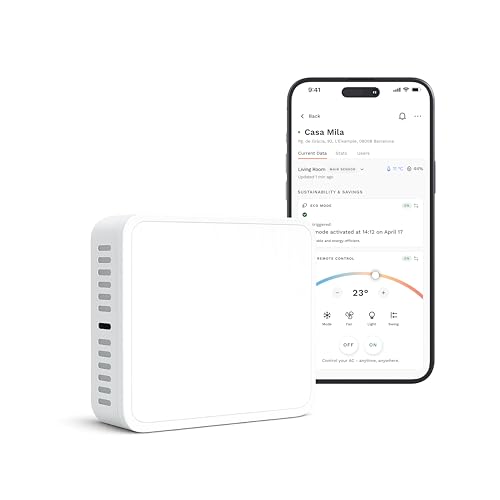
Should you want a simple way to make a mini split or heat pump “smart,” the Layla 1 Smart WiFi Air Conditioner Controller with Sensor is a great choice—its built-in temperature sensor and app-based remote let you monitor and adjust cooling or heating from anywhere, set schedules and timers, and let the controller auto-adjust to save energy. You’ll mount the compact Layla Eco device (2.75×2.75×0.99 in), power it via 5V USB, and pair it with most remote-controlled ACs, mini splits, or heat pumps within about 50 meters. It’s ideal for homes, offices, and rentals, and includes sensor, cable, and charger.
- Connectivity:Wi‑Fi
- Remote Control Capability:App-based remote control for AC
- Temperature Sensing / Monitoring:Built‑in temperature sensor
- Scheduling / Automation:Smart scheduling, timers, auto‑adjustments
- Voice Assistant Support:(Implied app control; voice not explicitly stated) — likely works with voice via app ecosystems (not specified)
- Power Source:5V USB
- Additional Feature:Built-in AC sensor
- Additional Feature:50 m maximum range
- Additional Feature:USB 5V power
eMylo Wi‑Fi IR Remote with Temp & Humidity Sensor
Should you want an affordable, plug-and-play way to add remote temperature and humidity control to any IR‑based AC, the eMylo Wi‑Fi IR Remote is a great choice. You’ll get a compact USB‑powered hub (65 x 65 x 17 mm, 50 g) with a 38 kHz IR emitter reaching about 10 m. Its built‑in sensor reports temperature (±1°C, °C/°F switchable) and humidity (0–99% RH, ±5% RH) to the Tuya/Smart Life app over 2.4 GHz Wi‑Fi. You can schedule timers, create automations (cool whenever >30°C), and use Alexa/Google voice commands. It’s ideal for rooms like nurseries, garages, or server closets.
- Connectivity:Wi‑Fi (Tuya/Smart Life)
- Remote Control Capability:Universal IR remote via app / voice
- Temperature Sensing / Monitoring:Built‑in temperature sensor (±1°C)
- Scheduling / Automation:Timer scheduling and DIY automations (Tuya)
- Voice Assistant Support:Alexa and Google Assistant support
- Power Source:USB DC 5V/1A
- Additional Feature:Temp accuracy ±1°C
- Additional Feature:Humidity accuracy ±5% RH
- Additional Feature:38 kHz IR frequency
Broadlink RM4 Mini IR Smart Remote Hub
In case you want a compact, affordable way to turn your phone into a universal IR remote for air conditioners and other home electronics, the Broadlink RM4 Mini is a solid choice — it supports over 50,000 IR devices and lets you build timers and scenes via the BroadLink app for remote or voice control. You’ll need a secured 2.4 GHz Wi‑Fi network and line‑of‑sight to devices; it won’t handle RF or Bluetooth remotes. The RM4 Mini works with Alexa, Google Assistant, Siri (iPhone), and IFTTT. It’s tiny, USB‑powered (adapter not included), cloud‑updatable, and offers IR learning when necessary.
- Connectivity:Wi‑Fi (2.4 GHz)
- Remote Control Capability:IR remote hub (phone becomes remote via app)
- Temperature Sensing / Monitoring:Does not include sensor hardware — uses IR control only (no built‑in temp sensor)
- Scheduling / Automation:Timers and custom scenes (BroadLink app/IFTTT)
- Voice Assistant Support:Alexa, Google Assistant (and Siri via iPhone)
- Power Source:USB cable included; requires 5V supply; also lists 2 AAA batteries required (item notes)
- Additional Feature:50,000+ IR devices
- Additional Feature:Cloud-updated IR library
- Additional Feature:IFTTT integration available
Replacement AC Remote for LG Dual Inverter Window AC
Provided that you need a direct, ready-to-use replacement for an LG Dual Inverter window air conditioner, this AKB73598009 remote fits a wide range of LW and VW models and simplifies control with familiar buttons and AAA battery power. You’ll get a compact 6.5 x 2 x 0.7-inch remote (1.76 oz) that works with many model numbers including LW1222IVSM, LW1817IVSM, LW2422IVSM and related LA/VW codes; alternate part AKB73598011. It uses two 1.5V AAA batteries, shows temperature in Celsius only, and changes setpoints in 2-degree steps. Check manufacturer AULCMEET Inc for warranty and support details.
- Connectivity:(infrared remote — no smart connectivity) — Replacement IR remote (not Wi‑Fi)
- Remote Control Capability:Physical IR remote control (replacement remote)
- Temperature Sensing / Monitoring:No temperature sensor — simple replacement remote (displays Celsius)
- Scheduling / Automation:No advanced scheduling (basic remote functions only)
- Voice Assistant Support:No voice support (IR replacement remote)
- Power Source:2 × 1.5V AAA batteries
- Additional Feature:Compatible LG model list
- Additional Feature:Celsius-only display
- Additional Feature:2° temperature increments
Boldr Klima Smart Thermostat for ACs and Heat Pumps
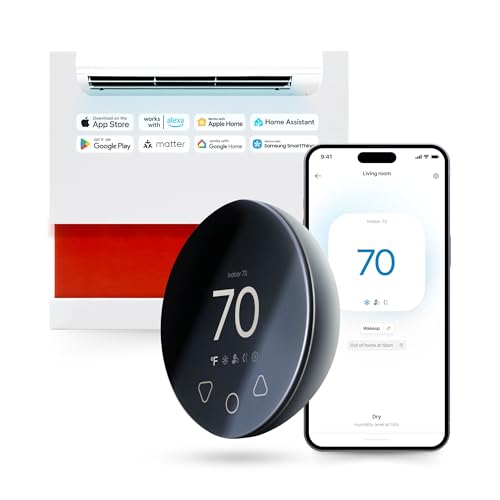
Provided that you want simple, plug-and-play smart control for window A/Cs, mini splits, or heat pumps, the Boldr Klima is a great choice because it combines easy DIY setup with remote app and voice control so you can automate comfort without rewiring. You’ll plug it into a standard outlet, follow guided in-app pairing with your Wi‑Fi, then control units from anywhere via the Klima app or Alexa and Google Assistant. Set weekly schedules, use location-based automations, and let Klima switch modes whenever you leave or return. It also tracks energy use and cost impact to help optimize efficiency and reduce bills.
- Connectivity:Wi‑Fi (app/cloud)
- Remote Control Capability:App/voice remote control for AC
- Temperature Sensing / Monitoring:Uses temperature sensing (automations/scheduling based on temp)
- Scheduling / Automation:Custom weekly schedules and location automation
- Voice Assistant Support:Amazon Alexa and Google Assistant support
- Power Source:Plug into regular power outlet (mains-powered)
- Additional Feature:Energy usage tracking
- Additional Feature:Location-based automation
- Additional Feature:Cost-impact display
MOES Smart Wi‑Fi Temp & Humidity Monitor with IR
Should you want precise climate control for a small space—like a bedroom, greenhouse, or pet area—the MOES Smart Wi‑Fi Temp & Humidity Monitor with IR is a great fit, since it combines real‑time temp/humidity readouts on an LCD with Tuya Wi‑Fi and an IR blaster to trigger your AC or humidifier remotely. You’ll get accurate temperature and humidity monitoring in a compact 2.56 x 0.67 x 2.56‑inch unit (3.2 oz) that pairs with Alexa. Install the WR-TY-THR-BK-MS, connect via Tuya, and use IR commands to automate climate adjustments. It’s practical for garages and humidifier accessory setups.
- Connectivity:Tuya Wi‑Fi
- Remote Control Capability:IR remote control with app integration
- Temperature Sensing / Monitoring:Built‑in temperature sensor (with display)
- Scheduling / Automation:Tuya automations/timers supported
- Voice Assistant Support:Alexa compatibility
- Power Source:USB (Tuya Wi‑Fi device) with LCD
- Additional Feature:LCD display
- Additional Feature:Tuya WiFi integration
- Additional Feature:Designed for humidifier accessories
Amazon Smart Thermostat – Works with Alexa & Ring
Should you want an easy smart upgrade that ties directly into Alexa and Ring, the Amazon Smart Thermostat is a solid choice—especially for households that already use Echo devices for presence detection and voice control. You’ll get automatic home/away/sleep temperature switching, comfort zones via select Echo devices or the Amazon Smart Air Quality Monitor, and Alexa “hunches” that infer state from phone location. It works with most 24V HVAC systems (needs C‑wire or adapter), uses 2.4 GHz Wi‑Fi, and lacks a far‑field mic. ENERGY STAR and ECOLOGO Gold certified, it offers app control, schedules, energy data, and rebate guidance.
- Connectivity:Wi‑Fi (Alexa/Amazon setup)
- Remote Control Capability:App/voice remote control for HVAC
- Temperature Sensing / Monitoring:Built‑in temperature sensing (thermostat device)
- Scheduling / Automation:Schedules (up to 7 periods/day), routines, Alexa automations
- Voice Assistant Support:Alexa (integrated) and Ring compatibility; works with Alexa routines
- Power Source:Hardwired 24V HVAC power (requires C‑wire or adapter)
- Additional Feature:ENERGY STAR certified
- Additional Feature:C-wire required (or adapter)
- Additional Feature:Alexa thermostat hunches
Factors to Consider When Choosing a Smart Air Conditioner Controller
At the time you shop for a smart AC controller, check that it supports your AC type and has accurate sensors you can place where they’ll measure room temperature correctly. Make sure the device offers reliable connectivity, a well-designed app, and useful energy-saving modes. Also confirm installation steps, power requirements, and whether you’ll need any extra adapters or wiring.
Compatibility With AC Types
Because air conditioners use different signaling methods and feature sets, you’ll want to confirm a smart controller matches your AC’s specific type and control method before buying. Check support for IR, RF, or proprietary protocols—many controllers only emulate infrared remotes while others add RF or cloud integrations. Verify compatibility with your unit type: window, mini‑split, heat pump, or central systems often use different signals and offer unique modes like heat, swing, or eco. Confirm command granularity so you get more than basic on/off and temperature: you might require mode switching, fan speed steps, swing/vent position, or eco modes. In the event you have multi‑zone or multi‑split setups, make certain the controller pairs with multiple indoor heads, and bear in mind IR line‑of‑sight versus RF range limits.
Sensor Accuracy And Placement
Although sensor specs could seem like fine print, they directly determine how well your controller keeps a room comfortable. Sensor accuracy matters: high-quality units hit about ±0.5°C, while consumer-grade sensors can be ±1–2°C, which affects how precisely setpoints are held. Place sensors away from direct sunlight, heat sources, vents, doors, and windows to avoid skewed readings that cause short cycling or overcorrection. Mount wall sensors at occupied-zone height (1.0–1.5 m / 3–5 ft) and ideally centered to reflect human comfort. In larger or zoned spaces, deploy multiple sensors or a remote sensor in the warmest and coolest frequently used areas, and configure averaging or prioritization to prevent uneven comfort. Also check response time and sampling interval—faster reporting avoids oscillation.
Connectivity And App Support
Anyone shopping for a smart AC controller should treat connectivity and app support as core features, since they determine how reliably you’ll control and automate your system. Make sure the controller works with common Wi‑Fi bands and protocols—most need secured 2.4 GHz and 802.11 b/g/n. Confirm the app offers both cloud (remote) and local control so you can operate the unit away from home and during outages. Check that apps exist for your phone’s OS (iOS and Android) and integrate with voice assistants or platforms you use, like Alexa, Google Assistant, or PROVIDED THAT. Prefer apps that provide solid scheduling, location and sensor‑based automations, easy scene creation, and a clear firmware‑update path with a record of regular security and feature updates.
Energy Saving Features
Whenever you prioritize energy-saving features in a smart AC controller, you’ll get more than convenience—you’ll cut runtime and utility bills through letting the device manage temperature, schedules, and behavior intelligently. Choose controllers with smart scheduling (weekday/weekend or fully customizable) to lower cooling during unoccupied hours. Prefer units with built-in temperature and humidity sensors for closed‑loop control so the system responds only whenever setpoints are exceeded, avoiding wasted cycles. Use automation like geofencing or temperature triggers to prevent unnecessary runtime (for example, turn on solely provided room >30°C). Look for energy‑monitoring and reporting—hourly/daily usage and cost estimates—to spot inefficiencies and measure savings. Finally, adaptive learning modes that tweak setpoints and cycle times provided occupancy and conditions can further minimize compressor runtime.
Installation And Power Needs
During planning installation and power for a smart AC controller, check its power source, mounting needs, and network requirements so you won’t run into surprises during setup. Decide whether you need a USB/mains-powered unit or a battery model—USB units need a nearby outlet; batteries require replacements or recharging. Confirm mounting options and dimensions so the controller or sensor can be wall-mounted or placed with clear IR line-of-sight without blocking airflow. Verify Wi‑Fi (usually 2.4 GHz) and make certain coverage at the installation spot for reliable remote and cloud access. Check whether additional wiring (C‑wire or hardwired power) or adapters are required and budget for electrician costs. Place temperature/humidity sensors away from windows, vents, and direct sun within the recommended sensor range.
Frequently Asked Questions
Can These Controllers Integrate With Zigbee or Z-Wave Home Hubs?
Yes — many do: some controllers natively support Zigbee or Z‑Wave, others use bridges or hubs to translate, and a few rely on Wi‑Fi plus smart-home platforms for integration, so you’ll choose based on protocol and ecosystem needs.
Are There Monthly Subscription Fees for Advanced Features?
Usually not—you’ll find most smart AC controllers offer core features without monthly fees, though some manufacturers charge subscriptions for advanced energy reports, remote professional support, or improved voice assistant integrations; check each product’s fine print.
Do Any Models Support Multi‑Zone AC Control Natively?
Yes — some do: you’ll find controllers that natively handle multi‑zone AC, letting you map dampers and thermostats per zone. You’ll envy how effortlessly they coordinate cooling, and you’ll ditch manual juggling forever.
How Do These Devices Handle Power Outages and Resume Operation?
They usually reconnect automatically after power returns, using local settings or cloud sync; you’ll keep schedules provided battery or internal memory stores them, but some require manual restart or app confirmation, so check each model’s recovery behavior.
Are Replacement Parts or Official Repairs Readily Available?
Yes — you’ll usually find parts and repairs, ironically as easy to locate as a missing sock: manufacturers and third-party shops supply common modules, but premium or discontinued models can be pricey or slow to service.
