

A thermostat is the quiet conductor of home comfort, and I’ve been tracking the smartest models that actually save energy and simplify life. I’ll walk you through seven leading thermostats for 2026—covering baseboard-specific units, learning hubs, budget Wi‑Fi options, and feature-rich touchscreens—so you can spot which fits your system and habits. I’ll point out key tradeoffs and compatibility pitfalls that could change your pick, so stick with me for practical comparisons.
Mysa Smart Thermostat for Electric Baseboard Heaters

Should you rely on high-voltage electric baseboards or fan-forced heaters, the Mysa Smart Thermostat is the best pick— you’ll get a Wi-Fi programmable thermostat made for 120–240V systems, handling up to 1900W at 120V and 3800W at 240V. It won’t work with low-voltage or two-wire setups, so check compatibility on older systems. Installation’s straightforward, and the unit is 40% smaller than prior models. Adaptive Display with Wake on Approach adjusts brightness. It integrates with Alexa, Google Assistant, and HomeKit, offers humidity and temperature alerts, and fast scheduling via the free mobile app.
Best For: Homeowners with high-voltage (120–240V) electric baseboard or fan-forced heating systems who want a compact, Wi‑Fi programmable thermostat with smart home integration.
Pros:
- Designed specifically for high/line voltage systems and supports up to 1900W (120V) / 3800W (240V).
- Integrates with Alexa, Google Assistant, and Apple HomeKit and offers remote scheduling via a free app.
- Adaptive Display with Wake on Approach and humidity/temperature alerts for convenience and awareness.
Cons:
- Not compatible with low-voltage or two‑wire baseboard systems, so older setups may require replacement or checks.
- Requires at least four wires (neutral or a second live), which may complicate installation in some homes.
- Load limits may not cover very large or multiple heater circuits without additional hardware.
Honeywell Home T9 WiFi Smart Thermostat with Sensor

In case you want smart temperature control that prioritizes the rooms you actually use, the Honeywell Home T9 WiFi Smart Thermostat with Sensor is an ideal pick—its Smart Room Sensors detect occupancy and steer heating or cooling to occupied spaces, improving comfort and often cutting energy use. You’ll control it via the Resideo app or voice assistants like Alexa, Google Assistant, and HomeKit. ENERGY STAR certification, Auto Home/Away Scheduling, and rebate/utility program options help trim bills. Sensors reach about 200 ft, support multi-room focus, and run on batteries. C-Wire or included adapter is required; guided setup eases installation.
Best For: tech-savvy homeowners who want multi-room, occupancy-based temperature control and smart-home integration to boost comfort and energy savings.
Pros:
- ENERGY STAR certified with Auto Home/Away Scheduling and rebate/utility program support to reduce energy costs.
- Smart Room Sensors focus heating/cooling on occupied rooms (up to ~200 ft range) for improved comfort and multi-room control.
- Works with Resideo app and major voice assistants (Alexa, Google Assistant, HomeKit); guided installation and included power adapter increase compatibility.
Cons:
- Requires a C‑Wire or the included power adapter, which may complicate installation for some homes.
- Not compatible with electric baseboard heating (120–240V) and some heating-only setups without a C‑Wire.
- Sensor range and performance can vary with home construction, and extra sensors are needed for wider multi-room coverage.
Nest T4000ES E Hubless Smart Thermostat

Should you want a thermostat that learns your schedule and actively trims energy use, the Nest T4000ES E Hubless Smart Thermostat is a top pick for tech-savvy homeowners seeking hands-off savings. It programs itself, shows the Nest Leaf at the moment you pick efficient temperatures, and logs Energy History with saving tips. Home/Away Assist shifts to Eco Temperature once you leave. You control it remotely via the Nest app on iOS/Android or a browser; it needs Wi‑Fi and works with Alexa, Google Assistant, and smart speakers. HVAC monitoring sends maintenance alerts. Installation is simple, it fits 95% of systems, and a frosted display blends with decor.
Best For: Tech-savvy homeowners who want a self-learning, energy-saving smart thermostat with remote control and voice assistant compatibility.
Pros:
- Learns your schedule and programs itself to reduce energy use, with Nest Leaf guidance and Energy History insights.
- Remote control via Nest app (iOS/Android/browser) and compatibility with Alexa, Google Assistant, and other smart speakers.
- HVAC monitoring with maintenance alerts, easy installation (fits ~95% of systems), and a subtle frosted display.
Cons:
- Requires a Wi‑Fi connection for full functionality and remote features.
- Nest Temperature Sensor sold separately for room-specific accuracy.
- Some users may prefer manual control or simpler thermostats without learning features.
WiFi Single-Stage Home Thermostat with App Control

Should you have a conventional single-stage HVAC system and a reliable 24V C-wire, this WiFi single-stage thermostat is a smart, budget-friendly choice that puts full app control and 7-day programmable scheduling on your phone. You’ll connect over 2.4GHz WiFi to adjust temperature remotely, monitor system status, and use an intuitive app. The seven-day, multi-period schedule and ±1°F accuracy keep comfort consistent and efficient, and a backlit LCD simplifies local use. It’s made for 1H/1C gas, oil, or electric systems only; it won’t work with heat pumps, multi-stage systems, line-voltage loads, mini-splits, or RV units. Confirm C-wire and compatibility before buying.
Best For: Homeowners with a conventional 1H/1C gas, oil, or electric HVAC system who have a reliable 24V C-wire and want affordable WiFi app control with 7-day programmable scheduling.
Pros:
- Affordable smart thermostat with remote control via 2.4GHz WiFi and an intuitive smartphone app.
- 7-day programmable, multi-period scheduling and ±1°F accuracy for consistent comfort and energy savings.
- Backlit LCD and user-friendly interface for easy local operation, including low-light conditions.
Cons:
- Requires a continuous 24V C-wire (no battery operation); will not power on without it.
- Incompatible with heat pumps, multi-stage systems, line-voltage heaters, mini-splits, PTACs, and RV HVAC units.
- Only supports 2.4GHz WiFi (no 5GHz) and limited to single-stage (1H/1C) systems, so unsuitable for many newer or complex setups.
Smart WiFi Touchscreen Thermostat with App & Voice
Should you want hands-free comfort and simple app control, the Smart WiFi Touchscreen Thermostat with App & Voice is ideal for busy households and small businesses that value convenience and efficiency. You’ll use voice commands or the responsive touchscreen and mobile app to adjust settings without interrupting tasks. Built from durable ABS, it resists abrasions and temperature extremes for long-term reliability. Dual heating and cooling modes maintain balanced indoor temperatures year-round, actively adapting to conditions. Installation is tool-free and fast, so you can mount it in homes, RVs, dorms, retail spaces, or hotel rooms and start saving energy immediately.
Best For: busy households and small businesses seeking convenient, energy-efficient temperature control via voice, touchscreen, or mobile app.
Pros:
- Hands-free voice control plus responsive touchscreen and mobile app for easy adjustments.
- Durable ABS construction resists abrasions and temperature extremes for long-term reliability.
- Dual heating and cooling modes with dynamic adjustments provide year-round comfort and energy savings.
Cons:
- May require compatible HVAC systems and Wi‑Fi network for full feature set.
- Advanced features and app/voice integration could involve a learning curve for some users.
- Tool-free installation may still be challenging for users unfamiliar with thermostat wiring (professional help might be needed in complex setups).
Honeywell Home RTH9585WF1004 Wi‑Fi Smart Color Thermostat
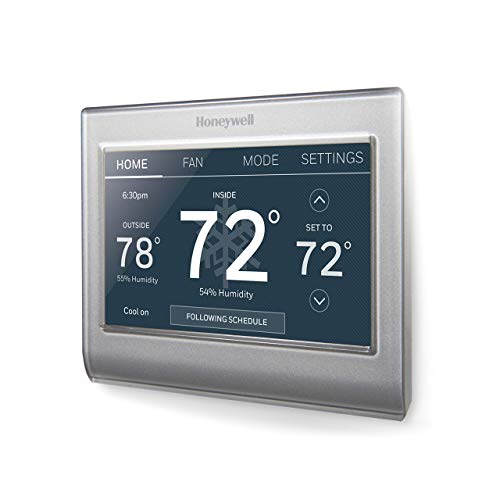
Should you want a customizable touchscreen that blends with your décor while giving you smart, energy-saving control, the Honeywell Home RTH9585WF1004 is a great fit. You get a 7-day programmable, color touchscreen with Wi‑Fi and app control, plus Alexa and Google Home voice commands. Energy Star certification, monthly reports, personalized tips and Smart Response alerts help you save and maintain filters/humidifier pads. It supports most forced-air, hot water, steam and heat-pump systems but not electric baseboard heat; C‑Wire is required. Installation includes hardware and guides; unit ships with a one-year warranty and US manufacturing.
Best For: Homeowners with central HVAC systems who want a customizable color touchscreen thermostat with Wi‑Fi, app control, and voice assistant integration for energy-saving scheduling and alerts.
Pros:
- 7-day programmable color touchscreen with customizable background and Smart Response alerts for maintenance and extreme conditions.
- Wi‑Fi and mobile app control plus Alexa/Google Home voice compatibility for remote and hands-free temperature management.
- Energy Star certified with monthly energy reports and personalized tips to help reduce energy use.
Cons:
- Requires a C‑Wire and 120V AC power (plus AAA backup battery), which may complicate installation in older homes.
- Not compatible with electric baseboard heating (120–240V), limiting use in some residences.
- Relatively short one-year warranty compared with some competing smart thermostats.
Honeywell Home Smart Thermostat X2S (Wi‑Fi, White)

Should you want a Matter‑certified, HomeKit‑friendly thermostat that works across both 2.4 GHz and 5 GHz Wi‑Fi, the Honeywell Home Smart Thermostat X2S is a strong pick—especially in case you need flexible scheduling and remote control via the Initial Alert app. You’ll get Alexa and Google Assistant support, Energy Star efficiency, and participation in demand‑response and rebate programs. It requires a C‑wire and supports many conventional and heat pump systems (not electric baseboard). Features include customizable display, filter alerts, indoor humidity monitoring, auto‑away, extended low‑heat down to 32°F, and a two‑year warranty for peace of mind.
Best For: Homeowners and smart‑home enthusiasts who want a Matter‑certified, HomeKit‑compatible thermostat with flexible scheduling, multi‑platform voice control, and support for both 2.4 GHz and 5 GHz Wi‑Fi.
Pros:
- Matter certified and compatible with Apple HomeKit, Alexa, and Google Assistant for broad smart‑home integration.
- Energy Star rated with demand‑response and rebate program support plus auto‑away and extended low‑heat down to 32°F for energy savings.
- Flexible scheduling options, indoor humidity monitoring, customizable display, and filter change reminders.
Cons:
- Requires a C‑wire, which may necessitate wiring upgrades in some homes.
- Not compatible with electric baseboard (120–240V) heating systems.
- Limited warranty length at 2 years compared with some competitors offering longer coverage.
Factors to Consider When Choosing a Smart Programmable Thermostat
Before you pick a smart thermostat, I check a few key things with every model: system compatibility and whether your HVAC needs a C‑wire or other power requirements. I also consider how hard installation will be, whether it plays nicely with my smart home ecosystem, and which energy‑saving features it actually offers. Those factors usually tell me whether a thermostat will work smoothly and save money long term.
System Compatibility Check
How will your existing HVAC and wiring affect which smart thermostat you can actually install? I always start upon matching the thermostat to the system type: line-voltage units for electric baseboard versus 24V low-voltage for forced-air furnaces. Check whether your setup is forced air, hot water, steam, heat pump, or electric baseboard because some thermostats exclude certain systems. Verify stage support—single-stage, multi-stage, or heat pump with backup—so controls will operate correctly. Inspect wiring: confirm the voltage and whether a common (C-wire) is present for continuous power, and count control wires to meet installation requirements. Don’t overlook older two-wire or special configurations; they often need adapters or a compatible model. Doing this upfront prevents purchase and installation headaches.
Power Requirements Needed
Because smart thermostats need steady power to run Wi‑Fi, sensors, and displays, I always start with confirming what your system and wiring can actually supply. Check whether your HVAC uses low‑voltage (24V) or line/line‑voltage (120–240V) because that determines compatible thermostat models. Most modern smart units expect a continuous 24V common (C‑wire); battery‑only setups or intermittent power can disrupt features or cause reboots. Some devices also require a neutral or additional live wires to support adaptive displays and full connectivity. Line‑voltage thermostats for electric baseboard heaters have separate wiring and load considerations and can’t be swapped with low‑voltage models. Should your wiring lack required conductors or have mismatched voltage, the thermostat might fail or lose smart functions—plan for an installer to verify and upgrade wiring as needed.
Installation Complexity Level
Want to tackle installation yourself or hire a pro? I recommend evaluating complexity before you buy. Installation varies: line-voltage baseboard heaters need different wiring than typical low-voltage HVAC, and some systems simply aren’t interchangeable. Check for a common (C) wire—many smart thermostats require it; should yours lack one, expect extra hardware or a more involved install. Look at the thermostat’s compatibility notes and verify wiring diagrams against your system to avoid surprises. Some models are built for DIY with step-by-step guides and simple connectors, while others demand professional know-how because of unusual voltages or complex control systems. Finally, confirm wireless requirements (for example, 2.4 GHz WiFi) to prevent connectivity headaches during setup.
Smart Home Integration
During my selection of a smart thermostat, I prioritize how well it will fit into my existing smart-home setup—voice-assistant support (Alexa, Google Assistant, HomeKit), app control, and Matter compatibility make day-to-day use frictionless. I want a thermostat that responds reliably to voice commands and appears alongside other devices in my preferred platform so I don’t juggle multiple apps. Mobile app control must be intuitive for remote adjustments and scheduling from my phone or tablet. Broad platform compatibility prevents lock-in and lets scenes or automations include my thermostat. I also value Matter certification because it improves cross-platform interoperability. Finally, I look for devices whose occupancy or auto-away features integrate with other sensors so automations trigger predictably.
Energy Savings Features
While I prioritize comfort, I also want a thermostat that actively trims energy waste—so energy-saving features are a top selection factor. I look for programmable scheduling that matches my routine, cutting HVAC run time whenever I’m asleep or out. Occupancy detection and auto home/away settings are essential so temperature shifts only occur whenever someone’s present, not wasted cycles. I value Energy Star certification because it confirms verified efficiency and lower bills. Integration with utility Demand Response Programs is a plus; slight automatic adjustments during peak periods can save money and help the grid. Finally, clear energy-usage history and real-time feedback let me spot trends and fine-tune setpoints for measurable savings.
Sensor And Zoning Support
Comfort and efficiency mean little in case a thermostat only reads the temperature in one spot, so I look for models with sensor and zoning support that match climate control to how we actually use the house. Sensor and zoning support lets me customize temperatures for different rooms or zones, improving comfort and cutting wasted energy. I prefer multi-room sensors that detect occupancy and temperature variations so heating or cooling focuses on occupied areas. Remote-placement sensors are useful for bedrooms or sunlit rooms where the main thermostat misreads conditions. I check sensor range—some stretch up to about 200 feet, but construction affects effectiveness and placement. Zoning capability is essential whenever I want simultaneous, independent settings across zones to reflect varied room usage and preferences.
User Interface Quality
Because I use my thermostat every day, the quality of its user interface matters as much as its technical features. I look for a touchscreen with clear, easy-to-read visuals and intuitive operation so adjustments are fast and frustration-free. Adaptive display tech that dims or brightens with ambient light keeps the screen readable without glare at night. I value voice control compatibility for hands-free tweaks and better accessibility whenever I’m busy or have limited mobility. Customizable scheduling inside the interface lets me set precise temperature changes for my routine without relying solely on an app. Still, a sturdy companion app is essential for remote access and deeper system management while I’m away from home.
Alerts And Maintenance
A reliable alert and maintenance system matters as much as a friendly interface, since I want my HVAC running efficiently without surprises. I rely on temperature and humidity alerts to keep indoor air quality steady and comfortable, and I value extreme-condition notifications that prevent damage or discomfort. Built-in HVAC diagnostics and monitoring let me spot issues promptly, avoiding costly repairs or sudden breakdowns. I also want filter-change prompts and maintenance prompts so routine upkeep actually happens and the system lasts longer. The best thermostats let me customize alert thresholds and choose delivery—mobile push, email, or both—so I get proactive notices that fit my life. In short, alerts plus maintenance features are nonnegotiable for peace of mind.
