

Like tuning a finely wound clock, I’ve narrowed the field to seven smart thermostats that balance comfort, savings, and Google Home ease. I’ll walk you through Nest’s top models, a couple of reliable renewed options, and strong alternatives from Honeywell, Emerson, and ecobee so you can match features to your system and priorities—keep going and I’ll help you avoid the common compatibility and setup pitfalls.
Google Nest Thermostat with Trim Kit (Snow)

Should you want an energy-focused, user-friendly option that blends clean looks with easy installation, the Google Nest Thermostat with Trim Kit (Snow) is a smart pick— you’ll get an ENERGY STAR certified thermostat that adjusts temperatures automatically whenever your home’s empty to cut waste. You can program schedules in the Google Home app on Android or iPhone and manage energy-efficient routines from anywhere. The included trim plate and steel mounting plate make wall installation tidy and cover imperfections from old thermostats, ensuring a clean fit over existing electrical boxes. It’s built for comfort and straightforward energy savings.
Best For: homeowners and renters seeking an energy-efficient, easy-to-install smart thermostat that integrates with the Google Home app for automated temperature control and simple scheduling.
Pros:
- ENERGY STAR certified for proven energy savings.
- Automatic temperature adjustments when the home is empty to reduce wasted energy.
- Includes trim plate and steel mounting plate to cover wall imperfections and fit over existing electrical boxes.
Cons:
- Designed specifically for the Nest Thermostat, so not a universal trim option for other thermostat brands.
- Requires the Google Home app and a compatible smartphone for full functionality.
- May lack some advanced features found on higher-end smart thermostat models.
Google Nest Thermostat (Renewed)

Should you want a budget-friendly Nest experience that still links seamlessly with Google Home, the renewed Google Nest Thermostat delivers ENERGY STAR efficiency and smart scheduling at a lower price point. You’ll check compatibility before buying—it’s not universal—and while many homes won’t need a C wire, heating-only, cooling-only, zone-controlled, or heat-pump systems might. Installation typically takes 30 minutes or less. With Wi‑Fi and internet, you control it remotely via the Nest or Google Home app and get notifications; manual control works offline. It supports Google Assistant and Alexa, works with Nest Renew, and automates setbacks whenever you’re away to save energy.
Best For: budget-conscious smart-home users who want ENERGY STAR efficiency and Google Home integration without paying full price for a new Nest thermostat.
Pros:
- Lower price than new models while still offering smart scheduling, remote control, and ENERGY STAR efficiency.
- Easy DIY installation (typically ~30 minutes) and works without a C wire in many homes.
- Integrates with Google Home, Google Assistant, Alexa, and Nest Renew for smarter, energy-aware automation.
Cons:
- Renewed unit may have limited warranty/unknown refurbishing history compared with new devices.
- Not compatible with all HVAC systems; some setups (heating-only, cooling-only, zone-controlled, heat pumps) may need a C wire or power accessory.
- Remote features require working Wi‑Fi/internet; manual control only when offline.
Google Nest Thermostat (Snow) with Trim Kit Wall Mount

Should you want an affordable, ENERGY STAR–rated thermostat that blends into modern homes and works seamlessly with Google Home, the Google Nest Thermostat (Snow) with Trim Kit Wall Mount is a strong pick. You’ll get a compact, round matte unit with backlit LED, matching steel trim plate, and simple wall-mount installation using included base, screws, and labels. It supports about 85% of HVAC systems, runs on 24V power, and connects via Wi‑Fi for remote control through the Google Home app or voice via Google Assistant and Alexa. ENERGY STAR features like Auto‑Schedule, Savings Finder, and HVAC alerts help cut energy use.
Best For: Homeowners or renters seeking an affordable, ENERGY STAR–rated smart thermostat that integrates with Google Home/Alexa and offers easy wall-mount installation and energy-saving automation.
Pros:
- Compact, modern design with backlit LED and matching steel trim plate that blends into contemporary interiors.
- ENERGY STAR certified with Auto‑Schedule, Savings Finder, and HVAC alerts to help reduce energy use.
- Wi‑Fi connectivity and Google Home/Alexa voice control for remote and hands‑free temperature management.
Cons:
- Compatible with about 85% of HVAC systems, so some setups may not be supported.
- Requires a 24V power source, which may necessitate professional wiring or a C‑wire in some homes.
- Limited physical controls (button-based) compared with higher-end Nest models that have more advanced interfaces.
Google Nest Thermostat (Charcoal) – Renewed
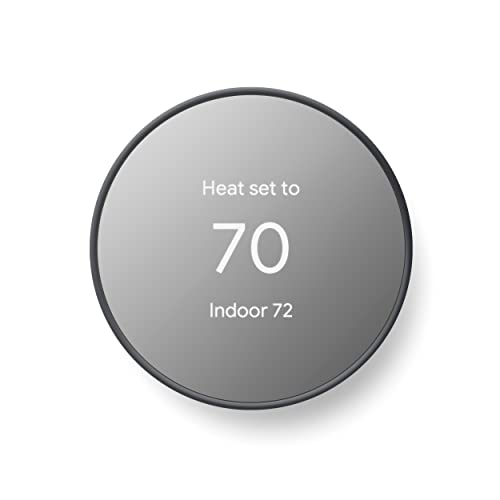
Should you want an affordable, eco-friendly upgrade that still works seamlessly with Google Home, the renewed Google Nest Thermostat in Charcoal is a great pick—it’s a compact, energy-saving smart thermostat that’s been professionally refurbished to look and perform like new. You’ll get a round, backlit LCD unit (T3007ES) that weighs just 5 ounces and measures 3.31 x 3.31 x 1.07 inches. It supports most HVAC systems, dual-band Wi‑Fi, Bluetooth, and Google Assistant control via app or button. Battery powered (2 AAA, 24V), it mounts to the wall and includes screws, plate, documentation, and Amazon Renewed protection.
Best For: eco-conscious homeowners or renters seeking an affordable, compact smart-thermostat that integrates with Google Home and saves energy without paying full retail for a new unit.
Pros:
- Professionally renewed to look and perform like new, often at a lower price than new units.
- Compatible with most HVAC systems, dual-band Wi‑Fi, Bluetooth, and Google Assistant for easy smart-home integration.
- Lightweight, compact round design with backlit LCD and both app and button controls; includes mounting hardware and Amazon Renewed protection.
Cons:
- Renewed (pre-owned/refurbished) device may have limited cosmetic imperfections compared with a brand-new unit.
- Requires 2 AAA batteries and 24V power source—no built-in rechargeable battery.
- May lack some advanced features found on higher-end Nest models (e.g., built-in learning algorithms or premium sensors).
Honeywell Home Wi‑Fi Smart Color Thermostat (RTH9585WF)
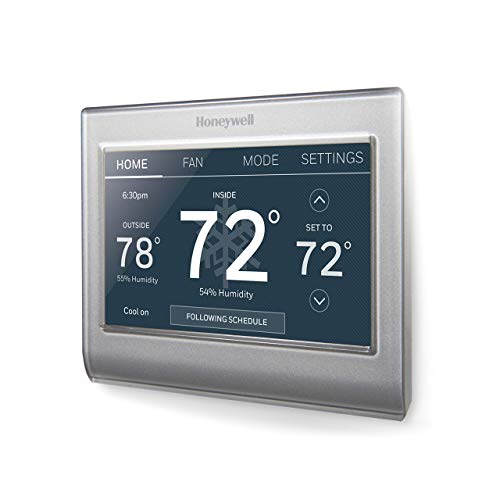
Should you want a customizable, easy-to-read thermostat that plays well with Google Home and other smart platforms, the Honeywell Home Wi‑Fi Smart Color Thermostat (RTH9585WF) is a strong pick—especially for homes with conventional forced-air systems or heat pumps. You’ll get a bright touchscreen you can personalize to match décor, ENERGY STAR efficiency, and monthly energy reports with tips. It supports forced air, hot water, steam, and heat pumps with electric backup but needs a C‑Wire (or adapter) and won’t work with electric baseboard heat. You can schedule around rates, control the fan, join demand‑response programs, and use Alexa or Google Home.
Best For: homeowners with forced-air systems or heat pumps who want a customizable, ENERGY STAR certified smart thermostat that integrates with Alexa/Google Home and offers remote control and energy reports.
Pros:
- Bright, customizable touchscreen and easy-to-read display for quick adjustments.
- ENERGY STAR certified with monthly energy reports, tips, and eligibility for rebates/Demand Response programs.
- Works with Alexa and Google Home and supports flexible scheduling, fan control, and remote app access.
Cons:
- Requires a C‑Wire (or C‑Wire adapter) and may need professional wiring in some homes.
- Not compatible with electric baseboard (120–240V) heating systems.
- May be incompatible or require caution with certain heating-only oil furnace setups without a C‑Wire.
Emerson Sensi Touch Wi‑Fi Smart Thermostat (ST75)

Should you want a user‑friendly, ENERGY STAR‑rated thermostat that balances smart features with straightforward DIY installation, the Emerson Sensi Touch ST75 is a top pick; its large color touchscreen and step‑by‑step app guidance make setup and daily control simple for anyone who’s not a HVAC pro. You’ll get a sleek display available in black, white, or silver, easy‑click illuminated terminals, and a built‑in level for quick c‑wire installation. The Sensi app gives remote control, usage reports, equipment alerts, and filter notifications. It’s ENERGY STAR certified and claims about 23% HVAC energy savings, plus it won’t sell your personal data.
Best For: homeowners who want an ENERGY STAR-rated, easy-to-install smart thermostat with a large touchscreen and app-based remote control without sacrificing privacy.
Pros:
- ENERGY STAR-certified and claims about 23% HVAC energy savings through scheduling and usage reports.
- Easy DIY installation with illuminated easy‑click terminals, built‑in level, and step‑by‑step app instructions (requires a C‑wire).
- Large, intuitive color touchscreen plus remote control, equipment alerts, and filter/maintenance reminders via the Sensi app.
Cons:
- Requires a common wire (C‑wire), which may necessitate wiring changes in some older homes.
- Advanced smart-home features (like learning schedules) are limited compared with some competitors.
- Color options and styling may not suit every décor despite three finishes (black, white, silver).
ecobee Smart Thermostat Essential — Wi‑Fi, Voice Compatible

Should you want a budget‑friendly, Google Home‑compatible thermostat that still delivers smart energy savings, the ecobee Smart Thermostat Essential is a strong pick — it’s designed for homeowners who want simple DIY installation and automatic efficiency improvements (up to 23% annual savings) without the extra frills. You’ll get eco+ features like humidity detection, schedule assistant, and time‑of‑use preheating to cut peak costs, plus free software upgrades. It works with about 85% of HVAC systems, supports HomeKit, Alexa and Google Assistant, and adds SmartSensors for room‑level control. The touchscreen, app monitoring, battery power and optional PEK simplify setup and use.
Best For: Budget‑conscious homeowners who want an easy DIY, Google Home/Smart Home‑compatible thermostat that delivers core smart energy savings without premium extras.
Pros:
- Affordable option that still offers smart energy savings (up to 23% annually) and eco+ features like humidity detection and schedule assistant.
- Broad HVAC compatibility (≈85% of systems) and works with Apple HomeKit, Amazon Alexa, and Google Assistant.
- Easy DIY installation with no required C‑wire (PEK available), touchscreen control, app monitoring, and optional SmartSensors for room‑level sensing.
Cons:
- Lacks some premium features found on higher‑end ecobee models (fewer built‑in sensors and advanced controls).
- SmartSensors sold separately, adding to total system cost for multiroom monitoring.
- Battery powered and compact design may offer fewer hardware options/visual appeal compared with larger, more premium thermostats.
Factors to Consider When Choosing a Smart Thermostat for Google Home
Before you pick a model for Google Home, I check a few key factors to make sure it actually works with my system and HVAC. I look for Google Assistant compatibility, required wiring or a C‑wire, and which energy‑saving features the thermostat offers. I also consider installation complexity and setup steps so I know whether I can do it myself or need a pro.
Compatibility With HVAC
Because HVAC systems vary so much, I always start upon confirming that a smart thermostat actually matches my home’s specific setup—gas, oil, electric, heat pump, forced air, or boiler—so I avoid buying a model that won’t control the equipment correctly. I check whether my system needs a C‑wire or whether the thermostat includes a power accessory, since lack of proper power ruins setup. I verify multi‑stage heating/cooling and zone control compatibility and record heat‑only or cool‑only configurations to prevent feature mismatches. I compare wiring and mounting requirements to make installation smooth or to plan for professional help. Finally, I favor thermostats with HVAC monitoring and maintenance alerts so I can catch irregularities promptly and keep efficiency high.
Voice Assistant Support
During the period I pick a smart thermostat for Google Home, I make sure it fully supports Google Assistant so voice control isn’t just a gimmick but a reliable way to manage comfort. I look for devices that respond accurately to basic commands—raise or lower temperature, set modes, or check current readings—without repeated phrasing. Multi-user voice recognition matters to me so each household member can trigger personalized schedules and preferences. I also verify advanced voice actions like creating or adjusting schedules, asking for maintenance alerts, and querying energy usage. Finally, seamless integration with other Google Home devices is essential so I can build routines that link lighting, blinds, and temperature through a single voice command for true home automation.
Power And Wiring
Since power and wiring determine whether a smart thermostat will actually work in your home, I always start through confirming what my HVAC system needs and what the thermostat expects. Most smart thermostats run on 24-volt AC/DC and commonly require a C-wire for continuous power, though some models skip it. I check whether my setup is heating-only, cooling-only, zone-controlled, or a heat pump, because those configurations often demand a C-wire or a compatible power accessory. In case a thermostat is battery-powered, I still verify wiring for control signals and long-term reliability. I also inspect the wall for proper mounting, screws, and steel base plates to cover existing electrical boxes. Doing this avoids surprises and extra adapters during installation.
Energy Saving Features
Wiring and power get your thermostat running, but saving energy is what keeps your bills down—so I look next at features that actively cut usage. I prioritize ENERGY STAR certified models because that certification means verified efficiency and real savings. I also want reliable vacancy detection: automatic temperature adjustment whenever the home’s empty trims wasted heating or cooling. Programmable schedules in the mobile app let me build routines for occupied and sleep hours, while self-programming auto-schedules and customized savings suggestions refine settings without constant tinkering. Finally, integration with energy-use monitoring and HVAC alerts helps me spot inefficiencies and receive maintenance notifications before problems cause energy loss. Together these features deliver measurable, low-effort reductions in my utility costs.
Installation And Setup
Upon I pick a smart thermostat for Google Home, I focus on how straightforward the installation and setup will be so I don’t get stuck partway through or need a pro. I initially confirm HVAC and wiring compatibility, checking for a C-wire or available power accessory so the unit will run reliably. I prefer models with clear DIY instructions, included mounting hardware, wall plates or trim kits to cover old marks, and labeled wiring terminals. Wall-mounting should use supplied screws, plates, and position labels so wiring’s correct. A guided mobile app that walks me through Wi‑Fi connection and Google Home linking speeds things up. I avoid units needing special tools or technician-only steps, aiming to finish setup in about 30 minutes.
Smart Home Integration
Although functionality matters most to me, I prioritize thermostats that integrate deeply with Google Home so voice control, app-based scheduling, and automated energy-saving routines all work without extra bridges or hacks. I check full Google Home compatibility initially to guarantee smooth Google Assistant voice commands and routine triggers. I want remote control and scheduling from the Google Home app on both Android and iPhone for consistent access. Integration should include presence-based energy savings—automatic setbacks whenever the house is empty—to cut bills without manual input. I also verify the thermostat can coordinate with other Google-connected devices so routines (lights, locks, cams) act together. Finally, I prefer models that receive firmware updates via Google Home, keeping features and security up-to-date.
