

I’ve spent months comparing thermostats and was surprised at how much variety still matters in 2026. I’ll walk you through seven top review roundups, from simple line-voltage models to smart, voice‑enabled systems, so you can find what fits your home and budget. There’s a clear trade‑off between features and ease of use, and one choice could change how comfortable — and efficient — your house feels.
Honeywell Home RTH8560D 7 Day Programmable Touchscreen Thermostat

Should you want a reliable, programmable thermostat that adapts to a weekly routine, the Honeywell Home RTH8560D is a solid pick—its 7-day scheduling and Smart Response Learning let it tailor heating and cooling to your lifestyle while minimizing run time. You’ll program day-by-day, weekend, or full-week cycles via a crystal-clear touchscreen with bright blue backlight, see indoor temperature and humidity, and get air filter alerts. It learns cycle times to hit setpoints efficiently. You can power it through battery or hard-wiring with permanent day/time backup. Compatible with most heating/cooling systems, the package includes the thermostat and receiver.
Best For: Homeowners who want a reliable, programmable thermostat with 7-day scheduling and learning features for improved comfort and energy efficiency.
Pros:
- 7-day programmability with day-by-day, weekend, or full-week scheduling for flexible routines.
- Smart Response Learning adapts to home system cycle times to reach setpoints efficiently.
- Clear touchscreen with humidity display, filter reminders, and battery or hard-wire power with permanent backup.
Cons:
- Lacks advanced smart-home integrations found in Wi‑Fi thermostats (e.g., remote app control).
- May require a compatible receiver or professional installation for some systems.
- Touchscreen and features may be more than needed for users who prefer simple manual thermostats.
Honeywell TL7235A1003 240V Line Volt Digital Thermostat

Should you need a simple, reliable wall thermostat for a 240V heating circuit, the Honeywell TL7235A1003 is a solid choice—its non‑programmable digital control and soundproof operation make it ideal for homeowners or landlords who want straightforward temperature management without the fuss of scheduling. You’ll get electronic temperature control designed for 240-volt line voltage systems, an on-demand backlight for easy reading, and a heating indicator that confirms at the time heat is active. Because it’s non‑programmable, you won’t fiddle with schedules; you’ll set your desired temperature and trust the thermostat to maintain it quietly and reliably day after day.
Best For: Homeowners or landlords who need a simple, reliable 240V wall thermostat without programming features and prefer quiet, straightforward temperature control.
Pros:
- Electronic temperature control with on-demand backlight for easy reading in any light.
- Soundproof operation reduces clicking noise common to line-voltage thermostats.
- Heating indicator provides clear, at-a-glance confirmation when heat is active.
Cons:
- Non-programmable design lacks scheduling or energy-saving automatic setpoints.
- Limited to 240V line-voltage systems, not suitable for low-voltage HVAC systems.
- Basic feature set may not satisfy users wanting smart/home-automation integration.
Digital Non-Programmable Thermostat with Temp & Humidity
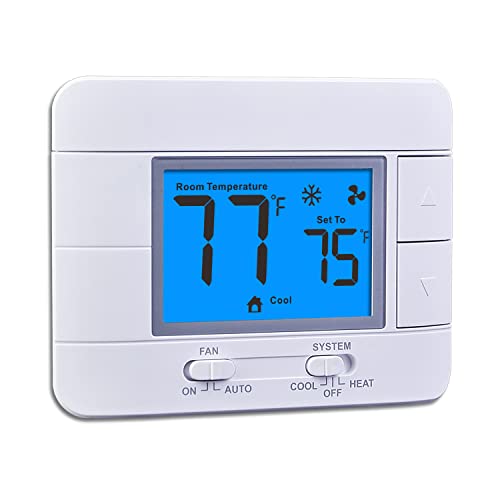
Should you want a straightforward, easy-to-read thermostat that tracks both temperature and humidity, this non-programmable digital model is ideal for seniors or anyone who prefers simplicity. You’ll get a large blue-backlit LCD with big characters and separate buttons for setpoint changes, plus built-in temp and humidity monitoring accurate to ±1°F/°C. It supports single-stage heating and cooling (1 heat/1 cool) for conventional gas, oil, or electric systems, but it’s not compatible with multistage, heat pump, dual-fuel, mini-split, line-voltage, hydronic, or RV systems. Installation’s simple without a C-wire, runs on 24VAC or two AAA batteries, and includes a two-year warranty.
Best For: Seniors or users who want a simple, easy-to-read, non-programmable thermostat that monitors temperature and humidity for single-stage conventional HVAC systems.
Pros:
- Large blue-backlit LCD with big characters and separate buttons makes operation clear and accessible.
- Built-in temperature and humidity monitoring with ±1°F/°C accuracy for reliable indoor environment tracking.
- Simple installation without a C-wire and dual power options (24VAC or 2 AAA batteries) plus compressor delay protection.
Cons:
- Not compatible with heat pumps, multistage systems, dual-fuel, mini-splits, hydronic, line-voltage, or RV systems.
- Limited to non-programmable single-stage control—no scheduling or advanced energy-saving features.
- Basic feature set (no smart/home integration) and only a 2-year warranty.
Emerson 1E78-140 Non-Programmable Heat-Only Thermostat

Should you’re heating a single-stage, heat-only home and want straightforward control without programming headaches, the Emerson 1E78-140 is a solid choice. You’ll get a non-programmable thermostat built for single-stage heat-only systems with a simple white vertical profile that measures 5-5/16″ high, 3-3/16″ wide, and 1-1/8″ deep. The large, backlit digital display stays easy to read in low light. Temperature control is precise to ±1°F, so you’ll maintain consistent comfort. Installation and operation are uncomplicated, making this model ideal in case you prefer reliable, no-frills control over advanced features.
Best For: Homeowners with single-stage, heat-only systems who want a simple, reliable, non-programmable thermostat with an easy-to-read display.
Pros:
- Large backlit digital display for good visibility, even in low light.
- Precise temperature control to ±1°F for consistent comfort.
- Simple, straightforward design and installation—no programming required.
Cons:
- Only compatible with single-stage heat-only systems (not suitable for multistage or cooling systems).
- Lacks programmable or smart features for energy scheduling or remote control.
- Basic aesthetic and functionality may not meet needs of users wanting advanced customization.
ecobee Smart Thermostat Enhanced — Wi‑Fi, Voice Assistant
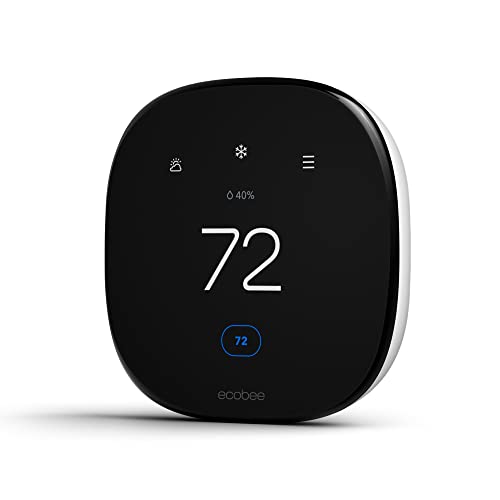
In case you want a thermostat that balances energy savings with smart-home convenience, the ecobee Smart Thermostat Improved is ideal for homes that need broad HVAC compatibility and hands‑free control. You’ll save up to 26% annually through learning your schedule, adjusting for humidity, and reducing conditioning whenever you’re away. It’s compatible with about 90% of systems, includes a Power Extender Kit and Trim Kit for easier DIY installation, and hardwires so you won’t change batteries. Built‑in radar and optional SmartSensors preheat or precool occupied rooms. You can control it via Siri, Alexa, Google Assistant, or the ecobee app.
Best For: homeowners who want significant energy savings and wide HVAC compatibility combined with smart‑home voice control and easy DIY installation.
Pros:
- Saves up to 26% annually by learning schedules, adjusting for humidity, and reducing conditioning when away.
- Broad compatibility (about 90% of HVAC systems) and includes Power Extender Kit and Trim Kit for easier DIY installation.
- Built‑in radar occupancy sensor and optional SmartSensors enable preheating/precooling and room‑level comfort; works with Siri, Alexa, Google Assistant, and the ecobee app.
Cons:
- May require wiring changes or use of the Power Extender Kit in some homes (not fully plug‑and‑play for all installations).
- Advanced features and integrations may have a learning curve for non‑technical users.
- Some users may prefer thermostat designs with different voice assistant availability or simpler interfaces.
Programmable 5-1-1 Thermostat for Single-Stage Home systems

Should you live in a single-stage home and want reliable, energy-smart scheduling, this programmable 5-1-1 thermostat is made for you—its weekday/weekend split and four daily periods (wake, leave, return, sleep) make automated comfort simple to set and maintain. You’ll get +/-1°F accuracy, a 3-inch backlit display, and separate heat/cool swing settings for comfort and savings. It supports 1H/1C conventional systems, select heat pumps without auxiliary heat, and various gas, oil, electric, and boiler applications, but not multistage, line-voltage, mini-split, PTAC, or certain RV units. Dual power, filter alerts, 2-year warranty, and 24-hour support included.
Best For: Homeowners with single-stage (1H/1C) conventional heating and cooling systems who want simple weekday/weekend programming and reliable, energy-saving temperature control.
Pros:
- Easy 5-1-1 programming with four daily periods (wake/leave/return/sleep) for automated comfort and energy savings.
- Accurate control (±1°F) with large 3-inch backlit display and separate heat/cool swing settings for fine tuning.
- Dual power options (24VAC or 2×AAA), filter change reminder, and 2-year warranty with 24-hour customer support.
Cons:
- Not compatible with multistage, line-voltage, mini-split, PTAC, many RV units, or complex multi-wire systems (requires 2–5 wires).
- C-wire may be required for some heat-only or cool-only systems, complicating installation for some setups.
- Lacks support for heat pumps with auxiliary stages and other advanced HVAC features found in higher-end thermostats.
Google Nest Thermostat Smart Wi‑Fi Thermostat (Charcoal)
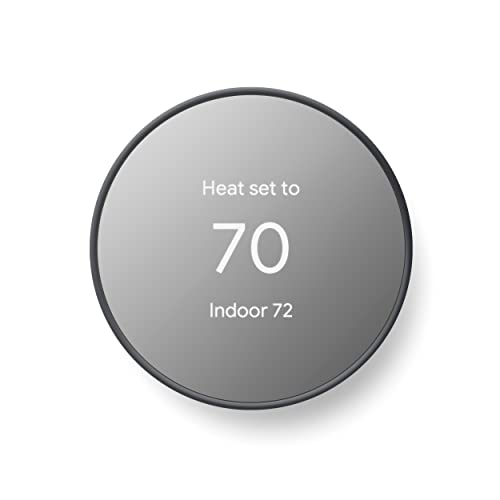
In case you want a simple, energy-focused smart thermostat that works without a C wire in most homes, the Google Nest Thermostat (Charcoal) is a strong pick — it’s ENERGY STAR certified, automatically cuts heating or cooling anytime you’re away, and offers Savings Finder tips to trim bills. You’ll get dual-band Wi‑Fi, Bluetooth Low Energy, and compatibility with Google Assistant, Google Home, and Matter-certified voice assistants. Use the Google Home app to set schedules and control temperatures remotely. HVAC monitoring alerts you to issues and maintenance needs. Check the online compatibility checker and with your energy provider for possible rebates.
Best For: homeowners or renters who want an energy-focused, easy-to-use smart thermostat that typically works without a C wire and integrates with Google Assistant and Matter ecosystems.
Pros:
- ENERGY STAR certified with automatic away detection and Savings Finder tips to reduce energy bills.
- Dual-band Wi‑Fi and Bluetooth Low Energy with Google Home app remote control and multi-user access.
- HVAC monitoring and maintenance alerts help detect issues and extend system life.
Cons:
- May still require a C wire or power accessory for some HVAC systems.
- No physical lock feature to prevent local temperature changes.
- Full legal disclaimers and rebate details require checking external sources (product description and energy provider).
Factors to Consider When Choosing Thermostat Review
Before you pick a thermostat, I check a few key things with every model: whether it’s compatible with your HVAC system, how flexible its scheduling is, and what wiring or power it requires. I also look at smart features like app and voice integration and whether the display and controls are intuitive. Those factors tell you whether a thermostat will actually fit your home and make life easier.
Compatibility With Systems
Because HVAC systems vary so widely, I always start upon matching a thermostat to the exact system type and power requirements you’ll be connecting it to. I check whether the device supports single-stage, multi-stage, heat pump, boiler/radiant, or line-voltage systems so it will control your equipment correctly. Next I verify voltage: is it low-voltage 24VAC or line-voltage 120/240V? That determines which models will physically work. I also look for C-wire requirements and under what conditions the thermostat offers workarounds when a common wire’s absent. Confirming supported stages matters too—some thermostats only handle single-stage setups while others manage multiple stages. Finally, I watch for limitations: incompatibility with mini-splits, dual-fuel hybrids, hydronic hot-water systems, or certain voltage configurations can derail installation.
Programmability And Scheduling
Programmability matters a lot as you’re picking a thermostat, so I look closely at how flexible the scheduling options are and whether they match your daily routine. I want separate weekday and weekend programs or full 7-day programming so you can set different temperatures for workdays and weekends. Split day segments—wake, leave, return, sleep—are essential; four or more periods per day let you fine-tune comfort and save energy. I also value learning or adaptive models that adjust automatically to occupancy and home heating/cooling needs, reducing manual tweaks. Finally, having the option to enable or disable features like compressor delay protection within program cycles protects your HVAC while keeping schedules efficient and reliable.
Power And Wiring Needs
During my evaluations of thermostats I always check their power and wiring needs initially, since a mismatch can keep a perfectly good unit from working or even harm your HVAC system. I look for whether a model uses batteries, hard-wiring to home power, or both, and whether it’s low-voltage (usually 24VAC) or high-voltage for baseboard systems. I verify the presence or need for a common (C) wire for continuous power, noting models that include power extender kits or battery-only options. I also confirm compatibility with multi-stage systems, heat pumps, or hydronic setups because specialized configurations require specific terminals. Finally, I stress following manufacturer wiring diagrams and professional installation to avoid malfunction or equipment damage.
Smart Features Integration
Once the wiring is sorted, I look at how a thermostat’s smart features will fit into your daily life and home ecosystem. I prioritize learning algorithms that adapt to routines and cut energy use without constant tweaking. Voice assistant and smart-home platform compatibility matters — I want a thermostat that joins scenes and routines you already use. Occupancy sensors and geofencing are big pluses; they let the unit change temperatures based on presence or your phone’s location, enhancing comfort and savings. Mobile app control is essential for remote monitoring and quick adjustments whenever you’re away. Finally, I check HVAC compatibility and supported communication protocols so those smart features actually work with your existing system, avoiding frustrating integration issues.
Display And Usability
Because I rely on the thermostat display for daily checks and quick tweaks, a clear, bright backlit touchscreen or readable digital display is nonnegotiable — it keeps information visible in dim hallways or bright sunlight. I prefer large characters and well-spaced buttons so I—or guests and older family members—can adjust temperatures without squinting or fumbling. Showing indoor temperature, humidity, and system status at a glance helps me monitor comfort and spot issues promptly. Intuitive menus and straightforward controls let me program schedules or make manual changes fast, reducing frustration. I also value on-screen alerts for filter changes and maintenance; they turn vague chores into timely, actionable prompts that keep the system running smoothly.
Energy Savings Potential
Provided that I pick a thermostat, I focus on how much it can cut my energy use without sacrificing comfort, since smart scheduling, occupancy sensing, and learning algorithms directly translate into lower bills and less HVAC runtime. I look for models that automatically adjust temperatures once I’m away or asleep, and ones that learn my patterns to optimize cycles and reduce runtime. Remote control and occupancy sensors let me prevent wasted heating or cooling in real time. I favor units with Energy Star certification and compressor delay protection because they improve efficiency and reduce HVAC wear. As I compare reviews, I weigh documented savings, ease of programming, and integration with my lifestyle—those factors predict real-world energy reductions more than marketing claims.
