

Last winter I helped a small rental owner swap a failing non‑programmable stat for a Honeywell Home T9 to cut complaints and lower bills. I’ll walk you through seven Honeywell Wi‑Fi thermostats that span basic single‑stage units to commercial models and Matter‑certified smart hubs. You’ll see which ones suit heat pumps, multi‑stage systems, tight budgets, or pro installs — and which tradeoffs to expect next.
Honeywell Home T9 WiFi Smart Thermostat (Renewed)

Should you want a budget-friendly way to get smart climate control without replacing your HVAC power setup, the renewed Honeywell Home T9 is a solid pick — it’s Wi‑Fi enabled, supports voice control with Alexa and Google Assistant, and works with Honeywell’s smart room sensors so you can prioritize comfort in specific rooms. You’ll get a wall‑mount touchscreen that’s compact (3.7 x 4.92 x 0.94 in) and HVAC‑powered, offering automatic temperature control and touchpad/voice inputs. The renewed unit is inspected and tested, might arrive in generic packaging with compatible accessories, and’s eligible for Amazon Renewed protections.
Best For: budget-conscious homeowners or renters who want Wi‑Fi smart thermostat features and room-sensor support without changing their HVAC power setup.
Pros:
- Compact touchscreen thermostat with Wi‑Fi and voice control via Alexa and Google Assistant.
- Compatible with Honeywell smart room sensors to prioritize comfort in specific rooms.
- Renewed unit is professionally inspected/tested and eligible for Amazon Renewed replacement or refund.
Cons:
- Renewed/pre-owned condition means accessories may be non-original and packaging may be generic.
- Some users report mixed experiences (average 3.5/5 from limited reviews).
- Requires HVAC system power (not battery-powered), which may limit installation options.
Honeywell TC500A-N Commercial Thermostat with Wi‑Fi

In case you manage commercial buildings and need a Wi‑Fi thermostat that integrates easily with building automation, the Honeywell TC500A‑N is built for you. You’ll get Wi‑Fi individual control plus BACnet and other BAS protocols for seamless integration, and compatibility with most legacy and new Honeywell sensors. The flat touch screen cleans easily and supports multiple lockouts and user privilege levels to restrict changes. Schedule up to four daily events, pre/post‑occupancy purges, and adaptive recovery for comfort and energy savings. Additional features include freeze protection, demand limiting, Fahrenheit/Celsius switching, and holiday/calendar scheduling for healthier, efficient buildings.
Best For: Facility managers and building owners seeking a Wi‑Fi enabled commercial thermostat that integrates with BACnet/BAS, supports legacy Honeywell sensors, and offers advanced scheduling and control for energy savings and healthy‑building operation.
Pros:
- Wi‑Fi plus BACnet and other BAS protocol support enables seamless individual and system integration.
- Flat touch screen with configurable lockouts and user privilege levels improves hygiene and prevents unauthorized changes.
- Advanced scheduling (up to four events/day), pre/post‑occupancy purge, and adaptive recovery optimize comfort and energy use.
Cons:
- Designed for commercial use—may be overfeatured and more costly than needed for small residential applications.
- Integration with complex BAS may require technical setup or professional commissioning.
- Limited to Honeywell sensor ecosystem for full feature compatibility, which could restrict third‑party sensor choices.
Honeywell Home TH8732WFH5004/U Smart Round WiFi PROGRAMMABLE Thermostat

Should you want a simple, Energy Star–rated smart thermostat that blends a round touchscreen with Wi‑Fi app control, the Honeywell Home TH8732WFH5004/U is a solid pick for budget‑minded homeowners who want remote heating and A/C management. You’ll get a white, round metal wall thermostat with touchscreen and button controls, corded electric 30V power, and Wi‑Fi connectivity for app control and remote scheduling. It’s programmable, mounts easily, and supports smart/remote temperature control for heating and A/C. At 7.5 ounces and compact packaging, it’s unobtrusive. Observe mixed user reviews despite Energy Star certification and basic smart features.
Best For: Budget‑minded homeowners seeking a simple, Energy Star–rated smart thermostat for basic remote heating and A/C control.
Pros:
- Affordable, Energy Star–rated option with Wi‑Fi app control for remote scheduling and temperature management.
- Clean, compact round touchscreen design with button controls that mounts easily on the wall.
- Supports both heating and A/C and runs on corded 30V power for reliable operation.
Cons:
- Mixed user reviews (2.4/5) suggest potential reliability or usability issues for some customers.
- Limited advanced smart features and integrations compared with higher‑end smart thermostats.
- Metal construction and corded electric power may require professional installation for some HVAC setups.
Honeywell Home Smart Thermostat X2S (Wi‑Fi, Gray)

Should you want a modern, Matter‑certified thermostat that plays nicely with Alexa, Google Assistant, and Apple HomeKit, the Honeywell Home Smart Thermostat X2S is a great pick — especially for homes with up to 2 heat/2 cool conventional systems or 2 heat/1 cool heat pumps. You’ll get Wi‑Fi app control via the First Alert app, Energy Star efficiency, demand response support, and a 2‑year warranty. It offers flexible programming (5‑1‑1, 5‑2, 7‑day, and non‑programmable), humidity display, filter alerts, and an auto‑away feature. Some installations require a C‑wire adapter; Matter certification guarantees broad smart‑home integration and reliability.
Best For: Tech-savvy homeowners seeking a Matter‑certified, Energy Star smart thermostat that integrates with Alexa, Google Assistant, and Apple HomeKit for homes with up to 2 heat/2 cool conventional systems or 2 heat/1 cool heat pumps.
Pros:
- Matter Certified for seamless integration across major smart home platforms (Alexa, Google Assistant, Apple HomeKit).
- Energy Star rated with demand response support, app control via First Alert, and flexible programming options for energy savings.
- Features like humidity display, filter reminders, auto‑away, and a 2‑year warranty enhance comfort and maintenance.
Cons:
- Some homes require a C‑wire power adapter for proper operation, adding installation complexity or cost.
- Compatibility limited to systems up to 2 heat/2 cool (conventional) or 2 heat/1 cool (heat pump), unsuitable for larger HVAC setups.
- Relies on Wi‑Fi and the First Alert app for advanced features, which may be a drawback for users preferring minimal cloud dependency.
Honeywell Wi‑Fi 8000 Thermostat TH8321WF1001/U
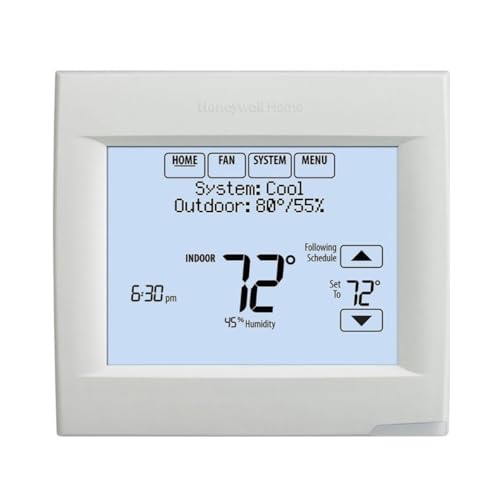
Should you want a reliable, no-frills smart thermostat that handles multi-stage systems, the Honeywell Wi‑Fi 8000 TH8321WF1001/U is a solid pick for homeowners or light commercial users who need 3-stage heat and 2-stage cool compatibility. You’ll get Wi‑Fi connectivity, Alexa compatibility, and remote control via Honeywell Total Connect Comfort on phones, tablets, or computers. The hardwired 24V unit mounts flush in white, features an LCD backlight, adaptive recovery (optional), equipment alerts, and intuitive programming for energy savings. At 4.8″ x 4.5″ x 1″ and about 12.6 oz, it’s a compact, American-made option that supports many HVAC setups.
Best For: Homeowners or light-commercial users who need a reliable, no‑frills smart thermostat that supports multi-stage (up to 3 heat/2 cool) HVAC systems and remote control via Wi‑Fi and Alexa.
Pros:
- Supports up to 3-stage heating and 2-stage cooling for versatile HVAC compatibility.
- Wi‑Fi connectivity with Honeywell Total Connect Comfort and Alexa compatibility for remote control.
- Adaptive Recovery, equipment alerts, and intuitive programming help improve comfort and energy savings.
Cons:
- Hardwired 24V installation may require professional wiring if replacing a battery-powered unit.
- Basic design and feature set may lack advanced smart-home integrations and learning features found in higher-end thermostats.
- Dated model (available since 2017) with a simple LCD rather than a modern color touchscreen interface.
Honeywell Lyric T6 Smart Thermostat (TH6320WF2003/U)
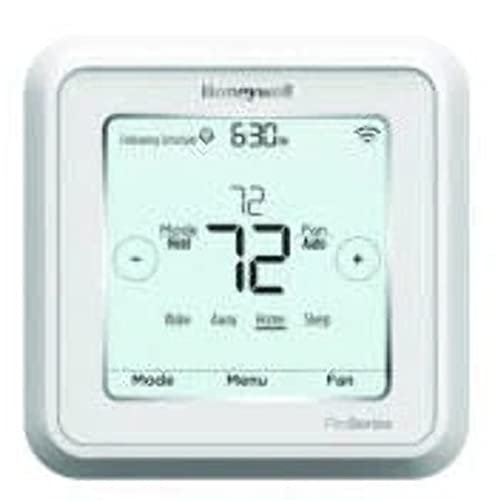
Should you want a straightforward, reliable smart thermostat that works well with heat pump systems, the Honeywell Lyric T6 (TH6320WF2003/U) is a strong pick because it combines Wi‑Fi app control and Energy Star efficiency in a compact, wall‑mounted design. You’ll get a modern, glossy white rectangular thermostat with a backlit LCD that fits 3 heat/2 cool heat pump or 2 heat/2 cool conventional systems. It needs a C‑wire (plus two AA batteries), supports Wi‑Fi and Ethernet, and works with Alexa. Install is simple for typical setups, it’s made in the USA, and warranty support is available.
Best For: homeowners with heat pump systems who want a simple, Energy Star–rated smart thermostat with reliable Wi‑Fi app control and Alexa compatibility.
Pros:
- Compact, modern design with backlit LCD that’s easy to read and wall-mounts cleanly.
- Compatible with 3 heat/2 cool heat pump or 2 heat/2 cool conventional systems and supports Alexa.
- Energy Star certified with Wi‑Fi/Ethernet connectivity and auto-scheduling via app.
Cons:
- Requires a C‑wire for full functionality (plus two AA batteries), which may complicate installation in some homes.
- Limited advanced smart features compared with higher-end thermostats (e.g., learning algorithms or extensive integrations).
- Glossy plastic finish may show fingerprints and can feel less premium than metal or textured models.
Honeywell Home Programmable Thermostat RTH21B (Single-Stage)

Should you want a simple, reliable programmable thermostat for a single-stage system, the Honeywell Home RTH21B delivers flexible scheduling and an easy install—so it’s ideal for renters or homeowners who need straightforward control without smart-home complexity. You’ll get compatibility with 1 heat/1 cool systems, 750 mV, hot water heat and forced air, though not electric baseboard heat. It runs on two AA batteries, offers 7-day/5-1-1/5-2/1-week or non-program modes, and directly replaces RTH2510/RTH2410. Features include filter alerts, interchangeable accents, backlit large display, extended low setpoint to 32°F, a UWP wall plate and a one-year warranty.
Best For: Renters or homeowners with single-stage heating/cooling systems who want a simple, reliable programmable thermostat without smart-home features.
Pros:
- Compatible with a variety of single-stage systems (1 heat/1 cool, 750 mV, hot water, forced air) and directly replaces RTH2510/RTH2410.
- Flexible scheduling options (7-day, 5-1-1, 5-2, 1-week, or non-program) and extended low setpoint to 32°F.
- Easy install with included UWP wall plate, large backlit display, filter reminders, interchangeable accent pieces, and battery power (2 AA).
Cons:
- Not compatible with electric baseboard heat (120–240V) or multi-stage/complex HVAC systems.
- Lacks smart-home connectivity and remote control features.
- Runs on batteries (2 AA) requiring periodic replacement and offers only a 1-year warranty.
Factors to Consider When Choosing a Honeywell Wifi Thermostat
Before you pick a Honeywell Wi‑Fi thermostat, I check compatibility with your HVAC system and confirm power and wiring needs so installation goes smoothly. I also weigh smart‑home integration, scheduling and energy‑saving features to match how you live. Finally, I consider how easy the unit is to install and maintain so you’re not stuck with unexpected hassles.
Compatibility With HVAC Systems
Upon I pick a Honeywell Wi‑Fi thermostat, I initially confirm it matches my HVAC type and wiring so I don’t end up with a unit that won’t power up or control my system properly. I check support for conventional heating/cooling, heat pumps, and multi-stage setups so the thermostat can handle my system’s control logic. I verify voltage compatibility—most systems use 24V—so signals and relays work as expected. I also confirm how many heat and cool stages are supported, and whether specific wiring is required, like a C‑wire or battery fallback. For commercial or complex installs, I look for BACnet or BAS integration to guarantee seamless building automation compatibility before buying.
Power Requirements And Wiring
While I review features and compatibility, I always check a thermostat’s power needs and wiring so it will work reliably in my home; many Wi‑Fi models need a C‑wire for continuous power, some draw HVAC system power directly, and others run on batteries or include adapters should a C‑wire be missing. I confirm whether my system is single‑stage, multi‑stage, or a heat pump so the chosen Honeywell model interfaces properly. In the event a C‑wire is absent, I look for units that include a power adapter or support alternative wiring kits to avoid unstable connections. For battery‑powered options, I take into account battery type and expected life. Verifying these details before purchase prevents installation headaches and keeps remote features online.
Smart Home Integration
Along with wiring and power, I also check how a Honeywell Wi‑Fi thermostat will fit into my smart home ecosystem, since voice control and automation are big reasons to upgrade. I prioritize support for Alexa, Google Assistant, and HomeKit so voice commands work everywhere. Matter certification is a must for me — it reduces compatibility headaches across platforms. I verify Wi‑Fi specs and hub compatibility so remote app control and local integrations are reliable. I also confirm the thermostat can work with smart sensors and additional devices to enable true zone control. Finally, I look for customizable programming that can be managed through my smart home system, ensuring the thermostat cooperates with scenes and automations I already use.
Scheduling And Energy Features
Because my daily routine varies, I favor thermostats that let me set detailed schedules—daily, weekly, or custom increments—so temperature changes match whenever I’m home, away, or sleeping. I look for multiple events per day so heating and cooling follow real activity patterns without constant overrides. Adaptive recovery is a must; I want the unit to reach setpoints prior to the desired time while minimizing energy waste. Pre- and post-occupancy purge options appeal once I consider ventilation and indoor air quality alongside efficiency. Finally, demand response compatibility matters: participating in utility programs can lower bills and reduce grid strain. Together, these scheduling and energy features give me precise comfort control and measurable savings.
Installation And Maintenance
In case I’m choosing a Honeywell Wi‑Fi thermostat, I check installation and maintenance needs initially so I don’t get surprised through wiring or upkeep down the line. I confirm whether a C‑wire is required or whether batteries or a C‑wire adapter will suffice, since power compatibility determines reliable operation. I look for models with universal wiring bases or wall plates that simplify replacing older thermostats and guarantee a secure, level wall mount for accurate sensors. For maintenance, I plan gentle cleaning of touchscreens to avoid damage from harsh disinfectants and activate filter‑change alerts so HVAC filters get swapped on schedule. Finally, I value thermostats with regular firmware updates and solid app connectivity to keep features current and integrate with my smart home.
