

For a comfortable and healthy summer, maintain your ideal indoor humidity between 30% and 50% relative humidity; 45% to 55% is often considered most comfortable. This ideal humidity level is crucial for your comfort, health, and home preservation during the warmer summer months. When humidity levels in your home rise above 60%, you face serious problems. High humidity encourages mold and dust mites, worsening allergies and respiratory issues. This imbalanced indoor humidity can even lead to dizziness and ear infections. Excessive indoor humidity causes an estimated 5,300€ in home damage annually. Your home humidity level directly impacts your well-being and property, especially the humidity in the summer. Monitoring your humidity level at home is crucial.
Key Takeaways
Keep your home’s humidity between 30% and 50% in summer. This range helps you stay healthy and protects your home.
High humidity causes mold, dust mites, and makes you feel hotter. It can also damage your house.
Use a hygrometer to check your home’s humidity levels. Smart home systems can also help you monitor it.
Your air conditioner helps with humidity. A dehumidifier or proper home sealing can also control moisture.
Controlling humidity saves energy and makes your home more comfortable. It also prevents costly damage.
Why Summer Humidity Matters
Maintaining proper humidity levels in your home is vital. Both too much and too little moisture in the air create problems. You need to understand these issues to protect your home and your health.
High Humidity Risks
When humidity levels in your home climb above 60%, you face several serious risks. High indoor humidity creates a perfect breeding ground for mold. Many types of mold thrive in moist environments. You might find Aspergillus on walls or in air conditioning systems. Penicillium often grows on water-damaged carpets and wallpaper. Cladosporium can appear on fabrics and wood, especially in basements. Alternaria likes showers and sinks. Even Stachybotrys chartarum, known as black mold, grows on water-soaked drywall. These molds release spores into your air.
Prolonged exposure to mold spores can significantly impact your health. You might experience chronic respiratory problems. Mold can trigger asthma attacks or even cause asthma in healthy people. It can also lead to chronic sinusitis and bronchitis. Mold exposure can affect your nervous system, causing cognitive dysfunction like brain fog or memory loss. You might also notice mood swings, anxiety, or depression. Mold can weaken your immune system, making you more susceptible to infections.
High humidity also encourages dust mites. These tiny creatures thrive in humid environments. They absorb water from the air. Dust mites grow rapidly when the relative humidity is above 45%. Under ideal conditions, with 70-80% relative humidity, dust mites develop from egg to adult in about one month. A single female can lay up to 100 eggs. You can find thousands of mites in just one gram of house dust. These mites are a common trigger for allergies and asthma.
Beyond health concerns, high humidity can damage your home’s structure. Wood, metal, and drywall are all susceptible. Wood can swell, warp, or even rot, weakening its ability to support weight. Metal components, like support beams, can corrode. This corrosion weakens your home’s structure. Drywall can swell, warp, and stain. It can even sag or collapse if it gets too wet. Insulation also becomes saturated, losing its effectiveness. This leads to higher energy bills and potential mold growth within your walls. Constant changes in moisture cause plaster, joists, and studs to swell and contract. This leads to cracks that require expensive repairs.
Low Humidity Issues
Low humidity, typically below 30%, also presents problems for you and your home. Dry air can irritate your skin. You might experience dry, itchy skin, especially during the summer. Low humidity can worsen conditions like eczema and psoriasis. Your skin may become cracked or peel.
Your respiratory system also suffers in dry conditions. Low humidity inflames and dries out the mucous membranes lining your respiratory tract. This increases your risk of colds, flu, and other infections. You might experience a sore throat due to less mucus coating. Your airways become less efficient at clearing irritants. This can lead to nasal congestion and a feeling of dryness in your sinuses. Many viruses survive longer in low humidity, making you more vulnerable to illness.
Low humidity can also harm your home’s wooden elements. Wood expands and contracts with changes in humidity. When the air is too dry, wood contracts. This can lead to cracks and weakened joints in your wooden furniture. Wood floorboards can bend and create gaps between planks. Mitered corners in wood can shift and separate. This affects the appearance and integrity of your wooden items.
Summer-Specific Concerns
Summer brings unique humidity challenges. Humid summer weather makes the air feel much warmer than the actual temperature. Your body cools itself by sweating. Sweat evaporates from your skin, taking heat with it. High humidity slows this evaporation process. This makes you feel hotter and less comfortable. For example, a room at 72°F with 70% relative humidity can feel like 78°F. This means the air feels about 5 degrees warmer. This increased discomfort can affect your performance, sleep quality, and overall well-being.
High humidity also invites more pests into your home. Many insects, like mosquitoes, termites, and cockroaches, thrive in moist environments. High indoor humidity creates ideal conditions for them to survive and reproduce. Cockroaches prefer humidity levels above 50%, and often above 70%. Termites become more active in warm, humid weather, leading to faster colony growth. This increased insect activity can lead to more frequent infestations. Effective humidity control helps keep these pests away.
Finally, high humidity impacts your energy consumption. Your air conditioner works harder to cool and dehumidify the air. This increased workload reduces efficiency and leads to higher electricity bills. Excess humidity can cause frost or ice to form on cooling coils. This further reduces efficiency and requires more energy for defrost cycles. Your AC unit’s compressor, evaporator coils, and condenser all work under greater strain. This can lead to premature wear and higher maintenance costs. Maintaining comfortable levels of relative humidity is key for your comfort, health, and home integrity. Good humidity control helps you save money and enjoy your summer.
Measuring and Monitoring Ideal Indoor Humidity
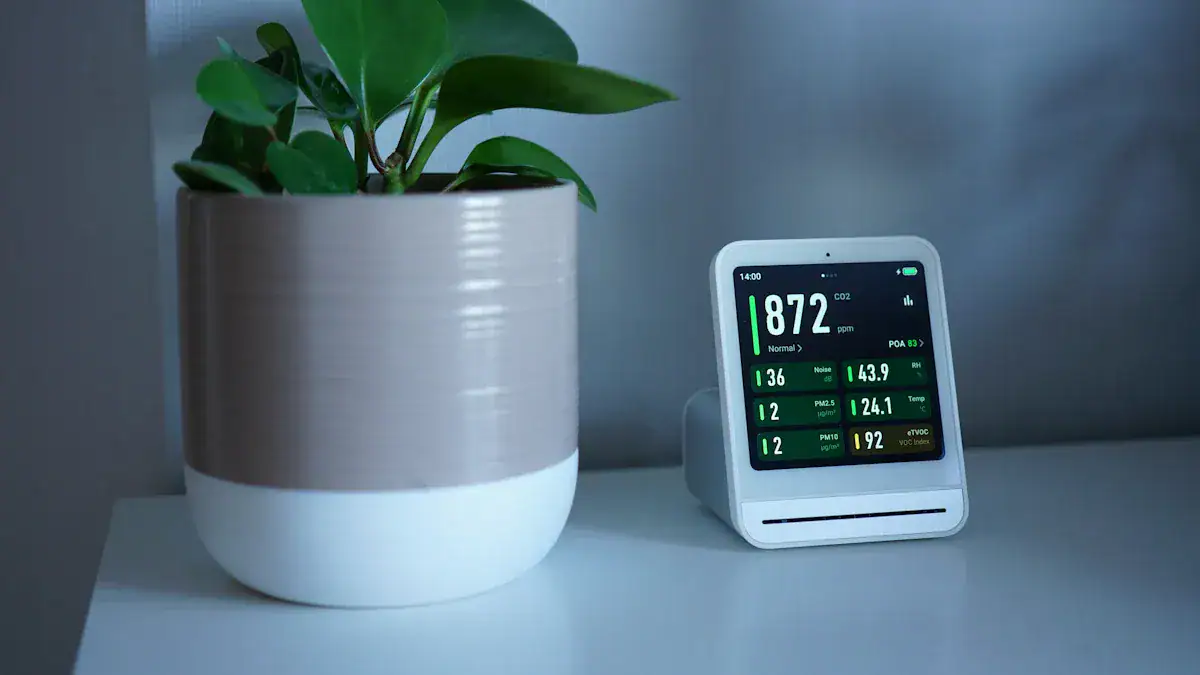
To maintain the ideal indoor humidity, you first need to know your current humidity levels. You can easily measure and monitor the humidity in your home. This helps you take action when needed.
Essential Tools
You need a reliable tool to measure humidity. A hygrometer is the most common device for this. When you choose a hygrometer for your home, consider several features. Digital models are generally best for home use. They offer precise readings and are easy to read. Look for models with good accuracy. Consumer-grade hygrometers typically have an accuracy of ±3% to ±5% Relative Humidity (RH). This accuracy is usually sufficient for monitoring your home’s comfort and basic climate control. Some hygrometers also offer remote monitoring and alerts. This is helpful if you want to check humidity from your phone.
Understanding Readings
Once you have a hygrometer, you need to understand what its readings mean. Relative humidity (RH) tells you the amount of water vapor in the air at a specific temperature.
A higher percentage means the air holds more moisture.
At 100% relative humidity, the air is completely saturated. It has reached its dew point.
Relative humidity only measures invisible water vapor. It does not include mist or fog.
You want to keep your ideal humidity between 30% and 50% for summer.
Smart Home Monitoring
Smart home systems offer excellent ways to monitor and control your home’s humidity. Integrating humidity sensors into your smart home provides many benefits.
Improved Energy Efficiency: Sensors help your system make smart choices. It can adjust your air conditioning or turn on a dehumidifier. This saves energy and lowers your electricity bills.
Enhanced Comfort and Air Quality: Sensors help maintain optimal temperature and humidity levels. This creates a healthy and comfortable living space. It prevents problems like mold growth.
Preventing Costly Damage: Sensors detect high humidity early. This allows you to take action. You can prevent expensive water damage or mold growth.
Devices like the Winland Electronic Humidity Alert 4 offer real-time monitoring. It reports accurate humidity levels within a 3% range. This device can send alerts via text, app, or email. This helps you keep your home’s humidity level in check. Smart home control helps you maintain the ideal humidity.
Achieving Ideal Humidity for Summer
You can achieve ideal humidity in your home during summer. You need to use a mix of strategies. These strategies involve your HVAC system, dehumidifiers, and home improvements.
HVAC System Optimization
Your HVAC system plays a big role in humidity control. Proper sizing of your system is very important. Correctly sized systems turn on and off at the right times. They keep your home at a comfortable temperature. They also help remove moisture from the air. This happens through the refrigeration cycle.
Oversized units cause problems. They give quick bursts of cold air. This makes your thermostat turn off too soon. This “short-cycling” means the system does not run long enough. It cannot remove enough moisture from the air. This leads to high indoor humidity. An improperly sized HVAC system directly affects your indoor humidity control. An oversized system will short cycle. It turns on and off too often. This stops the system from running long enough. It cannot take out enough moisture from the air. This causes high indoor humidity and discomfort.
For good moisture control, your HVAC equipment must handle both cooling and moisture removal. It needs to do this at all times. When humidity control is a main concern, it is better for your HVAC equipment to be a little small. For example, 10% undersized is better than oversized. Proper sizing makes sure your system can remove moisture. This is especially true when the total heat in your home goes down. Then, moisture removal becomes a bigger part of the total work.
You can also adjust your HVAC settings. During summer, set your air conditioner to a comfortable temperature. Avoid making it too cold. This helps manage humidity. You should use exhaust fans in bathrooms and kitchens. These remove extra moisture. Smart thermostats are very helpful. They can change settings automatically. They look at both indoor and outdoor humidity and temperature. You can integrate smart controls with your HVAC system. This lets you set very specific humidity levels. These systems use high-tech sensors. They watch air conditions and keep the humidity you want. Check your thermostat settings. Make sure your system is set for the right dehumidification mode. Look at the manufacturer’s guide if you need to.
You can set cooling temperatures between 76-78°F when people are home. Use schedules to stop the system from cycling too much when humidity is high. Use humidity controls on advanced thermostats. You can also connect them with whole-home dehumidification systems. This gives you full control. Modern variable speed HVAC systems remove humidity better. They do this through longer, slower cycles. Make sure your HVAC is sized correctly. This allows enough run time for moisture removal. You should also do monthly tasks. Check and replace air filters every 30-60 days. Look at condensate drain lines for clogs. Schedule professional maintenance. This includes a full system check. It also includes checking refrigerant levels and ductwork. They will also calibrate humidity controls.
Dehumidifier Use
A dehumidifier is a great tool for achieving ideal humidity. It helps you maintain comfortable humidity levels. Using a dehumidifier can save energy. You can set your thermostat higher and still feel comfortable. This means your air conditioner runs less. This saves energy and makes your AC last longer. Dedicated dehumidifiers remove moisture more efficiently than AC units alone.
There are different types of dehumidifiers.
Refrigerant dehumidifiers: These cool a metal plate. Moisture in the air turns into water on this plate. They work well when temperatures are 50°F or higher.
Desiccant dehumidifiers: These use a material that soaks up a lot of moisture. A spinning wheel with this material collects moist air. Then, warm air removes the moisture. These work well in cooler, drier places.
Heat pump dehumidifiers: These use a fan, a heat pump, and cold coils. They take moisture from the air. Then, they send drier air back into your home.
Dehumidifying ventilators: These have a sensor to find moisture. They use an exhaust fan to push air outside. You often find them in basements, attics, and crawl spaces.
Chemical absorbent dehumidifiers: These use materials like silica gel to absorb moisture. Many home units have single-use cartridges.
Dehumidifiers also come in different sizes.
Small-Capacity Dehumidifiers: These are for areas under 600 square feet. They remove less than 30 pints of moisture daily. They are good for damp, not wet, spaces.
Medium-Capacity Dehumidifiers: These are for 600 to 800 square feet. They remove 30 to 40 pints of moisture daily. They work best for slightly damp areas or places with a musty smell.
Large-Capacity Dehumidifiers: These are for big spaces (600 to 1,200 square feet). They also work for smaller areas with a lot of moisture. They remove 40 pints or more daily. They can handle many different humidity levels.
Whole-House Dehumidifiers: These can be portable or built into your central HVAC system. They can handle areas up to 5,000 square feet. They fix high humidity throughout your entire home.
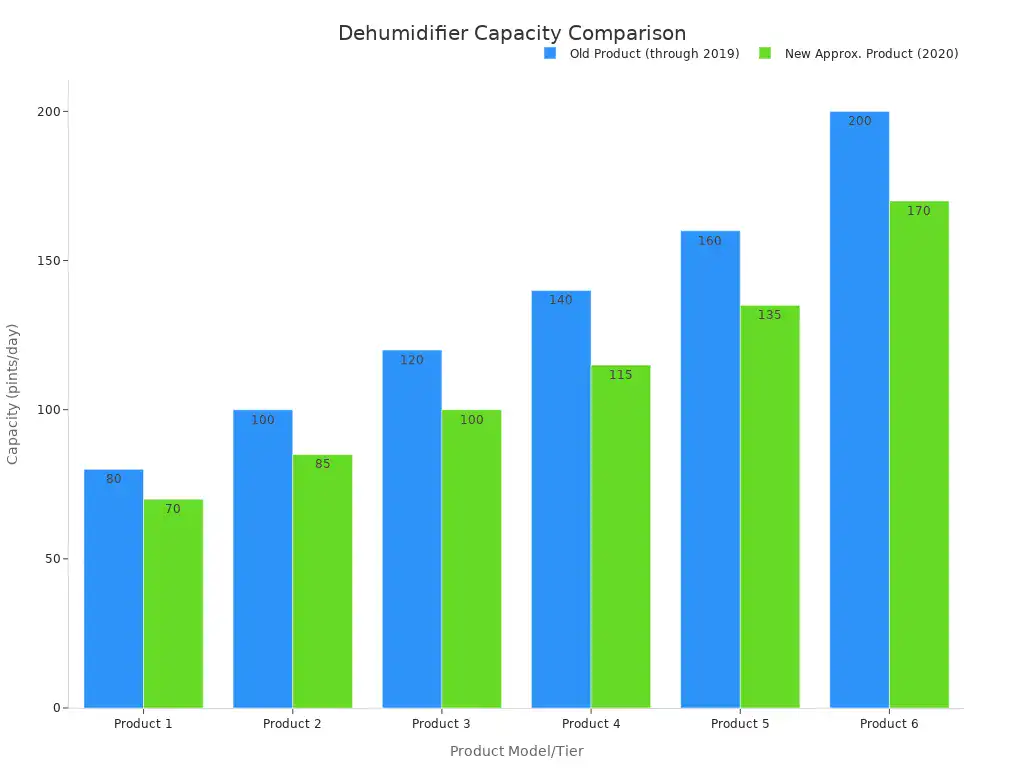
A whole-house dehumidifier can remove a lot of moisture. The capacity ratings for dehumidifiers tell you how much moisture they can remove. You might see that newer models have lower capacity ratings. This is because of a new testing method from the Department of Energy (DOE). The new method uses cooler, more realistic conditions. Cooler air has less moisture to remove. So, the reported capacities are lower. A newer model with a smaller capacity might still meet your needs. It can be as effective as an older, higher-rated unit.
Here is a comparison of whole-home dehumidifier capacities:
Whole-home dehumidifiers are generally more efficient than portable ones.
Characteristic | Whole-Home Dehumidifier | Portable Dehumidifier |
|---|---|---|
Efficiency Rating (L/kWh) | 2.6 | 1.5 |
Moisture Removal | More per unit of electricity | Less per unit of electricity |
Power Draw | May draw more at once | Lower individual draw |
Overall Efficiency | Runs more efficiently overall | Less efficient overall |
A whole-house dehumidifier can remove more moisture per unit of electricity. It runs more efficiently overall.
Home Sealing and Ventilation
Outdoor humidity can easily get into your home. You need to stop this. Common entry points include:
Gaps around windows and doors
Ductwork
Attic hatches
Basement rim joists
Electrical outlets on outside walls
Water seeping through basement floors and walls
Poor ventilation in crawlspaces
You can use specific sealing techniques. These stop outside air from entering your home.
Air Sealing Duct Leakage: Find and seal leaks in your ductwork. Leaky ducts can lose a lot of air.
Air Sealing Building Envelope Leaks: Fix gaps and cracks. These are around windows and doors. They are also in joints in ceilings, floors, and outside walls. Seal where pipes, wires, and ducts go through walls.
You can also use caulking and weatherstripping. Attic and wall insulation helps. Mastic sealant and duct tape sealant are also common ways to seal leaks.
Ventilation also plays a role. Energy recovery ventilators (ERVs) can help with humidity control. They can reduce the amount of dehumidification your system needs.
System Upgrades
Consider upgrading your systems for better humidity control. You can look for HVAC systems with multiple compressors. Variable-speed compressors and modulating fans match demand. This reduces power use. You can also add energy recovery to your central HVAC. This preconditions outside air. It reduces the work needed for cooling and dehumidification. Modulating Hot Gas Reheat allows for precise reheating. It uses less power. Return Air Bypass stops overcooling during dehumidification. Variable Capacity Technology uses special compressors and fans. They adjust how they work based on what you need. High Capacity Six-Row Coils maximize moisture removal. These upgrades help you keep your home comfortable all summer.
You must maintain your ideal indoor humidity between 30% and 50% this summer. This range ensures a healthy and protected home. A 45-55% humidity level is most comfortable. This improves your indoor air quality. It also reduces energy costs. You prevent mold and structural damage. This ensures better overall home quality. Implement these solutions to achieve optimal humidity. You will enjoy greater comfort. Take control of your home’s humidity level for a truly comfortable summer.
FAQ
What is the best indoor humidity level for summer?
You should keep your indoor humidity between 30% and 50% relative humidity. Many people find 45% to 55% most comfortable. This range helps you stay healthy and protects your home from damage.
Why is high humidity a problem during summer?
High humidity, above 60%, creates many issues. It encourages mold growth and dust mites, which can harm your health. It also makes you feel hotter and can damage your home’s structure.
How do I check the humidity in my house?
You can use a hygrometer to measure your home’s humidity. Digital hygrometers are easy to read and accurate. Some smart home systems also have built-in humidity sensors for continuous monitoring.
Can my air conditioner help with humidity control?
Yes, your air conditioner removes some moisture as it cools. A properly sized AC system runs long enough to dehumidify effectively. You can also use smart thermostats or a dedicated dehumidifier for better control.