

You’ll find wireless lighting options in 2026 that blend pro-grade performance with simple installs, from rechargeable magnet-mounted under-cabinet fixtures to whole-room H-track systems. Expect fast PIR motion sensing, USB‑C charging, adjustable dimming and color temps, and rugged builds that scale with your needs. Should you want a setup that’s as flexible for task work as it is for ambiance, keep going to see which systems fit different spaces and budgets.
| EZVALO Rechargeable Motion Sensor Under Cabinet Lights (5-Pack) |
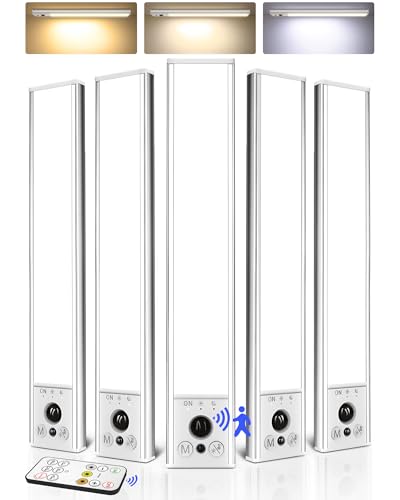
| Best for Flexibility | Installation Type: Tool-free/magnetic or adhesive (no wiring) | Compatibility/System: Standalone wireless under-cabinet system (magnetic/adhesive mounting) | Dimming/Adjustability: Dimmable 10%–100% (three color temps) | VIEW LATEST PRICE | Our Analysis |
| H-Type Track Lighting Live End Feed with Dimmer |
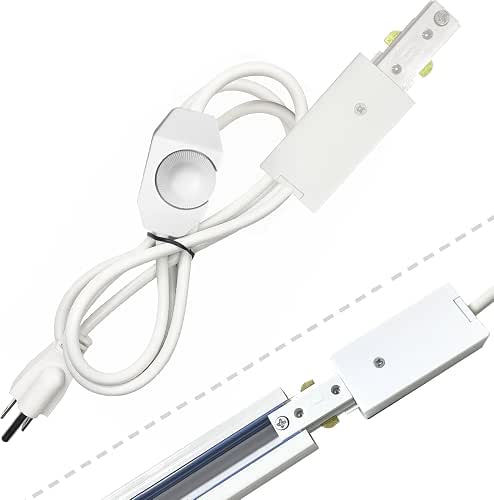
| Easy Dim Control | Installation Type: Plug-in live end feed into H-type track (no hardwiring) | Compatibility/System: H-type 3-wire track lighting systems (track-compatible) | Dimming/Adjustability: Inline dimmer integrated (adjustable via switch) | VIEW LATEST PRICE | Our Analysis |
| 52ft White H-Style 3-Wire Track Lighting Kit |
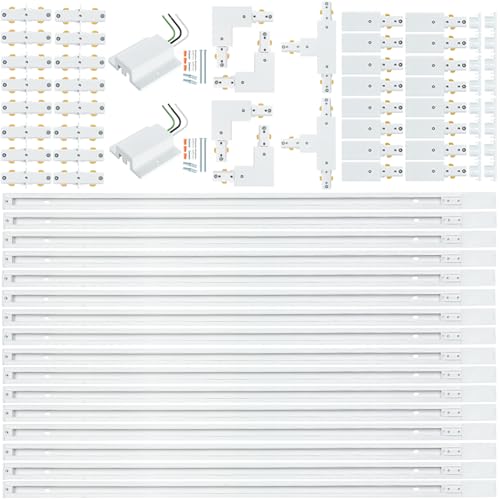
| Complete System Kit | Installation Type: Hardwired via junction box or live end feed connector | Compatibility/System: H-type 3-wire track lighting system (track kit) | Dimming/Adjustability: Supports dimmable H-style track heads (depends on heads used) | VIEW LATEST PRICE | Our Analysis |
| LED Hardwire Kitchen Light Kit 12V Dimmable Warm White |

| Professional Warmth | Installation Type: Hardwire installation (12V) | Compatibility/System: 12V hardwire LED lighting systems (under-cabinet/pro series) | Dimming/Adjustability: Dimmable LED system (with 40W electronic transformer) | VIEW LATEST PRICE | Our Analysis |
| 52ft White H-Track Lighting Rail Kit (3-Wire) |

| DIY Customizable Rail | Installation Type: Hardwired track rails (live end connectors; power cord not included) | Compatibility/System: H-style 3-wire single-circuit track system | Dimming/Adjustability: Supports dimmable track heads (system compatible; depends on heads) | VIEW LATEST PRICE | Our Analysis |
More Details on Our Top Picks
EZVALO Rechargeable Motion Sensor Under Cabinet Lights (5-Pack)
Should you want a no-fuss, install-anywhere under‑cabinet solution, the EZVALO 5‑pack is ideal — its built‑in 2400 mAh rechargeable batteries and strong magnets let you mount and power lights without wiring or battery swaps, while the PIR motion sensor and three modes (Night Motion, All‑Day Motion, Always‑On) deliver hands‑free, energy‑saving illumination where you need it. You’ll appreciate durable aluminum alloy and impact‑resistant ABS, USB‑C charging in about three hours, and Grade A+ Li‑poly cells for long life. The sensor reacts in ~0.1s across 120°/12 ft, auto‑off after ~20s, with dimming (10–100%) and 3 color temps.
- Installation Type:Tool-free/magnetic or adhesive (no wiring)
- Compatibility/System:Standalone wireless under-cabinet system (magnetic/adhesive mounting)
- Dimming/Adjustability:Dimmable 10%–100% (three color temps)
- Mounting/Hardware Included:Built-in magnets + adhesive strips included
- Construction Materials:Aluminum alloy housing + ABS plastic components
- Primary Use Case:Under-cabinet / closet / task lighting (portable/wireless)
- Additional Feature:Built-in 2400mAh battery
- Additional Feature:PIR sensor 12 ft range
- Additional Feature:USB-C fast recharge
H-Type Track Lighting Live End Feed with Dimmer
Should you want simple, tool-free control over an H-type 3-wire track, this H-Type Live End Feed with Dimmer is ideal — it plugs directly into H-type tracks, includes an inline dimmer for smooth brightness control, and handles up to 130W total so you can power multiple low‑wattage GU10s without extra wiring. You’ll confirm compatibility with H-type 3-wire-1 circuit tracks prior to buying. The unit’s all-in-one design has an H-type I connector and a 4.92 ft plug wire; no extra cord’s needed. Made from flame-retardant materials, it improves safety. Install through aligning and inserting; add extra live ends in parallel should load exceed 130W.
- Installation Type:Plug-in live end feed into H-type track (no hardwiring)
- Compatibility/System:H-type 3-wire track lighting systems (track-compatible)
- Dimming/Adjustability:Inline dimmer integrated (adjustable via switch)
- Mounting/Hardware Included:Live end feed with 4.92 ft plug wire (no extra cord required)
- Construction Materials:Flame-retardant materials (electrical components)
- Primary Use Case:Track lighting control for room/spot lighting
- Additional Feature:Integrated inline dimmer
- Additional Feature:4.92 ft plug wire
- Additional Feature:Flame-retardant construction
52ft White H-Style 3-Wire Track Lighting Kit
Should you need a durable, customizable track system for a mid- to large-sized space, the 52 ft White H-Style 3‑Wire Track Lighting Kit is a strong choice — it gives you a continuous 52.49 ft of H-type rail with pure copper conductors and aluminum construction so fixtures slide, rotate, and adjust reliably across long runs. You get 16 rails, connectors (floating canopies, mini I, L, T), 16 end caps and live end feeds, and instructions. The cuttable tracks and multi-stage splicing let you configure complex layouts. Install via junction box or live feed, use 120V H-style heads, and contact support within 24 hours.
- Installation Type:Hardwired via junction box or live end feed connector
- Compatibility/System:H-type 3-wire track lighting system (track kit)
- Dimming/Adjustability:Supports dimmable H-style track heads (depends on heads used)
- Mounting/Hardware Included:Tracks, connectors, end caps, canopy connectors included
- Construction Materials:Aluminum track with pure copper conductors
- Primary Use Case:Whole-track lighting layouts for residential/commercial spaces
- Additional Feature:Includes floating canopies
- Additional Feature:Cuttable track sections
- Additional Feature:Pure copper conductors
LED Hardwire Kitchen Light Kit 12V Dimmable Warm White
Should you want reliable, warm under‑cabinet lighting that’s easy for a pro or confident DIYer to install, the LED Hardwire Kitchen Light Kit delivers: a 12V, 40W dimmable system with ten matched 3000 K panels that keeps color consistent across counters while letting you dial brightness from ambient to focused task light. You’ll get a professional-grade hardwire kit with clear installation instructions, suited for kitchens, desks, or portable task zones. The included electronic converter and dimmable panels provide smooth, adjustable output. Install once to upgrade ambient and task lighting with warm, consistent illumination that blends seamlessly into modern spaces.
- Installation Type:Hardwire installation (12V)
- Compatibility/System:12V hardwire LED lighting systems (under-cabinet/pro series)
- Dimming/Adjustability:Dimmable LED system (with 40W electronic transformer)
- Mounting/Hardware Included:Kit includes 10 LED panels and 40W transformer (hardwire kit)
- Construction Materials:LED panels and electronic transformer (professional-grade components)
- Primary Use Case:Under-cabinet and task warm-white kitchen lighting
- Additional Feature:10-panel kit included
- Additional Feature:40W electronic transformer
- Additional Feature:Warm 3000K output
52ft White H-Track Lighting Rail Kit (3-Wire)
Should you need a flexible, high-capacity track system for a large room or commercial space, the 52 ft White H-Track Lighting Rail Kit (3-Wire) gives you a ready-to-install backbone that supports multiple fixtures and circuits. You get sixteen 3.3 ft tracks, mini I connectors, powerable live end connectors, end caps, screws, and anchors—power cord and floating canopy connector not included. The aluminum rails cut to fit and join with mini straight connectors, matching 3-wire single-circuit H-style systems. Installation is quick with pre-drilled mounting holes; durable materials promise long life. Three-year service coverage and 24-hour seller support round out the kit.
- Installation Type:Hardwired track rails (live end connectors; power cord not included)
- Compatibility/System:H-style 3-wire single-circuit track system
- Dimming/Adjustability:Supports dimmable track heads (system compatible; depends on heads)
- Mounting/Hardware Included:Tracks, mini connectors, end caps, screws and anchors included (power cord excluded)
- Construction Materials:Aluminum rails (robust build) with quality materials
- Primary Use Case:Long-run H-track rail installations for multi-fixture lighting
- Additional Feature:Screws & anchors included
- Additional Feature:3-year service coverage
- Additional Feature:Power cords not included
Factors to Consider When Choosing a Wireless Lighting System
Upon choosing a wireless lighting system, you’ll want to weigh power source options and how complex the installation will be. Consider control and connectivity standards, plus what sensors and automation can do for convenience and energy savings. Don’t forget to compare brightness and color quality to make sure the system meets your space’s needs.
Power Source Options
Because your choice of power source determines installation, runtime, and maintenance, weigh battery, hardwired, low-voltage, and USB-rechargeable options against your brightness and duty-cycle needs. Battery-powered fixtures give wire-free placement and easy installs but need periodic replacement or recharging; runtimes range from a few hours at high brightness to weeks in motion-sensor modes depending on capacity and duty cycle. Hardwired systems deliver continuous 12–120V AC/DC power for unlimited run time and higher sustained brightness but require permanent wiring and professional work. Low-voltage (e.g., 12V) setups with a centralized converter offer safer, efficient dimming over longer runs yet demand careful transformer sizing and wiring. USB-rechargeable lights recharge through common ports in hours for tool-free installs, though runtime varies with mAh and usage. Compare peak/average wattage, battery or circuit capacity, duty cycle, and maintenance needs.
Installation Complexity
Although wireless lighting promises simpler installs, you still need to evaluate complexity up front: confirm whether any hubs or bridges require wired power, check whether fixtures mount tool-free or need screws/drilling, count zones and devices to estimate pairing time, and verify the comms protocol so you can plan for a gateway, network setup, or electrician for hardwired components. Next, confirm whether the system is truly wireless (battery/solar) or uses wired feeds for hubs—wired parts add time and might need permits. Look for tool-free mounts (magnetic, adhesive, snap-fit) to avoid drills and anchors. Estimate provisioning effort: individual pairing versus bulk setup. Check required skill for wiring and dimming control (plug-and-play versus 12–120V hardwired) and budget for electrician work or firmware/gateway steps.
Control And Connectivity
You’ve checked mounts, wiring, and provisioning; now focus on how the system will actually communicate and be controlled. Pick a wireless protocol—Wi‑Fi, Bluetooth Mesh, Zigbee, Z‑Wave, or Thread—based on range, latency, and network size; Zigbee/Z‑Wave and Thread suit large, low‑power meshes, Wi‑Fi gives bandwidth at higher power. Verify how many concurrent devices the hub or mesh supports and whether nodes relay signals to guarantee coverage. Check control interfaces: local apps, cloud services, voice assistant compatibility, and support for secure local control without internet. Confirm latency and responsiveness—sub‑second activation for motion use cases—and whether automations run locally or in the cloud. Finally, assess security: encryption, firmware updates, and authentication to prevent unauthorized access.
Sensor And Automation
Start alongside matching sensors and automations to how people actually use the space: pick motion detectors with wide coverage (≥120°) and sufficient range (typically ~12 ft) so they reliably catch occupants, and verify the sensor’s activation speed (high‑quality PIRs can trigger in ~0.1 s) to avoid missed events. Choose systems with configurable auto-off timers (defaults around 20 seconds) and multiple modes—night-only, all-day motion, always-on—so you can balance convenience and energy savings. Prefer adjustable sensitivity and dimmable output (roughly 10%–100%) to adapt lighting to occupancy and ambient conditions. Check sensor power and autonomy: rechargeable fixtures should sustain motion mode for weeks depending on activity and offer fast, convenient charging (USB‑C in a few hours).
Brightness And Color
At any time picking a wireless lighting system, focus on the light output and color quality rather than wattage: aim for 300–800 lumens per under‑cabinet or task fixture depending on how demanding the work is, select a color temperature that matches the room’s function (2700–3000K for cozy ambient light, 3500–4500K for general tasks, 5000–6500K for detailed work), and insist on wide dimming (at least 10%–100%) plus CRI ≥80 (or ≥90 for color‑critical tasks); also check the manufacturer’s lumen‑maintenance or L70 data to confirm consistent brightness and color over time. Choose systems that let you set color temperature and dimming scenes so you’ll adapt lighting for tasks, mood, and energy savings while preserving accurate color rendition.
Compatibility With Tracks
Because track systems vary in wiring, connectors, and load limits, you should confirm electrical and mechanical compatibility before buying wireless fixtures. Verify the track type and wiring configuration (for example, H-type 3-wire single-circuit) so the wireless unit’s live feed and connectors mate correctly. Check the track’s maximum load capacity and confirm combined fixture wattage won’t exceed it—or plan additional feeds to distribute load. Match the physical connector form factor and contact spacing so modules slide, lock, and make proper electrical contact without modification. Make sure the track supports any required control wiring or protocols in case integrated dimming or three-wire control is used. Finally, review mounting and clearance requirements—floating canopy, live-end feed, surface, or recessed installations must fit the existing track layout.
Energy Efficiency Claims
Upon evaluating energy efficiency claims for wireless lighting systems, focus on measurable performance rather than marketing jargon: check lm/W ratings to compare raw efficacy, review standby and phantom loads from radios and hubs, and confirm driver efficiency across dimming ranges so low-output operation doesn’t erase expected savings. You should verify lm/W (efficient LEDs typically 80–200 lm/W) and insist on lab data like LM-79/LM-80, ENERGY STAR or DLC listings instead of brochure numbers. Account for always‑on wireless draw—0.5–5 W can negate gains—and model real use through comparing duty cycles (motion‑activated vs always‑on) to estimate annual kWh. Finally, confirm driver efficiency at low dimming levels; some drivers fall off below 20% output, reducing expected savings despite high rated efficacy.
Build Materials Quality
Durability matters: choose fixtures with corrosion-resistant housings (aluminum alloys or impact-resistant ABS) and flame‑stable materials around electrical parts so the system survives heat, moisture, and continuous operation. You should prefer pure copper conductors for reliable conductivity and grade A+ lithium‑polymer or high-quality battery cells for better energy density and longer cycle life. Pick lenses and diffusers made from UV‑stable, impact‑resistant plastics to avoid yellowing, cracking, and light degradation. Verify mechanical features—strong magnets, sturdy mounting points, or pre‑drilled metal rails—are built from durable metals or reinforced composites so fixtures don’t sag or loosen. Inspect thermal management: metal housings improve heat dissipation, extending LED life. Prioritize proven materials and clear component specs to reduce maintenance and safety risks.
