

Visualize the soft glow of your inhabited room lights shifting to match a quiet evening—I’m here to help you pick the switches that make that happen. I’ll walk you through seven top WiFi smart switches for 2026, comparing ease of install, voice assistants, and compatibility so you can upgrade without surprises. There’s a smart switch for older homes, high-power gear, and Matter-ready options—keep going to find the right fit for your setup.
Kasa HS200 Smart Wi‑Fi Light Switch (Black)

In case you want a reliable, no‑hub smart wall switch that works with Alexa and Google Assistant, the Kasa HS200 is a solid pick — especially in the event that your home has neutral wiring and 2.4 GHz Wi‑Fi. You’ll install it via the Kasa (or Tapo) app with step‑by‑step guidance, but consult an electrician should you be unsure about wiring. It’s UL certified, single‑pole, and comes in black. You can control lights hands‑free with voice, monitor and toggle them remotely, and use advanced scheduling, timers, countdowns, and Away Mode to simulate occupancy. No hub required; just set it up and go.
Best For: home users with neutral wiring who want a reliable, no-hub smart wall switch compatible with Alexa and Google Assistant for voice, remote, and scheduled control.
Pros:
- Requires no hub and works with Amazon Alexa and Google Assistant for hands-free control.
- App-guided setup with advanced scheduling, timers, countdowns, and Away Mode for automation and security.
- UL certified single-pole switch that allows remote monitoring and control via the Kasa/Tapo app.
Cons:
- Requires neutral wiring and 2.4 GHz Wi‑Fi, so not compatible with all homes without rewiring.
- Installation may require an electrician if you’re unfamiliar with electrical wiring.
- Available only in a single-pole configuration and black color, limiting options for multi-way setups or finishes.
TREATLIFE Smart Wi‑Fi Dimmer Switch 4-Pack
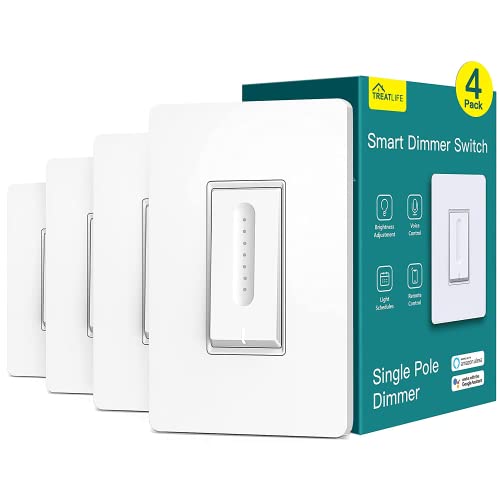
In case you want a straightforward, budget-friendly way to add dimming and voice control to multiple rooms, the TREATLIFE Smart Wi‑Fi Dimmer Switch 4‑Pack is a solid pick — especially for homes that already use dimmable, non‑smart bulbs. You’ll get 1%–100% dimming, last‑setting memory after outages, and Alexa/Google voice control without a hub. It requires a neutral wire, supports single‑pole wiring only, and uses 2.4GHz Wi‑Fi (no HomeKit or 5GHz). Max load: 150W LED/CFL or 400W incandescent. The app enables remote access, scheduling, grouping, and shared family control for simple, affordable smart lighting.
Best For: homeowners or renters who want an inexpensive, easy way to add dimming and voice control to multiple rooms that already use dimmable, non‑smart bulbs and have a neutral wire and 2.4GHz Wi‑Fi.
Pros:
- Affordable 4‑pack that adds 1%–100% dimming, voice control (Alexa/Google), and remembers last brightness after outages.
- App supports remote control, scheduling, grouping, and shared access for family members without needing a hub.
- High load capacity for incandescent (400W) and reasonable LED/CFL support (150W) with included wall plate cover and compact switch size.
Cons:
- Requires a neutral wire and supports only single‑pole setups, so not suitable for many older homes or 3‑way/multi‑way circuits.
- Works only with dimmable, non‑smart bulbs and is incompatible with Apple HomeKit and 5GHz Wi‑Fi networks.
- Limited to 2.4GHz Wi‑Fi and depends on the manufacturer app for full features, which may raise privacy or long‑term support concerns.
Leviton Wi‑Fi Bridge for Decora Smart Dimmers/Switches
Should you’ve got Decora Smart no‑neutral dimmers or switches and want full smart features, the Leviton Wi‑Fi Bridge is the essential add‑on that connects those devices to My Leviton, HomeKit, Alexa, and Google. You’ll need the bridge to enable Wi‑Fi for DN6HD dimmers and DN15S switches (not required for Decora Smart Wi‑Fi 1st/2nd Gen). Its compact plug‑in design installs out of the way and supports up to 25 Decora No‑Neutral devices plus Anywhere Companions. Coverage reaches about 2,500 sq. ft.; place it within 50 ft. of devices or add more bridges for larger homes. Setup’s done via the My Leviton app.
Best For: Homeowners with Decora Smart no‑neutral DN6HD dimmers or DN15S switches who want full Wi‑Fi smart features and integration with My Leviton, HomeKit, Alexa, and Google.
Pros:
- Enables full smart functionality for no‑neutral Decora devices (DN6HD/DN15S) and integrates with major platforms via the My Leviton app.
- Compact plug‑in form factor that doesn’t take up shelf or desk space and is easy to install.
- Supports up to 25 devices and Anywhere Companions with up to ~2,500 sq. ft. coverage; additional bridges can extend range.
Cons:
- Required only for no‑neutral Decora devices—adds extra hardware and cost for those users.
- Coverage and device limit may be insufficient for very large homes without purchasing multiple bridges.
- Requires placement within ~50 ft. of devices, which may constrain ideal router/placement locations.
Intermatic Smart Wi‑Fi Switch – Matter Certified

In case you want a no‑hub, Matter‑certified switch that plays nicely with Alexa, Google, Siri and SmartThings, the Intermatic Smart Wi‑Fi Switch is a smart pick — especially for users who need reliable control of both lights and motorized loads like ceiling fans or pumps. You get Matter interoperability, 2.4 GHz Wi‑Fi operation, and hands‑free voice control via Intermatic ABRA or any Matter app. It handles single‑pole and 3‑way installs without a companion switch, supports 120–277VAC at 15A, and runs motors up to 1 HP (120V) or 3 HP (240V). Schedules, timers, and remote control add convenience and energy savings.
Best For: tech-savvy homeowners and DIY installers who want a Matter‑certified, no‑hub smart switch that reliably controls lights and motorized loads (fans, pumps) across Alexa, Google, Siri, and SmartThings.
Pros:
- Matter certified for broad, future‑proof interoperability with major smart home platforms.
- Handles motors and various load types (up to 1 HP at 120V / 3 HP at 240V) and supports single‑pole and 3‑way installs without a companion switch.
- No hub required and offers hands‑free voice control, local schedules/timers, and remote/cloud control via 2.4 GHz Wi‑Fi.
Cons:
- Operates only on 2.4 GHz Wi‑Fi (no 5 GHz support), which may limit performance in congested networks.
- IP10 rating and limited operating temperature range (65°F–100°F) may restrict use in harsh or outdoor environments.
- Wire‑lead terminals and 1.65″ width may complicate installation in very tight or older switch boxes.
Ewelink 30A WiFi Smart Switch (2-Pack)

Should you need a heavy-duty smart switch for high-power appliances, the Ewelink 30A WiFi Smart Switch (2-Pack) is built for that job: each unit houses a 30A relay that handles up to 3,000W resistive or 800W inductive loads, making it ideal for water heaters, pumps, motors, and workshop equipment while still offering app-based scheduling, scene linkage, and Alexa/Google voice control. You’ll schedule fixed times, countdowns, or cycles via the eWeLink app (iOS/Android) and monitor status remotely over 2.4GHz Wi‑Fi. Group devices into scenes, use voice commands, and be sure to cut power during installation for safety.
Best For: Homeowners and small business operators needing a heavy-duty, Wi‑Fi controllable switch for high-power appliances like water heaters, pumps, and motors who want remote scheduling and voice control.
Pros:
- Supports up to 30A with 3,000W resistive/800W inductive capacity, suitable for high-power loads.
- App-based scheduling, countdowns, cycle timing, and scene linkage for automation and grouped control.
- Remote monitoring and voice control via eWeLink with Alexa/Google Assistant compatibility.
Cons:
- Requires 2.4GHz Wi‑Fi only (no 5GHz support), which may limit connectivity options.
- Installation involves high-voltage wiring—power must be cut and professional installation may be advisable.
- Limited to the capabilities and privacy practices of the eWeLink app/ecosystem.
WiFi Smart Double Light Switch — Alexa & Google Compatible

Should you need flexible control of two fixtures from one location, this WiFi Smart Double Light Switch is ideal for households that want multi-control and voice-enabled convenience. You can link it within 3-way circuits or connect two switches to control one light, and expand multi-control setups through linking other WiFi switches in the app. It works with Amazon Alexa and Google Home for hands-free commands, and the free Smart Life app (iOS/Android) gives remote access. Use 7-day schedules and countdown timers (1, 5, 30 minutes, 1 hour). It’s CE/FCC certified and includes a 1-year warranty and support.
Best For: Households or renters who want simple, voice-enabled and app-controlled management of two fixtures from one location without needing dimming or fan-speed control.
Pros:
- Offers multi-control and 3-way wiring support to control a light from multiple switches.
- Works with Amazon Alexa, Google Home, and the Smart Life app for remote and voice control.
- Includes 7-day scheduling, countdown timers, CE/FCC certification, and a 1-year warranty.
Cons:
- Does not support dimming or fan speed regulation.
- Requires compatible wiring (neutral may be needed) and some installation effort for 3-way setups.
- Reliant on WiFi and the Smart Life app—limited functionality during network outages.
Kasa HS220P3 Smart Dimmer Switch 3-Pack

In case you want reliable dimming without a hub and already have neutral wiring, the Kasa HS220P3 is a strong choice because it delivers 0–100% control, voice compatibility with Alexa and Google Assistant, and remote scheduling through the Kasa app. You’ll need a 2.4 GHz Wi‑Fi network and should consult an electrician should you be unsure about wiring. The switch supports single‑click on/off, double‑click fade‑off, and timers for routines like wake‑up soft glows. It’s UL certified, works with IFTTT and Nest, handles 15 A at 120 VAC (150 W), and comes as a three‑pack from Kasa Smart (TP‑Link).
Best For: Homeowners with existing neutral wiring who want reliable, hub‑free smart dimming with voice control and scheduling via a 2.4 GHz Wi‑Fi network.
Pros:
- 0–100% dimming with single‑click on/off, double‑click fade‑off, and remote control through the Kasa app.
- Works with Alexa, Google Assistant, IFTTT, and Nest without a hub; UL certified for safety.
- Sold as a 3‑pack and supports scheduling/timers for routines like wake‑up soft glows.
Cons:
- Requires neutral wiring and only supports 2.4 GHz Wi‑Fi, limiting compatibility in some homes.
- Rated for 15 A/120 VAC and 150 W, which may not suit high‑wattage fixtures.
- IP00 and indoor‑only temperature range (32°F–104°F) — not suitable for damp/outdoor locations.
Factors to Consider When Choosing a Wifi Smart Switch
Before you buy, I’ll walk you through the key factors that matter: wiring requirements, bulb compatibility, voice assistant support, whether you need a hub, and the switch’s load rating. Understanding whether you have a neutral wire, what bulbs you use, and which assistants you want will save headaches. I’ll also explain trade-offs between hub versus hubless systems and how load ratings affect safe performance.
Wiring Requirements
Because wiring determines whether a smart switch will actually fit your home, I’ll start through checking for a neutral wire and the type of switch setup you have; most WiFi smart switches need a neutral, which older homes (pre-mid-1980s) often lack. Also confirm whether your circuit uses a single-pole or a 3-way/multi-way setup—many models only support single-pole unless they explicitly list multi-way compatibility. Look at terminal connector types too: wire leads versus screw connectors affect how easily the switch mates with your existing wiring. Keep in mind switches generally use 2.4 GHz Wi‑Fi, not 5 GHz, so placement matters for signal. Finally, plan to cut power and consider hiring a licensed electrician for safe, code-compliant installation.
Bulb Compatibility
Although wiring sets the stage, bulb compatibility is what actually determines whether a Wi‑Fi smart switch will perform as you expect, so I check the bulb types and dimming specs before buying. I make sure the switch explicitly supports my bulbs—dimmable LEDs, incandescent, or CFL—because using unsupported types invites flicker or damage. I watch for dimmer-only switches that won’t work with smart or non‑dimmable bulbs and verify maximum wattage per bulb type to avoid overload. In case I plan to control motorized fixtures or specialty lighting, I confirm the switch handles those loads rather than just standard lamps. Checking compatibility upfront saves returns and guarantees smooth dimming, reliable control, and longer bulb life in my smart setup.
Voice Assistant Support
At the moment I choose a Wi‑Fi smart switch, I make voice assistant support a top priority because hands‑free control is one of the biggest conveniences of a smart home. I look for switches that work with Alexa, Google Assistant, and Siri so I can speak to whichever ecosystem I prefer. Compatibility with multiple assistants gives me flexibility whenever I add devices or change platforms. I check whether voice control is direct or requires a specific app or hub—direct integration is simpler, but hub‑based setups can offer more features. I expect voice commands to handle on/off, dimming, and scene activation or scheduling. Before buying, I confirm the switch explicitly supports my preferred assistant for seamless automation and daily use.
Hub Versus Hubless
Once I decide between a hub and a hubless Wi‑Fi smart switch, I focus on simplicity versus scalability: hubless switches plug straight into my home network for easier setup, while hub-based systems add a dedicated controller that can improve reliability and support more devices. I prefer hubless for quick installs and direct voice-assistant integration via standard apps, but I watch for Wi‑Fi dead zones and congestion that can limit performance. Provided I plan a large, diverse smart ecosystem, a hub appeals because it often uses stronger protocols, reduces wireless traffic, and enables broader device integration and advanced automation. I accept a hub’s upfront cost and setup complexity once I want better range, stability, and future growth potential.
Load And Rating
Now that I’ve settled the hub versus hubless choice, I check the switch’s load and ratings to make sure it matches what I want to control. I initially verify the maximum current rating in amps so the switch can safely handle the connected devices. Next I confirm the operating voltage range — most homes use ~120V or 240V — to match the supply. I also look at supported load types: resistive (incandescent), inductive (motors, fans), and electronic (LED/CFL), because compatibility matters. Total wattage capacity is crucial too; manufacturers often list separate limits for LED/CFL and incandescent, and that total must exceed the combined load. For heavy-duty items like water heaters or motors I choose switches rated 15 A or higher.
App Features And Control
Because I rely on the app as the primary interface for my smart switches, I check that it gives reliable remote access, easy scheduling and automation, and tight voice-assistant integration so I can control devices from anywhere or with a simple command. I expect clear remote control so I can monitor and operate lights from work or on the road. Strong scheduling and automation—timers, countdowns, custom on/off events—save energy and remove routine tasks. Voice-assistant support for Alexa, Google Assistant, or Siri makes hands-free control seamless. I also value grouping and shared access so family members can manage devices without friction. Finally, compatibility with third-party services and Matter-certified apps guarantees broader automation possibilities and future-proof interoperability.
Installation And Safety
While I want smart switches to be convenient, I always put installation and safety foremost, so I check wiring, certifications, and setup requirements before buying. To begin, verify whether your home has a neutral wire—most Wi‑Fi switches need one and older homes often lack it. Confirm the circuit type too: single‑pole versus 3‑way matters for compatibility and correct performance. Make sure the switch supports 2.4 GHz Wi‑Fi, since many don’t work on 5 GHz. Look for UL or other recognized safety certifications to meet code. Turn power off during installation and securely tighten wire leads or screws. In case you’re unsure about wiring or code compliance, hire a licensed electrician to install the device safely.
Future Interoperability
In case I want a smart switch to still work with my setup years from now, I prioritize devices that follow open standards and play nicely with major ecosystems like Alexa, Google, HomeKit, and SmartThings. I look for Matter certification and support for standard communication protocols because they make future integrations straightforward. I prefer switches with open APIs or documented local control so I’m not locked into one vendor’s cloud. Avoiding models that require proprietary hubs reduces dependence on single companies and improves cross-platform flexibility. Firmware updates and a clear update policy are must-haves; they keep devices compatible as wireless tech and smart home standards evolve. Choosing standards-first switches saves time and frustration down the road.
