

In case you need reliable whole‑home Wi‑Fi, you’ll want options that actually reach every room without constant drops or slow zones. I’ve narrowed five top choices—mesh systems and a strong standalone router—that balance speed, coverage, and ease of management. Keep going to see which setup fits your house size, device load, and budget so you can stop guessing and start getting consistent performance.
| TP-Link Deco X55 AX3000 WiFi 6 Mesh (3-Pack) |

| Best Value | Wi‑standard: Wi‑Fi 6 (802.11ax) | Package (units): 3‑pack mesh units | Coverage (approx.): Up to 6,500 sq. ft. | VIEW LATEST PRICE | Read Our Analysis |
| TP-Link Deco 7 Pro BE63 Tri-Band WiFi 7 (3-Pack) |

| Ultimate Performance | Wi‑standard: Wi‑Fi 7 | Package (units): 3‑pack mesh units | Coverage (approx.): Up to 7,600 sq. ft. | VIEW LATEST PRICE | Read Our Analysis |
| TP-Link Deco S4 AC1900 Mesh WiFi System (3-Pack) |
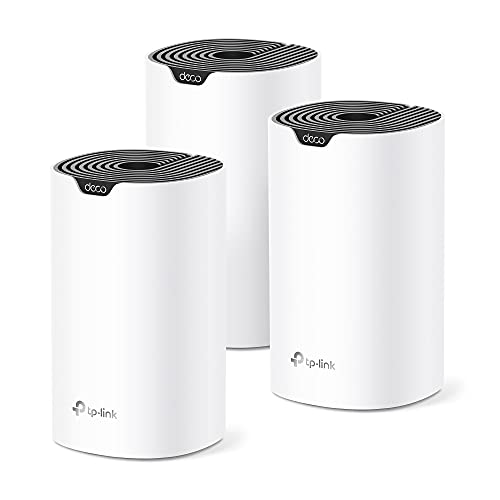
| Budget-Friendly Pick | Wi‑standard: Wi‑Fi 5 (AC) — AC1900 | Package (units): 3‑pack mesh units | Coverage (approx.): Up to 5,500 sq. ft. | VIEW LATEST PRICE | Read Our Analysis |
| TP-Link Deco 7 BE25 Wi‑Fi 7 Mesh System (3‑Pack) |

| High‑Performance Midrange | Wi‑standard: Wi‑Fi 7 | Package (units): 3‑pack mesh units | Coverage (approx.): Up to 6,600 sq. ft. | VIEW LATEST PRICE | Read Our Analysis |
| TP-Link Archer AX21 AX1800 WiFi 6 Router |

| Simple & Affordable | Wi‑standard: Wi‑Fi 6 (802.11ax) | Package (units): Single router (1 unit) | Coverage (approx.): (Not explicitly stated) — consumer‑router typical home coverage (smaller than listed mesh systems) | VIEW LATEST PRICE | Read Our Analysis |
More Details on Our Top Picks
TP-Link Deco X55 AX3000 WiFi 6 Mesh (3-Pack)
Should you need reliable whole‑home coverage without juggling extenders, the TP‑Link Deco X55 AX3000 (3‑pack) is built for large homes: its Wi‑Fi 6 speeds and AI‑driven mesh let you stream, game, and connect up to 150 devices across roughly 6,500 sq. ft., and any unit can act as the router with wired backhaul support for tougher links. You’ll get AX3000 throughput (2402 Mbps + 574 Mbps), three gigabit ports per node, and app‑guided setup. HomeShield delivers no‑cost security, QoS, and parental controls. It replaces routers and extenders, works with major ISPs, and usually requires a modem.
- Wi‑standard:Wi‑Fi 6 (802.11ax)
- Package (units):3‑pack mesh units
- Coverage (approx.):Up to 6,500 sq. ft.
- Wired ports / Backhaul:Each unit has 3 Gigabit Ethernet ports; supports wired Ethernet backhaul
- Device capacity (supported devices):Connects up to 150 devices
- Security & management:TP‑Link HomeShield (basic network security, QoS, parental controls); Deco app for setup/management
- Additional Feature:AI-driven mesh optimization
- Additional Feature:Any unit as router
- Additional Feature:3 Gigabit Ethernet ports
TP-Link Deco 7 Pro BE63 Tri-Band WiFi 7 (3-Pack)
Should you need top-tier coverage and future‑proof speeds for a very large home, the TP‑Link Deco 7 Pro BE63 (3‑pack) delivers Wi‑Fi 7 performance and mesh convenience without complicated setup. You’ll get tri‑band Wi‑Fi 7 with MLO, 4K‑QAM and 320 MHz channels, plus up to 5188/4324/574 Mbps on 6/5/2.4 GHz and six streams. A three‑node mesh covers about 7,600 sq ft and supports 200+ devices with AI‑driven seamless roaming. Four 2.5G WAN/LAN ports, USB 3.0, dual wired/wireless backhaul, HomeShield security, VPN client/server, and app management round out a future‑ready, ISP‑friendly system.
- Wi‑standard:Wi‑Fi 7
- Package (units):3‑pack mesh units
- Coverage (approx.):Up to 7,600 sq. ft.
- Wired ports / Backhaul:Four 2.5G WAN/LAN ports per unit; USB 3.0; supports wired + wireless backhaul
- Device capacity (supported devices):Supports 200+ devices
- Security & management:TP‑Link HomeShield (network protection, parental controls, IoT security); Deco app; VPN client/server support
- Additional Feature:10 Gbps-class capability
- Additional Feature:USB 3.0 port
- Additional Feature:Dual backhaul simultaneous
TP-Link Deco S4 AC1900 Mesh WiFi System (3-Pack)
Should you need reliable whole-home coverage without juggling multiple extenders, the TP-Link Deco S4 AC1900 (3-pack) is built for large homes up to about 5,500 sq. ft., letting you roam on a single network name and automatically handing devices off to the fastest unit. You get three identical Decos (any can be the primary), AC1900 3×3 6-stream speeds, and support for up to 100 devices. Each unit offers two Gigabit Ethernet ports and wired backhaul for better performance. Setup is via the Deco app; guest WiFi works with Alexa. Strong parental controls let you manage profiles, time limits, and site blocking.
- Wi‑standard:Wi‑Fi 5 (AC) — AC1900
- Package (units):3‑pack mesh units
- Coverage (approx.):Up to 5,500 sq. ft.
- Wired ports / Backhaul:Each unit has 2 Gigabit Ethernet ports; supports wired Ethernet backhaul
- Device capacity (supported devices):Supports up to 100 devices
- Security & management:Parental controls (robust), Deco app setup/management; guest Wi‑Fi via Alexa
- Additional Feature:AC1900 6-stream performance
- Additional Feature:Alexa guest WiFi control
- Additional Feature:2 Gigabit ports/unit
TP-Link Deco 7 BE25 Wi‑Fi 7 Mesh System (3‑Pack)
Should you need multi‑gig wireless for a sprawling house, the TP‑Link Deco 7 BE25 (3‑pack) delivers: Wi‑Fi 7 with MLO and 4‑stream BE5000 speeds (up to 4,324 Mbps on 5 GHz) plus two 2.5 Gbps ports per unit give you the bandwidth and wired backhaul options to keep gaming, 4K streaming, and dozens of smart devices running smoothly across about 6,600 sq. ft. You’ll get MLO, 4K‑QAM, Multi‑RUs, AI‑Roaming, four high‑gain antennas and FEMs, and support for 150+ devices. HomeShield security, VPN client/server, Alexa/Google control, and backward compatibility with other Deco units round it out.
- Wi‑standard:Wi‑Fi 7
- Package (units):3‑pack mesh units
- Coverage (approx.):Up to 6,600 sq. ft.
- Wired ports / Backhaul:Two 2.5 Gbps WAN/LAN ports per unit; supports simultaneous wired and wireless backhaul
- Device capacity (supported devices):Supports over 150 devices
- Security & management:TP‑Link HomeShield (basic security, IoT ID, parental controls), VPN client/server support; Deco app
- Additional Feature:4-stream BE5000 radios
- Additional Feature:4 high-gain antennas
- Additional Feature:2.5 Gbps WAN/LAN ports
TP-Link Archer AX21 AX1800 WiFi 6 Router
Should you need a budget-friendly Wi‑Fi 6 router that boosts device capacity and reaches farther rooms, the TP‑Link Archer AX21 (AX1800) is a solid pick—its OFDMA and four high‑gain antennas help serve many devices simultaneously and direct signal toward distant corners of a large home. You’ll get dual-band 802.11ax with up to 1.8 Gbps (1200 Mbps on 5 GHz; 574 Mbps on 2.4 GHz), beamforming, FEM chipset improvements, and Gigabit wired ports. It supports EasyMesh, OpenVPN/PPTP, Alexa, and major ISPs, but needs a separate modem. Keep firmware current via the Tether app; TP‑Link offers free expert support.
- Wi‑standard:Wi‑Fi 6 (802.11ax)
- Package (units):Single router (1 unit)
- Coverage (approx.):(Not explicitly stated) — consumer‑router typical home coverage (smaller than listed mesh systems)
- Wired ports / Backhaul:Gigabit wired ports (typical router ports); supports EasyMesh
- Device capacity (supported devices):Implied increased capacity with Wi‑Fi 6 / OFDMA (no explicit device count)
- Security & management:Built‑in security features, VPN server support (OpenVPN/PPTP); Tether app / firmware updates and Alexa compatibility
- Additional Feature:Four high-gain antennas
- Additional Feature:EasyMesh support
- Additional Feature:OpenVPN/PPTP server
Factors to Consider When Choosing Wifi For Large Home
Upon choosing Wi‑Fi for a large home, you’ll want to match coverage area needs with hardware that can reach every room and outdoor space. Consider device density and whether you can use wired backhaul between access points to keep performance high, while also prioritizing strong security and privacy features. Finally, pick gear that supports future‑proof tech like Wi‑Fi 6/6E so your network lasts.
Coverage Area Needs
To size your Wi‑Fi system correctly, measure the home’s total square footage and add a 10–20% buffer to account for walls and interference to ensure coverage slightly exceeds the footprint. Next, map the layout and floor count: multi‑story, L‑shaped, or split‑level homes usually need multiple access points—place at least one per major zone and one per floor to avoid dead zones. Check building materials; concrete, brick, metal studs, and stucco cut range, so increase AP density or use wired backhaul where they appear. Plan for peak simultaneous uses like streaming and gaming so throughput stays solid under load. Finally, include outdoor coverage for patios, garages, and yards through positioning APs near exterior walls or adding dedicated outdoor units.
Device Density Capacity
Because a large home often hosts dozens of gadgets at once, you need to size your Wi‑Fi for device density as much as for square footage. To start, estimate simultaneous clients—phones, TVs, cameras, smart speakers, and IoT sensors—and pick gear rated for at least that many concurrent devices; listings like 100, 150, or 200+ give scale. Favor standards and features that enhance per‑channel capacity: OFDMA and MU‑MIMO let one AP serve many low‑bandwidth clients efficiently. Check spatial streams and channel bandwidth—more streams and wider channels raise throughput but wider channels cut available non‑overlapping channels. Distribute devices across multiple APs so no AP serves more than a few dozen active high‑demand clients. Finally, size for mixed traffic: many low‑bandwidth devices stress connection management, while a few 4K streams need higher per‑client throughput.
Wired Backhaul Options
With wired Ethernet backhaul, you preserve full Wi‑Fi capacity for client devices through offloading inter‑node traffic onto Cat5e or, preferably, Cat6/Cat6a cabling. Run gigabit or multi‑gig switches and NICs (2.5G/10G where supported) so your backhaul won’t bottleneck high‑speed internet or LAN transfers. Choose a topology: star (each node to a central switch) gives lowest latency and full per‑node bandwidth; daisy‑chain cuts cabling but aggregates throughput. Terminate and test cables—certify length and category—to avoid intermittent faults. Place switches centrally, ventilated, and on UPS power to keep links stable. Configure VLANs or QoS to prioritize latency‑sensitive streams like gaming and video calls whenever multiple high‑bandwidth sessions share the backhaul.
Security And Privacy
Although strong coverage and speed matter, you’ll also want to lock down security and privacy from day one to keep a large home network safe. Use WPA3, or at minimum WPA2‑AES, and avoid WEP or open networks. Create a separate guest SSID and place IoT devices on a VLAN to limit lateral movement when something’s compromised. Set a strong, unique admin password and update router firmware regularly to patch vulnerabilities. Disable unused services like WPS, UPnP, and remote management, and close unnecessary ports to reduce attack surface. Where available, enable network‑level malware and intrusion detection protections. For remote access and sensitive traffic, use a VPN or end‑to‑end encryption so your data stays private even outside the house.
Future‑Proof Tech
In case you’re planning a large‑home Wi‑Fi setup, consider long term: choose routers or mesh systems that support the latest standards (Wi‑Fi 6/6E or 7), multi‑gigabit backhaul, wider channels, and more spatial streams so your network won’t choke as speeds and device counts climb. Pick hardware with 2.5G/5G/10G Ethernet or sturdy multi‑link wireless backhaul to avoid bottlenecks once gig+ plans arrive. Favor radios with extra spatial streams, 160/320 MHz channel support and higher QAM for better single‑client and aggregate throughput. Make certain the system scales to 150–200+ simultaneous clients and offers OFDMA/MLO-like multi‑link operation to keep latency low. Finally, choose vendors promising modular firmware, long security updates, WPA3 and built‑in VPN support.
