

You can secure your home effortlessly with top Wi-Fi systems like the tolviviov 15-piece kit, offering Alexa control and loud 120 dB alerts, or the PGST 2025 with a touchscreen and GSM backup. Options like PGST’s broader sensor support and smart door kits combine easy DIY setups and voice commands. For outdoor coverage, Hiseeu’s wireless cameras add extra protection. Keep your security reliable, expandable, and smart—explore more features and comparisons just ahead.
| tolviviov Home Security Alarm System 15-Piece Kit |
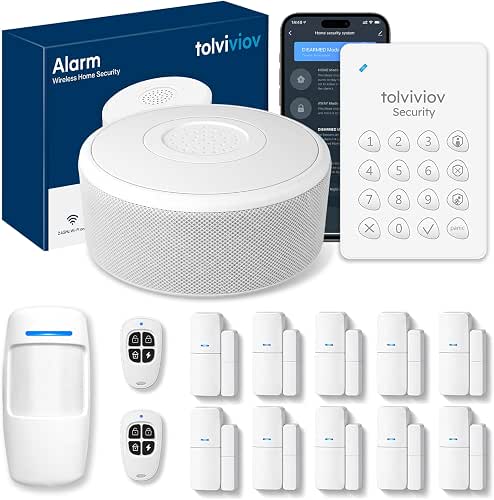
| Best for DIY Beginners | Wi-Fi Band Support: Supports 2.4 GHz only; no 5 GHz support | Number of Included Sensors: 10 door/window sensors, 1 motion sensor (total 11 sensors) | Siren Loudness: 120 dB | VIEW LATEST PRICE | Read Our Analysis |
| PGST 2025 WiFi Wireless Home Alarm System | Most Feature-Rich | Wi-Fi Band Support: Supports WiFi (5G not supported), GSM/4G also supported | Number of Included Sensors: 8 door/window sensors, 4 motion sensors (total 12 sensors) | Siren Loudness: 120 dB | VIEW LATEST PRICE | Read Our Analysis | |
| PGST WiFi Wireless Home Alarm Security System Kit |

| Maximum Expandability | Wi-Fi Band Support: Supports 2.4 GHz only; no 5 GHz support | Number of Included Sensors: Part of 24-piece kit including multiple sensors (exact count not specified but includes door and motion sensors) | Siren Loudness: Up to 100 dB | VIEW LATEST PRICE | Read Our Analysis |
| WiFi Wireless Smart Home Door Alarm System Kit |

| Compact & Simple | Wi-Fi Band Support: Supports 2.4 GHz only; no 5 GHz support | Number of Included Sensors: 5 door/window sensors; motion sensors optional add-ons | Siren Loudness: Not explicitly stated, but includes alarm siren station (likely similar range) | VIEW LATEST PRICE | Read Our Analysis |
| Hiseeu Wireless Outdoor Security Camera System |

| Best Outdoor Surveillance | Wi-Fi Band Support: Supports both 2.4 GHz and 5 GHz bands | Number of Included Sensors: Cameras with built-in PIR motion sensors (quantity not specified) | Siren Loudness: Not specified as siren loudness; includes alert notifications and light alarms | VIEW LATEST PRICE | Read Our Analysis |
More Details on Our Top Picks
tolviviov Home Security Alarm System 15-Piece Kit
In case you’re looking for a straightforward, no-fuss home security solution, the tolviviov Home Security Alarm System 15-Piece Kit delivers easy DIY installation and seamless WiFi control without monthly fees. This kit includes a WiFi alarm base station, keypad, motion sensor, 10 door/window sensors, and two remotes, covering all your entry points. You can control it via app, remote, or voice with Alexa and Google Assistant compatibility. The 120 dB siren alerts you loudly, while battery backup guarantees security during power outages. Plus, it supports up to 20 sensors, letting you expand as needed.
- Wi-Fi Band Support:Supports 2.4 GHz only; no 5 GHz support
- Number of Included Sensors:10 door/window sensors, 1 motion sensor (total 11 sensors)
- Siren Loudness:120 dB
- Voice Assistant Compatibility:Compatible with Alexa and Google Assistant
- Installation Type:DIY wireless installation; no professional setup needed
- Mobile App Control:App control with real-time smartphone alerts
- Additional Feature:Expandable to 20 sensors
- Additional Feature:120 dB siren loudness
- Additional Feature:Battery backup with 8-hour life
PGST 2025 WiFi Wireless Home Alarm System
Most Feature-Rich
View Latest PriceChoose the PGST 2025 WiFi Wireless Home Alarm System provided that you want a compact, all-in-one security solution that fits seamlessly into your home or office. You get a 4.3-inch full-touch LCD for easy control, plus four ways to operate it—touchscreen, app, remote, or RFID card. It connects via GSM/4G and WiFi, with no monthly fees. The system supports up to 99 sensors and sends alerts through app notifications, SMS, or calls. Installation is quick and wireless, and the 120 dB siren guarantees you’re alerted loudly. Plus, it works with Alexa for voice commands.
- Wi-Fi Band Support:Supports WiFi (5G not supported), GSM/4G also supported
- Number of Included Sensors:8 door/window sensors, 4 motion sensors (total 12 sensors)
- Siren Loudness:120 dB
- Voice Assistant Compatibility:Compatible with Alexa
- Installation Type:Wireless installation; approx. 10 minutes; no wiring required
- Mobile App Control:Smart Life app control with real-time monitoring and notifications
- Additional Feature:4.3″ full-touch LCD screen
- Additional Feature:Supports GSM/4G connectivity
- Additional Feature:Silent alarm mode option
PGST WiFi Wireless Home Alarm Security System Kit
In case you’re looking to set up a reliable home security system without monthly fees or complex contracts, the PGST WiFi Wireless Home Alarm Security System Kit is designed to fit your needs perfectly. It connects via 2.4 GHz Wi-Fi and supports GSM networks with a SIM card for calls and SMS (SIM not included). You control everything remotely through the Smart Life/Tuya app—arming, disarming, monitoring, and receiving instant alerts. The kit includes a central host, supports up to 100 sensors, and offers a loud 100 dB alarm. Installation is DIY-friendly, with Alexa and Google Home compatibility for voice control.
- Wi-Fi Band Support:Supports 2.4 GHz only; no 5 GHz support
- Number of Included Sensors:Part of 24-piece kit including multiple sensors (exact count not specified but includes door and motion sensors)
- Siren Loudness:Up to 100 dB
- Voice Assistant Compatibility:Compatible with Alexa and Google Home
- Installation Type:DIY installation with screws and manual; no professional needed
- Mobile App Control:Smart Life / Tuya app for full remote control and alerts
- Additional Feature:Supports 100 wireless zones
- Additional Feature:One-click SOS emergency button
- Additional Feature:Alarm output up to 100 dB
WiFi Wireless Smart Home Door Alarm System Kit
Supposing you want a straightforward, no-fuss security setup that you can put together yourself, the WiFi Wireless Smart Home Door Alarm System Kit fits the bill perfectly. This 8-piece kit includes five sensors, an alarm siren, and two remotes, all easy to install without tools or wall damage. You’ll control it via smartphone or voice with Alexa and Google Assistant, but keep in mind it only works on 2.4 GHz WiFi. It offers modes like Away and Home, sends instant alerts, and supports expansions up to 20 sensors. The alarm station needs constant power, with a backup battery for emergencies.
- Wi-Fi Band Support:Supports 2.4 GHz only; no 5 GHz support
- Number of Included Sensors:5 door/window sensors; motion sensors optional add-ons
- Siren Loudness:Not explicitly stated, but includes alarm siren station (likely similar range)
- Voice Assistant Compatibility:Compatible with Alexa and Google Assistant
- Installation Type:DIY wireless, no tools, no wall damage
- Mobile App Control:App control with instant push notifications
- Additional Feature:Compatible with wireless doorbell
- Additional Feature:8-piece kit configuration
- Additional Feature:Backup battery emergency use
Hiseeu Wireless Outdoor Security Camera System
Should you require thorough outdoor coverage without blind spots, the Hiseeu Wireless Outdoor Security Camera System stands out with its dual-lens design combining a fixed camera and a PTZ camera. You get two views per unit, with 360° pan and tilt for wide surveillance. Setup is plug-and-play, connecting the NVR to your TV for instant viewing. The system supports dual-band WiFi with up to 100 ft range and uses PIR sensors for accurate motion detection. Night vision offers color footage even in darkness. With IP67 weatherproofing and no subscription fees, it’s a reliable choice for all-encompassing outdoor security.
- Wi-Fi Band Support:Supports both 2.4 GHz and 5 GHz bands
- Number of Included Sensors:Cameras with built-in PIR motion sensors (quantity not specified)
- Siren Loudness:Not specified as siren loudness; includes alert notifications and light alarms
- Voice Assistant Compatibility:Not explicitly stated; app-based alerts via EseeCloud
- Installation Type:Plug-and-play; easy outdoor installation but requires wired power
- Mobile App Control:EseeCloud app alerts and remote viewing
- Additional Feature:Dual-lens fixed + PTZ
- Additional Feature:360° pan and tilt
- Additional Feature:IP67 weatherproof rating
Factors to Consider When Choosing Wi-Fi Home Security Systems
While selecting a Wi-Fi home security system, you’ll want to check whether it works smoothly with your existing network and supports the sensor types you need. Consider how easy it is to install and whether it integrates with your voice assistant for hands-free control. Also, contemplate about how you’ll receive alerts—via app, email, or text—to stay informed in real time.
Network Compatibility Options
Although choosing a Wi-Fi home security system may seem straightforward, ensuring network compatibility is essential to avoid connectivity issues. To begin, confirm whether your system supports 2.4 GHz only or dual-band 2.4/5 GHz Wi-Fi, since many sensors and hubs connect solely to 2.4 GHz. Check whether the alarm hub offers cellular fallback with a SIM card for alerts during internet outages, and whether an active service is needed. Verify your router meets requirements like WPA/WPA2 security and DHCP availability, ensuring the system can obtain an IP without static addressing or port forwarding. Make sure the system’s app and cloud services work smoothly on your mobile device and network. In conclusion, consider device limits and Wi-Fi range to avoid network congestion or coverage gaps.
Sensor Types Included
Since securing every entry point is essential, Wi‑Fi home security systems include various sensor types customized to different needs. Door/window sensors use magnetic contacts to detect open or close events, providing indispensable entry-point protection. Motion sensors, either PIR or microwave, detect body heat or movement indoors but could require pet-immune versions to avoid false alarms. Glass-break sensors listen for the sound or vibration of breaking glass, covering windows and doors that contact sensors could miss. Environmental sensors monitor smoke, carbon monoxide, water leaks, and freezing temperatures, offering critical life-safety alerts. Auxiliary sensors, like vibration, shock, and outdoor perimeter devices, extend protection to fences, sheds, or vulnerable windows and often let you adjust sensitivity and alert settings to minimize false alarms and tailor security to your home’s unique layout.
Installation Ease Level
Choosing the right Wi-Fi home security system means considering how easy it is to install and manage. You want a truly DIY wireless system that you can set up in under 30 minutes using included adhesives, mounts, or plug-in modules—no professional help needed. Check network requirements carefully; many systems only work on 2.4 GHz Wi-Fi, so verifying compatibility avoids connection headaches. Pay attention to power needs for each component to plan placement and guarantee uninterrupted operation, whether it’s AC adapters, DC power, or batteries with backup runtime. Look for multiple control options, like mobile apps and keypads, plus an intuitive setup interface to speed configuration and reduce errors. Finally, confirm your system can expand with extra sensors or remotes in the future without requiring a reinstall.
Voice Assistant Integration
Whenever you integrate voice assistants with your Wi-Fi home security system, make certain it supports your preferred platform, like Alexa or Google Assistant, so you can arm, disarm, and check status hands-free. Check whether voice commands work locally on your LAN or rely on cloud processing—cloud-based control might fail should your internet goes down. Understand the level of control you’ll have; some systems let you fully manage security features via voice, while others limit sensitive actions for safety. Make sure the system uses secure voice authentication, such as voice PINs or app verification, to prevent unauthorized use. Finally, consider whether voice commands trigger audible announcements and whether you can mute or customize these prompts to maintain your privacy.
Alert Notification Methods
You’ll often rely on alert notification methods to stay informed about your home’s security status in real time. Push notifications sent to your smartphone app offer instant alerts over Wi-Fi or cellular data, but you’ll need the app installed with notifications enabled. SMS and phone calls can reach you even though you’re offline or don’t have the app, though they could be slower and could incur carrier fees. Audible alarms at your home, typically 100–120 dB, provide immediate local deterrence and alert neighbors. Silent alarms send discreet alerts remotely without sounding sirens, useful during burglaries or duress. Choosing a system with multi-channel notifications—app, SMS, calls—and customizable contact settings enhances your chances of timely alerts while minimizing false alarms.
Expandability And Upgrades
Alert notifications keep you informed, but your system should also grow with your needs. Start by checking the maximum number of sensors and remotes your hub supports—some handle up to 100 zones, allowing plenty of room for expansion. Confirm which accessories are compatible, such as motion detectors, cameras, and smoke sensors, so you can customize protection. Make certain your hub supports both Wi-Fi bands or offers cellular backup, as adding many devices demands strong, reliable connectivity. Look for systems that let you control devices via apps, keypads, or voice commands and integrate third-party tools without replacing the core unit. Finally, verify that firmware updates, local backups, and cloud options are available to secure and simplify adding new devices over time.
Power Source Requirements
Although Wi-Fi home security systems offer convenience and flexibility, their power source requirements play a crucial role in reliable operation. Initially, check whether the base station and sensors use mains power, batteries, or both, and confirm backup battery life to keep things running during outages. For battery-powered sensors, observe battery type and lifespan, and guarantee easy access for replacements. Be aware some devices only support 2.4 GHz Wi-Fi, impacting router placement and signal strength needed to maintain power. For wired components, verify adapter voltage and current specs to avoid outlet overloads. Provided external power cables are needed for cameras or NVRs, especially outdoors, confirm they’re weatherproof. Planning around these factors secures your system stays powered and effective whenever you need it most.
