

I know how frustrating a dirty pool can feel once you just want clear water and less work. That’s why I put these seven pool vacuums side side, from easy robotic cleaners like the Dolphin Nautilus CC to budget suction models like VINGLI and XtremepowerUS, plus cordless picks for quick cleanups. As I move through them, I’ll show which ones save the most time, which ones need stronger pumps, and which one could fit your pool best.
Dolphin Nautilus CC Robotic Pool Vacuum Cleaner

Should you want a pool vacuum that keeps cleanup simple and hands-off, the Dolphin Nautilus CC is a strong fit, especially for pool owners with above-ground or in-ground pools up to 33 feet long. You just drop it in, power it on, and let its wall-climbing brush scrub away dirt in about two hours. Because it uses active scrubbing, you get strong debris removal without rough treatment on pool surfaces. The top-load filter basket makes cleanup easy, too. And since it’s freestanding with no assembly required, you’ll start fast. Backed after Maytronics’ long track record, it gives you reliable, efficient cleaning with less work.
Best For: Pool owners who want a simple, hands-off robotic cleaner for above-ground or in-ground pools up to 33 feet long.
Pros:
- Plug-and-play operation with no assembly required, making setup fast and easy.
- Wall-climbing active scrubber brush delivers strong cleaning performance in about 2 hours.
- Top-load filter basket makes debris removal and routine maintenance simple.
Cons:
- Corded electric design may be less convenient than cordless alternatives.
- Limited to pools up to 33 feet in length.
- 1-year warranty is relatively short compared with some premium robotic pool cleaners.
POOL BLASTER Max Cordless Pool Vacuum
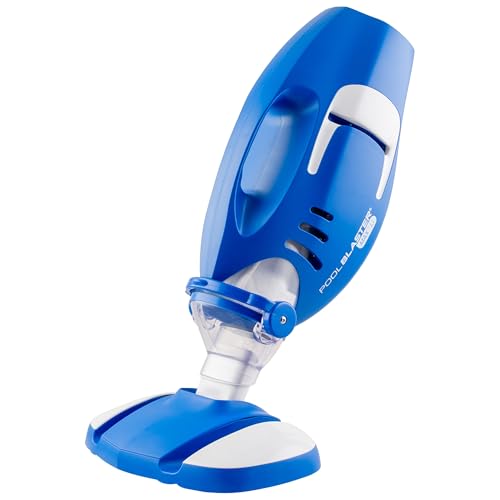
If you want a pool vacuum that’s best for quick weekly cleanups without hoses or cords getting in your way, the POOL BLASTER Max Cordless Pool Vacuum is a strong fit. You get strong suction from the Water Tech P30 motor, plus a 10.5-inch head for fast passes and a crevice nozzle for tight corners. It grabs leaves, acorns, twigs, sand, and dirt with ease. Because it’s cordless and push-button simple, you can spot clean or cover the whole pool without hassle. You’ll get up to one hour of runtime, and it attaches to a standard telescopic pole, though you’ll need to buy that separately.
Best For: Pool owners who want a cordless, easy-to-use vacuum for quick weekly maintenance and spot cleaning in in-ground or soft-sided above-ground pools.
Pros:
- Strong Water Tech P30 suction cleans leaves, acorns, twigs, sand, and dirt effectively.
- Cordless, hose-free design with push-button operation makes cleaning simple and convenient.
- Includes a wide 10.5-inch vacuum head plus a crevice nozzle for both broad coverage and tight corners.
Cons:
- Telescopic pool pole is not included and must be purchased separately for extended reach.
- Up to 1 hour of runtime may be limiting for larger or heavily dirty pools.
- Not intended for pool opening or heavy-debris cleanup.
VINGLI Automatic Pool Vacuum Cleaner with 33FT Hoses

For pool owners who want strong cleaning without the cost or hassle of a robotic unit, the VINGLI Automatic Pool Vacuum Cleaner with 33FT Hoses is a smart fit. You connect it to your existing filtration system, and it gets to work with suction power that cleans floors, climbs walls, and reaches tight corners with its wheel deflector. Setup takes about three minutes, so you won’t waste your weekend.
You also get ten scuff-resistant hoses, adjustable suction, and quiet operation. If your pool pump meets the 3/4 HP or 1600 GPH minimum, this cleaner handles dirt and debris without constant babysitting, plus warranty-backed replacement parts help.
Best For: Pool owners with in-ground pools who want an affordable, quiet automatic cleaner that works with their existing filtration system and can handle floors, walls, and tight corners.
Pros:
- Quick 3-minute setup and connects to your existing filtration system for convenient, user-installed operation.
- Suction-powered cleaning handles dirt and debris on pool floors and walls, with adjustable suction and a wheel deflector for tight corners.
- Includes 33 ft of scuff-resistant hoses, operates quietly, and comes with a one-year warranty plus free replacement for broken parts.
Cons:
- Requires a minimum 3/4 HP pump or 1600 GPH, so it may not work well with weaker pool systems.
- Designed as a suction cleaner, so it depends on your pool’s filtration performance rather than operating independently like a robotic unit.
- Made of plastic and has a limited warranty, which may be a drawback for buyers wanting more premium materials or longer coverage.
Cordless Robotic Pool Vacuum Cleaner for Inground Pools

A cordless robotic pool vacuum cleaner for inground pools is a smart pick whenever you want strong cleaning without the hassle of cords, hoses, or constant setup. You get battery-powered freedom, plus an automatic stop at the pool edge when the cycle ends or power runs low, so retrieval feels easy with the included hook. Its independent pump motor and 300μm filter handle leaves, sand, algae, hair, and other debris on floors, walls, and the waterline. Large top-load cartridges rinse clean fast. With a 7800mAh battery, 150-plus minutes of runtime, 3D guidance, and support for surfaces up to 2200 square feet, you can clean with confidence.
Best For: Pool owners who want a cordless robotic cleaner that can handle floor, wall, and waterline cleaning across different pool shapes and surfaces with minimal setup.
Pros:
- Cordless, battery-powered design eliminates tangled cords and hoses, and it automatically stops at the pool edge for easier retrieval.
- Cleans floors, walls, and waterline while capturing leaves, sand, algae, and hair with an independent pump motor and 300μm filtration.
- Long 150+ minute runtime, fast 2.3-hour charging, and 3D navigation support pools up to 2200 sq.ft. in rectangular, oval, and free-form layouts.
Cons:
- The 300μm filter may not capture the finest dust or ultra-fine particles compared with finer filtration systems.
- At 8.44 kg, it may feel somewhat heavy for some users when lifting it out of the pool.
- Load capacity is listed at 2 pounds, which may limit how much larger debris it can hold before needing to be emptied.
T403 Handheld Rechargeable Pool Vacuum with Telescopic Pole

Busy pool owners who want quick, cordless cleanup will get the most from the Enhulk T403 Handheld Rechargeable Pool Vacuum with Telescopic Pole. You get strong suction from a 20V, 40W motor, with up to 4200L/h flow and 18.5 gallons per minute to lift leaves, sand, bugs, and twigs fast.
That power pairs nicely with easy handling. You can switch between the short handle and the 3 to 7.3 foot telescopic pole for steps, corners, and deeper water. Four reusable filter bags, including 180 and 500 mesh options, help you match fine sand or bigger debris. It runs up to 60 minutes and recharges in only 1.5 hours.
Best For: Pool owners who want a cordless, lightweight vacuum for fast spot cleaning of leaves, sand, bugs, and small debris in above-ground or in-ground pools.
Pros:
- Strong 20V, 40W motor delivers up to 4200L/h flow and 18.5 gallons per minute suction for quick debris pickup.
- Includes both a short handle and a telescopic pole that extends from 3 to 7.3 ft for flexible cleaning reach.
- Up to 60 minutes of runtime with a fast 1.5-hour recharge, plus four reusable filter bags in 180 and 500 mesh options.
Cons:
- Assembly and manual installation are required before first use.
- Plastic and polypropylene construction may feel less premium than heavier-duty materials.
- Needs to be cleaned and dried after each use to maintain performance.
POOL SHARK Pro Cordless Pool Vacuum Cleaner

When you want strong suction without dragging a cord through the water, the POOL SHARK Pro Cordless Pool Vacuum Cleaner stands out as a smart pick for pool and spa owners who need fast, flexible cleanup. You get powerful underwater cleaning for up to 1.5 to 2 hours, and it recharges in about 3 hours.
That freedom matters because you can move easily from open floors to tight corners. Its 3 in 1 tools include a large pool head brush nozzle, a spa brush nozzle, and a roller nozzle for edges and tricky spots. The large debris chamber and filtration system trap leaves, acorns, sand, and dirt in inground, above ground, and spa settings.
Best For: Pool and spa owners who want strong cordless suction, flexible tool options, and easy cleaning for inground pools, above ground pools, and spas.
Pros:
- Cordless design delivers strong underwater suction with up to 1.5–2 hours of runtime.
- Includes 3-in-1 cleaning tools for floors, corners, edges, and other hard-to-reach areas.
- Large debris chamber and filtration system capture leaves, acorns, sand, dirt, and other debris efficiently.
Cons:
- 3-hour recharge time may feel long between cleaning sessions.
- Runtime may be limiting for very large pools or extended deep-cleaning jobs.
- Manual vacuum design may require more hands-on effort than fully automated pool cleaners.
XtremepowerUS Automatic Suction Pool Cleaner with Hose Set

For pool owners who want simple, hands-free cleaning without adding extra power costs, the XtremepowerUS Automatic Suction Pool Cleaner with Hose Set is a strong fit. You connect it to your pool’s existing filtration system, so you won’t need tools or extra electricity. It works best in in-ground pools and cleans the bottom and walls, though it won’t handle stairs.
That practical setup also keeps upkeep easy. You get 10 hoses for pools up to 30 feet, and the cleaner moves at 8 to 12 feet per minute with self-navigation and a set pattern. Just make sure your pump has at least 1 hp or 1600 GHP.
Best For: In-ground pool owners who want an automatic, hands-free suction cleaner that uses their existing filtration system without adding electricity costs.
Pros:
- Connects to the existing filtration system with no tools or extra electricity required
- Cleans both pool floors and walls with automatic self-navigation and set-pattern operation
- Includes 10 hoses for pools up to 30 feet and offers low-maintenance, eco-friendly operation
Cons:
- Not suitable for cleaning stairs
- Requires a pool pump with at least 1 hp or 1600 GHP
- Designed for in-ground pools only, limiting compatibility with other pool types
Factors to Consider When Choosing Vacuums For Pools
Before I choose a pool vacuum, I look at whether it fits your pool type and can clean the full coverage area without missing key spots. I also compare power source options, then check runtime and charge so you don’t end up with a cleaner that quits too soon. Just as crucial, I pay close attention to filtration and debris handling, because that’s what keeps your pool looking clear instead of half-clean.
Pool Type Compatibility
Because the right pool vacuum has to fit your pool, I always start with compatibility instead of features. Initially, I match the cleaner to the pool itself. Some vacuums work only in in-ground pools, while others also handle above-ground and even soft-sided models. That one detail can save you money and frustration.
Next, I check the pool surface. Vinyl, tile, fiberglass, and concrete all have different needs, and not every vacuum is safe for each finish. Then I verify the size limit, since some models top out at 30 feet, 33 feet, or about 2200 square feet. When you want a suction-side cleaner, I also confirm your pump can support it, whether that means 3/4 HP, 1 HP, or roughly 1600 GPH. I also check whether it cleans floors, walls, and waterlines.
Cleaning Coverage Area
Once I know a vacuum fits the pool itself, I look at how much of the pool it can actually clean on its own. I match its coverage rating to my pool size, because some units handle pools up to 30 or 33 feet, while others cover about 2,200 square feet.
Next, I check what surfaces it cleans. Some vacuums clean only the floor, while others scrub the floor, walls, and waterline. That wider reach saves me from annoying hand-cleaning later.
Then I consider layout. Provided I have a rectangular, oval, or free-form pool, I want smart route guidance that helps the vacuum cover the whole shape. For suction cleaners, I verify hose length and flow needs too. And provided my pool has tight corners or tricky edges, wall-climbing ability or special corner tools really matter.
Power Source Options
While coverage tells me where a pool vacuum can clean, its power source tells me how easy that cleaning will feel day after day. I look initially at three choices: corded electric, cordless battery, and suction-powered models that use your pool pump.
From there, I match the vacuum to your setup. Corded electric units give steady power and often support cleaning cycles of two hours or more, but they need an outlet and smart cable handling. Cordless models feel lighter and easier to move, which can be a relief around steps or tight corners. Suction-powered cleaners skip a separate motor, yet they depend on your filtration system, so pump strength matters. I also check voltage, battery capacity, and operating depth, because those details shape suction, all-around performance, and safe use in your pool.
Runtime And Charge
Usually, I treat runtime and charge time as the real test of whether a cordless pool vacuum will fit your routine, because a cleaner that quits prematurely can turn a simple chore into a second trip outside.
When I compare models, I look first at full-charge runtime. Some run about 60 minutes, while stronger options can pass 150 minutes. That gap matters more than it seems. Battery size often explains it, too, since packs around 7800mAh usually last longer than smaller 2200mAh versions. Next, I check recharge speed. Some units refill in roughly 1.5 to 2.3 hours, but others need 3 to 4. Should you’re cleaning a large pool, I’d pick a vacuum that comfortably outlasts the job. For light upkeep, shorter runtime can work, though faster charging still saves frustration later.
Filtration And Debris
Because debris can range from big leaves to nearly invisible grit, I pay close attention to the vacuum’s filtration system before I trust it in my pool. I match the mesh or basket size to what actually falls in. Wider openings handle leaves and twigs well, while finer filters catch sand, hair, and algae that can cloud water fast.
Just as vital, I check debris capacity. A bigger basket or chamber means fewer stops, which makes cleaning feel far less frustrating. Whenever my pool gets a mix of heavy and tiny debris, I prefer strong suction paired with reusable filter bags or top-load baskets. For very fine material, I look for micro-level filtration, like 300μm filters. I also want a debris path that resists clogging and fits how I like to clean every week.
Setup And Maintenance
Since a pool vacuum only helps provided it’s easy to get running and simple to care for, I always check setup and maintenance before I buy one. I match the vacuum to my pool system first, because some are truly plug-and-play, while others need hoses, a pole, or connection to the existing filter.
From there, I look at assembly time. If I can get it working in minutes, I’m happier and more likely to use it often. After setup, cleanup matters just as much. I prefer a top-load basket or a large filter cartridge I can pull out and rinse fast with a garden hose. With battery models, I plan around charging time and runtime. I also like reusable filter bags, auto-stop at the pool edge, and designs that cut down on scrubbing.
Hose Cord Limitations
After I know a pool vacuum is easy to set up and maintain, I look at how far it can actually reach. That sounds basic, but it matters more than most people expect. A hose-based cleaner can miss areas when the hose is too short for the pool size. In suction-side models, I also watch for kinks, weak flow, and layouts that fight the hose path.
Then I compare corded and cordless options. A corded robotic vacuum frees me from hoses, yet the power cord still has to reach the farthest spot safely. A cordless model removes both hose and cord limits, which feels wonderfully simple. Still, I have to respect battery time, often about 60 to 150 minutes. And in pools with tight corners or curves, longer hoses can make movement clumsy and coverage uneven.
Warranty And Support
While reach and runtime tell me how well a pool vacuum can cover the water, warranty and support tell me what happens whenever real life gets messy. I always check the warranty length initially, because coverage often ranges from one year to limited plans that change depending on model. That small detail can save you stress later.
Next, I look for clear support before I buy. I want customer service I can actually reach, replacement-part rules that make sense, and troubleshooting guides that don’t read like a riddle. I also prefer brands that explain repair help for broken parts, since that cuts downtime and surprise costs. From there, I verify as soon as coverage starts, usually on the purchase date, and what it includes. Good manuals and simple care instructions also make ownership feel much easier over time.
Frequently Asked Questions
Can Pool Vacuums Be Safely Used in Saltwater Pools?
Many pool vacuums work safely in saltwater pools when they are made with corrosion resistant stainless steel or durable plastics. Rinse the vacuum after each use and check the manufacturer’s saltwater compatibility instructions before using it.
How Often Should I Replace a Pool Vacuum’s Filter?
Replace your pool vacuum’s filter every 1 to 2 seasons, or earlier if the vacuum gets a lot of use. One summer, mine clogged after three months and suction fell off quickly, so waiting longer did not make sense.
Are Pool Vacuums Covered Under Homeowners or Pool Warranties?
Homeowners insurance rarely pays for a pool vacuum unless it was damaged by a specific covered peril such as fire, theft, or a storm. Manufacturer warranties or pool equipment warranties may help with defects for a limited period, but routine wear, misuse, and replaceable parts are commonly excluded.
Can Pool Vacuums Remove Algae After a Pool Shock Treatment?
Pool vacuums can pick up dead algae after shock treatment, but they do not eliminate active algae. Wait until the water chemistry stabilizes, then vacuum at a slow pace so the debris is not stirred back into the water. Finish by cleaning the vacuum and rinsing or backwashing the filter thoroughly.
What’s the Average Lifespan of a Pool Vacuum Motor?
A pool vacuum motor usually lasts 3 to 8 years. Cleaning the filters, preventing overheating, and storing the unit correctly can help the motor last longer.
