

I envision a smooth, modern thermostat glowing on an older home’s wall, quietly replacing tangled wiring and guesswork. I know swapping thermostats can feel intimidating, but there are solid options that skip the C wire without sacrificing smart features. I’ll walk you through seven top selections for 2026 and what makes each one worth considering—so you can find the right balance of simplicity, compatibility, and control.
Honeywell Home RTH6580WF Wi-Fi 7-Day Programmable Thermostat, White

In case you want a budget‑friendly, easy‑to‑install smart thermostat that still gives you remote control and voice integration, the Honeywell Home RTH6580WF fits the bill—though be aware it actually requires a C‑wire, so it’s best in case your home already has one or you’re comfortable adding one during DIY installation. You’ll control it via the Honeywell apps or Total Connect Comfort, and use Alexa, Google Assistant, or Cortana for voice commands. The large backlit display and Smart Response learning simplify daily use. It’s Energy Star certified, supports utility programs, and suits many forced‑air, hot water, steam, and heat pump systems.
Best For: home owners who want a budget‑friendly, DIY smart thermostat with app and voice control and who already have (or can add) a C‑wire.
Pros:
- Affordable smart thermostat with remote control via Honeywell apps and compatibility with Alexa, Google Assistant, and Cortana.
- Easy DIY installation for most forced‑air, hot water, steam, and heat pump systems; large backlit display and Smart Response learning for simplified daily use.
- Energy Star certified and supports utility programs for added energy savings and integration with smart home ecosystems.
Cons:
- Requires a C‑wire (not suitable out‑of‑the‑box for homes without one unless you add wiring).
- Not compatible with high‑voltage electric baseboard heating (120–240V) systems.
- Lacks some advanced features found in higher‑end smart thermostats (fewer sensors, less sophisticated scheduling/learning).
Programmable 2H/2C Multi-Stage HVAC Thermostat

Looking for a thermostat that handles complex systems without a C-wire? You’ll appreciate this Programmable 2H/2C Multi-Stage HVAC Thermostat provided your home uses single- or multi-stage equipment. It supports forced air (gas, oil, electric), electric furnaces, hot water/steam, gravity radiant, heat-only systems, certain heat pumps, millivolt and gas fireplaces, floor/wall furnaces, and cool-only systems. It won’t work with heat pumps needing aux/emergency heat, dual fuel setups, electric baseboard (110–240V), line voltage, convectors, radiant-ceiling, mini-splits, or 12V RV systems. Installation is quick with a universal sub-base, clear backlit LCD, flexible programming, and 24/7 manufacturer support.
Best For: Homeowners with single- or multi-stage forced-air or hydronic HVAC systems who need programmable multi-stage control without relying on a C-wire.
Pros:
- Supports up to 2 heat / 2 cool stages and a wide range of system types (forced air, hot water/steam, gravity radiant, millivolt, gas fireplace), making it versatile for many residential setups.
- Easy installation with a universal sub-base and large terminal blocks, plus a clear backlit LCD and user-friendly programming (7-day, 5/1/1) for flexible scheduling and visibility.
- Includes a factory energy-efficiency program and 24/7 manufacturer support from an experienced producer, helping optimize system performance and get help when needed.
Cons:
- Not compatible with common modern systems like heat pumps requiring auxiliary/emergency heat, dual-fuel hybrids, mini-splits, electric baseboard (110–240V), line voltage, or radiant-ceiling heating.
- Requires confirming system voltage/type beforehand; incompatible system types (e.g., 12V RV, convectors) limit applicability and may necessitate buying a different thermostat.
- Lacks support for C-wire-powered smart features (if the user specifically needs Wi-Fi/smart integrations), so functionality may be more basic compared with smart thermostats.
Honeywell Home Non-Programmable Single-Stage Thermostat

The Honeywell Home Non-Programmable Single-Stage Thermostat is the best choice in case you want a simple, reliable digital control for 1 heat/1 cool systems without a C wire. You’ll get model X1N (RTH11B), a non-programmable digital thermostat for single-stage heating/cooling, compatible with 750 mV, hot water, and forced-air systems (not 120–240V baseboard). It uses 2 AAA batteries, mounts on a UWP wall plate, and features a large backlit LCD, push-button control, customizable display, and change-filter alerts. It measures 6.44×1.50×8.25 inches, weighs 0.84 lb, includes a one-year warranty, and ships without batteries.
Best For: Homeowners or renters who want a simple, reliable, non-programmable digital thermostat for single-stage heating/cooling systems (no C wire) with easy installation and a clear backlit display.
Pros:
- Simple, user-friendly push-button digital control with a large backlit LCD for easy visibility.
- Compatible with common single-stage systems (750 mV, hot water, forced air) and mounts on a UWP wall plate for easy setup and future upgrades.
- Battery-powered (2 AAA) so it works without a C wire and includes change-filter reminders for basic maintenance.
Cons:
- Not compatible with electric baseboard heat (120–240V) or multi-stage HVAC systems.
- Non-programmable—lacks scheduling, remote control, or smart home integration features.
- Batteries not included and only a 1-year manufacturer warranty.
Smart WiFi Programmable Thermostat with C-Wire Adapter

Should you want a hassle-free upgrade for homes without a C-wire, this Smart WiFi Programmable Thermostat with C-Wire Adapter is a great pick—its included adapter powers the unit without rewiring, so you’ll get smart features even on single-stage or battery systems. You’ll find broad compatibility with 3H/2C heat pumps and conventional multi-stage setups, making it suitable for upgrades or new installs. A bright LED color touchscreen gives intuitive controls and quick status checks. Use Tuya Smart, Smart Life, Google Home, or Alexa for remote and voice control. Seven-day programming balances comfort and savings, and DIY setup is straightforward.
Best For: Homeowners seeking an easy, budget-friendly smart thermostat upgrade for homes without a C-wire who want app and voice control plus simple 7-day scheduling.
Pros:
- Includes a C-wire adapter so it powers systems without rewiring, enabling compatibility with single-stage or battery systems.
- Wide system compatibility (3H/2C heat pump and multi-stage conventional systems) suitable for upgrades or new installs.
- Bright LED color touchscreen with intuitive controls and integration with Tuya Smart, Smart Life, Google Home, and Alexa for remote and voice control.
Cons:
- May lack advanced learning or energy-optimization features found in higher-end smart thermostats.
- Reliance on the adapter for power could be less reliable than a true C-wire connection in some setups.
- DIY installation, while straightforward, might still be challenging for users uncomfortable with basic HVAC wiring.
WiFi Single-Stage Home Thermostat with App Control

In case you have a single-stage 1H/1C HVAC system and can provide a 24V C-wire, this WiFi thermostat gives you app-based remote control and precise ±1°F temperature management—ideal for homeowners who want 7-day scheduling and real-time monitoring without fuss. You’ll connect over 2.4GHz WiFi (no 5GHz), use the smartphone app to adjust temps, set multi-period schedules, and monitor system status from anywhere. It’s for standard single-stage gas, oil, or electric furnaces only; no heat pumps, multi-stage systems, mini-splits, PTACs, baseboard heaters, or RV units. Requires C-wire; pro install recommended should missing. Specs: Heagstat STN701W.
Best For: Homeowners with a standard single-stage (1H/1C) gas, oil, or electric HVAC system who have (or can install) a 24V C‑wire and want app-based remote control and 7-day scheduling.
Pros:
- Precise ±1°F temperature control with 7-day programmable, multi-period scheduling for energy savings.
- App-based remote control and real-time system monitoring from anywhere via 2.4GHz WiFi.
- Backlit LCD and user-friendly interface; compact design and straightforward compatibility with common single-stage systems.
Cons:
- Requires a mandatory 24V C‑wire (no battery operation), which may necessitate professional installation in older homes.
- Only supports 2.4GHz WiFi and is incompatible with 5GHz networks.
- Not compatible with heat pumps, multi-stage systems, PTACs, mini-splits, electric baseboard (line-voltage) heaters, or RV units.
Non-Programmable Single-Stage Home Thermostat (1 Heat/1 Cool)

Need a simple, reliable thermostat? You’ll like this non-programmable single-stage model for 1 heat/1 cool systems. It keeps temperature control straightforward, reduces wasted energy with separate heating/cooling swings, and displays settings on a large white backlit LCD. The minimalist plastic housing uses push buttons and touch input, shows low-battery alerts, and has eco-friendly features. DIY installation takes about 30 minutes using the universal sub-base and large terminal blocks; it accepts 2–5 wires and runs on 24VAC or two AAA batteries (no C-wire usually needed). Includes thermostat, screws, manual, and cable label; check wiring compatibility before buying.
Best For: homeowners with a straightforward single-stage (1 heat/1 cool) HVAC system who want an easy-to-install, no-frills thermostat for reliable temperature control and energy savings.
Pros:
- Simple non-programmable design with large white backlit LCD and intuitive push-button/touch controls for easy daily use.
- Flexible power options (24VAC or 2×AAA batteries) and universal sub-base with large terminal blocks enable quick DIY installation (approx. 30 minutes) for 2–5 wire systems.
- Separate heating and cooling swing optimization and low-battery indicator help improve comfort and reduce wasted energy.
Cons:
- Not compatible with more complex 6–8 wire systems or advanced HVAC setups (no multi-stage or smart features).
- Limited functionality due to non-programmable design—no scheduling, remote control, or learning capabilities.
- Minimalist plastic housing and basic feature set may not suit users wanting premium aesthetics or advanced energy-management tools.
Smart WiFi Programmable Thermostat w/ C-Wire Adapter
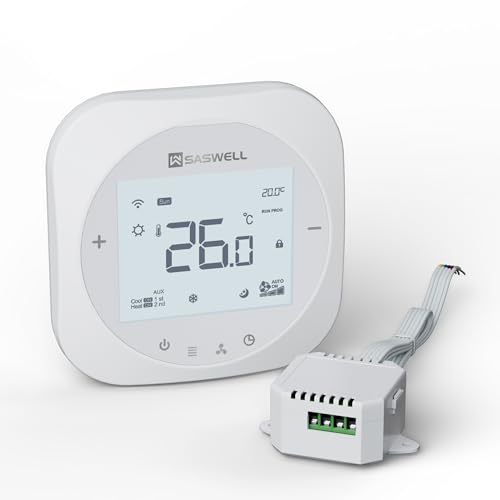
Should you don’t have a C-wire but want full smart control, the SASWELL T18BUTW-7-WIFI(TY) is a great pick—its included C-wire adapter lets you retrofit most single-stage or battery-powered systems without calling an electrician. You’ll get Wi‑Fi access, Tuya/Smart Life app support, and Google Home/Alexa voice control to adjust temperature remotely. The bright LED touch screen shows status clearly and supports 7-day scheduling for weekday/weekend routines. It works with 3H/2C heat pumps and conventional multi-stage systems, offers fan control, and runs on 24V. DIY installation is straightforward, and the white, wall‑mount design fits most interiors.
Best For: Homeowners or DIYers without a C-wire who want an affordable smart thermostat with app and voice control for retrofit or multi-stage systems.
Pros:
- Includes C-wire adapter for easy retrofit to battery-powered or single-stage systems without an electrician.
- Wi‑Fi with Tuya/Smart Life, Google Home, and Alexa support for remote app control and voice commands.
- Bright LED touch screen and 7-day scheduling (weekday/weekend) for convenient local control and programming.
Cons:
- Requires a 24V system, so incompatible with some low-voltage or proprietary HVAC controls.
- May not support every obscure or very old HVAC wiring configuration despite broad compatibility.
- Relies on third-party Tuya/Smart Life ecosystem, which may be a concern for users preferring native brand/cloud independence.
Factors to Consider When Choosing Thermostats Without C Wire
Before you pick a no-C-wire thermostat, I look at five key factors: available power options, compatibility with your HVAC system, how complex the install will be, which smart features it supports, and the clarity of the display and controls. Those points determine reliability, ease of setup, and whether the device will actually meet your daily needs. Keep them in mind as we compare specific models.
Power Options Available
While you don’t have a C-wire, you still have practical power choices for a thermostat: I look for battery-powered models (usually AA or AAA), units with a C-wire adapter, or dual-supply designs that use 24VAC with battery backup. I prefer battery-powered units for easy installation; they run on common cells and avoid rewiring, although you’ll need to swap batteries periodically. C-wire adapters let the thermostat steal power from existing wires without a dedicated common, a neat compromise whenever you don’t want new wiring. Dual-supply options combine 24VAC input with battery backup, giving reliable operation during short power interruptions. Manufacturers also optimize power consumption to stretch battery life while keeping displays and wireless features active, so check estimated runtimes.
Compatibility With Systems
Because my home’s wiring and HVAC type determine what a no-C-wire thermostat can actually drive, I always check system compatibility initially. I look for thermostats that can run on batteries or use built-in power-stealing or adapter solutions, since many models won’t work where 24VAC is required. Single-stage forced-air systems are usually fine, but multi-stage and heat pump setups often have limited support, so I verify manufacturer lists. I never assume electric baseboard (120–240V line voltage) will be compatible; those typically need line-voltage thermostats. Some no-C-wire models include adapters or specific support for hot-water or steam systems, but I confirm the exact HVAC type and wiring voltages before choosing one to avoid mismatch and guarantee reliable control.
Installation Complexity Level
Having confirmed compatibility with my HVAC, I next look at how hard the actual installation will be—no-C-wire options can save a lot of wiring work, but they vary in complexity. I’ve found most no-C-wire thermostats simplify installation through avoiding a dedicated common wire, which is especially helpful in older homes. Many are designed for DIY setup, using existing wires and clearer terminal blocks, so installation often takes 30 to 60 minutes. Some models include C-wire adapters to bridge gaps without costly rewiring. Before I begin, I always review wiring diagrams and power requirements to avoid compatibility issues. In the event a system’s wiring looks unusual or the adapter won’t help, I’ll hire a pro to prevent damage or performance problems.
Smart Features Supported
In case I want a no-C-wire thermostat to feel truly “smart,” I focus on which connectivity and control features it actually offers. I prioritize Wi‑Fi so I can use a smartphone app for remote temperature changes, scheduling, and system monitoring without crawling into the attic. Battery operation or a C‑wire adapter matters since these power approaches affect feature reliability. I look for voice control compatibility with Alexa, Google Assistant, or similar ecosystems so hands‑free commands work smoothly. Programmable schedules — typically 7‑day or multi‑period — let me balance comfort and energy savings even without a hardwired power source. Finally, a clear touchscreen or LED display helps me manage settings locally whenever my phone or voice isn’t handy.
Display And Controls
I also pay close attention to display and controls, since they’re what I use every day whenever my phone or voice assistant isn’t handy. I look for large, clear backlit LCD or LED displays so I can read settings at a glance in bright or dim rooms. I prefer touchscreens as long as they’re responsive and intuitive, but well-designed button controls work fine provided they’re simple to operate. Color LED screens with touch make status checks and programming faster, letting me confirm modes without digging into menus. Display size and adjustable brightness matter for visibility. Finally, I value responsive controls that suit DIY installation—easy scheduling and temperature changes without complex wiring keep the thermostat practical and frustration-free.
Energy Saving Modes
Because my goal is to cut energy use without sacrificing comfort, I focus on how a no-C-wire thermostat saves power through smarter scheduling, adaptive learning, and low-power operation. I prioritize models that offer programmable schedules—7-day or weekend/weekday options—so heating and cooling match at times people are actually home. I value adaptive learning that predicts cycles and reduces runtime without noticeable temperature swings. Low-power strategies like dimming displays and throttling Wi‑Fi extend battery life and cut standby draw, which is essential without a C wire. I also look for automatic heat/cool switchover to prevent simultaneous system operation. In short, the best no-C-wire thermostats combine precise scheduling, learning algorithms, and conservative hardware behaviors to lower energy use reliably.
