

Most people don’t realize many smart thermostats can run without a C‑wire via relying on batteries or power-stealing tricks. You’ll want to know which models actually keep schedules, stay connected, and won’t short out your HVAC system. This guide compares seven top options for 2026—covering learning thermostats, battery-powered basics, and rechargeable smart units—so you can pick the right balance of features and compatibility before you commit.
| Nest T3016US – Programmable Thermostat |
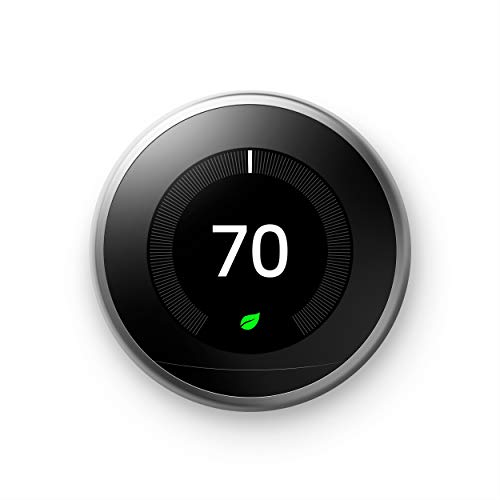
| Smart Learning Pick | Compatibility Type: Works with many central HVAC systems; online compatibility checker | Power Options / C‑Wire Requirement: Implied battery/low‑power design; compatibility checker for power requirements (C‑wire guidance) | Remote / App or Control Support: Remote control via Nest app | VIEW LATEST PRICE | Read Our Analysis |
| Vine WiFi Smart Thermostat with Nightlight (C-Wire) |
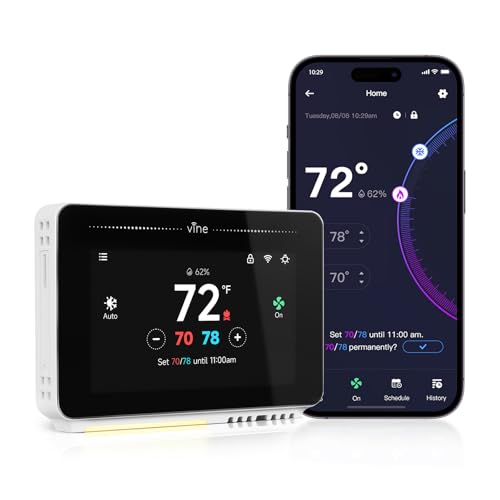
| Feature-Rich Smart | Compatibility Type: Compatible with ~90% of 24V systems (2H/2C, heat pump, heat‑only/cool‑only) | Power Options / C‑Wire Requirement: Requires C‑wire (common wire required) | Remote / App or Control Support: Remote control via Vine Thermostat or Smart Life app | VIEW LATEST PRICE | Read Our Analysis |
| Honeywell Home RTH2300B1038 5-2 Day Programmable Thermostat White |
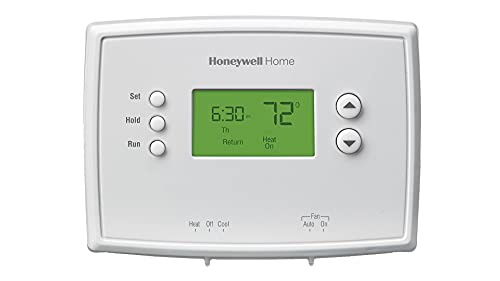
| Simple Programmable Option | Compatibility Type: Compatible with furnaces, central AC, hot water, millivolt, heat pumps without aux heat | Power Options / C‑Wire Requirement: Battery powered (retains memory); no explicit C‑wire required | Remote / App or Control Support: No remote/app control (local digital thermostat only) | VIEW LATEST PRICE | Read Our Analysis |
| Honeywell Home RTH7600D 7-Day Programmable Touchscreen Thermostat White |

| Advanced Control Choice | Compatibility Type: Compatible with single‑stage and multi‑stage HVAC, heat pumps, hot water, steam, 750 mV, gas fireplaces | Power Options / C‑Wire Requirement: Typical line/24VAC installation; C‑wire not explicitly required (works with many system types) | Remote / App or Control Support: Local touchscreen control (no cloud app described) | VIEW LATEST PRICE | Read Our Analysis |
| Honeywell T5 WiFi Smart Thermostat (RTH8800WF2022) |

| Energy-Saving Smart | Compatibility Type: Works with most heat/cool systems (C‑wire recommended); not for heating‑only oil without C‑wire | Power Options / C‑Wire Requirement: C‑wire required (or C‑wire adapter may be needed) | Remote / App or Control Support: Wi‑Fi enabled for remote control and Alexa compatibility | VIEW LATEST PRICE | Read Our Analysis |
| Nonprogrammable Digital Thermostat for Single-Stage HVAC |

| No-Frills Reliable | Compatibility Type: Compatible with single‑stage heating & cooling, various heat‑only systems; not for multistage or heat pumps | Power Options / C‑Wire Requirement: Dual power: 24 VAC or 2×AA batteries; C‑wire not required for most systems (required for some) | Remote / App or Control Support: Local control only (nonprogrammable digital) | VIEW LATEST PRICE | Read Our Analysis |
| Non-Programmable Single-Stage Home Thermostat (1 Heat/1 Cool) |

| Easy DIY Pick | Compatibility Type: Compatible with conventional single‑stage systems (1 heat/1 cool); C‑wire may be required for some heat‑only/cool‑only setups | Power Options / C‑Wire Requirement: Dual power: 24VAC or 2×AAA batteries; C‑wire not required for most systems (required for heat‑only/cool‑only) | Remote / App or Control Support: Local control only (nonprogrammable) | VIEW LATEST PRICE | Read Our Analysis |
More Details on Our Top Picks
Nest T3016US – Programmable Thermostat
Should you want a smart thermostat that works without a C wire and virtually eliminates manual programming, the Nest T3016US is a strong pick—its Auto‑Schedule learns your temperature preferences over time, so you don’t have to fiddle with settings, and Home/Away Assist helps cut energy use whenever no one’s home. You’ll see a Nest Leaf whenever your chosen temperature saves energy, and Energy History shows usage and why changes occurred. Control it remotely via the Nest app, check system compatibility with Google Nest’s online checker before buying, and enjoy a thermostat that adapts over time so you rarely touch the controls.
- Compatibility Type:Works with many central HVAC systems; online compatibility checker
- Power Options / C‑Wire Requirement:Implied battery/low‑power design; compatibility checker for power requirements (C‑wire guidance)
- Remote / App or Control Support:Remote control via Nest app
- Programmability / Scheduling:Self‑learning Auto‑Schedule (no manual programming required)
- Display Type:Built‑in display (Nest visual interface)
- Installation / DIY Friendly:DIY install with online compatibility checker and support resources
- Additional Feature:Nest Leaf indicator
- Additional Feature:Energy History reports
- Additional Feature:Auto-Schedule learning
Vine WiFi Smart Thermostat with Nightlight (C-Wire)
Should you have a conventional 24V system and can add a common wire, the Vine WiFi Smart Thermostat with Nightlight is a strong pick for homeowners who want a straightforward, feature-rich upgrade. You’ll get broad compatibility with 90% of 24V systems—including conventional and heat pump setups—and a QR code to confirm fit. The 4.3-inch touchscreen includes a gentle nightlight for dark rooms. Control it remotely via the Vine Thermostat or Smart Life app, and use Alexa or Google voice commands. You’ll also get 7-day scheduling, Auto Home/Away, fan control, weather forecasts, OTA updates, and easy DIY installation.
- Compatibility Type:Compatible with ~90% of 24V systems (2H/2C, heat pump, heat‑only/cool‑only)
- Power Options / C‑Wire Requirement:Requires C‑wire (common wire required)
- Remote / App or Control Support:Remote control via Vine Thermostat or Smart Life app
- Programmability / Scheduling:7‑day scheduling with 8 periods per day
- Display Type:4.3‑inch large touchscreen
- Installation / DIY Friendly:Quick DIY install (≈30 minutes) with guides, wire labels, mounting hardware
- Additional Feature:4.3″ touchscreen display
- Additional Feature:Built-in nightlight function
- Additional Feature:OTA updates & encryption
Honeywell Home RTH2300B1038 5-2 Day Programmable Thermostat White
In case you want a straightforward programmable thermostat that works without a C wire, the Honeywell RTH2300B1038 is a solid pick for households that need reliable, simple scheduling—especially in case you want separate weekday and weekend routines. You’ll get 5-2 day programming with four periods per day (wake, leave, arrive, sleep) and ±1°F accuracy. Set minimum cooling and maximum heating limits to protect systems. It’s compatible with many furnaces, central AC, hot water and millivolt systems, but not with multistage, line-voltage, radiant, or heat pumps with backup. DIY install, backlit display, memory retention, and battery/filter alerts make it practical.
- Compatibility Type:Compatible with furnaces, central AC, hot water, millivolt, heat pumps without aux heat
- Power Options / C‑Wire Requirement:Battery powered (retains memory); no explicit C‑wire required
- Remote / App or Control Support:No remote/app control (local digital thermostat only)
- Programmability / Scheduling:5‑2 day programming; 4 periods per day
- Display Type:Digital backlit display
- Installation / DIY Friendly:Easy DIY installation; retains memory during outages
- Additional Feature:±1°F accuracy
- Additional Feature:Battery/filter reminders
- Additional Feature:Retains memory outage
Honeywell Home RTH7600D 7-Day Programmable Touchscreen Thermostat White
Should you want a programmable touchscreen thermostat that works with many older and diverse HVAC setups without demanding a C wire, the Honeywell Home RTH7600D is a solid pick. You get a large backlit touchscreen that shows room and set temperatures together, plus an auto-adjusting clock. Its 7-day programming lets you set four periods per day with home/away temps and temporary or permanent holds. Smart Response learns run times; compressor protection prevents rapid restarts. It supports single- and multi-stage systems, heat pumps, furnaces, hot water, steam, gas fireplaces and 750 mV systems. Installation is simple and alerts are optional.
- Compatibility Type:Compatible with single‑stage and multi‑stage HVAC, heat pumps, hot water, steam, 750 mV, gas fireplaces
- Power Options / C‑Wire Requirement:Typical line/24VAC installation; C‑wire not explicitly required (works with many system types)
- Remote / App or Control Support:Local touchscreen control (no cloud app described)
- Programmability / Scheduling:7‑day programmable; 4 periods per day
- Display Type:Large backlit touchscreen display
- Installation / DIY Friendly:Simple installation; straightforward operation
- Additional Feature:Smart Response Technology
- Additional Feature:Compressor protection delay
- Additional Feature:Auto DST clock adjust
Honeywell T5 WiFi Smart Thermostat (RTH8800WF2022)
Should you have a home with a C-wire and want reliable smart scheduling plus utility incentive options, the Honeywell T5 WiFi (RTH8800WF2022) is a strong pick—its 7‑day flexible scheduling, geofencing, and ENERGY STAR certification help cut heating and cooling costs while qualifying you for demand‑response programs and possible rebates. You’ll get 8–16% estimated savings, monthly energy reports, and personalized tips. Use Auto Home/Away or choose schedule- or location-based control. It’s Wi‑Fi and Alexa compatible. Confirm C-wire compatibility (adapter might be needed); it supports most heat/cool oil furnaces but won’t work with heating‑only oil systems without a C‑wire.
- Compatibility Type:Works with most heat/cool systems (C‑wire recommended); not for heating‑only oil without C‑wire
- Power Options / C‑Wire Requirement:C‑wire required (or C‑wire adapter may be needed)
- Remote / App or Control Support:Wi‑Fi enabled for remote control and Alexa compatibility
- Programmability / Scheduling:7‑day flexible scheduling; schedule or geofence options
- Display Type:Wi‑Fi smart display/interface (screened control)
- Installation / DIY Friendly:Home installation with potential C‑wire adapter; verify compatibility before purchase
- Additional Feature:ENERGY STAR certified
- Additional Feature:Geofencing location control
- Additional Feature:Utility demand-response eligible
Nonprogrammable Digital Thermostat for Single-Stage HVAC
In case you want a simple, reliable thermostat for a conventional single-stage heating or cooling system, this nonprogrammable digital model is a smart choice—its ±1°F accuracy and clear backlit LCD make precise temperature control easy. You’ll get straightforward control for 1 heat/1 cool systems, a room display (41–95°F) and control range (44–90°F), plus separate heating/cooling swing adjustments. It runs on 24 VAC or 2 AA batteries, usually doesn’t need a C-wire, and the base accepts up to five wires. Compatible with common furnaces and boilers but not multistage, heat pumps, mini-splits, or electric baseboard systems.
- Compatibility Type:Compatible with single‑stage heating & cooling, various heat‑only systems; not for multistage or heat pumps
- Power Options / C‑Wire Requirement:Dual power: 24 VAC or 2×AA batteries; C‑wire not required for most systems (required for some)
- Remote / App or Control Support:Local control only (nonprogrammable digital)
- Programmability / Scheduling:Nonprogrammable (single‑setpoint, manual control)
- Display Type:White backlight LCD display
- Installation / DIY Friendly:Easy DIY install (under 30 minutes); universal sub‑base
- Additional Feature:Dual 24VAC/AA power
- Additional Feature:Large terminal blocks
- Additional Feature:2-year warranty
Non-Programmable Single-Stage Home Thermostat (1 Heat/1 Cool)
Should you want a simple, reliable thermostat that works without a C‑wire, this non‑programmable single‑stage model is a solid pick for homes with one heat and one cool system. You’ll get straightforward temperature control for 1 heat/1 cool setups, adjustable swing (cycle rate) for comfort and efficiency, and a white backlit LCD that’s easy to read. It runs on 24VAC or two AAA batteries (note: C‑wire needed for heat‑only or cool‑only installs), and the base accepts only 2–5 wires. Installation is DIY‑friendly (about 30 minutes), but review wiring instructions and proceed cautiously should you be inexperienced.
- Compatibility Type:Compatible with conventional single‑stage systems (1 heat/1 cool); C‑wire may be required for some heat‑only/cool‑only setups
- Power Options / C‑Wire Requirement:Dual power: 24VAC or 2×AAA batteries; C‑wire not required for most systems (required for heat‑only/cool‑only)
- Remote / App or Control Support:Local control only (nonprogrammable)
- Programmability / Scheduling:Nonprogrammable (manual single‑stage thermostat)
- Display Type:Backlit LCD display
- Installation / DIY Friendly:Easy DIY installation; universal sub‑base with large terminal blocks
- Additional Feature:Adjustable swing (cycle rate)
- Additional Feature:Universal sub-base
- Additional Feature:AAA battery backup
Factors to Consider When Choosing a Thermostat Without C Wire
Upon picking a thermostat without a C wire, you’ll want to check what power options it supports and whether it’s compatible with your heating and cooling system. Consider which smart features matter to you, how difficult the installation will be, and whether the unit actually saves energy. These factors will help you choose a reliable, efficient model that fits your home and skills.
Power Options Available
Although you can get a thermostat working without a C‑wire, you’ll want to weigh how each power option affects reliability, features, and compatibility with your HVAC system. You can use replaceable AA/AAA batteries or built‑in rechargeable cells for continuous operation, but you’ll need periodic changes or charging. Power‑stealing models pull a tiny current from the control circuit to top up electronics; they avoid batteries but can destabilize older furnaces or control boards. Add‑on power modules (power extenders) install at the control board to simulate a C‑wire, supplying 24 VAC so smart features and radios run reliably without new wiring. For heavy‑duty smart thermostats, installing a real C‑wire or using a C‑wire adapter via a pro remains the most dependable option.
Compatibility With Systems
Because different HVAC setups demand different control signals, you’ll want to match the thermostat’s power method to your system type and wiring before swapping units. Check whether you have single‑stage or multistage equipment, a heat pump, or a heat‑only/cool‑only setup and count the control wires at the wall. Basic single‑stage digital or nonprogrammable units often run on batteries or intermittent 24 VAC and can work without a C‑wire. Heat‑only or cool‑only systems might still need batteries or power‑stealing designs to avoid a C‑wire. Multistage systems, heat pumps, and units with auxiliary/backup heat usually require a dedicated C‑wire for reliable, continuous power. Take into account that power‑stealing or adaptive charging can clash with some furnace or air‑handler control boards, so verify compatibility before installation.
Smart Features Supported
After you’ve matched the thermostat to your system wiring and power method, check which smart features will actually work without a C‑wire. You’ll want a unit that supports battery power or power‑stealing operation because Wi‑Fi, a continuous display, and frequent cloud sync need steady power. Look for models offering limited smart modes for C‑wire–less setups: basic remote control, scheduling, and geofencing that use intermittent radio/Wi‑Fi bursts to save energy. Confirm whether advanced capabilities—continuous learning, detailed energy reports, or real‑time syncing—are reduced or unavailable without a C‑wire. Also verify reliable voice‑assistant and third‑party integration only provided network uptime is maintained, and observe that OTA updates or weather features might be throttled to low‑power windows to preserve battery life.
Installation Complexity Level
As you contemplate installation complexity for a thermostat that doesn’t use a C‑wire, contemplate how your system type, your wiring, and your comfort with basic electrical troubleshooting will influence the time and tools required. Most no‑C‑wire models use batteries, so installation is often simpler and under 30 minutes for single‑stage systems whenever wiring and labels are intact. Complexity jumps in case you need Wi‑Fi or advanced sensors; adding a C‑wire adapter, repurposing an unused conductor, or running new wire adds time and electrical skill. Troubleshooting intermittent power, frequent battery drain, or reboots could require multimeter checks of control board voltage and mode wiring. For multi‑stage, heat‑pump, or hybrid systems, contemplate professional assessment—those setups are usually more complex.
Energy Saving Capabilities
At times you’re choosing a thermostat that doesn’t use a C‑wire, focus on how it’s powered and how it controls runtime—battery‑powered units and power‑stealing models behave very differently and that affects savings. You’ll want to check battery life and replacement frequency so you don’t get unexpected downtime that forces longer HVAC cycles. Prefer models with adaptive or adjustable swing settings to cut short cycling and improve system efficiency. Simple scheduling (weekday/weekend or multiple periods) can reduce runtime without constant Wi‑Fi draw. Basic, nonprogrammable units usually use less standby power than Wi‑Fi-heavy thermostats, so weigh connectivity against background energy use. Finally, consider occupancy or home/away sensing that works offline or with minimal power to trim runtime when no one’s home.
Frequently Asked Questions
Can a Thermostat Without C-Wire Support Zoned HVAC Systems?
Yes — you can use a thermostat without a C-wire for zoned HVAC provided it supports battery operation, wireless sensors, or a power adapter; you’ll need compatible zone controllers and careful wiring to guarantee reliable communication and power.
How Do Battery-Free Models Maintain Wi-Fi Connectivity?
They draw tiny power from the HVAC control signals using power-stealing circuits or use a rechargeable internal capacitor charged during furnace/blower cycles, so they’ll maintain Wi‑Fi without batteries via harvesting system power intermittently.
Are There Compatibility Issues With Heat Pump Systems?
Consider your thermostat as a translator: yes, you can run into compatibility issues with heat pumps whenever the thermostat doesn’t support O/B switching, auxiliary heat, or dual-stage systems. You’ll want models that explicitly list heat-pump support.
Can a Non-C-Wire Thermostat Control Humidifiers or Dehumidifiers?
Yes — you can, but it’s limited: non-C-wire thermostats can often control basic humidifiers/dehumidifiers via relay or accessory outputs, yet advanced humidity control or continuous power might require a C-wire or external power adapter for reliability.
Do Installers Charge Extra to Add a C-Wire Later?
Yes — installers often charge extra to add a C-wire later; you’ll pay a little for “wiring tidying,” since they’ll spend time fishing cable, accessing panels, and testing, so expect labor and small parts fees.
