

At the time I swapped my old thermostat for the meross Smart WiFi model, I was surprised how simple it felt without a C-wire. I’ll walk you through seven top no-C-wire options for 2026, from basic backlit models to smart, Matter-ready units that still work on batteries. I’ll highlight compatibility, ease of install, and energy features so you can pick the right upgrade for your HVAC—and why some choices matter more than others.
meross Smart WiFi Thermostat (Matter, Alexa, HomeKit)

Should you want a no‑C‑wire thermostat that still plays nicely with every smart home platform, the meross Smart WiFi Thermostat is a solid pick — it supports Matter for true local integration with HomeKit, Alexa, Google Home, Home Assistant, and SmartThings while handling 95% of HVAC setups. You’ll get app and voice control over WiFi, 24/7 scheduling with home/away/sleep modes, and energy tracking to trim usage. Smart alerts warn about filters and malfunctions so you can act before problems escalate. It isn’t compatible with baseboard heaters, millivolt, or two‑wire systems; some installs need a C wire.
Best For: homeowners and renters with modern HVAC systems who want a Matter-compatible smart thermostat that offers local HomeKit/Alexa/Google/SmartThings integration, scheduling, and energy tracking without relying on cloud services.
Pros:
- Supports Matter for true local integration with HomeKit, Alexa, Google Home, Home Assistant, and SmartThings.
- Handles 95% of HVAC systems and offers 24/7 scheduling, home/away/sleep modes, and energy usage tracking.
- Smart alerts for filter life and system issues plus sleek glass design in black or white.
Cons:
- Not compatible with 110V/120V/240V electric baseboard heaters, millivolt systems, or two‑wire setups.
- Some installations require a C‑wire, so no‑C‑wire guarantee may not apply to all homes.
- Requires WiFi and a Matter-certified ecosystem for full local integration; advanced features may need app setup.
Non-Programmable Single-Stage Home Thermostat, Backlit

In case you want a simple, reliable thermostat for a basic home system, this non-programmable single-stage model is a great fit because it supports one heat and one cool stage while running on 24VAC or two AAA batteries so you usually won’t need a C-wire. You’ll get a backlit LCD and straightforward controls for easy daily use. Separate heating and cooling swing settings help reduce cycling and lower energy costs. Large terminal blocks and a universal sub-base let you install it in about 30 minutes, but check wiring requirements—systems needing 6–8 wires aren’t compatible and novices should proceed cautiously.
Best For: homeowners with basic single-stage heating and cooling systems who want a simple, reliable, easy-to-install thermostat without programming features.
Pros:
- Simple backlit LCD and straightforward controls make daily use easy.
- Supports 24VAC or 2 AAA batteries so a C-wire is generally not required.
- Large terminal blocks and a universal sub-base enable quick installation (about 30 minutes) for compatible systems.
Cons:
- Non-programmable, so no scheduling or advanced energy-management features.
- Incompatible with more complex systems requiring 6–8 wires.
- May be challenging for novices to wire correctly—careful review of instructions recommended.
Nonprogrammable Digital Thermostat for Single-Stage HVAC

Should you want a simple, reliable thermostat for a single-stage heating or cooling system, this nonprogrammable digital model fits the bill—especially at times you don’t have (or want) a C‑wire. You’ll get compatibility with single-stage gas, oil, electric furnaces (heat only), boiler radiant, forced-air, gas fireplaces (24V), and cooling-only systems, but not with multistage, heat pumps, mini-splits, 3-wire hydronic, dual-fuel, RV, convectors, or 120–240V baseboard. Installation is DIY-friendly with a universal sub-base and large terminals; power comes from 24VAC or two AA batteries. The backlit LCD, +/-1°F accuracy, separate swing settings, 30-day returns, and two-year warranty round it out.
Best For: homeowners or renters with a single-stage heating or cooling system who want a simple, reliable, nonprogrammable thermostat that typically doesn’t require a C‑wire.
Pros:
- Easy DIY installation with a universal sub-base and large terminal blocks; runs on 24VAC or two AA batteries.
- Clear backlit LCD, accurate to +/-1°F, with separate heating and cooling swing settings for comfort and efficiency.
- Broad compatibility with single-stage gas/oil/electric furnaces, boiler radiant, forced-air, gas fireplaces (24V), and cooling-only systems plus 30-day returns and a 2-year warranty.
Cons:
- Not compatible with multistage systems, heat pumps, mini-splits, 3‑wire hydronic, dual-fuel setups, RVs, or 120–240V electric baseboard heat.
- Base only supports 2–5 wires, so systems needing 6–8 wire connections won’t fit.
- Nonprogrammable—lacks scheduling features for automated energy savings beyond manual temperature adjustments.
Nonprogrammable Digital Thermostat for Single-Stage HVAC

In case you want a simple, reliable thermostat for a basic 1 heat/1 cool system, this nonprogrammable digital model is a top pick because it runs without a C‑wire on most setups and uses either 24VAC or two AA batteries for power. You’ll get precise control to ±1°F, a readable LCD with white backlight, and separate heat/cool swing settings to optimize comfort and energy use. It supports most single‑stage systems (furnaces, boilers, gas fireplaces, cooling only) but won’t work with multistage, heat pumps, mini‑splits, electric baseboard, or RV systems. Install in about 30 minutes; read instructions. Warranty: two years.
Best For: Homeowners or renters with a simple single-stage (1 heat/1 cool) HVAC system who want a reliable, easy-to-install nonprogrammable thermostat that doesn’t usually require a C‑wire.
Pros:
- Simple, user-friendly nonprogrammable design with clear LCD and white backlight for easy operation.
- Dual power options (24VAC or 2 AA batteries) and typically no C‑wire required, simplifying installation.
- Accurate temperature control to ±1°F with adjustable heat/cool swing for comfort and energy savings.
Cons:
- Not compatible with multistage systems, heat pumps, mini‑splits, electric baseboard heat, RVs, or other specialized setups.
- Limited to single-stage systems and 2–5 wiring; systems needing 6–8 wires are unsupported.
- Lacks programmable scheduling features for automated energy management.
Honeywell RTH7560E 7-Day Programmable Thermostat (White)
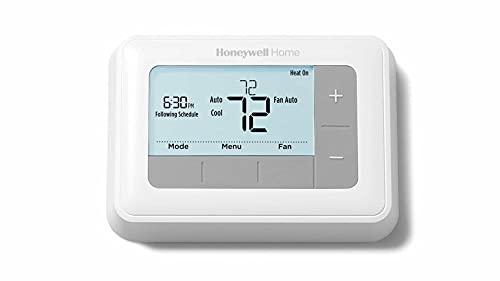
Should you want a no C‑wire thermostat that’s ideal for homeowners who prefer customized weekly schedules, the Honeywell RTH7560E delivers with its 7‑day flexible programming that lets you set different routines for each day, weekends only, or one plan for the whole week. You’ll appreciate the extra-large backlit display showing time, current room temp, and set point simultaneously. Smart Response Learning adapts run times so your space reaches target temps at the moment you want. The UWP mounting system simplifies installation and future upgrades, while program settings survive power outages. The unit also alerts you to dirty filters and low battery status.
Best For: homeowners who want a programmable, no C‑wire thermostat with flexible weekly scheduling and a large, easy-to-read display.
Pros:
- 7-day flexible programming allows different schedules for each day, weekends only, or one plan for the entire week.
- Extra-large backlit display shows time, current room temperature, and set point at once for easy monitoring.
- Smart Response Learning adapts heating/cooling run times and program settings are retained during power outages.
Cons:
- Lacks advanced smart-home integrations (Wi‑Fi/app control) found in many modern thermostats.
- Still requires occasional battery changes despite power-loss memory.
- May not support systems that require a common (C) wire for some advanced features.
Non-Programmable Single-Stage Home Thermostat with Backlight

In case you want a straightforward, no-frills thermostat that works without a C-wire on most systems, this non-programmable single-stage model is a great pick—its large terminal blocks and universal sub-base let you install it in about 30 minutes, and the clear blue backlit LCD keeps settings easy to read. You’ll get dual power (24VAC or 2 AAA), front-load battery access, and no C-wire requirement except for heat-only and cool-only setups. It supports most single-stage systems (forced air, furnaces, boilers, millivolt, gas fireplaces) but not multi-stage, dual-fuel, line-voltage, minisplits, or electric baseboard units. Adjustable swing, calibration, °C/°F, and compressor delay add useful control.
Best For: Homeowners or DIYers seeking a simple, reliable non-programmable thermostat for single-stage systems who want easy installation without a C-wire on most setups.
Pros:
- Easy DIY installation with large terminal blocks and universal sub-base — typically installed in about 30 minutes.
- Dual power options (24VAC or 2 AAA batteries) and no C-wire required for most systems, plus front-load battery access.
- Clear blue backlit LCD and simple controls, with features like adjustable swing, calibration, °C/°F conversion, and selectable compressor delay.
Cons:
- Not compatible with heat pump systems that use auxiliary/emergency heat, dual-fuel/hybrid setups, mini-splits, or electric baseboard (line-voltage) heating.
- Non-programmable — lacks scheduling capabilities for energy savings or automatic temperature setbacks.
- Limited to single-stage (1 Heat / 1 Cool) systems, so unsuitable for multi-stage HVAC configurations.
Non-Programmable Single-Stage Home Thermostat (Blue Backlight)

Should you want a simple, reliable thermostat that works without a C-wire, this non-programmable single-stage model with a blue backlight is a great pick—especially for homeowners with conventional 1 heat/1 cool systems who value ease of use and clear readability. You’ll find a large, easy-to-read display, adjustable temperature control (44–90°F), and room readout (41–95°F). It accepts 2–5 existing wires and runs on 24VAC or 2 AAA batteries. Features include heat/cool swing (0.2–2°F), selectable 5-minute compressor delay, room calibration (±1°F), low-battery indicator, 2-year limited warranty, and 24-hour support. Check wiring ports before buying.
Best For: Homeowners with conventional single-stage (1 heat/1 cool) HVAC systems who want a simple, non-programmable thermostat that runs without a C-wire and offers a large, easy-to-read display.
Pros:
- Simple, easy-to-use interface with large blue-backlit display ideal for middle-aged or elderly users.
- Operates on 24VAC or 2 AAA batteries (no C-wire required) and accepts 2–5 existing wires for straightforward installation.
- Features useful protections and adjustments: selectable 5-minute compressor delay, adjustable heat/cool swing (0.2–2°F), and ±1°F room calibration.
Cons:
- Not compatible with multistage systems, heat pumps, line-voltage baseboard heat, mini-splits, PTACs, or other advanced HVAC setups.
- Non-programmable—no scheduling or energy-saving programming options.
- Limited to basic features compared with smart thermostats (no remote control, app integration, or learning capabilities).
Factors to Consider When Choosing Thermostat No C Wire
Before you pick a no-C-wire thermostat, I check compatibility with your HVAC system and weigh available power-source options so nothing trips up installation. I also consider wiring simplicity and the layout of display and controls to make daily use straightforward. Finally, I look at energy-management features to guarantee the thermostat saves energy without sacrificing comfort.
Compatibility With HVAC
Compatibility hinges on the type and wiring of your HVAC system, so I’ll walk you through the key limits to check prior to choosing a no-C-wire thermostat. I always start by confirming wire count: no-C-wire thermostats typically work with 2–5 wire systems and conventional single-stage heating and cooling. They support gas, oil, electric furnaces, and cooling-only setups that don’t need constant 24VAC. Don’t try them on systems that rely upon line voltage, millivolt controls, or more complex controls. Heat pumps with aux/emergency heat, dual-fuel or multistage HVAC, electric baseboard, hydronic (3-wire hot water), mini-splits, and other specialized configurations usually require a dedicated C wire and are incompatible. Verify wiring and system type before you buy.
Power Source Options
Now that you know which HVAC setups can and can’t handle a no-C-wire thermostat, we need to look at how those thermostats get power. I recommend checking whether a model uses dual sources—24VAC from your system plus AA/AAA batteries—because that flexibility often prevents dropouts. Battery-only units simplify installation in case you lack a C-wire, but they need regular replacements and might limit continuous WiFi or advanced features. Some models will run purely on 24VAC provided your HVAC supplies enough voltage without a dedicated C-wire; verify that with your system specs. Before buying, I verify compatibility with both power modes and confirm battery access is easy for routine swaps to avoid service interruptions.
Wiring Requirements Simplicity
Should I assess wiring simplicity for a no-C-wire thermostat, I focus on how many conductors the unit needs and how straightforward the terminal layout is. I look for models that operate with 2 to 5 wires so they match most existing HVAC setups; anything requiring 6 to 8 wires usually means a no-C option won’t work. I also check whether the thermostat accepts dual power—batteries or 24VAC—so a dedicated common wire isn’t required. I verify system type, since some heat-only or cool-only systems could still need a C wire. Finally, I prefer units with large terminal blocks and universal sub-bases that let me complete a DIY install quickly, often in under 30 minutes.
Display And Controls
A clear, responsive display and straightforward controls matter more than flashy features, so I prioritize thermostats with backlit LCDs and intuitive buttons or a simple touchscreen that let me change temperature and modes without digging through menus. I look for crisp backlighting—white, blue, or soft tones—that keeps numbers readable day or night. Practical control ranges matter too: displays commonly show 41°F–95°F, while usable control is typically about 44°F–90°F, which suits most homes. I value separate heating and cooling swing adjustments to fine-tune comfort and reduce cycling. Features like compressor delay protection and temperature calibration are useful add-ons that improve system longevity and accuracy without complicating basic operation. In general, clarity and ease beat complexity.
Energy Management Features
Good displays and simple controls make daily use easy, but I also watch for energy management features that keep systems efficient over time. I prefer thermostats that let me adjust heating and cooling cycle rates (swing) to reduce energy waste and avoid short-cycling. In case a model isn’t programmable, temperature differential settings can still improve efficiency and extend equipment life. I value basic scheduling flexibility so heating and cooling match occupancy without overcomplicating setup. Alerts for maintenance—filter changes or system faults—help me keep the HVAC running efficiently. Finally, temperature calibration and compressor delay protection are must-haves; they prevent unnecessary activations and maintain steady comfort, which together cut runtime and energy costs over months and years.
Installation Ease
Because I often install smart thermostats in older homes, ease of installation is a top deciding factor for me each time choosing a no C wire model. I look for units that accept dual power sources—24VAC or batteries—so I can connect to existing wiring without running a new C wire. Compatible wiring bases that handle 2 to 5 wires and universal sub-bases with large terminal blocks speed the job and usually let me finish within about 30 minutes for DIY installs. I always review wiring diagrams initially because some setups are incompatible and could force professional help. Clear backlit displays and simple controls cut configuration errors, making the whole process smoother and less time-consuming for homeowners.
Alerts And Monitoring
As soon as I pick a no C‑wire thermostat, I prioritize alerts and monitoring because they catch HVAC issues promptly and keep homeowners from facing costly failures. I look for devices that notify me of system malfunctions so I can arrange timely maintenance before small problems escalate. Smart filter-life alerts are essential — they remind me to replace filters, which preserves air quality and system efficiency. I value long-term monitoring that spots unusual usage patterns, since those often signal energy waste or failing components. Temperature-deviation alerts matter too; in case a thermostat can report failures to maintain setpoints, I avoid comfort surprises. On the whole, effective alerts drive energy savings through prompting optimization and preventing unnecessary consumption.
