

Let’s call it sensible comfort—you want a garage that’s usable without wasting energy. You’ll want a thermostat that matches your heater’s voltage and amps, works with gloves, and won’t trip breakers on a cold morning. I’ll walk you through seven top options for 2026 and the key features and safety checks to compare so you can pick the right setup for your space and wiring.
| Honeywell TH1100DV1000/U Pro 1000 Vertical Non-Programmable Thermostat |

| Reliable Classic | Temperature Control: Digital thermostat with temperature display | Power Compatibility / Voltage: 24 Volt system (uses 24V power) | Digital Display / Backlight: LCD with backlight | VIEW LATEST PRICE | Read Our Analysis |
| Digital Temperature Controller Plug Outlet for Heating/Cooling |
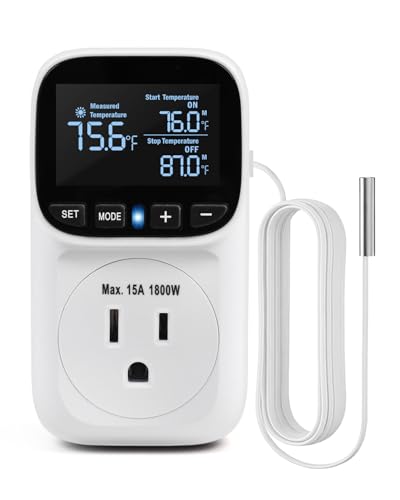
| Precision Controller | Temperature Control: Digital temperature control (–40°F to 210°F range) | Power Compatibility / Voltage: Plug‑in mains (supports up to 15A / 1800W) — mains voltage compatible | Digital Display / Backlight: LCD backlit display (stays on ~30s) | VIEW LATEST PRICE | Read Our Analysis |
| Honeywell TL7235A1003 240V Line Volt Digital Thermostat |

| Line-Voltage Simple | Temperature Control: Digital line‑volt thermostat (electronic temperature control) | Power Compatibility / Voltage: 240 Volt line‑voltage operation | Digital Display / Backlight: On‑demand backlight digital display | VIEW LATEST PRICE | Read Our Analysis |
| 1500W Greenhouse Heater with Thermostat (Silver) |

| Rapid Greenhouse Heat | Temperature Control: Built‑in digital thermostat (adjustable 41°F–108°F) | Power Compatibility / Voltage: 120V/240V appliance (1500W electric heater — typical mains) | Digital Display / Backlight: Digital display for temperature | VIEW LATEST PRICE | Read Our Analysis |
| Non-Programmable Single-Stage Home Thermostat (1 Heat/1 Cool) |

| Easy DIY Install | Temperature Control: Digital thermostat (single‑stage heating/cooling control) | Power Compatibility / Voltage: 24 VAC or battery (dual power) | Digital Display / Backlight: Large LCD with bright white backlight | VIEW LATEST PRICE | Read Our Analysis |
| InoKraft 7,500W Electric Garage Heater with Thermostat |

| Heavy-Duty Power | Temperature Control: Digital thermostat (adjustable 40°F–99°F) | Power Compatibility / Voltage: 240 Volt operation (7,500W) | Digital Display / Backlight: Digital thermostat display | VIEW LATEST PRICE | Read Our Analysis |
| GiveBest 1500W Smart WiFi Wall/Floor Heater |

| Smart Zone Heater | Temperature Control: Precise digital thermostat (setpoint control) | Power Compatibility / Voltage: 120V mains (1500W heater; wall heater powered by household AC) | Digital Display / Backlight: Touch control panel with temperature display | VIEW LATEST PRICE | Read Our Analysis |
More Details on Our Top Picks
Honeywell TH1100DV1000/U Pro 1000 Vertical Non-Programmable Thermostat
Should you want a simple, reliable thermostat for a garage heater, the Honeywell TH1100DV1000/U Pro 1000 is a solid pick — it’s a non‑programmable, wall‑mount unit with a clear backlit LCD and 24V power that keeps temperature control straightforward and durable for workshop or garage use. You’ll find a glossy, premier white plastic body that mounts vertically, fits compact spaces (about 4 11/16″ x 2 7/8″ x 1 1/8″), and uses push‑button touch controls plus an 8″ display. It runs on 24V with two AAA backups, supports basic heating and AC control, and’s made in the United States.
- Temperature Control:Digital thermostat with temperature display
- Power Compatibility / Voltage:24 Volt system (uses 24V power)
- Digital Display / Backlight:LCD with backlight
- Safety/Protection:(Implied) thermostat features standard safety (no explicit overheat listed)
- Mounting / Installation Type:Wall mount
- Intended Application / Use:HVAC/air‑conditioner and heating room temperature control (residential thermostat)
- Additional Feature:Touch button controls
- Additional Feature:Corded electric power
- Additional Feature:2× AAA backup
Digital Temperature Controller Plug Outlet for Heating/Cooling
Provided you need precise, plug-and-play temperature control for a garage heater or similar equipment, this digital temperature controller is often the best choice for DIYers and small-shop owners. You get –40°F to 210°F range with 0.1°F accuracy on a backlit LCD that stays on ~30 seconds after use. Switch between heating and cooling modes for heaters, fans, incubators, fridges, or ventilation. It handles up to 15A/1800W resistive loads. Use the calibration function and factory reset (“+” and “–” together) for accuracy. Four timer modes (cycle, delay ON/OFF, countdown) automate starts, stops, and maintenance cycles.
- Temperature Control:Digital temperature control (–40°F to 210°F range)
- Power Compatibility / Voltage:Plug‑in mains (supports up to 15A / 1800W) — mains voltage compatible
- Digital Display / Backlight:LCD backlit display (stays on ~30s)
- Safety/Protection:Protects connected equipment by controlling temperature (no explicit overheat listed)
- Mounting / Installation Type:Plug‑in outlet controller (plug‑in installation)
- Intended Application / Use:Environmental control (brewing, greenhouse, incubator, freezer, garage)
- Additional Feature:Four timer modes
- Additional Feature:15A / 1800W capacity
- Additional Feature:Temperature calibration function
Honeywell TL7235A1003 240V Line Volt Digital Thermostat
Should you need a straightforward, reliable control for a 240V garage heater, the Honeywell TL7235A1003 is a solid choice for homeowners and DIYers who want simple manual temperature management. You’ll get electronic temperature control tuned for 240-volt line-voltage systems and a non-programmable interface that keeps operation easy. The on-demand backlight helps you read settings in dim garages, and the heating indicator shows at a glance whenever heat’s active. Soundproof operation minimizes clicking noise common with mechanical units. Install it where line-voltage control is required, and you’ll have dependable, no-frills temperature regulation without complex programming.
- Temperature Control:Digital line‑volt thermostat (electronic temperature control)
- Power Compatibility / Voltage:240 Volt line‑voltage operation
- Digital Display / Backlight:On‑demand backlight digital display
- Safety/Protection:Soundproof operation; typical line‑voltage safety design
- Mounting / Installation Type:Wall/line‑voltage thermostat (wall mount)
- Intended Application / Use:Line‑voltage heating control for homes/garages
- Additional Feature:Soundproof operation
- Additional Feature:Heating status indicator
- Additional Feature:240V line-voltage design
1500W Greenhouse Heater with Thermostat (Silver)
Should you need fast, reliable warmth for a greenhouse or garage, the 1500W heater with built-in digital thermostat is a smart choice — it kicks on in 3 seconds and maintains temperatures between 41°F and 108°F for consistent climate control. You’ll get instant heat across up to 215 sq ft, with dual modes: 1500W rapid heat and 25W circulation for gentle airflow. The digital display offers precise setpoints, while overheat protection with automatic shutoff lets you run it unattended. Lightweight with a carry handle and adjustable angle, it’s portable for greenhouses, patios, garages, workshops, grow tents, and nurseries.
- Temperature Control:Built‑in digital thermostat (adjustable 41°F–108°F)
- Power Compatibility / Voltage:120V/240V appliance (1500W electric heater — typical mains)
- Digital Display / Backlight:Digital display for temperature
- Safety/Protection:Built‑in overheat protection with auto shutoff
- Mounting / Installation Type:Portable with carry handle; can be placed or mounted/angled
- Intended Application / Use:Greenhouse/grow tent/garage heater (small space heating)
- Additional Feature:Rapid 3-second heat
- Additional Feature:Dual power modes
- Additional Feature:Carry handle portability
Non-Programmable Single-Stage Home Thermostat (1 Heat/1 Cool)
In case you want a straightforward, no-fuss thermostat for a single heating and cooling system, this non‑programmable 1 Heat/1 Cool model is a great fit—especially for homeowners or DIYers who value simplicity and quick installation. You’ll get a Miuputake 3201-White with push-button controls, a bright white backlit LCD, and separate heat/cool swing adjustment to reduce energy use. It runs on 24 VAC or two AAA batteries (C-wire usually not needed), mounts on a universal sub-base, and typically installs in under 30 minutes. Note wiring limits (2–5 wires) and review the manual to make certain compatibility.
- Temperature Control:Digital thermostat (single‑stage heating/cooling control)
- Power Compatibility / Voltage:24 VAC or battery (dual power)
- Digital Display / Backlight:Large LCD with bright white backlight
- Safety/Protection:Low battery indicator and standard thermostat safeguards
- Mounting / Installation Type:Wall mount with universal sub‑base (DIY install)
- Intended Application / Use:Home single‑stage heating/cooling systems (room/garage)
- Additional Feature:Dual power supply
- Additional Feature:Large terminal blocks
- Additional Feature:Quick DIY installation
InoKraft 7,500W Electric Garage Heater with Thermostat
Provided that you need reliable, high‑output heat for a large garage or workshop, the InoKraft 7,500W electric heater with digital thermostat delivers powerful, adjustable warmth for spaces up to about 750 sq ft. You’ll get 240V, fan‑forced output with selectable high/low and an automatic ECO mode that cuts power whenever not needed. The digital thermostat (40°F–99°F) plus 1–24 hour timer gives precise control; safety features include overheat protection and auto shutoff. Wall or ceiling mount saves floor space, five angle settings and adjustable louvers direct airflow, and a quiet 65 dB fan aids even distribution.
- Temperature Control:Digital thermostat (adjustable 40°F–99°F)
- Power Compatibility / Voltage:240 Volt operation (7,500W)
- Digital Display / Backlight:Digital thermostat display
- Safety/Protection:Overheat protection and automatic shutoff; ECO safety features
- Mounting / Installation Type:Wall or ceiling mount (requires professional install for mains)
- Intended Application / Use:Garage/workshop heating (large space)
- Additional Feature:NEMA 14-50P plug
- Additional Feature:Five adjustable angles
- Additional Feature:Automatic ECO mode
GiveBest 1500W Smart WiFi Wall/Floor Heater
Should you want a compact, plug-and-play solution for heating a single garage zone up to about 200 sq. ft., the GiveBest 1500W Smart WiFi Wall/Floor Heater fits the bill: it combines wall- or floor-mount flexibility, precise thermostat control with an ECO mode to cut energy use, and remote/WiFi operation so you can warm the space before you get there. You’ll get 1500W (≈5200 BTU) heating, touch controls showing temperature, and a remote for adjustments. It supports 2.4 GHz WiFi only, includes tip-over and overheat protection, uses V-0 materials, is ETL-listed, and warns against sharing a circuit with other high-power appliances.
- Temperature Control:Precise digital thermostat (setpoint control)
- Power Compatibility / Voltage:120V mains (1500W heater; wall heater powered by household AC)
- Digital Display / Backlight:Touch control panel with temperature display
- Safety/Protection:ETL listing, overheat protection, tip‑over/flame‑retardant materials
- Mounting / Installation Type:Wall mount (also floor placement option with feet)
- Intended Application / Use:Zone heating for indoor rooms including garage/bedroom/bathroom
- Additional Feature:2.4 GHz WiFi control
- Additional Feature:Remote control included
- Additional Feature:Tip-over protection
Factors to Consider When Choosing a Thermostat for Garage Heater
When choosing a thermostat for your garage heater, you’ll want to match it to your heat source and confirm the temperature range covers your needs. Check the voltage and wiring requirements, decide whether you prefer manual, programmable, or smart controls, and consider about how complex the installation will be. These factors will help you pick a reliable, safe, and convenient thermostat.
Heat Source Compatibility
Because your garage heater’s electrical and control characteristics determine what thermostats will work, start matching the thermostat to the heater’s power and control type. Make certain the thermostat is rated for the heater’s supply—line‑voltage (120/240V) versus low‑voltage (24VAC)—since mismatches can prevent control or cause damage. Confirm the thermostat style: fan‑forced electric units usually need line‑voltage mechanical or electronic thermostats, while HVAC systems use low‑voltage models. Match amperage and wattage ratings to the heater’s load (for example, 15A/1800W or higher for many portable units; several thousand watts for hardwired heaters) to avoid overheating contacts or tripping circuits. For multi‑stage or modulating heaters, pick a thermostat that supports single‑stage, multi‑stage, or PWM control. In the event the heater has internal safety or ECO features, verify external control won’t conflict.
Temperature Range Needs
Should you need precise climate control, pick a thermostat whose adjustable setpoint range and resolution match the garage’s expected extremes and the items you’re protecting. Choose a model that covers typical human comfort (about 40°F–99°F) and up to ~108°F when you store heat‑sensitive equipment or plants. For freeze protection only, a unit that engages around 35°F–45°F minimizes energy use while preventing pipe damage. In the event that you keep electronics, batteries, or plants, prioritize fine resolution and calibration (±0.1–0.5°F) and a range that includes their maintenance temperature. Decide whether you need both heating and cooling control: garages that overheat in summer require higher maximum setpoints and fan/AC control. Always confirm the thermostat’s rated control range matches your heater’s safe operating limits to avoid overloads or excessive cycling.
Voltage And Wiring
In case your garage heater runs on line voltage, you’ll need a thermostat and wiring that match its supply and current draw—pick a line‑voltage thermostat (or a suitably rated relay/contactor) for 120–240V units and a low‑voltage 24VAC thermostat only for furnace‑style systems with a transformer. Check the heater’s amperage and select a thermostat or relay/contactor rated at or above that current—many 240V garage heaters draw 15–30A or more. Verify whether the thermostat must switch one or both hot legs; 240V installations often require a double‑pole device to meet code. Confirm conductor size and breaker rating for the combined load, and make certain proper R, W and common wiring for low‑voltage setups or direct hot switching for line‑voltage units.
Control Type Preference
Decide how you want to interact with your garage heater before you pick a thermostat: do you need precision temperature control and scheduling, or just a simple on/off switch that’s easy to operate with gloves? Should you want tight setpoints, choose a digital thermostat with ±0.1–1°F accuracy; in case basic control suffices, a mechanical or non‑programmable unit works. Pick programmable units to schedule setbacks and save energy, or non‑programmable for straightforward manual use. Determine whether you need separate heating/cooling modes or a single‑stage heating‑only control based on ventilation or cooling needs. Evaluate interfaces—touchscreen, buttons, rotary dial, remote or Wi‑Fi app—and favor sturdy physical buttons or remote control for gloved operation. Finally, match thermostat type (low‑voltage vs line‑voltage/relay) to your heater’s electrical requirements.
Installation Complexity
Because garage heaters and thermostats use different voltages, wiring, and mounting needs, you should assess installation complexity before buying so you don’t end up with an incompatible unit or costly rework. Check whether the thermostat is line‑voltage (120/240V) or low‑voltage (24VAC); line‑voltage models often mount differently and might require breaker changes. Determine whether a dedicated circuit, hardwiring, or simple plug‑in is required—high‑amp or hardwired installs usually call for a licensed electrician. Verify clearance, mounting orientation, and enclosure type for dust, moisture, or vibration. Confirm whether a neutral or C‑wire is required for power or Wi‑Fi; adding conductors raises complexity. Finally, account for contactors/relays for high‑current heaters, fan delays/timers, and labeling terminals for easier hookup and maintenance.
Safety And Certifications
When you’re picking a thermostat for a garage heater, prioritize safety certifications and electrical ratings so the device matches the heater’s voltage and current and meets fire‑safety standards; look for recognized marks like UL, ETL, or CSA that specify the intended line‑voltage (120/240V) or low‑voltage (24VAC) use. Verify the thermostat’s maximum current and wattage match or exceed the heater (for example, 15A/1800W for many plug‑in controllers or higher for hard‑wired units) to avoid overloaded switches and wiring. Prefer models with automatic overheat shutoff, fault indicators, and compatibility with ground‑fault protection. For dusty, humid, or flammable garage environments, choose ruggedized enclosures, flame‑retardant materials, and correct ingress protection. Have high‑power hard‑wired installs inspected or performed by a licensed electrician.
Frequently Asked Questions
Can a Thermostat Handle Garage Humidity and Condensation Control?
Yes — you can’t magically stop a rainforest forming, but a thermostat can control humidity and condensation via running dehumidifiers, ventilation, or timed heaters. You’ll need the right sensor, compatible controls, and proper installation.
Will a Garage Thermostat Work With Radiant Floor Heating?
Yes — you can use a garage thermostat with radiant floor heating provided it supports floor sensor input or external temperature sensors, relay control or a compatible relay/actuator, and is configured for low-temperature hydronic systems.
Are Battery Backups Needed for Garage Thermostat Memory Retention?
Absolutely—you’re safer with one; memory can vanish like a thunderclap during power loss, and a battery backup guarantees settings, schedules, and time stay intact so your garage heater runs exactly how you programmed it.
Can a Thermostat Be Mounted on Insulated Garage Doors Safely?
You shouldn’t mount a thermostat on insulated garage doors because they’ll give false readings from drafts, temperature stratification, and door movement; instead, you should install it on a stable interior wall at typical occupant height for accurate control.
Do Thermostats Affect Garage Heater Warranty or Insurance Coverage?
Yes — they can. Imagine a policy fine print like frost on glass: should you install or wire a thermostat improperly, you’ll risk voiding warranties or triggering insurance exclusions, so follow manufacturer and local electrical rules precisely.
