

Consider of your thermostat like a reliable co‑pilot that knows your route home; a DOE study found smart setbacks can cut heating bills up to 10%. You’ll want settings that match varied schedules, gradual starts, and simple overrides so comfort and savings actually work together. I’ll point out seven practical options—plus what to watch for with wiring and locks—that make modern programmable thermostats worth their price, but initially consider how you use your day.
| Lux Pro P711 Thermostat — Programmable & Non-Programmable |

| Best DIY Choice | Programmable: Programmable or non-programmable (user-selectable 7/5/2-day or off) | Display / Backlight: Easy-view backlight | Compatibility with HVAC types: Multi-stage heating and AC systems | VIEW LATEST PRICE | Read Our Analysis |
| Honeywell Home RTH8560D 7 Day Programmable Touchscreen Thermostat |

| Smart Learning Pick | Programmable: 7-day programmable (day-to-day, weekend, or full-week) | Display / Backlight: Bright backlit touchscreen (blue) | Compatibility with HVAC types: Single- and multi-stage heating/cooling; heat pumps; many system types listed | VIEW LATEST PRICE | Read Our Analysis |
| MAXKOSKO WiFi Smart Touchscreen Thermostat for Floors |

| Best for Floor Heating | Programmable: Customizable scheduling (programmable for floor heating) | Display / Backlight: Touchscreen LED display | Compatibility with HVAC types: Designed for underfloor/electric floor warming systems (floor heating) | VIEW LATEST PRICE | Read Our Analysis |
| Bionaire 24–36″ Window Fan with Remote |

| Ventilation Companion | Programmable: Programmable thermostat (auto on/off by temperature) | Display / Backlight: Digital LED screen (with dimmer) | Compatibility with HVAC types: Window fan thermostat controls room temperature (fits many windows) | VIEW LATEST PRICE | Read Our Analysis |
| Programmable 5-1-1 Digital Thermostat with Blue Backlight |
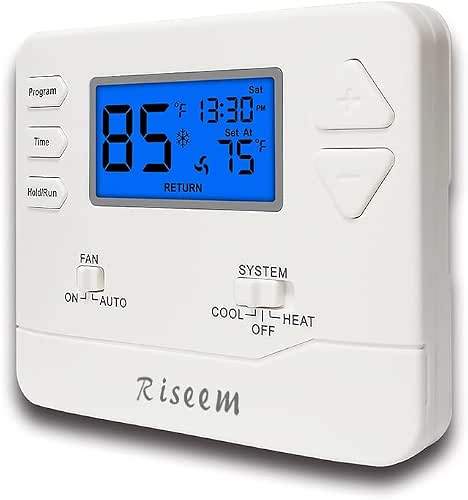
| Budget Programmable Pick | Programmable: 5/1/1 day programmable (factory pre-set program; flexible) | Display / Backlight: LCD backlight (blue) | Compatibility with HVAC types: Compatible with single- and multi-stage systems + many HVAC types (lists supported/unsupported) | VIEW LATEST PRICE | Read Our Analysis |
| Honeywell Home RTH2510B1018 7-Day Programmable Thermostat |

| Reliable Daily Scheduler | Programmable: 7-day programmable (separate program per day; 4 periods/day) | Display / Backlight: Digital backlit display | Compatibility with HVAC types: Works with furnaces, central AC, hot water systems, heat pumps (not multistage) | VIEW LATEST PRICE | Read Our Analysis |
| Emerson Thermostats 1F85U-22PR Programmable Thermostat |

| Flexible Programming Leader | Programmable: Selectable programming (7-day, 5-1-1, or off) | Display / Backlight: Big clear display with backlight button | Compatibility with HVAC types: Advanced multi-system control; dual-fuel support; multi-system compatibility | VIEW LATEST PRICE | Read Our Analysis |
More Details on Our Top Picks
Lux Pro P711 Thermostat — Programmable & Non-Programmable
Provided that you want a thermostat that fits both simple and complex HVAC setups, the Lux Pro P711 is a smart pick — it’s offered in programmable and non-programmable versions and works with multi-stage heating and AC systems, so you can set 7-day, 5/2-day, or non-programmable schedules and choose 2 or 4 periods per day to match your routine. You’ll get digital energy-saving features, easy-view backlight, keypad lock, and customizable daily heating/cooling schedules. Batteries are included, installation is DIY-friendly, and quick setup gets it running fast. Choose the model that fits your programming needs.
- Programmable:Programmable or non-programmable (user-selectable 7/5/2-day or off)
- Display / Backlight:Easy-view backlight
- Compatibility with HVAC types:Multi-stage heating and AC systems
- Installation / DIY-friendly:Easy installation; DIY installation
- Power options / Battery backup:Batteries included (implies battery power support)
- Temperature control / Setpoint features:Customizable daily schedules for heating/cooling; energy-saving control
- Additional Feature:Keypad lock protection
- Additional Feature:User-selectable periods
- Additional Feature:Multi-stage HVAC support
Honeywell Home RTH8560D 7 Day Programmable Touchscreen Thermostat
In case you want a touchscreen thermostat that learns your home’s cycle times and lets you set different schedules for each day of the week, the Honeywell Home RTH8560D is a smart pick. You’ll get a brightly backlit blue touchscreen showing indoor temperature and humidity, plus on-screen prompts to change air filters. Use 7-day programming for separate weekday and weekend schedules or individual day settings; Smart Response Learning times your system so rooms reach target temps whenever you want. It supports battery or hard-wire power, preserves settings during outages, and works with most single- and multistage heating and cooling systems.
- Programmable:7-day programmable (day-to-day, weekend, or full-week)
- Display / Backlight:Bright backlit touchscreen (blue)
- Compatibility with HVAC types:Single- and multi-stage heating/cooling; heat pumps; many system types listed
- Installation / DIY-friendly:Battery or hard-wire operation; fits home installations
- Power options / Battery backup:Battery or hard-wire operation; permanent backup preserves settings
- Temperature control / Setpoint features:Learns cycle times to hit setpoint; displays indoor temp/humidity
- Additional Feature:Smart Response Learning
- Additional Feature:Indoor humidity readout
- Additional Feature:On-screen filter reminders
MAXKOSKO WiFi Smart Touchscreen Thermostat for Floors
Choose the MAXKOSKO WiFi Smart Touchscreen Thermostat should you want precise, remote control of an underfloor heating system—its Smart Life app and Alexa/Google Assistant compatibility let you adjust temperatures and schedules from anywhere, so you’ll save energy without sacrificing comfort. You’ll program custom schedules and modes to automate setbacks and maintain comfort while cutting usage. The touchscreen LED and intuitive app make adjustments simple, and app reports show energy patterns so you can refine settings. It’s built for most electric floor-warming systems, includes a 15 ft floor sensor for accurate readings, and supports DIY installation with a clear manual.
- Programmable:Customizable scheduling (programmable for floor heating)
- Display / Backlight:Touchscreen LED display
- Compatibility with HVAC types:Designed for underfloor/electric floor warming systems (floor heating)
- Installation / DIY-friendly:DIY installation with manual; floor sensor included
- Power options / Battery backup:(Powered; includes sensor) — typical power via thermostat with WiFi (implies mains with supplied sensor)
- Temperature control / Setpoint features:Precise floor temperature control with supplied floor sensor
- Additional Feature:WiFi remote control
- Additional Feature:Includes 15 ft sensor
- Additional Feature:App energy insights
Bionaire 24–36″ Window Fan with Remote
Provided that you want hands-off temperature control, the Bionaire 24–36″ window fan with a programmable thermostat is ideal for sleepers, home-office users, or anyone who prefers automatic on/off cycles tied to room temperature. You’ll choose reversible electronic blades to intake fresh air, exhaust warm air, or exchange both for strong cooling. Use three speeds and the remote to set airflow without leaving your seat. The digital LED shows room temp and offers a dimmer for night. It fits most double-hung, vertical slider, and casement windows with accordion and extra extenders, plugs in ready to use, and includes a 3-year warranty.
- Programmable:Programmable thermostat (auto on/off by temperature)
- Display / Backlight:Digital LED screen (with dimmer)
- Compatibility with HVAC types:Window fan thermostat controls room temperature (fits many windows)
- Installation / DIY-friendly:Plug-in, ready to use; fits most windows (no assembly)
- Power options / Battery backup:Plug-in power (AC mains)
- Temperature control / Setpoint features:Programmable thermostat auto on/off based on selected temperature; displays room temp
- Additional Feature:Reversible airflow modes
- Additional Feature:Built-in extender panels
- Additional Feature:3-year limited warranty
Programmable 5-1-1 Digital Thermostat with Blue Backlight
Should you want a simple, energy-focused thermostat that handles a typical week’s schedule while supporting up to two heat and two cool stages, the Programmable 5-1-1 Digital Thermostat with Blue Backlight is a smart pick. You’ll get 5/1/1 day programming, a clear blue backlit LCD, and dual power (24 VAC or 2×AAA) so most installs don’t need a C-wire. It fits many forced-air and radiant systems but excludes line-voltage, mini-splits, dual-fuel, and baseboard electric. Install in about 30 minutes using the universal sub-base. You can adjust swing, calibration, compressor delay, and view low-battery alerts.
- Programmable:5/1/1 day programmable (factory pre-set program; flexible)
- Display / Backlight:LCD backlight (blue)
- Compatibility with HVAC types:Compatible with single- and multi-stage systems + many HVAC types (lists supported/unsupported)
- Installation / DIY-friendly:Installable within 30 minutes; universal sub-base
- Power options / Battery backup:Dual power: 24 VAC or 2×AAA batteries; no C-wire for most systems
- Temperature control / Setpoint features:Separate heat/cool controls; adjustable differential; temperature calibration
- Additional Feature:No C-wire required
- Additional Feature:Large terminal blocks
- Additional Feature:Compressor delay protection
Honeywell Home RTH2510B1018 7-Day Programmable Thermostat
Provided you want a simple, reliable 7-day schedule with four daily setpoints and precise ±1°F control, the Honeywell Home RTH2510B1018 is a strong choice. You can program each day separately with four periods—wake, leave, arrive, sleep—and use Advanced Start so your target temperature’s reached on time. The backlit digital display gives one-touch access to setpoints, and battery backup preserves programming through outages. Built-in alerts prompt battery and filter changes. It supports most single-stage systems and heat pumps but won’t work with multistage setups. If you want dependable, straightforward control, this unit delivers without complexity.
- Programmable:7-day programmable (separate program per day; 4 periods/day)
- Display / Backlight:Digital backlit display
- Compatibility with HVAC types:Works with furnaces, central AC, hot water systems, heat pumps (not multistage)
- Installation / DIY-friendly:Simple installation; battery-backed memory
- Power options / Battery backup:Battery-backed memory; retains programming during power outage
- Temperature control / Setpoint features:Precise control ±1°F; Early Start to reach setpoint by time
- Additional Feature:Early Start function
- Additional Feature:+/-1°F accuracy
- Additional Feature:Filter/battery reminders
Emerson Thermostats 1F85U-22PR Programmable Thermostat
Should you want a straightforward programmable thermostat that’s flexible for varied schedules, the Emerson 1F85U-22PR is a solid choice — it offers selectable 7-day, 5-1-1, or non-program modes so you can match setpoints to your household routine. You’ll appreciate the big, clear display and backlight button for low-light readability, plus a keypad lock to prevent accidental changes. Setup is quick via a streamlined menu, built-in level, and pluggable terminals for easy installation. Use temperature limits and programmable setpoints to control comfort and efficiency. Dual-fuel support and multi-system features give reliable operation without needing extra sensors.
- Programmable:Selectable programming (7-day, 5-1-1, or off)
- Display / Backlight:Big clear display with backlight button
- Compatibility with HVAC types:Advanced multi-system control; dual-fuel support; multi-system compatibility
- Installation / DIY-friendly:Easy installation with built-in level indicator and pluggable terminals
- Power options / Battery backup:Standard thermostat power with advanced features (battery/back-up implied by programmable memory and installation design)
- Temperature control / Setpoint features:Programmable setpoints; temperature limits and multi-system temperature management
- Additional Feature:Built-in level indicator
- Additional Feature:Pluggable terminals
- Additional Feature:Dual-fuel standard support
Factors to Consider When Choosing Settings for Programmable Thermostat
Before you set schedules, check system compatibility so your thermostat can control heating and cooling properly. Match the daily schedule to whenever people are home and use a temperature setback strategy to save energy during absences and sleep. Balance occupant comfort preferences with your energy-saving goals to pick practical setpoints.
System Compatibility
Because your thermostat has to talk to your HVAC, you’ll want to confirm compatibility with your specific system type (single‑stage, multi‑stage, heat pump, boiler, millivolt, or line‑voltage) and control method so you don’t end up with a device that can’t operate or that causes short cycling. Verify whether your system needs a common (C) wire or can run on batteries, since many digital and Wi‑Fi models require steady power. Should you have a heat pump, auxiliary/backup heat, or multi‑stage equipment, confirm the thermostat supports those stages to avoid improper sequencing. Check control method — 24VAC relay, line‑voltage, or proprietary minisplit protocols — and make certain underfloor or radiant systems accept external floor sensors and the correct sensing mode (air vs. floor) to prevent overheating.
Daily Schedule Needs
When you set up a programmable thermostat, start upon mapping your typical week—identify which days you’re home or away and pick 7‑day or 5/2 programming so each day’s schedule matches real use. Next, choose 2–4 periods per day (wake, leave, return, sleep) to balance comfort and savings; use fewer periods in case your routine’s consistent, more in case it varies. Add a vacation/extended-absence setback to save energy while preventing problems like frozen pipes. Use advance-start or recovery features to stagger start times so spaces reach comfort exactly when occupied. Finally, set minimum run durations and modest temperature differentials (about 4–6°F/2–3°C for heating) to avoid short-cycling while still capturing energy savings.
Temperature Setback Strategy
Now that you’ve mapped daily schedules and recovery times, pick setback temperatures that actually save energy without making your home uncomfortable or forcing the system to work harder. Setbacks of 7–10°F (4–6°C) from your comfort setpoint during unoccupied or sleeping periods usually yield real savings; limit those to practical windows — about 6–8 hours overnight or an 8-hour workday — since longer setbacks give diminishing returns in well-insulated homes. In case you have a heat pump or multi-stage system, keep setbacks modest (2–4°F / 1–2°C) to avoid auxiliary heat and short-cycling. Use gradual ramps or advance-start features so recovery completes before scheduled occupancy. Finally, test and adjust for your home’s thermal mass and occupancy patterns: heavy mass needs smaller, longer setbacks; lightweight homes benefit from larger, shorter ones.
Occupant Comfort Preferences
Balancing comfort and efficiency means picking thermostat setpoints that match how people actually live and sleep, so program separate wake, leave, return, and sleep temperatures based on your household’s preferred ranges (for example, 70–75°F daytime, 68–72°F sleeping) and adjust slightly warmer for elderly or very young occupants as needed. Determine individual preferences and enter distinct wake, leave, arrive, and sleep setpoints. Account for age and health by raising daytime temps 1–3°F for seniors or infants, and follow physician guidance for sleeping temps. Use gradual transitions (5–15 minutes) or extra program periods to avoid sudden swings. Match settings to activity and clothing—higher when sedentary, lower when active or warmly dressed. Get household consensus and lock the keypad or create user profiles to protect schedules.
Energy-Saving Goals
Should you want to cut energy use without sacrificing comfort, set clear energy-saving goals that guide your programmable thermostat settings. Aim for setbacks of at least 7–10°F (4–6°C) from your comfort setpoint to realize typical 5–15% savings for heating and cooling. Use distinct weekday and weekend schedules—or full 7‑day programming—to match occupancy and avoid conditioning empty rooms. Limit temperature changes to 2–4 periods daily (wake/leave/return/sleep) to balance comfort and reduce cycling. Use pre-start programming so your system reaches the setpoint by occupancy without holding higher temperatures all day. Finally, pair setback schedules with sensible temperature swing and compressor delay settings to prevent short-cycling, improve efficiency, and extend equipment life.
Program Flexibility Options
Whenever you pick a programmable thermostat, prioritize flexibility so the unit fits your household’s actual routines and not the other way around. Choose a programming type—7-day, 5/2, 5/1/1, or non-programmable—that matches your week so weekdays and weekends can differ whenever needed. Decide how many periods per day (commonly 2, 4, or up to 6) to balance comfort and savings; more periods give precise setback windows but need more setup. Prefer true 7-day scheduling in case your day-to-day varies, rather than forcing identical weekday/weekend programs. Make certain temporary and permanent holds let you override for vacations or one-offs without erasing routines. Finally, pick units with selectable program modes and easy interfaces so adjustments and seasonal changes remain simple.
Installation And Wiring
Before you change any settings, confirm your system type and wiring so you connect the thermostat correctly and avoid damage. Verify whether you have single‑stage, multi‑stage, heat pump, or millivolt equipment so you map controls to the right terminals and retain features like aux/heat stages and fan control. Confirm whether the new thermostat needs a common (C) wire for 24 VAC; in the event it does and no C exists, run one or use an approved power‑adapter. Always turn off power at the furnace/air‑handler breaker and check wires with a multimeter for live voltage before disconnecting. Label each wire at the wall and control board (R, W, Y, G, O/B) and follow manufacturer diagrams plus local electrical codes for secure terminals and proper gauge.
Frequently Asked Questions
Can a Programmable Thermostat Reduce Pets’ Overheating Risk When I’m Away?
Yes — you can: envision a cool breath slipping through the room; you’ll set conservative temperature limits, use programmable schedules and remote monitoring, and add alerts or pet-focused sensors so your pet won’t overheat while you’re away.
Will Smart Thermostats Share My Temperature Data With Third Parties?
They can, but it depends on the manufacturer and settings; you should review privacy policies, disable sharing options, use local-only controls whenever available, and update firmware to minimize telemetry or third-party data transfers.
How Do Power Outages Affect Programmed Schedules and Settings?
Power outages can erase unsaved schedules or pause active programs; should your thermostat have battery backup or cloud syncing, it’ll restore settings automatically. You’ll need to manually reprogram models without backup or after data corruption.
Are There Health Risks From Rapid Temperature Changes Overnight?
Yes, you can face risks: rapid overnight temperature swings can trigger asthma, worsen cardiovascular issues, disrupt sleep, and increase fall risk for the elderly. You should keep gradual changes and stable humidity to reduce those hazards.
Can Zoning Controls Be Added to Older HVAC Systems?
Sure — you can. Carefully consider component compatibility: adding zoning often means dampers, extra thermostats, and a zoning controller; contractors can convert older systems, but you’ll want professional assessment, cost estimates, and possible ductwork adjustments before proceeding.
