

In case you want reliable comfort without overspending, these seven programmable thermostats under $50 are smart picks for 2026. You’ll find easy 5‑2 and 5‑1‑1 scheduling, clear backlit displays, battery or dual power options, and straightforward 4‑period programming for single‑stage systems. Some models skip Wi‑Fi for simplicity, while a few add app control provided you’ve got a C‑wire—keep reading to see which tradeoffs match your home.
| Honeywell Home RTH20B Programmable Single-Stage Thermostat |

| Reliable Replacement | System Type: Single-stage (1 Heat / 1 Cool) | Mounting: Wall mount | Display Type: Large backlit LCD | VIEW LATEST PRICE | Read Our Analysis |
| 5-1-1 Programmable Thermostat for Single-Stage Home Systems |

| Flexible Scheduling | System Type: Single-stage (1 Heat / 1 Cool) | Mounting: Wall mount | Display Type: 3″ white backlit LCD | VIEW LATEST PRICE | Read Our Analysis |
| Non-Programmable Single-Stage Home Thermostat (1 Heat/1 Cool) |

| Simple & Clear | System Type: Single-stage (1 Heat / 1 Cool) | Mounting: Wall mount | Display Type: Large backlit LCD | VIEW LATEST PRICE | Read Our Analysis |
| Non-Programmable 1 Heat/1 Cool Home Thermostat |

| No-Frills Basic | System Type: Single-stage (1 Heat / 1 Cool) | Mounting: Wall mount | Display Type: Backlit LCD (blue) | VIEW LATEST PRICE | Read Our Analysis |
| WiFi Single-Stage Home Thermostat with App Control |

| Smart Remote Control | System Type: Single-stage (1 Heat / 1 Cool) | Mounting: Wall mount | Display Type: Backlit LCD | VIEW LATEST PRICE | Read Our Analysis |
| Honeywell Home Smart WiFi Thermostat X2S (Gray) |

| Feature-Rich Smart | System Type: Supports conventional up to 2H/2C (includes single-stage compatibility) | Mounting: Wall mount | Display Type: LCD (large backlit) | VIEW LATEST PRICE | Read Our Analysis |
| Honeywell RTH7560E 7-Day Programmable Thermostat |
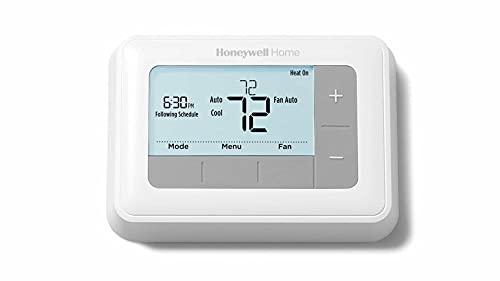
| Energy-Savvy Scheduler | System Type: Heating & cooling (single-stage residential compatibility) | Mounting: Wall mount (UWP mounting hardware included) | Display Type: Extra-large backlit LCD | VIEW LATEST PRICE | Read Our Analysis |
More Details on Our Top Picks
Honeywell Home RTH20B Programmable Single-Stage Thermostat
In case you want a no-frills, budget-friendly programmable thermostat that’s easy to install, the Honeywell Home RTH20B fits the bill — it gives you a straightforward 5-2 day schedule, a large backlit LCD, and battery-powered operation so you won’t need a C-wire. You’ll get single-stage control for 1 heat/1 cool systems, support for hot water and forced-air setups, and a user-selectable filter reminder. It mounts to the wall, runs on 2 AA batteries, and replaces older RTH models. It isn’t for electric baseboard heat, but it’s reliable, simple, and supported through a one-year warranty.
- System Type:Single-stage (1 Heat / 1 Cool)
- Mounting:Wall mount
- Display Type:Large backlit LCD
- Power Options:Battery powered (2 × AA)
- Compatibility Limitation:Not for line‑voltage (120–240V) electric baseboard
- Control Method:Push‑button (button) control
- Additional Feature:Large backlit LCD
- Additional Feature:Change air-filter reminder
- Additional Feature:5-2 day programmable
5-1-1 Programmable Thermostat for Single-Stage Home Systems
In case you have a conventional single-stage heating or cooling setup and want a straightforward, budget-friendly programmable thermostat, the Heagstat H705 is a strong fit because it offers 5-1-1 day programming and a large 3″ backlit LCD that’s easy to read. You’ll get separate weekday/weekend schedules with four periods daily, accurate ±1°F control, and a temperature display from 41–95°F. It supports 1 heat/1 cool systems, runs on 24VAC or two AAA batteries, and includes compressor delay protection, cycle-rate adjustment, filter notifications, and low-battery alerts. Check wiring: it won’t work for multistage, line-voltage, or many heat-pump systems.
- System Type:Single-stage (1 Heat / 1 Cool)
- Mounting:Wall mount
- Display Type:3″ white backlit LCD
- Power Options:24VAC or 2 × AAA batteries
- Compatibility Limitation:Not compatible with multistage, line‑voltage, mini‑split, many heat pumps
- Control Method:Button control
- Additional Feature:5-1-1 day programming
- Additional Feature:3″ white backlit LCD
- Additional Feature:5-minute compressor delay
Non-Programmable Single-Stage Home Thermostat (1 Heat/1 Cool)
Should you want a simple, reliable thermostat that’s easy to install and won’t break the bank, the non-programmable single-stage 1 Heat/1 Cool model fits the bill; it’s ideal for homeowners or renters who need basic temperature control without scheduling features. You’ll get the Miuputake 3201-White: a white, minimalist unit with large backlit LCD, push/touch controls, and separate heat/cool swing settings. It runs on 24 VAC or two AAA batteries (no C-wire for most installs), mounts on a universal sub-base, and accepts up to five wires. Included are screws, anchors, manual, and cable label. Check wiring before install.
- System Type:Single-stage (1 Heat / 1 Cool)
- Mounting:Wall mount
- Display Type:Large backlit LCD
- Power Options:24VAC or 2 × AAA batteries
- Compatibility Limitation:Not for 120–240V line‑voltage systems; C‑wire note for some systems
- Control Method:Push‑button / touch noted
- Additional Feature:Large backlit LCD
- Additional Feature:Room temp calibration
- Additional Feature:Universal sub-base
Non-Programmable 1 Heat/1 Cool Home Thermostat
Should you want a simple, reliable thermostat for a basic single-stage HVAC system, the Suuwer S701 delivers clear control without programming hassles. You’ll get a large 4.5″ blue-backlit LCD, push-button control, and dual power (24 VAC or two AAA batteries) so no common wire’s usually needed. It supports 1 heat/1 cool conventional systems, offers ±1°F accuracy, adjustable swing (0.2–2°F), selectable 5-minute compressor delay, and low-battery indicator. It’s compact (0.98″D x 4.72″W x 3.86″H), plastic, and includes mounting screws and instructions. Avoid multistage, heat-pump, line-voltage, mini-split, and certain hydronic or RV systems.
- System Type:Single-stage (1 Heat / 1 Cool)
- Mounting:Wall mount
- Display Type:Backlit LCD (blue)
- Power Options:24VAC or 2 × AAA batteries
- Compatibility Limitation:Not compatible with multistage, heat pumps, line‑voltage, mini‑split
- Control Method:Push‑button / button control
- Additional Feature:Separate heat/cool swing
- Additional Feature:5-minute compressor delay
- Additional Feature:Blue backlight display
WiFi Single-Stage Home Thermostat with App Control
Should you want a budget-friendly smart thermostat that’s easy to control from your phone, the Heagstat STN701W is a strong pick—you’ll get app-based remote temperature adjustments and 7-day scheduling for under $50. You’ll connect via 2.4 GHz WiFi, monitor system status in real time, and set 7-day or temporary schedules through a backlit LCD app interface. It fits single-stage heating/cooling (1H/1C) and needs a continuous 24V C-wire—no batteries. Expect ±1°F accuracy and energy-saving runtime reduction. Verify HVAC compatibility and wiring beforehand; professional C-wire installation is recommended should you lack one. Check the manufacturer warranty and reviews.
- System Type:Single-stage (1 Heat / 1 Cool)
- Mounting:Wall mount
- Display Type:Backlit LCD
- Power Options:24VAC C‑wire required (no battery backup)
- Compatibility Limitation:Not compatible with heat pumps, multistage, PTAC, line‑voltage, mini‑split
- Control Method:App (remote) + local controls (backlit interface)
- Additional Feature:2.4 GHz Wi‑Fi
- Additional Feature:App remote control
- Additional Feature:Requires C-wire
Honeywell Home Smart WiFi Thermostat X2S (Gray)
Should you want a budget-friendly smart thermostat that still plays well with today’s connected homes, the Honeywell Home X2S Smart Thermostat (Gray) fits the bill—Matter-certified and compatible with Alexa, Google Assistant, and Apple HomeKit. You’ll get Wi‑Fi, app and voice control, flexible 5-1-1/5-2/7-day scheduling, ENERGY STAR efficiency, auto-away and demand-response support, plus filter alerts and optional humidity display. It requires 24V AC and a C-wire (adapter might be needed), mounts to the wall, and uses a clear LCD with interchangeable accents. Honeywell backs it with a two-year warranty and broad smart-home integration for straightforward setup.
- System Type:Supports conventional up to 2H/2C (includes single-stage compatibility)
- Mounting:Wall mount
- Display Type:LCD (large backlit)
- Power Options:24VAC (C‑wire required)
- Compatibility Limitation:Supports conventional and heat pump up to 2H/2C but requires 24V C‑wire (not for line‑voltage)
- Control Method:Push‑button, app, voice controls (multiple methods)
- Additional Feature:Matter certified compatibility
- Additional Feature:ENERGY STAR certified
- Additional Feature:Voice assistant support
Honeywell RTH7560E 7-Day Programmable Thermostat
Should you want a straightforward, budget-friendly thermostat that still gives flexible weekly scheduling, the Honeywell RTH7560E is a smart pick—its 7-day programming (day-to-day, weekends-only, or a single weekly schedule) and extra-large backlit LCD make it easy to set and see temperature and time at a glance. You’ll appreciate Smart Response Technology that learns run times to hit setpoints, battery-powered operation with two AA cells, and schedule retention after outages. The UWP mounting simplifies installation and future upgrades. It supports heating and cooling systems, offers filter and low-battery alerts, and comes with a one-year limited warranty.
- System Type:Heating & cooling (single-stage residential compatibility)
- Mounting:Wall mount (UWP mounting hardware included)
- Display Type:Extra-large backlit LCD
- Power Options:Battery powered (2 × AA)
- Compatibility Limitation:Designed for standard HVAC (not line‑voltage); conventional heating/cooling systems
- Control Method:Push‑button (touch control noted)
- Additional Feature:Smart Response Technology
- Additional Feature:UWP mounting hardware
- Additional Feature:Schedule retained after outage
Factors to Consider When Choosing a Programmable Thermostat Under Dollar50
Before you buy, check that the thermostat works with your HVAC system type and meets the power source requirements your home can provide. Consider how many programmable schedules you need, whether the display is clear and easy to use, and what installation or wiring could be required. These factors will help you pick a reliable model under $50 that actually fits your setup.
Compatibility With System Type
While picking a budget programmable thermostat, make sure it actually matches your system type so you don’t end up with an incompatible unit. Verify it supports your configuration—single‑stage heat/cool, heat‑only, cool‑only, or multi‑stage—since many sub‑$50 models only handle one heat and one cool. Check whether your HVAC uses low‑voltage 24VAC or high‑voltage line‑voltage (120–240V); inexpensive units are usually 24VAC and won’t work with electric baseboard line‑voltage. Determine whether you have a conventional furnace/AC or a heat pump—budget thermostats often lack heat pump and auxiliary/emergency heat support. Confirm terminal count and wiring needs (most accept 2–5 wires) so you don’t need adapters or a C‑wire. For boiler or millivolt systems, look for explicit support before buying.
Power Source Requirements
Because your thermostat’s power setup determines whether it will run reliably or not, check how the unit is powered and what your system supplies. Decide whether you have a 24VAC common (C‑wire) or only battery power. Many basic programmable thermostats run on 2×AA/AAA batteries; Wi‑Fi or advanced features often need a C‑wire. Battery models require periodic replacement and can lose features or schedules when batteries die, so note battery life and low‑battery alerts. In case your HVAC provides 24VAC, confirm whether the thermostat accepts dual power (24VAC with battery backup) or strictly needs a C‑wire. Line‑voltage systems (120–240V) won’t work with low‑voltage units. In the event you lack a C‑wire, look for power‑stealing or adapter options and check for furnace compatibility.
Programmable Scheduling Options
Power setup affects more than reliability—it also determines what scheduling features you can actually use—so once you’ve confirmed power compatibility, look closely at a thermostat’s programming options. Choose 5-2, 5-1-1, or 7-day formats depending on whether you want simple weekday/weekend splits, separate weekend days, or full daily customization. Observe how many periods per day (usually 2–4) are available so you can set wake/leave/return/sleep setbacks that match your routine. Verify whether schedules are stored locally with battery backup or need continuous power, since some low-cost units lose programs during outages. Prefer models with straightforward programming—push buttons or templates—to avoid lengthy menu guidance. Finally, make certain the unit supports temporary holds or a non-programmable mode for vacations and short-term overrides.
Display And Ease Of Use
How easy is it to read and operate your thermostat while you’re rushing out the door or it’s dark? Pick a model with a large backlit LCD and high-contrast fonts so numbers and schedules stay legible across the room and at night. Simpler controls matter: choose push-button or one-touch interfaces with clearly labeled functions to speed setup and reduce programming errors. Make sure the screen shows current temperature and setpoint simultaneously to prevent mode confusion and needless adjustments. Look for intuitive schedule entry that supports 5-2 or 5-1-1 programming with separate weekday/weekend options and named time periods, avoiding deep menus. Finally, visible status indicators (battery low, heating/cooling active, compressor delay) and easy filter-change alerts simplify maintenance and troubleshooting.
Installation And Wiring Needs
A clear display and simple controls are only the start — you also need to make sure the thermostat will actually work with your system and wiring. First, confirm your HVAC type: many sub-$50 models support only conventional single-stage heat/cool or heat-only/cooling-only systems and won’t work with heat pumps, multistage, or line-voltage (120–240V) systems. Count wall wires—budget units usually accept 2–5 low-voltage (24VAC) conductors; systems needing 6–8 wires or a dedicated C (common) wire could require an adapter. Check power needs: battery-operated units often avoid a C-wire, while Wi‑Fi or advanced features typically require continuous 24VAC. Verify terminal labels, base screw spacing, and wire colors for physical fit. Should you be unsure, factor in tools, wallplate adapters, or professional installation.
Energy Saving Features
Often you’ll get the most savings through choosing a programmable unit that supports flexible schedules and protections customized to your routine. You should pick models offering 5‑2 or 5‑1‑1 schedules so weekdays and weekends use different setbacks, and make certain at least four daily periods (wake, leave, return, sleep) to maximize setback hours without losing comfort. Check for programmable temperature limits and an extended low‑heat setpoint near 32°F for deeper automatic setbacks during absences or seasonal use. Prefer thermostats with cycle/compressor protection (for example, a 5‑minute delay) and adjustable heat/cool swing settings to prevent short cycling and improve efficiency. Finally, verify the unit keeps schedules through outages via battery backup so your programs aren’t lost.
Frequently Asked Questions
Can These Thermostats Run on Battery Power Only?
Yes, some will run on batteries only; some need a C wire. You’ll check compatibility, you’ll install fresh batteries, you’ll monitor power alerts, and you’ll replace cells promptly to keep controls reliable and responsive.
Are Installation Tools and Screws Included?
Usually yes — you’ll get basic screws and a mounting plate, but installers’ tools aren’t included. You’ll need a screwdriver, drill, level, and possibly wire connectors. Check the product listing to confirm exact included items.
Do Any Models Support External Temperature Sensors?
Yes — some models support external temperature sensors; you’ll feel relief like a cool breeze once a remote probe steadies readings, letting you place sensors in rooms for accurate, balanced comfort that follows your home’s real temperatures.
Will They Work With Heat Pump Systems?
Yes — many programmable thermostats under $50 will work with heat pumps provided they explicitly list heat pump compatibility and support O/B reversing valve wiring; check wiring labels, installer instructions, and supported system types before buying.
Is There a Warranty Longer Than One Year?
Surely — yes, some sellers supply warranties stretching several years. You’ll spot select manufacturers offering three-year guarantees, sometimes extended with registration, and occasional retailer promotions that push protection further, so check terms carefully before purchasing.
