

Like stumbling into Edison’s workshop with today’s tech, you’ll want bulbs that actually deliver—bright, efficient, and true-to-tone. You’ll weigh lumens, watts, CRI, color temp, fit, and smart features without getting locked into junk. I’ll point out reliable models, where to save, and what to avoid so you can pick bulbs that last and look right—keep going to match each room to the right light.
| 100W Equivalent 5000K A19 LED Bulbs (4-Pack) |

| Brightest Choice | Bulb Shape: A19 | Base Type: E26 (standard medium) | Color Temperature Range / Daylight Option: 5000K (daylight) | VIEW LATEST PRICE | Read Our Analysis |
| LE 60W Equivalent LED A19 Light Bulbs (5-Pack) |
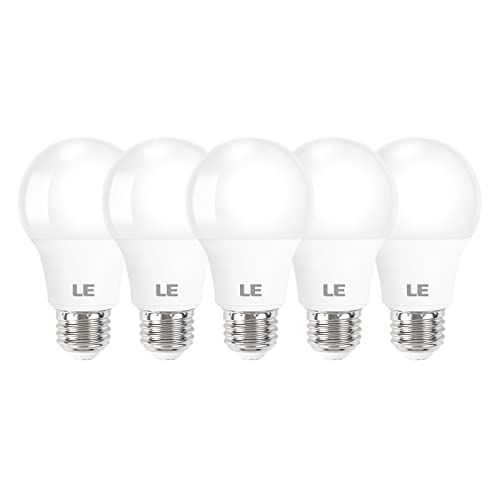
| Best Value Pack | Bulb Shape: A19 | Base Type: E26 (standard medium screw) | Color Temperature Range / Daylight Option: 5000K (daylight) | VIEW LATEST PRICE | Read Our Analysis |
| GE Refresh LED A19 Daylight Bulbs 10W (4-Pack) |

| Color-Accuracy Pick | Bulb Shape: A19 | Base Type: E26 | Color Temperature Range / Daylight Option: 5000K (daylight) | VIEW LATEST PRICE | Read Our Analysis |
| DAYBETTER A19 5000K 100W-Equivalent LED Bulbs (12-Pack) |

| Bulk Bright Buy | Bulb Shape: A19 | Base Type: E26 (standard) | Color Temperature Range / Daylight Option: 5000K (daylight white) | VIEW LATEST PRICE | Read Our Analysis |
| Linkind Smart A19 RGBW Wi‑Fi Light Bulbs (4-Pack) |

| Smart & Versatile | Bulb Shape: A19 | Base Type: E26 | Color Temperature Range / Daylight Option: Tunable white including 6500K (supports daylight 5000K range) | VIEW LATEST PRICE | Read Our Analysis |
More Details on Our Top Picks
100W Equivalent 5000K A19 LED Bulbs (4-Pack)
Should you need bright, daylight-balanced light for task-focused rooms, these 100W-equivalent 5000K A19 LEDs (4-pack) are a smart pick—delivering 1,500 lumens at just 13 watts each so you get strong, accurate illumination with big energy savings. You’ll appreciate the high CRI (85+) for truer colors and even light distribution, ideal for kitchens, offices, or retail. They fit standard E26 sockets for easy swap-ins, aren’t dimmable, and last about 15,000 hours, cutting replacements. Using roughly 85% less energy than traditional 100W bulbs, they lower bills and environmental impact while providing reliable, long-lasting performance.
- Bulb Shape:A19
- Base Type:E26 (standard medium)
- Color Temperature Range / Daylight Option:5000K (daylight)
- LED Light Source:LED
- Indoor Use:Indoor (kitchen, bedroom, retail, office)
- Non-Incandescent Wattage Equivalent:100W-equivalent
- Additional Feature:1500 lumens output
- Additional Feature:13W power consumption
- Additional Feature:15,000-hour lifespan
LE 60W Equivalent LED A19 Light Bulbs (5-Pack)
Should you want bright, energy-saving bulbs for everyday indoor rooms, the LE 60W equivalent A19 five-pack delivers 800 lumens at just 9 watts and a crisp 5000K daylight white that’s ideal for kitchens, garages, and workspaces. You’ll get five non-dimmable A19 bulbs with E26 bases, 180° beam angle, CRI 80, and instant-on, flicker-free light. Rated for 120V and lasting about 10,000 hours, they save roughly 85% energy versus a 60W incandescent. Each plastic-shelled bulb measures 60 mm × 105 mm, weighs 0.17 kg, and is for indoor use only; please note shipments exclude California.
- Bulb Shape:A19
- Base Type:E26 (standard medium screw)
- Color Temperature Range / Daylight Option:5000K (daylight)
- LED Light Source:LED
- Indoor Use:Indoor only
- Non-Incandescent Wattage Equivalent:60W-equivalent
- Additional Feature:800 lumens output
- Additional Feature:9W power consumption
- Additional Feature:10,000-hour lifespan
GE Refresh LED A19 Daylight Bulbs 10W (4-Pack)
In case you want crisp, natural-feeling light that makes colors pop, the GE Refresh LED A19 Daylight 10W (4-pack) is a strong choice for workspaces and rooms where accurate color matters. You get four frosted A19 LEDs at 5000K providing 800 lumens each with a high CRI of 90, so colors look bolder and contrast improves. They replace 60W incandescents while using just 10W, carry Energy Star certification, and are rated up to 13.7 years (3 hours/day). Dimmable and E26-compatible, they suit home offices, garages, kitchens, and entryways; a five-year warranty adds peace of mind.
- Bulb Shape:A19
- Base Type:E26
- Color Temperature Range / Daylight Option:5000K (daylight)
- LED Light Source:LED
- Indoor Use:Indoor
- Non-Incandescent Wattage Equivalent:60W-equivalent
- Additional Feature:90 CRI enhanced color
- Additional Feature:Dimmable with switches
- Additional Feature:5-year warranty
DAYBETTER A19 5000K 100W-Equivalent LED Bulbs (12-Pack)
Should you need bright, daylight-quality lighting for workspaces or garages, the DAYBETTER A19 5000K 100W-equivalent 12-pack delivers — 1,500 lumens per bulb and a crisp 5,000 K color temperature make details pop and reduce eye strain during long tasks. You get twelve A19 LED bulbs with standard E26 bases, 15 watts each (100W incandescent equivalent) and 280° beam angle for broad, even coverage. With 85+ CRI, no buzzing or flicker, and no mercury, they suit long daily use indoors. They’re non-dimmable, rated about 15,000 hours, and include 12 months of customer support from DAYBETTER.
- Bulb Shape:A19
- Base Type:E26 (standard)
- Color Temperature Range / Daylight Option:5000K (daylight white)
- LED Light Source:LED
- Indoor Use:Indoor
- Non-Incandescent Wattage Equivalent:100W-equivalent
- Additional Feature:12-bulb pack
- Additional Feature:15W power consumption
- Additional Feature:100 lm/W efficiency
Linkind Smart A19 RGBW Wi‑Fi Light Bulbs (4-Pack)
Should you want lively, customizable lighting that’s easy to control, the Linkind Smart A19 RGBW 4‑pack is ideal for party hosts and smart‑home beginners alike. You’ll get 16 million colors plus tunable white (1800K–6500K) at 800 lumens—60W equivalent—and a 25,000‑hour lifespan. Setup requires 2.4 GHz Wi‑Fi and the AiDot App; no hub required, and it works with Alexa and Google Home. Dual Wi‑Fi/Bluetooth guarantees local control should Wi‑Fi drop. Use 104 scenes, timers, group control, music sync, and DIY Light Lab effects. Reminder: don’t use traditional dimmer switches; adjust brightness through the app or voice.
- Bulb Shape:A19
- Base Type:E26
- Color Temperature Range / Daylight Option:Tunable white including 6500K (supports daylight 5000K range)
- LED Light Source:LED (RGBW)
- Indoor Use:Indoor (smart home use)
- Non-Incandescent Wattage Equivalent:60W-equivalent (800 lumens)
- Additional Feature:RGBW 16M colors
- Additional Feature:Wi‑Fi + Bluetooth
- Additional Feature:25,000-hour lifespan
Factors to Consider When Choosing LED Lightbulbs
At the time you’re picking LED bulbs, pay attention to brightness (lumens), color temperature, and the bulb’s CRI to get the light quality you want. Also check energy consumption and expected lifespan so you save on bills and avoid frequent replacements. Durability matters too—look for sturdy builds and good warranties.
Brightness And Lumens
Clarity matters: lumens tell you how much visible light a bulb puts out, so pick roughly 800 lm for a 60W-equivalent room lamp and about 1,500 lm for a 100W-equivalent bright area. You’ll match lumen output to a room’s function—task zones like kitchens and workspaces need higher lumens per fixture than ambient spaces such as hallways or bedrooms. Check fixture limits and beam angle: a high-lumen bulb in a narrow beam creates intense spot lighting, while a wide beam spreads the same lumens evenly. Compare efficacy (lm/W) to balance brightness with energy use—higher lm/W gives more light per watt. Whenever replacing multiple bulbs, add their lumens to reach target room lux (for example, 300–500 lux for offices, 100–300 for habitation areas).
Color Temperature Choice
Brightness and lumen needs guide how much light you want, but color temperature shapes how that light feels and how well you see colors. Choose warm white (2700–3000K) for relaxed, cozy rooms like bedrooms and living areas; it reads yellowish and soothes. Use neutral/bright white (3500–4000K) for general-purpose spaces, and 4000–5000K whenever tasks demand clarity. Daylight tones (5000–6500K) increase contrast and alertness, useful in garages, workshops, or offices, but they can feel harsh for winding down. If replacing bulbs or matching fixtures, keep Kelvin within about 200K to avoid visible mismatches. For color-critical tasks—artwork, retail displays, makeup—pair the right temperature with strong color-rendering performance to make certain accurate color judgment.
Color Rendering Index
Because color makes such a big difference in how a space feels and how you perceive objects, pay close attention to a bulb’s Color Rendering Index (CRI) whenever choosing LEDs. CRI rates how faithfully a light shows colors versus a natural reference on a 0–100 scale. You’ll want CRI 80–85 for most rooms; opt for CRI 90+ whenever tasks demand accurate color—retail displays, artwork, makeup, photography. Note CRI doesn’t tell you color temperature or brightness: a high-CRI bulb can be warm (2700K) or cool (5000K). Also check spectral power distribution (SPD) provided, since two bulbs with identical CRI can render certain hues differently. Use CRI plus SPD and your intended use to pick the best LED.
Energy Consumption Rates
While you’re comparing LEDs, focus on how much light they deliver per watt and how that translates into real-world energy use—lumens per watt tells you efficiency, while annual kWh (wattage × hours used) shows the real cost. Check lm/W: higher values (say 100 lm/W) give more brightness per watt, so a 13–15 W LED can replace a 100 W incandescent for ~1500 lumens, cutting wattage about 85%. Calculate yearly use: wattage × hours/day × 365 to estimate kWh and cost. Keep in mind smart features and standby draws—fractions of a watt add up over time. Balance immediate wattage savings with realistic daily usage to choose bulbs that actually lower your energy bills.
Lifespan And Durability
Efficiency and annual cost are essential, but you’ll want to pair those savings with bulbs that actually last—rated lifespans tell you how long an LED should operate before it fails or dims markedly. Look for hour ratings—common values run 10,000–25,000+ hours—since longer lifespans mean fewer replacements and lower lifetime cost. Check luminous maintenance or the L-rating (for example, L70 at 25,000 hours) to see how long the bulb keeps a set percentage of its initial brightness. Consider warranty length (typically 1–5 years) as protection against premature failures. Inspect build quality: good heat sinks and thermal design reduce lumen depreciation. Should you switch lights often or face extreme temperatures, choose LEDs tested for high cycle life and reliable performance.
Compatibility And Base
As you’re choosing LEDs, confirm the bulb base and voltage match your fixture so the lamp fits securely and operates safely. Check the socket type—E26, E12, or others—so the bulb threads correctly and makes proper electrical contact. Match the bulb’s rated voltage to your fixture (most U.S. homes use 120 V) to avoid malfunction or hazards. Should the fixture use a dimmer, pick bulbs labeled dimmable; non-dimmable LEDs can flicker or be damaged on dimmer circuits. For recessed or enclosed fixtures, use LEDs rated for enclosed or high-heat environments to prevent premature failure. Finally, upon replacing bulbs in multi-bulb or smart setups, confirm the socket type and control method (hub, Wi‑Fi, Bluetooth) align with your fixture’s control hardware.
Smart Features Availability
Whenever you’re picking smart LEDs, focus on the connectivity and control options so the bulb actually works with your home setup and habits. Check whether it uses Wi‑Fi, Bluetooth, Zigbee, or Z‑Wave so it’ll pair with your existing hub or ecosystem. Confirm voice-assistant support and whether a hub or bridge is required for voice control and remote access. Look for tunable white, full RGB, scenes, schedules, and music-sync provided you desire richer automation. Verify control paths—mobile app, local Bluetooth fallback, and cloud control—and whether remote access needs an account or subscription. Finally, review network and security details: 2.4 GHz vs 5 GHz compatibility, encryption standards, and firmware update policy to protect privacy and reliability.
