

You want water that’s both safe and tastes great, yet your options span emergency sachets to countertop RO systems. You’ll need to weigh microbes, chemicals, flow, and long-term cost—so the right pick depends on what matters most in your home. I’ll compare five top choices for 2026, from portable P&G packets to advanced alkaline ionizers, to help you narrow it down.
| P&G Portable Water Purification Powder Packets (12) |

| Emergency Ready | Purpose: Emergency/portable water disinfection | Removes/Reduces Contaminants: Bacteria (99.9999%) and viruses (99.99%) via disinfectant action | Installation/Use Style: Mix-in single-use packets (no installation) | VIEW LATEST PRICE | Read Our Analysis |
| Bluevua RO100ROPOT-UV Countertop Reverse Osmosis Water Filter |
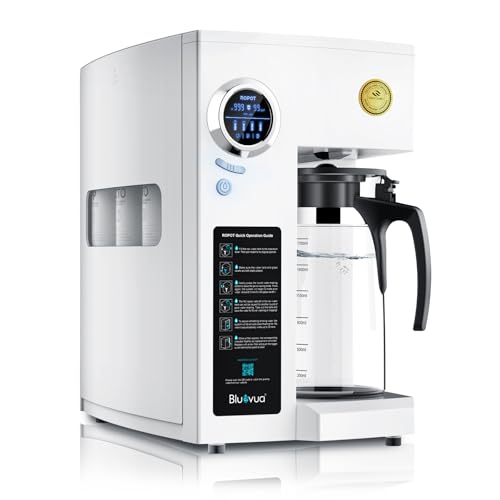
| High-Tech Purity | Purpose: Countertop reverse-osmosis drinking water purification | Removes/Reduces Contaminants: TDS, PFOA/PFOS, chlorine, fluoride, arsenic, lead, etc. | Installation/Use Style: Plug-in countertop unit (no plumbing) | VIEW LATEST PRICE | Read Our Analysis |
| SimPure Whole House 2-Stage Water Filter System |

| Whole-Home Protection | Purpose: Whole-house sediment + carbon filtration | Removes/Reduces Contaminants: Chlorine, taste/odor, sediment, iron, rust, heavy particles | Installation/Use Style: Plumbed whole-house inline system (hard‑plumb installation) | VIEW LATEST PRICE | Read Our Analysis |
| Aqua Ionizer Deluxe 5.0 Home Alkaline Water Ionizer |

| Versatile Alkalizer | Purpose: Home alkaline water ionizer (drinking and multi-use) | Removes/Reduces Contaminants: Chlorine, odor, dissolved solids (via activated carbon) | Installation/Use Style: Countertop/home unit that connects to water supply (home installation) | VIEW LATEST PRICE | Read Our Analysis |
| Aqua Ionizer Deluxe 7.0 Alkaline Water Ionizer |

| Premium Performance | Purpose: Home alkaline water ionizer (drinking and multi-use) | Removes/Reduces Contaminants: Chlorine, odor, dissolved solids (via activated carbon) | Installation/Use Style: Countertop/home unit that connects to water supply (home installation) | VIEW LATEST PRICE | Read Our Analysis |
More Details on Our Top Picks
P&G Portable Water Purification Powder Packets (12)
Should you need a lightweight, EPA-registered option for emergency or on-the-go water treatment, P&G’s Purifier of Water packets are a solid pick—each single-use packet treats 2.5 gallons (10 L) and knocks out 99.9999% of bacteria and 99.99% of viruses in about 30 minutes. You’ll get 12 individual powder packets (1 lb total) that mix into contaminated water, separate visible dirt, and clarify within the treatment window. They’re ideal for camping, hiking, travel to areas with poor infrastructure, and preparedness kits. Pack dimensions and long shelf life (available since 2019, expires Aug 2027) make them truly portable.
- Purpose:Emergency/portable water disinfection
- Removes/Reduces Contaminants:Bacteria (99.9999%) and viruses (99.99%) via disinfectant action
- Installation/Use Style:Mix-in single-use packets (no installation)
- Filter/Lifespan Info:Single-use packets (treats 2.5 gal each); expiration Aug 2027
- Portability/Size Class:Highly portable, lightweight travel packets
- Additional/Unique Functionality:EPA-registered disinfectant; visible dirt separation; 30‑minute treatment
- Additional Feature:EPA-registered disinfectant
- Additional Feature:Treats 2.5 gallons
- Additional Feature:Visible dirt separation
Bluevua RO100ROPOT-UV Countertop Reverse Osmosis Water Filter
Assuming you want a portable, countertop RO that removes a broad range of contaminants while adding back essential minerals, the Bluevua RO100ROPOT-UV is a strong choice—its 6-stage system pairs a 0.0001 μm RO membrane with UV sterilization and a remineralization filter to deliver cleaner, better-tasting water without hard plumbing. You’ll reduce TDS, PFOA/PFOS, chlorine, fluoride, arsenic, lead, and more, with WQA/SGS testing and lead-free certification. It’s plug-in portable, includes a borosilicate glass carafe, built-in TDS meter, and power-saving standby. Expect 2:1 waste efficiency, 12–24 month filters, a 1-year warranty, and modest flow at 0.26 L/min.
- Purpose:Countertop reverse-osmosis drinking water purification
- Removes/Reduces Contaminants:TDS, PFOA/PFOS, chlorine, fluoride, arsenic, lead, etc.
- Installation/Use Style:Plug-in countertop unit (no plumbing)
- Filter/Lifespan Info:Filter life 12–24 months; built-in replacement monitor
- Portability/Size Class:Portable countertop unit (23.2 lb)
- Additional/Unique Functionality:6-stage RO + UV + remineralization; built-in TDS meter; borosilicate carafe
- Additional Feature:Borosilicate glass carafe
- Additional Feature:Built-in TDS meter
- Additional Feature:2:1 pure-to-drain ratio
SimPure Whole House 2-Stage Water Filter System
Should you want whole-house protection that’s easy to monitor and maintain, the SimPure DB10C-2 delivers with its clear 10” x 4.5” housings and a two-stage sediment-plus-CTO carbon setup so you can see whenever cartridges need attention and cut chlorine, taste, odor, rust, and heavy particles before they reach appliances. You’ll get a DIY-friendly 1″ NPT brass-port system that supports standard 10” x 4.5” cartridges, runs up to 15 gpm, and handles TDS up to 1,000 ppm. Expect carbon life of 3–6 months, sediment 6–12 months, 25–90 psi operation, and up to ~80,000 gallons annual capability.
- Purpose:Whole-house sediment + carbon filtration
- Removes/Reduces Contaminants:Chlorine, taste/odor, sediment, iron, rust, heavy particles
- Installation/Use Style:Plumbed whole-house inline system (hard‑plumb installation)
- Filter/Lifespan Info:Sediment 6–12 months; carbon 3–6 months
- Portability/Size Class:Stationary whole-house system (≈17–18 lb; plumbed)
- Additional/Unique Functionality:Clear housings for visual monitoring; 1″ NPT brass port; high flow (15 GPM)
- Additional Feature:Clear housings for monitoring
- Additional Feature:1″ NPT brass port
- Additional Feature:Up to 15 GPM flow
Aqua Ionizer Deluxe 5.0 Home Alkaline Water Ionizer
Should you want flexible pH control and antioxidant-rich drinking water, the Aqua Ionizer Deluxe 5.0 is a strong choice because it delivers a wide pH range (4.5–10.5) and up to -600 mV negative ORP while offering seven practical water settings for drinking, cooking, cleaning, and cosmetic uses. You’ll get four continuously variable alkaline levels, a non-ionized purified option, and two acidic presets. Its activated carbon filter treats about 4,000 liters, removing chlorine, odor, and dissolved solids, but it isn’t compatible with well water. Auto polarity reversal and plate washing every ~10 gallons simplify maintenance while producing micro-clustered, easily absorbed alkaline water.
- Purpose:Home alkaline water ionizer (drinking and multi-use)
- Removes/Reduces Contaminants:Chlorine, odor, dissolved solids (via activated carbon)
- Installation/Use Style:Countertop/home unit that connects to water supply (home installation)
- Filter/Lifespan Info:Carbon filter capacity ~4,000 L (per filter)
- Portability/Size Class:Home countertop unit (designed for kitchen use)
- Additional/Unique Functionality:pH adjustable 4.5–10.5; negative ORP up to −600 mV; self-cleaning polarity reversal
- Additional Feature:pH 4.5–10.5 range
- Additional Feature:Self-cleaning polarity reversal
- Additional Feature:Not for well water
Aqua Ionizer Deluxe 7.0 Alkaline Water Ionizer
Provided you want adjustable pH and strong antioxidant potential from a single countertop unit, the Aqua Ionizer Deluxe 7.0 is a smart pick: its fully variable 4.5–11.0 pH range and up to −750 mV ORP let you dial in drinking, cooking, or cosmetic water strengths precisely. You’ll get seven water settings (four variable alkaline, one purified, two acidic), seven platinum-coated titanium plates for durable, energy-efficient ionization, and a built-in active carbon filter that treats about 1,585 gallons per cartridge. The unit auto-reverses polarity after use, runs an auto-plate wash every 10.5 gallons, shows status on a backlit LCD, and carries a five-year warranty.
- Purpose:Home alkaline water ionizer (drinking and multi-use)
- Removes/Reduces Contaminants:Chlorine, odor, dissolved solids (via activated carbon)
- Installation/Use Style:Countertop/home unit that connects to water supply (home installation)
- Filter/Lifespan Info:Carbon filter capacity ~4,000 L (≈1,585 gal) / typical annual life up to 1 year
- Portability/Size Class:Home countertop unit (larger electroplate ionizer)
- Additional/Unique Functionality:pH adjustable 4.5–11.0; 7 platinum-coated titanium plates; ORP to −750/−800 mV; 5‑year warranty
- Additional Feature:7 platinum-coated plates
- Additional Feature:Up to −750 mV ORP
- Additional Feature:5-year warranty
Factors to Consider When Choosing Home Water Purifier Comparisons
Upon comparing purifiers, you’ll want to check the filtration technology and what contaminants it actually removes. Consider installation and maintenance needs, flow rate and capacity, plus ongoing operating costs and energy efficiency. Those factors will help you match a system to your water quality and household demands.
Filtration Technology Type
Start through matching the purifier’s filtration type to the contaminants you need removed and the water qualities you care about. In case dissolved solids, heavy metals, or synthetic chemicals concern you, choose reverse osmosis (RO) — it removes down to ~0.0001 μm and cuts TDS effectively. Should microbial safety be the issue, add ultraviolet (UV) disinfection to inactivate bacteria and viruses, but keep in mind UV won’t remove chemicals or particulates. For taste and odor, activated carbon adsorbs chlorine, organics, and some pesticides, though it won’t handle most salts, fluoride, or pathogens. Use sediment or mechanical filters to trap sand, rust, and particulates and protect downstream stages. Consider multi-stage systems that layer these technologies to balance purity, mineral content, and taste.
Contaminant Removal Capacity
After matching filtration types to your water issues, focus next on a purifier’s contaminant removal capacity—what it actually takes out and how reliably it does so. Check certified removal rates for specific contaminants (e.g., >99.99% viruses, >99.999% bacteria, or ppm reductions) rather than vague claims. Match the unit’s tested contaminant list to your source: microbial pathogens, lead, arsenic, fluoride, PFOA/PFOS, chlorine, and TDS. Verify smallest particle or pore size removed (RO ~0.0001 μm, ultrafiltration, carbon micron ratings) to judge virus, bacteria, and particulate control. Consider capacity and throughput: how much treated water a cartridge or unit delivers before replacement and its gpm rating. Prefer systems with independent certifications or lab reports (NSF/ANSI, WQA, SGS) that specify tested contaminants and percent reductions.
Installation And Maintenance
Although installation can be straightforward for many point‑of‑use units, you should still confirm connections, space, and skill level before buying so you don’t run into surprises. Check inlet/outlet pipe sizes, clearance for cartridge changes, and whether the unit mounts on a wall or countertop. Decide should you DIY—most POU units use a cold‑water tap adapter or quick‑connects—or hire a plumber for hard‑plumb whole‑house systems or RO installs. Verify a grounded outlet for pumps, UV, or electronics and a waste‑water drain or air gap for RO reject flow. Estimate filter lifespans (sediment/carbon 3–12 months, RO membranes 12–24 months) and ongoing costs. Prefer visible housings, filter indicators, or easy‑open designs for simple monitoring and swaps.
Flow Rate And Capacity
Because your household’s needs can change in the minute, flow rate and system capacity are the two practical specs you should match to daily use and peak demand. Flow rate, shown in GPM or L/min, controls how fast purified water reaches taps—point‑of‑entry systems often deliver 2–5 GPM, while countertop RO units run around 0.2–0.5 L/min. Match flow to simultaneous fixtures and appliances to avoid pressure drops. System capacity, rated as gallons or liters per day or annual throughput, tells you how much water the unit can reliably produce before performance limits or filter changes. Keep in mind higher flow can require bigger filters, membranes, or pressure and might reduce contact time with media. Check rated service life in volume or months to plan replacements against your household consumption.
Operating Cost And Efficiency
Flow rate and capacity tell you what a purifier can deliver, but operating cost and efficiency show what it will really cost to run. To compare units, calculate cost per gallon or liter via dividing total annual filter replacements and energy costs via expected treated volume (e.g., $/1000 gallons). Add energy use for pumps and UV lamps—estimate kWh/day × local rates—to yearly bills. Include frequency and unit cost of consumables (filters, membranes, UV bulbs) based on rated life. For membrane systems, factor in waste ratios: higher reject water raises your water bill and lowers efficiency. Don’t forget routine maintenance labor and incidental parts (O-rings, sanitizing, professional service), which can materially change lifetime affordability.
Certification And Testing
At the moment comparing purifiers, don’t rely on marketing—insist on third-party certifications and readable test reports that show exactly what a system removes and under what conditions. You should look for NSF/ANSI, WQA, or equivalent listings that match specific standards like 42, 53, 58, and 401. Verify reports give quantitative removal rates or limits (percent reduction or ppm) for contaminants you care about—lead, arsenic, fluoride, bacteria, viruses, PFOA/PFOS, chlorine. Check that tests used realistic source-water parameters (TDS, pressure, flow) and observe any maximum input levels. Prefer models with material safety validation (NSF/ANSI/CAN 372) plus performance testing from accredited labs (SGS, Intertek). Finally, confirm the scope and date of certifications for the exact filter stages and cartridges you’ll buy.
