

You want a gravity water purifier that actually works at the crucial moment, not just a shiny claim. I’ll walk you through reliable options—from backpacking-ready units to stainless home systems—explain what filtration layers really do, and point out certifications, flow, and maintenance that make a purifier trustworthy. Keep this in mind as we compare brands and features so you pick a system that fits your needs and won’t let you down.
| Travel Berkey Gravity Water Filter with 2 Elements |

| Best Overall | Power Source: Gravity-fed (no electricity) | Primary Use Cases: Camping, RV, off-grid, emergencies, home | Contaminant Reduction Capability: Removes/reduces 200+ contaminants (microbial and chemical) | VIEW LATEST PRICE | Read Our Analysis |
| LifeStraw Family 1.0 Portable Gravity Water Purifier |

| Best for Purity | Power Source: Gravity-fed (no electricity) | Primary Use Cases: Emergency preparedness, camping, family use | Contaminant Reduction Capability: Removes viruses (0.02 µm), 99.9999% bacteria, 99.9% protozoa | VIEW LATEST PRICE | Read Our Analysis |
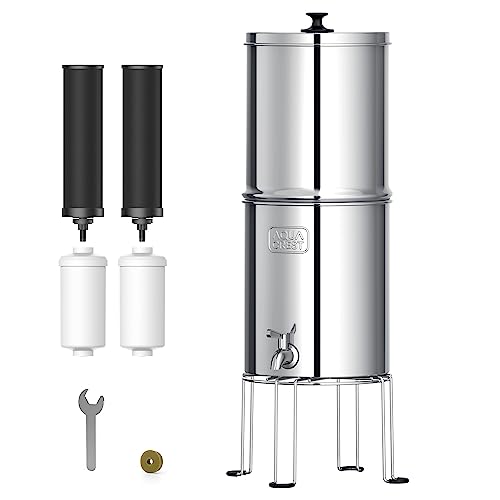
| AQUA CREST 304 Stainless Steel Gravity Water Filter System |
| Best for Durability | Power Source: Gravity-fed (no electricity) | Primary Use Cases: Home, camping, RV, off-grid, emergencies | Contaminant Reduction Capability: Reduces chlorine ~99%, fluoride (third‑party tested), heavy metals, sediment | VIEW LATEST PRICE | Read Our Analysis |
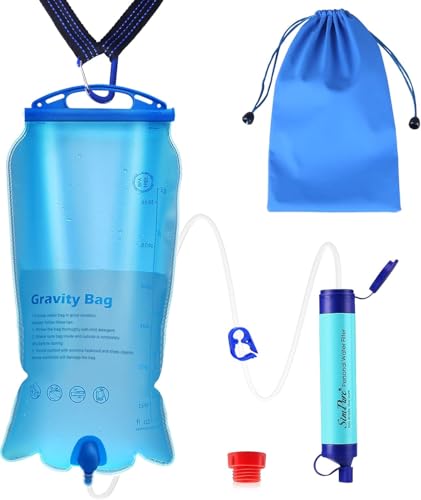
| SimPure Gravity-Fed Portable Water Filter (3L) |
| Best for Backpacking | Power Source: Gravity-fed (no electricity) | Primary Use Cases: Backpacking, camping, emergency preparedness | Contaminant Reduction Capability: 0.1 µm ultrafiltration; >99.99999% contaminant removal, reduces chlorine/odors | VIEW LATEST PRICE | Read Our Analysis |
More Details on Our Top Picks
Travel Berkey Gravity Water Filter with 2 Elements
In case you need reliable, off-grid potable water for one to three people, the Travel Berkey Gravity Water Filter with 2 Elements is a smart pick — it gives you up to 1.5 gallons of filtered water without electricity, tools, or plumbing, making it ideal for camping, RVing, emergencies, and everyday use where convenience and portability matter. You’ll get Black Berkey Elements that independently reduce over 200 contaminants from lakes, rivers, and tap sources. At 18″ tall and 7.5″ diameter, it serves hydration, cooking, and hygiene needs. Each element pair treats up to 6,000 gallons, keeping costs to pennies per gallon.
- Power Source:Gravity-fed (no electricity)
- Primary Use Cases:Camping, RV, off-grid, emergencies, home
- Contaminant Reduction Capability:Removes/reduces 200+ contaminants (microbial and chemical)
- Lifespan / Capacity:Each pair of elements up to 6,000 gallons
- Installation / Setup:Standalone stainless/portable unit — no tools or plumbing
- Portability:Portable travel-sized (1.5 gal), 18″ tall
- Additional Feature:Black Berkey Elements
- Additional Feature:1.5 gallon capacity
- Additional Feature:6,000 gallons per pair
LifeStraw Family 1.0 Portable Gravity Water Purifier
In case you need a compact, no-chemistry solution for long-term family emergency water, the LifeStraw Family 1.0 Portable Gravity Water Purifier is built for you. You’ll use its sealed, portable unit to gravity-filter water: pour into the top and collect purified water from the bottom at 9–12 liters per hour. It removes viruses down to 0.02 microns, 99.9999% of bacteria, and 99.9% of protozoan cysts, surpassing EPA purifier standards without iodine, chlorine, or other chemicals. With a 18,000-liter capacity, it can supply a family of four for about three years—ideal for preparedness and camping.
- Power Source:Gravity-fed (no electricity)
- Primary Use Cases:Emergency preparedness, camping, family use
- Contaminant Reduction Capability:Removes viruses (0.02 µm), 99.9999% bacteria, 99.9% protozoa
- Lifespan / Capacity:Purifies 18,000 liters (≈4,755 gallons)
- Installation / Setup:Hang/top-fill gravity unit — simple setup, sealed for storage
- Portability:Portable family unit (designed for storage/transport)
- Additional Feature:Virus removal 0.02µm
- Additional Feature:18,000 liters lifespan
- Additional Feature:9–12 L/hour flow
AQUA CREST 304 Stainless Steel Gravity Water Filter System
Should you want a durable, off-grid-ready purifier that slashes chlorine and fluoride while avoiding single-use plastics, the AQUA CREST 304 stainless steel gravity system fits the bill. You’ll get five-stage filtration that cuts chlorine up to 99% and lowers fluoride (third-party tested); black carbon filters certified to NSF/ANSI 42 remove heavy metals, sediment, rust and other impurities while TDS remains unchanged. Each unit includes two white fluoride filters (1,000 gallons each) and two black carbon filters (6,000 gallons each), a 304 food-grade stainless housing, spigot, non-slip stand and leak-resistant design. No plumbing or power needed — ideal for home, RVs, camping and emergencies.
- Power Source:Gravity-fed (no electricity)
- Primary Use Cases:Home, camping, RV, off-grid, emergencies
- Contaminant Reduction Capability:Reduces chlorine ~99%, fluoride (third‑party tested), heavy metals, sediment
- Lifespan / Capacity:Carbon filters up to 6,000 gal each; fluoride filters 1,000 gal each
- Installation / Setup:Stainless steel assembly with spigot and stand — no plumbing required
- Portability:Portable but heavier stainless unit (home/camp use)
- Additional Feature:304 food-grade stainless steel
- Additional Feature:Replaces ~45,000 plastic bottles
- Additional Feature:Includes stainless spigot
SimPure Gravity-Fed Portable Water Filter (3L)
Choose the SimPure Gravity-Fed Portable Water Filter (3L) provided you want effortless, hands-free filtration for backpacking, camping, or emergency kits — its 0.1-micron hollow fiber membrane and 5-micron coconut shell GAC combo removes >99.99999% of contaminants while the 3 L TPU reservoir and 27 L/hour flow keep clean water flowing for days without pumping. You’ll hang the lightweight, 2.8-ounce bag with the included tree strap, or use the filter inline with the 29.5-inch extension tube to fill a bottle. The 0.2-micron PP prefilter cuts sediment; lifespan is 5,000 L (≈1,320 gal), enough for years of family use.
- Power Source:Gravity-fed (no electricity)
- Primary Use Cases:Backpacking, camping, emergency preparedness
- Contaminant Reduction Capability:0.1 µm ultrafiltration; >99.99999% contaminant removal, reduces chlorine/odors
- Lifespan / Capacity:Lifespan 5,000 liters (≈1,320 gallons)
- Installation / Setup:Hangable TPU reservoir with strap; hands-free gravity hanging
- Portability:Very lightweight, roll-up 3 L bag (backpacking-friendly)
- Additional Feature:0.1µm hollow-fiber membrane
- Additional Feature:3 L TPU roll-up bag
- Additional Feature:Hangable with tree strap
Factors to Consider When Choosing a Gravity Water Purifier
Upon choosing a gravity water purifier, you should compare filtration performance metrics like micron ratings and flow rates to match your needs. Consider capacity and lifespan, plus portability and size should you be moving it often. Also check contaminant coverage and the ease and cost of maintenance and filter replacement.
Filtration Performance Metrics
Because different contaminants require different defenses, you’ll want to compare clear, measurable filtration metrics before you buy a gravity water purifier. Check pore size: ultrafiltration (0.01–0.1 µm) removes bacteria and most viruses, while 0.2–0.5 µm blocks protozoa and bacteria but could miss some viruses. Look for log reduction value (LRV) or percent removal—higher LRV (e.g., 6-log = 99.9999%) means stronger microbial removal. Verify claims with certified standards and third‑party lab reports like NSF/ANSI ratings. Confirm the contaminant scope so the unit addresses viruses, bacteria, protozoa, heavy metals, chlorine, or dissolved solids as needed. Finally, observe flow rate metrics to make certain the purifier delivers validated performance at the speed you require.
Capacity And Lifespan
After you’ve checked filtration metrics, you’ll want to match capacity and lifespan to how you actually use the purifier. Pick a reservoir size that fits daily needs—a 1.5–3 L unit suits one to three people for drinking and cooking, while larger reservoirs work for families or extended use. Check rated service life in gallons or liters so you know total throughput before replacement; ranges commonly span hundreds to tens of thousands of gallons. Recall element lifespan depends on contaminant load: turbid or polluted sources shorten effective life and raise replacement frequency. Compare flow rate to your routine—higher flow cuts wait time but can stress filters. Finally, calculate replacement cost per gallon to assess long‑term economics and sustainability.
Portability And Size
Pick a purifier whose size and weight match how you’ll carry and use it: ultralight systems (components under ~3 oz or total weight under 1–2 kg) are practical for backpacking, while heavier stainless‑steel or multi‑gallon units work better for car camping, basecamps, or home use. Consider filled and empty weight—water adds mass—so compare pack weight for travel units (1.5–3 L) that serve 1–3 people versus bulky several‑gallon dispensers for groups. Prioritize packed size and stowability: collapsible reservoirs and compact filter housings save space. Check setup needs—hanging from a tree strap or using a small stand is more versatile than systems requiring large, flat footprints. Finally, factor replacement filter size and count; extra elements increase carry weight and affect trip logistics.
Contaminant Coverage Range
Often you’ll need to match a purifier’s contaminant coverage to the water sources you expect to encounter, because technologies vary in what they stop: ultrafiltration membranes and ceramic elements physically block bacteria and protozoa, true virus removal requires much smaller pore sizes or specialized media, and activated carbon targets chlorine and many organic chemicals but won’t remove dissolved salts or heavy metals unless it’s designed with specific adsorption media. You should check which classes—bacteria, viruses, protozoa, sediment, chlorine, heavy metals, chemicals—a unit addresses, and verify pore-size or particle-size ratings (e.g., 0.02–0.1 µm for viruses/bacteria, 0.2–0.5 µm for protozoa). Look for independent test claims or log-reduction/certified percent reductions to quantify performance, and confirm whether adsorption media affects TDS.
Maintenance And Replacement
Because even the best gravity purifier is only as good as the parts that’re maintained, you should track filter life, follow cleaning schedules, and keep spare cartridges and seals on hand to avoid downtime or contamination. Check the filter element’s rated service life (liters/gallons) and log cumulative treated volume so you know the moment to replace media. Follow manufacturer cleaning steps—backflushing, rinsing, scrubbing pre-filters—on the recommended schedule to preserve flow and performance. Replace cartridges at the stated contaminant-capacity or time interval; recall heavy turbidity or poor source water shortens lifespan. Inspect seals, O-rings, housings, and spigots for cracks, biofilm, or leaks; lubricate or swap parts per guidance. Store spare filters and parts in a cool, dry place for prompt swaps as needed.
