

Whenever winter bites into your shop, you need heaters that actually deliver consistent, safe warmth without blowing your breaker or burning out. I’ll walk you through five top options—from quiet ceiling‑mounted infrared units and portable 1,500 W space heaters to industrial 22 kW three‑phase systems and high‑output diesel/kerosene forced‑air heaters—plus the key safety and installation factors that separate smart buys from costly mistakes.
| Shinic Ceiling-Mount Electric Garage Heater with Remote |

| Space-Saving Heat | Power Source: Electric (120 V) | Mounting / Mobility: Ceiling- or wall-mountable | Primary Heating Type: Radiant (halogen/quartz tubes) | VIEW LATEST PRICE | Read Our Analysis |
| DR. Infrared Portable Indoor/Outdoor Space Heater (Black) |

| Outdoor-Ready Radiant | Power Source: Electric (120 V) | Mounting / Mobility: Wall- or ceiling-mountable (portable capable) | Primary Heating Type: Infrared (carbon radiant) | VIEW LATEST PRICE | Read Our Analysis |
| Comfort Zone 1500W Electric Garage Heater Milkhouse Style |

| Portable Workshop Heater | Power Source: Electric (120 V) | Mounting / Mobility: Portable (carry handle) | Primary Heating Type: Electric forced/space heater with fan | VIEW LATEST PRICE | Read Our Analysis |
| SPECRAFT 22kW 480V 3-Phase Industrial Garage Heater |

| Heavy-Duty Industrial | Power Source: Electric (480 V three-phase) | Mounting / Mobility: Portable with wheels and carry handle | Primary Heating Type: Forced-air (electric, copper coils + fan) | VIEW LATEST PRICE | Read Our Analysis |
| 210,000 BTU Forced Air Kerosene Heater |
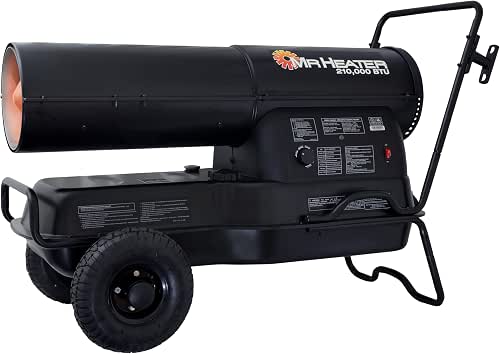
| High-Capacity Warmth | Power Source: Kerosene (portable fuel) | Mounting / Mobility: Portable with oversized tires and handle | Primary Heating Type: Forced-air combustion (kerosene with fan) | VIEW LATEST PRICE | Read Our Analysis |
More Details on Our Top Picks
Shinic Ceiling-Mount Electric Garage Heater with Remote
Should you work in a medium-sized shop or garage and need quick, targeted warmth without sacrificing floor space, the Shinic Ceiling-Mount Electric Garage Heater with Remote is a strong choice—its dual quartz tubes deliver focused radiant heat for 200–300 sq. ft., it mounts to the ceiling or wall to free up work area, and the included remote + 5-mode settings let you dial in comfort from across the room. You’ll get 1500W or 750W power, 90° tilt for directional heating, a halogen work light, cool-touch metal housing, ETL listing, overheat auto-off, and a grounded plug. It’s compact, effective, and simple to install.
- Power Source:Electric (120 V)
- Mounting / Mobility:Ceiling- or wall-mountable
- Primary Heating Type:Radiant (halogen/quartz tubes)
- Safety Features:Overheat auto-off, grounded plug, ETL listed
- Controls / Adjustability:5 modes, adjustable tilt, remote control
- Intended Use / Coverage:Garages, workshops, basements — ~200–300 sq. ft.
- Additional Feature:Halogen work light included
- Additional Feature:90° adjustable tilt
- Additional Feature:Cool-touch exterior
DR. Infrared Portable Indoor/Outdoor Space Heater (Black)
Provided you need a weatherproof, wall- or ceiling-mounted electric heater that delivers instant, odorless infrared warmth for large garages or covered patios, the DR. Infrared Portable Indoor/Outdoor Space Heater (DR-238) fits the bill. You get a durable anodized-aluminum body, IP55 rating, and ETL listing for reliable indoor/outdoor use. Its carbon infrared element provides radiant heat at three power levels (900W, 1200W, 1500W) on 120V, and a high-mirror reflector enhances efficiency. It mounts on wall or ceiling, includes remote control, brackets, cord and batteries, and carries a one-year limited components warranty for peace of mind.
- Power Source:Electric (120 V)
- Mounting / Mobility:Wall- or ceiling-mountable (portable capable)
- Primary Heating Type:Infrared (carbon radiant)
- Safety Features:ETL listed, weather-proof (IP55)
- Controls / Adjustability:3 power settings, remote control (no thermostat)
- Intended Use / Coverage:Indoor/outdoor patios, garages, commercial — weather-rated for outdoor use
- Additional Feature:IP55 weatherproof rating
- Additional Feature:High-mirror reflector (~90%)
- Additional Feature:Ceiling & wall brackets
Comfort Zone 1500W Electric Garage Heater Milkhouse Style
In case you need a compact, portable heater for a garage or workshop, the Comfort Zone 1500W Milkhouse-style unit delivers dependable 1,500-watt electric heat with two settings and an adjustable thermostat so you can dial in comfort without fuss. You’ll get Low and High heat plus a fan-only mode for circulation. The built-in thermostat lets you maintain precise temperatures while overheat protection and a tip-over switch keep operation safe. It’s ETL listed, ruggedly built with a cool-to-the-touch body, and has an oversized carrying handle for easy transport between work areas. It’s a practical, no-nonsense shop heater.
- Power Source:Electric (120 V)
- Mounting / Mobility:Portable (carry handle)
- Primary Heating Type:Electric forced/space heater with fan
- Safety Features:Overheat protection, tip-over switch, ETL listed
- Controls / Adjustability:Two heat settings, adjustable thermostat, fan-only mode
- Intended Use / Coverage:Garages, workshops, utility spaces (shop use)
- Additional Feature:Oversized carrying handle
- Additional Feature:Fan-only mode
- Additional Feature:Built-in adjustable thermostat
SPECRAFT 22kW 480V 3-Phase Industrial Garage Heater
Should you run a large garage, warehouse, or jobsite that needs fast, industrial-strength heat, the SPECRAFT 22kW 480V 3-phase heater delivers rapid warm-up and high BTU output to handle big spaces. You’ll get 22 kW of heating power with copper coils that generate heat quickly while an efficient fan spreads warmth evenly through a front mesh guard. Controls include dual rotary knobs and a thermostat for precise settings, plus overheat protection and secure terminals in reinforced steel housing. It’s portable with large rubber wheels and a carry handle, easy to assemble, and built for durable industrial use.
- Power Source:Electric (480 V three-phase)
- Mounting / Mobility:Portable with wheels and carry handle
- Primary Heating Type:Forced-air (electric, copper coils + fan)
- Safety Features:Overheat protection, reinforced safety terminals
- Controls / Adjustability:Dual rotary knobs (fan speed and temperature), thermostat included
- Intended Use / Coverage:Large garages, jobsites, warehouses — industrial heat for large areas
- Additional Feature:Copper heating coils
- Additional Feature:Large rubber transport wheels
- Additional Feature:Dual rotary control knobs
210,000 BTU Forced Air Kerosene Heater
Should you need to heat a very large shop quickly, the 210,000 BTU forced-air kerosene heater is built for that job—it’s rated to warm up to about 5,250 sq ft and includes an adjustable thermostat so you can keep temperatures steady without babysitting the unit. You’ll get 210,000 BTU output, a 14-gallon tank for up to eight hours of run-time, and a high-output fan that moves heat fast. Safety features include no-flame and over-heat sensors with auto shut-off plus a power indicator. It’s portable with oversized tires, cord storage, compact dimensions, and backed with a one-year limited warranty.
- Power Source:Kerosene (portable fuel)
- Mounting / Mobility:Portable with oversized tires and handle
- Primary Heating Type:Forced-air combustion (kerosene with fan)
- Safety Features:No-flame safety sensor, over-heat auto shut-off, power indicator
- Controls / Adjustability:Adjustable thermostat, built-in controls
- Intended Use / Coverage:Very large spaces — up to ~5,250 sq. ft.
- Additional Feature:14-gallon fuel tank
- Additional Feature:Oversized tires for transport
- Additional Feature:No-flame safety sensor
Factors to Consider When Choosing a Heater for a Large Shop
Upon choosing a heater for your large shop, you’ll want to match heating capacity to the space and consider fuel type options like propane, natural gas, diesel, or kerosene. Check coverage and output ratings so you know a unit can maintain temperature across the whole shop, and review installation requirements for venting, power, and placement. Finally, compare energy efficiency ratings to keep operating costs manageable.
Heating Capacity Needed
Start via estimating how much heat your shop actually needs—use the common rule of thumb of 30–60 BTU per square foot as a baseline, moving toward the higher end for poor insulation, high ceilings, or frequent door openings. Multiply square footage via your chosen BTU/ft², then convert electric units whenever needed (1 kW ≈ 3,412 BTU; a 1,500 W heater yields ~5,118 BTU). Factor ceiling height and volume: tall or mezzanine spaces often require 1.5–2× the capacity of an 8–9 ft ceiling calculation. Add for losses from windows, doors, and infiltration—poor insulation or constant openings can substantially raise needs, sometimes doubling the baseline. Finally include a 10–25% safety margin so the system recovers quickly and stays comfortable in extreme cold.
Fuel Type Options
Because fuel choice affects upfront cost, running expense, installation complexity, and safety, you should weigh several factors before picking a heater for a large shop. Electric heaters give instant, clean heat with simple installation and low maintenance, though you’ll need adequate 120–480 V capacity. Propane and natural gas deliver higher output and lower cost per BTU for big spaces, yet require gas lines or cylinders, ventilation choices, and combustion safety controls. Diesel/kerosene forced‑air units produce very high BTUs and long runtimes from large tanks but emit combustion byproducts and usually need outdoor or well‑ventilated use. Infrared models warm people and surfaces directly, improving perceived warmth in drafty or high‑ceiling shops. Consider hybrid or portable options for seasonal flexibility, checking fuel availability, storage, and BTU-per-dollar economics.
Coverage And Output
In case you want consistent warmth in a large shop, size matters: use 20–30 BTU per sq ft for well‑insulated spaces (30–50 BTU for poorly insulated or high‑ceiling areas) and plan for multi‑kW or tens/hundreds of thousands of BTUs for high‑bay or very large volumes. Calculate total output from that rule of thumb, then add a 10–25% safety margin for doors, drafts, and cold snaps. Match heater type to coverage: radiant or portable electric units typically warm 200–300 sq ft per unit, while forced‑air or fuel‑fired systems condition much larger volumes. Account for ceiling height and stratification—every extra 5–10 ft often needs proportionally more capacity or destratification fans. For very large shops, consider multiple zoned units to spread heat evenly.
Installation Requirements
Upon selecting a heater for a large shop, you’ll need to match the unit to your site’s electrical service, mounting clearances, ventilation needs, and structural capacity—plus plan for permits and code‑compliant hookups. Verify voltage, phase, and amperage; many high‑output units require 240–480 V or three‑phase power or an electrical upgrade. Measure ceiling height, wall space, and required clearances from combustibles to choose floor, wall, or ceiling mounting and guarantee proper airflow. For fuel‑burning heaters, plan flue routing, fresh‑air intake, and exhaust to avoid carbon monoxide and meet local codes. Confirm structural supports, vibration allowance, and secure anchoring or brackets. Finally, check local electrical and fire codes and arrange permits and professional installation, dedicated circuits, disconnects, and control wiring.
Energy Efficiency Ratings
Upon choosing a heater for a large shop, focus on measurable efficiency metrics and how the unit delivers heat to your space—AFUE or thermal efficiency and COP tell you how much fuel or electricity becomes usable heat, while delivery method (radiant vs. forced‑air) and part‑load performance determine how much of that heat actually warms people and equipment versus being lost to the building. Compare AFUE or thermal efficiency percentages—85%–95% is ideal to cut operating costs. For electric options check COP or convert watts to BTU/hr (1 W ≈ 3.412 BTU/hr) to estimate output and hourly cost. Prefer radiant in high‑ceiling shops, forced‑air for quick whole‑space heating, and prioritize modulating controls, zoning, and envelope improvements to reduce required capacity.
Safety Features Included
While you shop for a heater, prioritize built‑in safety systems that shut the unit down before a small fault becomes a big hazard. Make sure it has automatic overheat protection that cuts power in the event internal temps climb too high, and thermal fuses or reliable thermostats for redundant control. For fuel‑burning models, insist on tip‑over and no‑flame sensors so fuel flow stops in the event the unit tilts or the flame goes out. Confirm grounded plugs and properly rated cords and circuit protection (e.g., 120V/15A or as specified) to avoid overloads and shocks. Choose heaters with ETL/UL or equivalent listings. In the event the unit vents or burns fuel, require CO and O2 depletion sensors and still install independent carbon monoxide detectors in the shop.
Durability And Construction
Because a shop heater will face knocks, dust, chemicals, and long runtimes, you should prioritize rugged construction and serviceable design that keep it running year after year. Choose heavy-gauge steel or reinforced metal housings with corrosion-resistant finishes to resist impacts and shop chemicals. Favor industrial-grade internals—copper coils or high-quality heating elements and sealed, continuous-duty motors—to lower failure risk. Look for sturdy mounting or mobility options like welded brackets, vibration-isolating mounts, or heavy-duty casters to cut mechanical stress during use or relocation. Verify IP ratings or weatherproofing when moisture, particulates, or outdoor exposure are concerns. Finally, prioritize units with replaceable modular parts and accessible service panels so you can perform quick maintenance and extend the heater’s usable lifespan.
Operational Noise Levels
Often you’ll observe a heater’s noise before its warmth, so check decibel ratings and how they’re measured at your typical work distance. Compare specs—portable forced-air and industrial units often sit between ~50 dB (moderate) and 85+ dB (very loud). Observe continuous noise from fans and ignition cycles versus intermittent spikes from combustion starts or blower kick-ins. Match levels to shop tasks and OSHA exposure limits: continuous noise should stay under 85 dB over eight hours or you’ll need quieter equipment or hearing protection. Consider mounting and placement; ceiling or wall-mounted radiant and infrared units usually sound quieter than wheeled forced-air heaters. Finally, plan acoustical mitigation—isolation mounts, barrier panels, or enclosures—to reduce reflected sound without sacrificing heating performance.
