

You’re shopping for a mesh that actually fixes your dead zones and keeps up with streaming, gaming, and smart devices. Pick between proven tri‑band powerhouses like the Orbi 770, emerging Wi‑Fi 7 options from eero and Deco, or budget workhorses such as the Deco S4—each fits different home sizes and priorities. I’ll walk you through the key models and what matters most so you can decide which one makes sense for your setup.
| Amazon eero 6+ Mesh WiFi System 3-Pack |

| Reliable Home Network | Wi‑Fi Generation: Wi‑Fi 6 | Coverage (pack): Up to 4,500 sq. ft. (3‑pack) | Device Capacity: Connects 75+ devices | VIEW LATEST PRICE | Our Analysis |
| NETGEAR Orbi 770 Tri-Band WiFi 7 Mesh System |

| High-Performance Powerhouse | Wi‑Fi Generation: Wi‑Fi 7 | Coverage (pack): Up to 8,000 sq. ft. (router + 2 satellites) | Device Capacity: Supports up to 100 devices | VIEW LATEST PRICE | Our Analysis |
| Amazon eero 7 Dual-Band Wi‑Fi 7 Router (3-Pack) |

| Best Value Wi‑Fi 7 | Wi‑Fi Generation: Wi‑Fi 7 (dual‑band) | Coverage (pack): Up to 6,000 sq. ft. (3‑pack) | Device Capacity: Supports 120+ devices | VIEW LATEST PRICE | Our Analysis |
| TP-Link Deco S4 AC1900 Mesh WiFi System (3-Pack) |
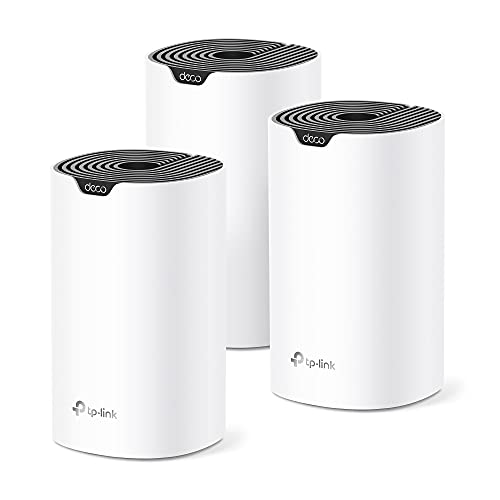
| Budget Mesh Starter | Wi‑Fi Generation: Wi‑Fi 5 (AC1900) — AC standard (802.11ac) | Coverage (pack): Up to 5,500 sq. ft. (3‑pack) | Device Capacity: Supports up to 100 devices | VIEW LATEST PRICE | Our Analysis |
| TP-Link Deco 7 BE23 Wi‑Fi 7 Mesh System (2-Pack) |

| Multi‑Gig Performance | Wi‑Fi Generation: Wi‑Fi 7 | Coverage (pack): Up to 4,500 sq. ft. (2‑pack) | Device Capacity: Supports up to 150 devices | VIEW LATEST PRICE | Our Analysis |
More Details on Our Top Picks
Amazon eero 6+ Mesh WiFi System 3-Pack
Should you need a simple, reliable mesh that handles busy households and smart‑home gear, the Amazon eero 6+ 3‑pack is a solid choice: it delivers up to 1 Gbps speeds with Wi‑Fi 6 and 160 MHz channels, covers about 4,500 sq ft, supports 75+ devices, and includes a built‑in Thread/Zigbee smart‑home hub so your Alexa ecosystem and IoT gadgets stay connected. You’ll get eero TrueMesh routing to reduce drop‑offs and dead spots, backward compatibility with older eeros, and app‑guided setup with remote management. Automatic updates improve security; optional subscriptions add advanced controls. US phone and email support finish the package.
- Wi‑Fi Generation:Wi‑Fi 6
- Coverage (pack):Up to 4,500 sq. ft. (3‑pack)
- Device Capacity:Connects 75+ devices
- Backhaul/Wired Options:Mesh routing (TrueMesh); supports wired backhaul implicitly (eero mesh)
- Smart Home / Hub Support:Built‑in smart home hub (Thread and Zigbee), Alexa integration
- Security & Software Updates:Automatic updates; optional subscription for advanced security
- Additional Feature:eero TrueMesh routing
- Additional Feature:Built‑in Thread & Zigbee
- Additional Feature:Automatic app setup
NETGEAR Orbi 770 Tri-Band WiFi 7 Mesh System
Should you need blistering Wi‑Fi 7 speeds and wide coverage for a busy home or hybrid work setup, the NETGEAR Orbi 770 delivers—its tri‑band design and enhanced backhaul push up to 11 Gbps across as many as 100 devices and roughly 8,000 sq. ft., making it a solid pick for streaming, gaming, and large smart‑home deployments. You get a router plus two satellites (RBE773) with high‑performance antennas, 360° coverage, and a 2.5GbE internet port. It’s backward compatible, offers automatic firmware updates and Advanced Router Protection, and ships in a compact package backed with NETGEAR’s customer warranty.
- Wi‑Fi Generation:Wi‑Fi 7
- Coverage (pack):Up to 8,000 sq. ft. (router + 2 satellites)
- Device Capacity:Supports up to 100 devices
- Backhaul/Wired Options:Tri‑band with enhanced backhaul; wired 2.5 Gb port available
- Smart Home / Hub Support:Marketed for smart home convenience; backward compatibility (no dedicated hub specified)
- Security & Software Updates:Automatic firmware updates; Advanced Router Protection
- Additional Feature:WiFi 7 tri‑band architecture
- Additional Feature:2.5 Gig internet port
- Additional Feature:High‑performance 360° antennas
Amazon eero 7 Dual-Band Wi‑Fi 7 Router (3-Pack)
The Amazon eero 7 (3‑pack) is a strong pick for households that want simple, future‑proof mesh Wi‑Fi—its dual‑band Wi‑Fi 7 radios, MLO support, and up to 6,000 sq. ft. coverage make it easy to wipe out dead zones and handle 120+ devices while staying compatible with older eero gear and select Echo devices. You’ll get wireless speeds up to 1.8 Gbps, support for internet plans to 2.5 Gbps, two 2.5 Gbps Ethernet ports per unit, and a 1.1 GHz quad‑core processor with 1 GB RAM. Setup uses the eero iOS/Android app; security includes WPA3 and optional eero Plus.
- Wi‑Fi Generation:Wi‑Fi 7 (dual‑band)
- Coverage (pack):Up to 6,000 sq. ft. (3‑pack)
- Device Capacity:Supports 120+ devices
- Backhaul/Wired Options:Multi‑link Operation (MLO) and two 2.5 Gb Ethernet ports; wired backhaul supported
- Smart Home / Hub Support:Built‑in Thread, Zigbee, Matter controller options; works with Alexa
- Security & Software Updates:Software security updates; optional eero Plus subscription for Advanced Security and other features
- Additional Feature:Dual‑band MLO support
- Additional Feature:Two 2.5 GbE ports
- Additional Feature:Qualcomm Dragonwing chipset
TP-Link Deco S4 AC1900 Mesh WiFi System (3-Pack)
For homes that need reliable whole-house coverage on a budget, the TP-Link Deco S4 AC1900 (3‑pack) nails the sweet spot: its Deco Mesh system blankets up to 5,500 sq. ft., supports about 100 devices, and lets you plug units together with Ethernet backhaul for steadier performance. You’ll get AC1900 (3×3, 6-stream) speeds across a single SSID so devices roam seamlessly. Each unit has two Gigabit LAN ports and any can act as the primary router, replacing a separate router and extender. Setup and controls run through the Deco app, with solid parental controls and Alexa-manageable guest Wi‑Fi. A modem is required.
- Wi‑Fi Generation:Wi‑Fi 5 (AC1900) — AC standard (802.11ac)
- Coverage (pack):Up to 5,500 sq. ft. (3‑pack)
- Device Capacity:Supports up to 100 devices
- Backhaul/Wired Options:Wired Ethernet backhaul supported (Gigabit ports)
- Smart Home / Hub Support:Alexa voice control for guest Wi‑Fi; app control (no hub)
- Security & Software Updates:App controls with parental controls; firmware/app updates via Deco app
- Additional Feature:3×3, 6‑stream AC1900
- Additional Feature:Two Gigabit ports per unit
- Additional Feature:Alexa guest‑Wi‑Fi control
TP-Link Deco 7 BE23 Wi‑Fi 7 Mesh System (2-Pack)
Designed for homes and power users who need multi‑gig wired hookups and Wi‑Fi 7 wireless speed, the TP‑Link Deco 7 BE23 (2‑pack) delivers up to 2882 Mbps on 5 GHz, dual 2.5 Gbps WAN/LAN ports per node, and MLO‑enabled stability so you can stream, game, and back up large files without bottlenecks. You’ll get 4‑stream dual‑band Wi‑Fi 7 with 160 MHz, 4K‑QAM, Multi‑RUs, and simultaneous wired/wireless backhaul for resilient throughput. The two units cover about 4,500 sq. ft and handle 150 devices. HomeShield, WPA3, VPN support, AI‑Roaming, and Deco compatibility round out its secure, flexible feature set.
- Wi‑Fi Generation:Wi‑Fi 7
- Coverage (pack):Up to 4,500 sq. ft. (2‑pack)
- Device Capacity:Supports up to 150 devices
- Backhaul/Wired Options:Simultaneous wireless and wired backhaul; two 2.5 Gbps WAN/LAN ports
- Smart Home / Hub Support:AI‑Roaming and smart features; interoperable with Deco ecosystem (no dedicated hub specified)
- Security & Software Updates:TP‑Link HomeShield (security, parental controls); regular updates and CISA secure‑by‑design note
- Additional Feature:4‑stream Wi‑Fi 7 radios
- Additional Feature:Two 2.5 Gbps ports
- Additional Feature:Built‑in VPN client/server
Factors to Consider When Choosing a Wireless Mesh System
Upon selecting a mesh system, you’ll initially match coverage to your square footage and account for walls or floors that kill signal. Check how many devices the system can reliably handle, whether it supports Wi‑Fi 6/7, and provided it offers wired or wireless backhaul for the throughput you need. Also confirm security features and privacy policies so your network stays fast and protected.
Coverage Area Needs
Coverage area is the foundation of any mesh decision, so start measuring the total square footage you need to cover—including all floors—and add 20–30% to that number to account for walls, furniture, and other signal loss. Match that adjusted area to systems whose stated coverage meets or exceeds it, noting manufacturer figures assume ideal conditions. Factor in construction: concrete, brick, metal studs and thick floors cut range and often require nodes in adjacent rooms or per floor. Plan node spacing roughly 30–50 feet indoors, aiming for clear line‑of‑sight or minimal obstructions between units and the primary router. Should you have multi‑gig service or distant users, add nodes or wired backhaul points to preserve throughput across the whole coverage area.
Device Capacity Limits
Although device counts are easy to enumerate, you should focus on real-world capacity: pick a mesh rated above your household peak (typical systems handle 50–150+ concurrent devices) and add a 20–30% buffer for growth. Check the maximum concurrent devices but keep in mind manufacturers often assume many low‑bandwidth IoT clients; lots of 4K streams, gaming, or uploads will hit limits faster. Look at radio design and spatial streams—tri‑band systems and more streams sustain higher concurrency with less contention. In the event you expect many simultaneous high‑priority clients, choose gear with QoS and bandwidth‑management features so latency‑sensitive apps stay responsive. Finally, audit current devices and projected additions to pick a system that won’t be obsolete within a few years.
Wi‑Fi Generation Support
Consider the Wi‑Fi generation as the engine under your mesh: it determines peak PHY rates, supported spatial streams, and advanced features like MU‑MIMO, OFDMA, and multi‑link operation that directly impact throughput, latency, and multi‑device performance. Choose Wi‑Fi 6 or 7 provided you want wider channels, higher modulation (1024‑QAM/4K‑QAM and beyond), and MLO for lower latency and better simultaneous-client handling. Newer generations stay backward compatible, but legacy devices will run at their native speeds and can drag overall performance in case many remain. Match the generation to your device mix and concurrency needs: lots of 4K/8K streams, cloud gaming, or multi‑gig internet justify Wi‑Fi 7. Should you plan to upgrade clients, pick the latest supported generation to future‑proof capacity.
Backhaul And Throughput
At the moment you pick a mesh system, backhaul type and capacity determine whether your internet and local traffic actually reach devices at their rated speeds. Choose wired (Ethernet) backhaul when possible—it’s the simplest way to preserve full LAN/WAN throughput and cut wireless congestion. Should you must go wireless, prefer tri‑band models that dedicate a 5 GHz radio for backhaul so client speeds don’t compete with node links. Check backhaul channel widths (80/160 MHz) and support for Multi‑Link Operation (MLO); wider channels and MLO raise aggregate throughput and lower latency. Mind node count and placement: more nodes cut hop counts and contention, but each wireless hop reduces usable bandwidth versus a wired backbone. For multi‑gig plans, make certain backhaul supports 2.5 Gbps or higher.
Security And Privacy
Because your mesh is the hub of all local and internet traffic, you’ll want a system that enforces modern encryption (WPA3 with WPA2 fallback), keeps firmware patched automatically, and gives you granular admin controls like MFA, local-management options, and per-device access rules to limit exposure and keep attackers out. You should also prefer vendor-managed automatic updates to shrink vulnerability windows and check whether intrusion detection/prevention, malware filtering, or traffic inspection are bundled or sold separately. Use network segmentation (separate SSIDs or VLANs) to isolate IoT and other weak devices from laptops and workstations. Verify admin features: strong password enforcement, MFA for management, local-admin access, complete logging/auditing, and per-device controls so you can restrict services and reduce lateral movement after a compromise.
Smart Home Compatibility
Want your mesh to be the nervous system for smart devices, not a bottleneck? Make sure it natively supports the protocols you use—Zigbee, Thread, Matter, or BLE—so sensors and bulbs join without extra hubs. Confirm voice‑assistant or hub integration (or open APIs) should you rely on Alexa, Google, or Home ecosystems; built‑in hub functionality simplifies setup and control. Prefer systems with a dedicated smart‑home radio or a separate IoT SSID to isolate low‑bandwidth, battery‑powered devices for reliability and security. Verify ongoing firmware updates and modern encryption like WPA3 to protect devices. Finally, look for multicast handling, low‑latency scheduling, and multi‑link operation (MLO) to keep many sensors, cameras, and automations responsive.
Management And Features
Whenever you pick a mesh system, management and feature set will determine how easy it is to run, secure, and adapt your network over time. You’ll want centralized management via a mobile app or web portal that supports remote monitoring, seamless device onboarding, and one‑click firmware updates to simplify setup and maintenance. Confirm the system can apply automatic, scheduled, or forced security patches so you’re not chasing vulnerabilities. Prioritize parental controls, guest networks, per‑device/user profiles, and QoS for precise access and bandwidth control. Should you use IoT, check built‑in smart‑home hub support and Thread or Zigbee compatibility. For power users, verify VLAN, DHCP reservations, port forwarding, VPN client/server, and analytics to handle advanced configurations.
