

Suppose one smoke detector could single-handedly stop every house fire, you’d still want a backup. You’ll want detectors that combine photoelectric and ionization or multi-criteria sensing, hardwire reliability, and solid battery backups so they actually work at the moment it counts. I’ll walk you through five top picks and the key features that separate lifesaving models from the rest—keep going to find the right fit for your home.
| Sensing Plus Multi-Criteria Smoke Fire & CO Alarm | Advanced Detection | Power Type: Hardwired with 10-year battery backup | Dual Detection: Smoke (multi-criteria) + CO | Interconnectable: Interconnect capable; Quick Find pinpoints first alarm | VIEW LATEST PRICE | Read Our Analysis | |
| Kidde Hardwired Photoelectric Smoke & CO Detector (KN-COPE-IC) |

| Voice-Alert Specialist | Power Type: Hardwired with 9V battery backup (included) | Dual Detection: Photoelectric smoke + CO | Interconnectable: Interconnect hardwired unit (model KN-COPE-IC) | VIEW LATEST PRICE | Read Our Analysis |
| BRK First Alert Hardwired Smoke Alarm (3-Pack) |

| Home Coverage Pack | Power Type: Hardwired with battery backup (pack) | Dual Detection: Smoke (precision detection) — includes CO? (This is a smoke alarm pack; described as smoke-only in summary) | Interconnectable: Interconnect hardwire detector (3-pack) | VIEW LATEST PRICE | Read Our Analysis |
| Kidde Hardwired Smoke & CO Detector with 10-Year Backup |
| Low-Maintenance Security | Power Type: Hardwired with 10-year lithium battery backup | Dual Detection: Ionization smoke + CO | Interconnectable: Interconnect capability (up to 24 Kidde alarms) | VIEW LATEST PRICE | Read Our Analysis |
| Kidde Hardwired Smoke & CO Detector 4-Pack |
| Cost-Effective Protection | Power Type: Hardwired with 10-year battery backup | Dual Detection: Smoke + CO | Interconnectable: Interconnect capability (consult User Guide for specifics) | VIEW LATEST PRICE | Read Our Analysis |
More Details on Our Top Picks
Sensing Plus Multi-Criteria Smoke Fire & CO Alarm
Advanced Detection
View Latest PriceShould you need a single, maintenance-light alarm that reliably detects both fast flaming and slow smoldering fires while also monitoring carbon monoxide, the Sensing Plus Multi-Criteria Hardwired Combo is a strong choice—it’s hardwired with a 10-year battery backup, uses multi-criteria sensors to reduce missed events, and gives you interconnect capability plus Quick Find so you can pinpoint the initial triggered unit in a network. You’ll get integrated CO detection, an 85 dB alarm, visible power and alarm LEDs, and a test/silence button. A built-in microprocessor minimizes false alarms, so you can trust continuous, reliable protection for a decade.
- Power Type:Hardwired with 10-year battery backup
- Dual Detection:Smoke (multi-criteria) + CO
- Interconnectable:Interconnect capable; Quick Find pinpoints first alarm
- Alarm/Voice Alerts:85 dB audible alarm; visible LEDs
- False-Alarm Reduction / Hush:Microprocessor reduces false alarms; test/silence button
- User Controls / Test Button:Test/silence button; visible LEDs
- Additional Feature:Multi-criteria detection
- Additional Feature:10-year battery backup
- Additional Feature:Quick Find pinpointing
Kidde Hardwired Photoelectric Smoke & CO Detector (KN-COPE-IC)
Should you want reliable combined smoke and CO protection that’s easy to maintain, the Kidde KN-COPE-IC is a great choice—its hardwired AC power with a front-loading 9V battery backup and tamper-resistant design makes it ideal for homeowners who need continuous protection with simple battery access. You’ll get a photoelectric smoke sensor that catches smoldering fires promptly and CO monitoring that announces dangerous levels. Voice alerts and distinct beep patterns differentiate fire, CO, low battery, hush status, and alarm memory. Use the test/reset button for checks and to hear memory messages. The front-loading battery and tamper-resistant feature simplify upkeep and security.
- Power Type:Hardwired with 9V battery backup (included)
- Dual Detection:Photoelectric smoke + CO
- Interconnectable:Interconnect hardwired unit (model KN-COPE-IC)
- Alarm/Voice Alerts:Audible tones + voice messages for Fire, CO, Low Battery, Hush
- False-Alarm Reduction / Hush:Hush feature with voice confirmation; reduces nuisance alarms
- User Controls / Test Button:Test/reset button (also triggers alarm-memory voice)
- Additional Feature:Voice alarm messages
- Additional Feature:Front-loading battery
- Additional Feature:Tamper-resistant design
BRK First Alert Hardwired Smoke Alarm (3-Pack)
Should you want dependable whole-home protection that keeps everyone alerted, the BRK First Alert Hardwired Smoke Alarm 3-pack is a smart pick — it interconnects so whenever one unit sounds, all compatible alarms sound, giving you fast, house‑wide warning. You get BRK First Alert SMI100-AC detectors with Precision Detection advanced sensing that meets new industry standards and cuts down cooking nuisance alarms while still providing prompt fire warning. Hardwiring supplies primary power; battery backup keeps protection during outages. A Quick Connect Plug speeds installation without rewiring, and an alarm indicator shows which unit triggered, simplifying response and maintenance.
- Power Type:Hardwired with battery backup (pack)
- Dual Detection:Smoke (precision detection) — includes CO? (This is a smoke alarm pack; described as smoke-only in summary)
- Interconnectable:Interconnect hardwire detector (3-pack)
- Alarm/Voice Alerts:Audible alarm with indicator identifying initiating unit
- False-Alarm Reduction / Hush:Reduces cooking nuisance alarms (precision detection)
- User Controls / Test Button:(Includes Quick Connect; standard test/reset functionality implied for smoke alarms)
- Additional Feature:Precision Detection technology
- Additional Feature:3-pack value bundle
- Additional Feature:Quick Connect plug
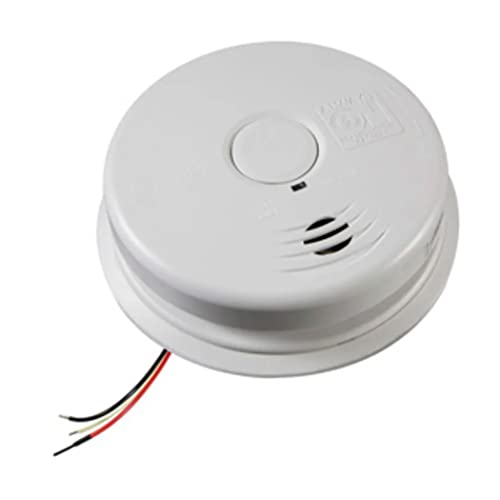
Kidde Hardwired Smoke & CO Detector with 10-Year Backup
Should you want a low-maintenance, whole-home safety solution, the Kidde hardwired smoke and CO detector with a 10-year lithium backup is a great fit — it combines ionization smoke sensing and electrochemical CO detection in one unit and lets you interconnect up to 24 alarms so every room wakes you to danger. You’ll get an 85‑dB alarm plus voice prompts that say “Fire!”, “Warning Carbon Monoxide”, or “Replace Alarm” at end of life. The sealed 10-year lithium backup removes battery chores, and UL certification with a 10‑year limited warranty gives confidence. Use the Test-Hush button to check and silence nuisances.
- Power Type:Hardwired with 10-year lithium battery backup
- Dual Detection:Ionization smoke + CO
- Interconnectable:Interconnect capability (up to 24 Kidde alarms)
- Alarm/Voice Alerts:85 dB alarm + voice alerts (“Fire!”, “Warning Carbon Monoxide”, “Replace Alarm”)
- False-Alarm Reduction / Hush:Test-Hush button to silence false alarms
- User Controls / Test Button:Test-Hush button for testing and silencing
- Additional Feature:10-year lithium backup
- Additional Feature:End-of-life voice
- Additional Feature:Up to 24-unit interconnect
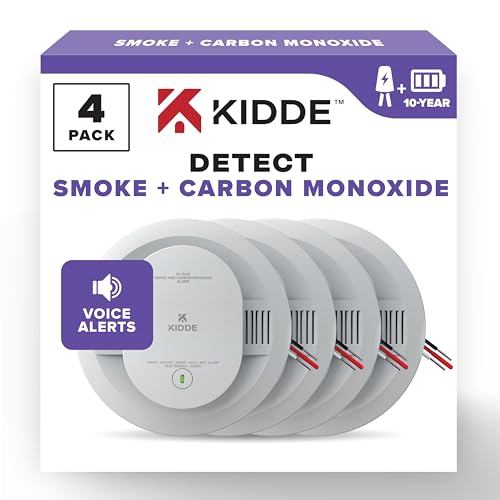
Kidde Hardwired Smoke & CO Detector 4-Pack
Should you want reliable whole-home protection and fewer nuisance alarms, the Kidde Hardwired Smoke & CO Detector 4‑Pack is a smart choice—each unit combines smoke and carbon monoxide sensing with improved technology that cuts down on cooking false alarms, hardwires to your 120V ceiling wiring with a 10‑year battery backup, and links with other alarms so one trigger notifies the entire house. You get UL-tested dual detection (UL 217, UL 2034), voice alerts that announce “Fire!” or “Warning! Carbon Monoxide!”, LED indicators, and interconnect capability. As a single-device solution, it’s cost-effective and can save up to about $40 over its life.
- Power Type:Hardwired with 10-year battery backup
- Dual Detection:Smoke + CO
- Interconnectable:Interconnect capability (consult User Guide for specifics)
- Alarm/Voice Alerts:Voice alerts (“Fire!”, “Warning! Carbon Monoxide!”) + LED indicators
- False-Alarm Reduction / Hush:Enhanced sensing to reduce false alarms from cooking
- User Controls / Test Button:Voice alerts and standard user controls (test/hush implied in user guide)
- Additional Feature:UL & FCC tested
- Additional Feature:Estimated life savings
- Additional Feature:4-pack convenience
Factors to Consider When Choosing a Hardwired Dual Sensor Smoke Detector
Whenever choosing a hardwired dual sensor smoke detector, you’ll want to compare detection technology types to make sure both photoelectric and ionization sensors meet your needs. Check power and backup options, interconnect compatibility with your existing system, and how well the unit resists false alarms. Also confirm alert types and volume so alarms are loud and clear where you need them.
Detection Technology Types
Choose sensors that match the kinds of fires and environments you want to protect: photoelectric units catch slow, smoldering fires from upholstery or wiring, ionization picks up fast, flaming fires, CO sensors measure dangerous carbon monoxide levels to standard thresholds, and heat or multi-criteria systems combine inputs (and algorithms) to improve accuracy and cut nuisance alarms. You’ll want photoelectric protection in bedrooms and lounge rooms where smoldering fires start, while ionization helps where open flames or rapid combustion are possible. CO sensors protect occupants from invisible gas per UL/ANSI time/ppm thresholds. Heat or rate-of-rise sensors supplement areas with little smoke but fast temperature increases, such as kitchens or attics. Multi-criteria detectors fuse data to reduce false alarms and improve overall detection.
Power And Backup
Because your home’s safety depends on continuous operation, pick hardwired dual sensor detectors that use 120V AC as their primary power and include a dependable long‑life backup battery so they keep working during outages. You should verify the unit’s backup type—9V or sealed lithium—and remark its expected service life. Prefer models with a 10‑year sealed backup or long‑life lithium cell to avoid frequent replacements and reduce maintenance. Confirm the detector provides clear low‑battery notifications, both audible and visual, plus straightforward replacement or service instructions. Finally, make certain the power design preserves backup operation whenever interconnected so the whole system still alerts correctly during power failures, maintaining reliable protection across your home.
Interconnect Compatibility
Should your home’s alarms don’t speak the same interconnect language, they won’t give you whole‑house alerts, so verify new detectors use the same wire‑based or wireless protocol as your existing units. Check maximum interconnect capacity and topology limits so all devices reliably propagate an alarm; some systems cap the network (for example, 24 units). Verify wiring and connector types—three‑ or four‑wire interconnects, polarity sensitivity, and a common interconnect line—to avoid miscommunication during installation. Confirm the interconnect conveys distinct smoke and CO events versus a generic alarm when you want hazard‑specific alerts or voice/coded signaling. Finally, make certain matching voltage and signaling characteristics and that battery‑backup or auxiliary power schemes won’t disrupt interconnect signaling during power loss.
False-Alarm Resistance
Once you’ve confirmed interconnect compatibility, consider how often your detectors will cry wolf—false alarms undermine safety via prompting users to disable devices or ignore alerts. Choose photoelectric or multi-criteria sensors over ionization-only units because they better detect smoldering fires and resist nuisance triggers from cooking or steam. Prefer models with onboard microprocessors or signal-analysis algorithms that filter transient particulates and cut false-trigger rates. A temporary “hush” feature helps suppress nuisance alarms without disabling monitoring, reducing the temptation to remove detectors. Check visible/audible status indicators and alarm-memory functions so you can pinpoint which unit triggered and whether alerts were false, aiding placement adjustments. Finally, follow placement guidance—site photoelectric/multi-criteria units away from kitchens and bathrooms and nearer bedrooms and inhabited areas.
Alert Types And Volume
How loud and how an alarm communicates can make the difference between waking everyone and getting ignored—so look for units that deliver at least 85 dB at 10 feet and offer multiple alert modes (continuous, temporal patterns, pulsed) that match NFPA/UL signaling. You’ll also want alarms that combine high-decibel tones with clear voice or verbal alerts so occupants can distinguish smoke from CO incidents quickly. Visual indicators and alarm-location ID LEDs help you pinpoint the initiating unit in interconnected systems. In the event someone in your home is hearing-impaired, pick models that support strobes, wireless bed-shakers, or integration with supplementary alerting devices. Prioritizing these features guarantees alerts are noticeable, identifiable, and actionable for everyone in your household.
Ease Of Installation
Installing a hardwired dual sensor smoke detector should be straightforward, so check that the unit matches your home’s 120V ceiling wiring and interconnect system before you buy. Verify specific wiring pins or connectors; some models need matched plugs for full functionality. Confirm support for standard interconnection protocols (often up to 24 units) and make certain your junction boxes and wiring layout can handle those connections. Favor detectors with quick-connect plugs or front-loading battery designs to simplify hookup and allow tool-free battery access. Look for clear mounting templates, included screws/anchors, and a simple mounting base to cut installation time. Finally, match unit weight and backbox depth to your ceiling box so the detector sits flush without stressing wiring.
Maintenance And Lifespan
Planning maintenance and tracking lifespan will keep your hardwired dual sensor smoke detector reliable and compliant. You should test detectors monthly with the built-in button and log results so sensors, alarms, and interconnects stay verified. Replace the backup battery yearly or confirm a sealed 10-year battery; should sealed, plan to replace the entire unit at end-of-life. Clean detectors every six months through vacuuming vents or using compressed air to remove dust and insects that impair sensing. Observe the manufacturer-specified end-of-life—typically seven to ten years—and replace the detector then because sensor sensitivity and CO electrochemical cells degrade. Keep installation, maintenance, and alarm event records to track performance and guide timely replacement or professional service.
