

Most low‑back armless chairs hide a deliberately shaped Y‑ or S‑curve that targets lower lumbar support more than you’d expect. You’ll notice how that firm lower support paired with softer upper backing changes posture and comfort during long shifts. I’ll point out two standout models and the exact specs—cushion thickness, adjustability range, materials—that matter for multi‑user setups, so you can pick what actually fits your workday.
| Yaheetech Low Back PU Leather Armless Office Chair |

| Sleek & Supportive | Back Type: Low-back PU leather curved backrest | Armless: Armless design (integrated seat) | Height Adjustability: Gas lift, seat height 18.3″–24.2″ | VIEW LATEST PRICE | Read Our Analysis |
| Sweetcrispy Ergonomic Low-Back Mesh Office Chair |
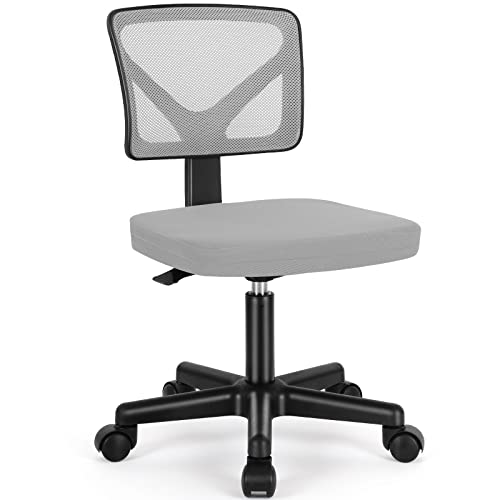
| Best for Small Spaces | Back Type: Low-back Y-shaped mesh backrest | Armless: Armless design (space-saving task chair) | Height Adjustability: Gas lift, seat height 15.94″–20.67″ | VIEW LATEST PRICE | Read Our Analysis |
More Details on Our Top Picks
Yaheetech Low Back PU Leather Armless Office Chair
Should you need a compact, budget-friendly chair that lets you move freely, the Yaheetech Low Back PU Leather Armless Office Chair is a smart pick—its armless, low-back design frees up your shoulders and saves space while a ribbed PU-leather cover and chrome base keep it looking sharp. You’ll get an ergonomic curved backrest that supports your spine, high-elastic foam padding, and deluxe PU leather for comfort and durability. The SGS-certified gas lift adjusts seat height from 18.3″–24.2″, and casters plus swivel let you glide around tasks. It holds up to 265 lb, assembles in under ten minutes, and suits home or office use.
- Back Type:Low-back PU leather curved backrest
- Armless:Armless design (integrated seat)
- Height Adjustability:Gas lift, seat height 18.3″–24.2″
- Mobility:360° swivel with caster wheels
- Cushioning:High-elastic foam padding under PU leather
- Assembly Time:Quick assembly, under 10 minutes (minimal tools)
- Additional Feature:Ribbed PU leather upholstery
- Additional Feature:Chrome-finish base
- Additional Feature:SGS-certified gas lift
Sweetcrispy Ergonomic Low-Back Mesh Office Chair
Should you need a compact, breathable task chair that supports long hours without armrests getting in the way, the Sweetcrispy Ergonomic Low-Back Mesh Office Chair fits the bill. You’ll get a Y-shaped mesh back that follows your lower spine, reducing pressure and helping prevent pain, plus a foam-molded seat for comfort. Its armless, small-profile design saves space and suits kids, students, and adults. You can adjust height from 15.94 to 20.67 inches, swivel 360 degrees, and roll on silent PU casters. Assembly takes 10–15 minutes; the removable cushion simplifies cleaning, and BIFMA-tested parts guarantee durability.
- Back Type:Low-back Y-shaped mesh backrest
- Armless:Armless design (space-saving task chair)
- Height Adjustability:Gas lift, seat height 15.94″–20.67″
- Mobility:360° swivel with PU silent casters
- Cushioning:Foam-molded seat cushion (removable)
- Assembly Time:Assembly in 10–15 minutes (includes screws/tools/manual)
- Additional Feature:Y-shaped mesh backrest
- Additional Feature:BIFMA-tested base
- Additional Feature:Removable seat cushion
Factors to Consider When Choosing an Ergonomic Armless Office Chair
Whenever choosing an ergonomic armless office chair, you’ll want to match the back support shape to your natural spine curve for proper lumbar alignment. Check seat cushion quality and height adjustability range to guarantee long-term comfort and correct posture. Also consider breathability and material plus mobility and casters so the chair stays cool, supportive, and easy to move.
Back Support Shape
Balance matters: pick a backrest with a pronounced Y- or S-shaped lumbar curve that follows your lower spine to reduce pressure and prevent lower-back pain. You should choose a back support that mirrors the spine through the lumbar and lower thoracic regions rather than a flat panel, since proper curvature improves posture and spreads load. For armless, low-back chairs, prioritize a well-defined lower-back contour because these models give less overall coverage and rely on lumbar shape for primary support. Look for breathable materials and ergonomic contouring that combine firmer lumbar support with softer upper backing so you get alignment without stiffness. Finally, confirm the backrest height and curve place lumbar support near your natural waist or beltline for effective daily use.
Seat Cushion Quality
Choose a seat cushion that keeps you comfortable and supported all day: aim for high-resilience foam 1.5–3 inches thick with a density around 1.8–2.5 lb/ft³ so the pad holds its shape and contours to your body. Pick foam that rebounds well (under 20% permanent set) so it won’t flatten after months of use. Prefer PU leather or mesh-covered foam based on temperature: mesh breathes better, PU is easier to wipe. Look for a contoured profile or waterfall edge to cut thigh pressure and enhance circulation during long sessions. Confirm the cushion is securely bonded or easily removable for cleaning or replacement. These specifics keep an armless chair comfortable, durable, and hygienic without sacrificing support.
Height Adjustability Range
Because your knees, hips and desk all have to align for comfortable, productive work, pick a chair with a seat-height range that lets your feet sit flat and your knees rest near 90 degrees—typically about 16–21 inches for standard desks and 18–24 inches for raised surfaces. Check that the chair’s minimum and maximum heights match your body: shorter users often need a minimum near 15–17 inches; taller users usually require a maximum above 22 inches. Make sure the chair provides 3–5 inches of overlap with your desk for proper leg clearance. Prefer a smooth gas-lift pneumatic adjustment that supports your weight without sinking. For shared workspaces, choose a wider range—at least 6–8 inches—so multiple users can sit ergonomically.
Breathability And Material
How hot will you get after a few hours at your desk? You’ll want a chair that manages heat and moisture: mesh backrests outperform PU leather or dense fabric through letting air flow and dissipating sweat. For the seat, choose high-elastic foam with a breathable cover so pressure points are reduced while some airflow continues. Look for materials labeled moisture-wicking or ventilated—open-weave mesh can lower skin temperature in warm rooms. Balance breathability with durability: denser fabrics or coated surfaces resist wear and stains but trap more heat. Check maintenance details—removable, washable cushion covers extend hygiene and preserve airflow, whereas non-absorbent PU surfaces clean easily yet might feel less breathable over long sessions.
Mobility And Casters
Anytime moving around your workspace, smooth mobility and the right casters make a big difference: pick wheels matched to your floor (hard-floor for wood or tile, soft-floor for carpet), aim for 360° swivel with a sturdy gas lift and multi-directional casters, and check wheel size and hardness—larger (≥2″) and softer polyurethane or rubber wheels roll quieter and handle thresholds better. You should also verify per-wheel load ratings and multiply by your base’s wheel count to confirm total capacity for your weight plus chair components. Prefer sealed-bearing casters for lower maintenance and dirt resistance, and choose modular, easy-to-replace wheels so you can swap worn casters without replacing the whole chair. Smooth, rated casters keep you productive and protect floors.
Build Durability Standards
While comfort matters, you’ll get the most long-lasting value via prioritizing build durability: check for BIFMA or SGS component certifications, confirmed static and kinetic weight capacities (typically 250–300+ lb), and materials like reinforced nylon or metal bases, steel-reinforced mechanisms, and high-density foam or resilient mesh that resist compression and tearing. Beyond specs, verify declared load ratings explicitly cover long-term static and dynamic use, not just peak loads. Look for multi-year warranties on frame and mechanism as a manufacturer confidence signal. Where available, review cycle-testing data — swivel, tilt, and gas lift tested for 10,000+ cycles indicate real-world resilience. Finally, inspect assembly points and fasteners; solid joints and quality finishes reduce squeaks and premature failure.
