

You’d reckon a single alarm could stop a house fire and save the planet, but real protection needs better tech and placement. You’ll want devices that marry photoelectric smoke sensing with electrochemical CO detection, long sealed batteries, loud alerts, and clear displays so you get fast, accurate warnings. I’ll walk you through five top dual detectors and the key features that make them worth installing—start with where to put them and why it matters.
| Photoelectric Battery Smoke Alarm with LED Warning | Reliable Photoelectric | Detection Type: Photoelectric (smoke) | Power Source: 9V battery (replaceable) | Audible Alarm Level: >85 dB | VIEW LATEST PRICE | Read Our Analysis | |
| 2-in-1 Smoke and Carbon Monoxide Detector with LCD | CO + Smoke Combo | Detection Type: Photoelectric (smoke) + Electrochemical (CO) | Power Source: 3 × AA batteries (replaceable) | Audible Alarm Level: 85 dB | VIEW LATEST PRICE | Read Our Analysis | |
| 3-Pack Combination Smoke & Carbon Monoxide Detector Alarm | Long-Life 3-Pack | Detection Type: Photoelectric (smoke) + Electrochemical (CO) | Power Source: Built-in sealed lithium (10-year) | Audible Alarm Level: >85 dB | VIEW LATEST PRICE | Read Our Analysis | |
| Kidde Smoke and Carbon Monoxide Detector Combo (10-Year) |
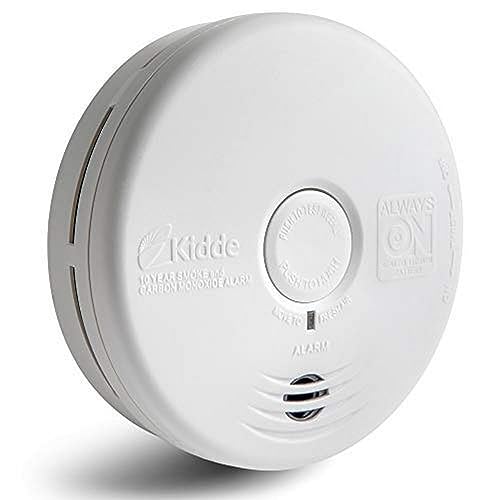
| Trusted Brand (10-Year) | Detection Type: Photoelectric (smoke) + Electrochemical (CO) | Power Source: Built-in lithium (10-year) | Audible Alarm Level: 85 dB | VIEW LATEST PRICE | Read Our Analysis |
| Interconnected Smoke & CO Detector 3-Pack (10-Year) | Whole-Home Interconnected | Detection Type: Photoelectric (smoke) + Electrochemical (CO) | Power Source: Built-in sealed 10-year lithium | Audible Alarm Level: (Loud) standard ~85 dB | VIEW LATEST PRICE | Read Our Analysis |
More Details on Our Top Picks
Photoelectric Battery Smoke Alarm with LED Warning
Reliable Photoelectric
View Latest PriceShould you want a reliable, low-maintenance alarm that excels at spotting slow, smoldering fires from furniture or appliances, this photoelectric battery smoke alarm is a smart pick. You’ll get dual-sensor photoelectric detection tuned for slow-burning fires, 0.1 bar sensitivity and 0.08s response with a 360° inlet and flue feed for fast capture. It minimizes false alarms, uses a high-capacity 9V battery lasting about three times longer than AA units, and draws 85 dB alarms, see rapid red LED flashes, get low-battery and end-of-life alerts, mount via tape or screws, and expect UL217 support.
- Detection Type:Photoelectric (smoke)
- Power Source:9V battery (replaceable)
- Audible Alarm Level:>85 dB
- Installation Method:Ceiling or wall; 3M tape or screws included
- End-of-Life / Service Life:Designed for long service life (up to 10 years); end-of-life signal
- Standards / Certification:Tested to meet UL 217
- Additional Feature:Ultra-low standby current
- Additional Feature:Rapid 360° smoke inlet
- Additional Feature:9V high-capacity battery
2-in-1 Smoke and Carbon Monoxide Detector with LCD
CO + Smoke Combo
View Latest PriceShould you want reliable whole‑home protection in a single, easy‑to‑install unit, the 2‑in‑1 Smoke and Carbon Monoxide Detector with LCD is a smart choice; it combines fast‑response photoelectric smoke sensing with a high‑precision electrochemical CO sensor and shows real‑time CO levels on a large LCD. You’ll get UL217 and UL2034–listed performance, an 85 dB alarm plus flashing LED, and a 360° air‑intake for full‑room monitoring. Battery powered with three AA cells, it mounts quickly with included screws and brackets. Long‑life sensors suit bedrooms, hallways, basements, garages, apartments, RVs, and other inhabited spaces.
- Detection Type:Photoelectric (smoke) + Electrochemical (CO)
- Power Source:3 × AA batteries (replaceable)
- Audible Alarm Level:85 dB
- Installation Method:Quick DIY mount with screws and bracket
- End-of-Life / Service Life:Long-life sensors (implied multi-year), meets standards (no explicit 10-yr)
- Standards / Certification:Meets UL217 (smoke) and UL2034 (CO)
- Additional Feature:Real-time CO PPM LCD
- Additional Feature:360° air-intake design
- Additional Feature:Battery-powered (3×AA)
3-Pack Combination Smoke & Carbon Monoxide Detector Alarm
Long-Life 3-Pack
View Latest PriceShould you want reliable, long-lasting protection for a small home, RV, or rental, this 3-pack combination smoke and carbon monoxide alarm is a smart choice. You get dual sensing: photoelectric smoke and electrochemical CO, with upgraded sensors for faster response, fewer false alarms, and higher sensitivity. Each unit has a sealed lithium battery providing 10 years of continuous power and an option to turn off whenever not in use. The ultra-thin Ø4.7 x 1.1-inch design includes a large top test/silence button you can reach with a long stick. Installation is quick with included adhesive tape and screws.
- Detection Type:Photoelectric (smoke) + Electrochemical (CO)
- Power Source:Built-in sealed lithium (10-year)
- Audible Alarm Level:>85 dB
- Installation Method:Quick wall/RV install; adhesive tape and screws included
- End-of-Life / Service Life:10-year battery/lifespan
- Standards / Certification:(Implied compliant) upgraded sensors; audible per standard (>85 dB) — marketed as safety certified
- Additional Feature:Built-in 10-year lithium
- Additional Feature:Large top test/silence
- Additional Feature:Ultra-thin compact profile
Kidde Smoke and Carbon Monoxide Detector Combo (10-Year)
Should you want a low-maintenance safety solution for bedrooms or hallways, the Kidde 2-in-1 combo is a smart choice: its photoelectric smoke sensor catches smoldering fires while an electrochemical CO sensor watches for poisonous gas, and a sealed 10-year lithium battery means you won’t have to swap batteries during the unit’s rated life. You’ll get an 85-decibel alarm with red LED indication, automatic activation upon mounting, and a Test-Hush button to silence false alarms. It’s UL listed, signals end-of-life chirps, and includes a 10-year limited warranty that begins once the unit is powered on.
- Detection Type:Photoelectric (smoke) + Electrochemical (CO)
- Power Source:Built-in lithium (10-year)
- Audible Alarm Level:85 dB
- Installation Method:Mounting bracket (auto-activate on bracket); screws included
- End-of-Life / Service Life:10-year design; end-of-life chirp; 10-year limited warranty
- Standards / Certification:UL listed
- Additional Feature:Alarm auto-activates on mount
- Additional Feature:Test-Hush silencing button
- Additional Feature:10-year lithium warranty
Interconnected Smoke & CO Detector 3-Pack (10-Year)
Whole-Home Interconnected
View Latest PriceShould you want seamless, whole-home protection with no wiring or battery chores, this interconnected 3-pack is for you: the pre-linked, wireless units combine photoelectric smoke and electrochemical CO sensors with a sealed 10-year battery so you’ll get fast, accurate alerts and numeric CO readouts without maintenance. You’ll get dense sensor holes for quicker detection and fewer false alarms, plus real-time LCD CO (PPM) and battery readouts. The mesh network reaches up to 980 ft, so whenever one alarm trips all alerts sound. Installation is plug-and-play with included hardware. UL-tested, U.S. support and lifetime replacement back the product.
- Detection Type:Photoelectric (smoke) + Electrochemical (CO)
- Power Source:Built-in sealed 10-year lithium
- Audible Alarm Level:(Loud) standard ~85 dB
- Installation Method:Wall/ceiling mount; all mounting hardware included; pre-linked
- End-of-Life / Service Life:10-year sensor/built-in battery lifespan
- Standards / Certification:Tested to UL 217 and UL 2034 by accredited lab
- Additional Feature:Wireless pre-linked setup
- Additional Feature:980 ft mesh range
- Additional Feature:Dual-color smart LEDs
Factors to Consider When Choosing a Dual Smoke Detector
While choosing a dual smoke detector, you’ll want to weigh detection technology types so you know whether ionization, photoelectric, or a combination suits your home. Check power and battery life, false alarm reduction features, and whether units can interconnect to cover all sleeping areas. Also consider installation and mounting options to guarantee proper placement and reliable performance.
Detection Technology Types
Start through matching the detector’s sensing technology to the kinds of fires and environments in your home. Photoelectric sensors use a light-scattering chamber to detect visible smoke from slow, smoldering fires and usually respond faster to upholstery or wiring fires. Ionization sensors detect smaller particles from fast-flaming fires via measuring ion-current changes and generally react quicker to open-flame sources. Combination (dual) detectors pair photoelectric and ionization—or photoelectric plus electrochemical CO—to cover both smoldering and flaming profiles while also monitoring carbon monoxide. Electrochemical CO sensors output a signal proportional to CO concentration and can give real-time PPM readings for air-quality awareness. Upon choosing, weigh response speed for different fire classes, false-alarm susceptibility (photoelectric fewer nuisance alarms), and compliance with safety standards.
Power And Battery Life
Balancing power options and battery life is key to keeping your dual smoke detector reliable without constant upkeep. Choose long-life power—sealed lithium batteries rated up to 10 years or high-capacity 9V/AA cells—to cut replacement frequency. Check standby current and energy efficiency; units with ultra-low quiescent draw (for example, 85 dB) during outages.
False Alarm Reduction
Because nuisance alarms erode trust and lead people to disable protections, pick dual smoke detectors designed to minimize false alerts without sacrificing safety. Choose models with photoelectric sensors so cooking and steam won’t trigger alarms as easily; they detect larger particles from smoldering fires rather than tiny kitchen aerosols. Prefer units with intelligent signal-processing or adjustable sensitivity that filter nuisance signatures yet react quickly to real threats. Look for designs with dedicated smoke inlets and 360° or multi-directional sampling to prevent localized dust buildup from causing false trips. Make sure detectors offer a Test/Hush or temporary silence function and clear low-battery indicators so you can silence verified nuisances without disabling protection. Finally, install them at recommended ceiling locations away from stoves, bathrooms, and vents.
Interconnection And Coverage
Reducing false alarms is only part of the equation—coverage and interconnection determine whether a real alarm reaches everyone in time. You’ll want interconnected detectors so one triggered unit makes them all sound within seconds, giving whole‑home notification instead of isolated alerts. Decide between wireless mesh systems—often covering around 300 m/980 ft between units, good for reducing dead zones in larger homes—and hardwired networks that rely on household power with battery backup for continued operation during outages. For full coverage, place detectors in every sleeping area, outside bedroom clusters, and on every level. Before you buy or install, confirm the interconnection method, protocol compatibility, and the maximum number of linked devices to make sure the system scales and performs reliably.
Installation And Mounting
As you install a dual smoke detector, ceiling mounting gives the best chance of prompt detection since hot smoke rises—place units at least 4 inches from walls and centered on the ceiling whenever possible; should you must mount on a wall, put the top edge 4 to 12 inches below the ceiling. Keep detectors away from drafts, vents, ceiling fans, doors, and windows so airflows don’t divert smoke. Use manufacturer-recommended mounting hardware or adhesive and secure the unit so it won’t dislodge over its service life. For multi-unit or interconnected systems, mount units uniformly on each level and in sleeping areas. Verify wireless interconnect range and line-of-sight during installation to make certain alarm signals propagate reliably.
Alerts And User Interface
Once your detectors are properly mounted, you’ll want to focus on how they communicate hazards and maintenance needs. Choose units with at least an 85 dB audible output so alarms wake sleepers and carry to adjacent rooms. Look for rapid-flashing red LEDs during alarm events and distinct low-battery flash patterns so you can tell danger from maintenance at a glance. A clearly labeled test/silence (Hush) button lets you run monthly checks and temporarily mute nuisance alarms without removing the detector. Prefer models with numeric LCD CO readouts in PPM for real-time carbon monoxide awareness rather than a simple binary light. Finally, make certain smoke and CO use distinct tones or LED colors, reducing confusion and enabling faster, appropriate responses.
