

I’ve tested and compared the top smart AC control options for 2026 so you can pick what fits your home and budget. I’ll cover universal remotes, DIY thermostats, mini‑split controllers, and energy‑focused models that save money and work with Alexa and Google. I’ll also point out compatibility quirks and installation tips so you don’t start a project you can’t finish — here’s what surprised me most.
MOES WiFi RF IR Universal Smart Home Remote Controller

Should you want a single hub that tames both infrared and RF devices, the MOES WiFi RF IR Universal Remote Controller is a smart pick — it lets you control TVs, A/C units, fans, curtains and other 433/315 MHz RF gadgets as well as IR appliances from your phone or with Alexa/Google, so you won’t need multiple remotes or hubs to manage mixed-device homes. You’ll use the Smart Life/Tuya app over 2.4GHz WiFi or 4G to operate devices remotely, enable voice control, and add unsupported brands via DIY learning. It’s compact (2.67×2.67×0.77 in), lightweight, and supports wide RF/IR compatibility.
Best For: tech-savvy homeowners or renters who want a single, compact hub to control a mix of IR and 433/315 MHz RF devices from their phone or via Alexa/Google.
Pros:
- Controls both IR and RF (433/315 MHz) devices, reducing the need for multiple remotes or hubs.
- Remote smartphone control via Smart Life/Tuya app and voice control with Alexa/Google for convenient hands-free and away-from-home operation.
- DIY learning feature covers unsupported IR brands and wide protocol support for many RF gadgets.
Cons:
- Only supports 2.4 GHz WiFi (no 5 GHz), which may be inconvenient on 5 GHz–only networks.
- Compatibility may vary by device—some brands or RF protocols might not be supported, requiring manual checking.
- Setup and learning features may be fiddly for non-technical users compared with plug-and-play universal hubs.
Sensi Smart Thermostat ST55 — Wi‑Fi, Alexa Compatible

In case you want a straightforward, DIY-friendly smart thermostat that works with most residential HVAC systems and doesn’t usually need a common wire, the Sensi ST55 is a smart choice — it pairs easily with Alexa, Google Assistant, SmartThings, and Vera while offering simple app-guided installation and ENERGY STAR‑certified energy savings. You’ll mount the glossy white unit in the same footprint as your old thermostat, use the app’s step-by-step guide and included hardware, and power it with 24VAC plus one AAA battery. It tracks usage, sends alerts and filter notifications, supports auto changeover, and comes with a three-year warranty.
Best For: DIY homeowners who want an easy-to-install, Wi‑Fi‑enabled smart thermostat that works with most residential HVAC systems and popular smart assistants without usually needing a common wire.
Pros:
- ENERGY STAR-certified and can reduce HVAC energy costs with flexible scheduling and remote control.
- Simple app-guided DIY installation that fits standard thermostat footprints and includes mounting hardware.
- Integrates with Alexa, Google Assistant, SmartThings, and Vera and provides usage reports, alerts, and maintenance reminders.
Cons:
- Although a c-wire is not required in most cases, some systems may still need one or additional wiring.
- Relies on a single AAA battery for backup, which requires periodic replacement.
- Limited physical controls (button interface) and a basic LED display compared with some higher-end smart thermostats.
Vine WiFi Smart Thermostat for Home (C-Wire)

Who needs an affordable, easy-to-install smart thermostat that still supports advanced scheduling? You do, provided you have a C‑wire and want reliable 24V compatibility—Vine handles about 90% of systems (conventional, heat pump, heat/cool only). You’ll install it in roughly 20 minutes using online guides; the package includes trim plate, wiring labels, screws, manual, and wall plate. Connect via Wi‑Fi and control with the Vine or Smart Life apps, Alexa, Google Assistant, touch controls, or voice. You get 7‑day/8‑period scheduling, geofencing, Auto Home/Away, energy savings (ENERGY STAR), alerts, filter notifications, and child lock.
Best For: homeowners or renters with a C‑wire looking for an affordable, easy‑to‑install Wi‑Fi thermostat that supports advanced 7‑day/8‑period scheduling and broad 24V system compatibility.
Pros:
- Wide compatibility with ~90% of 24V systems (conventional, heat pump, heat/cool only) and ENERGY STAR certified for energy savings.
- Multiple control options (Vine & Smart Life apps, Alexa/Google voice control, touch controls) plus geofencing and Auto Home/Away for convenience and efficiency.
- Quick, user-friendly installation (~20 minutes) with included trim plate, wiring labels, screws, manual, and online guides/videos.
Cons:
- Requires a C‑wire, so households without one may need additional wiring or a power extender.
- Limited to 24V systems—won’t work with non‑compatible HVAC setups or proprietary systems.
- Basic physical display and controls (small LCD, touch buttons) may lack the polish or advanced UI of higher‑end smart thermostats.
Honeywell T5 WiFi Smart Thermostat (RTH8800WF2022)

Should you want a straightforward, energy-focused smart thermostat that adapts to your routine, the Honeywell T5 WiFi (RTH8800WF2022) is a solid pick because it combines 7-day flexible scheduling, geofencing Auto Home/Away, and ENERGY STAR efficiency tools that can cut heating and cooling costs approximately 8–16%. You’ll get monthly energy reports, personalized tips, and eligibility for utility demand-response programs or rebates. The touchscreen and Alexa compatibility make control simple. It needs a C‑Wire (or adapter) and works with most heat/cool oil furnace systems but not heating-only oil setups without a C‑Wire. Check compatibility before buying.
Best For: homeowners seeking a simple, energy-focused smart thermostat that adapts to daily routines and integrates with smart home assistants.
Pros:
- 7-day flexible scheduling plus geofence-based Auto Home/Away for automated energy savings (estimated 8–16%).
- ENERGY STAR certified with monthly energy reports, personalized tips, and eligibility for utility demand-response programs or rebates.
- Touchscreen interface and Alexa compatibility for easy local and voice control.
Cons:
- Requires a C‑Wire or separate power adapter; may need additional installation work for some homes.
- Not compatible with heating-only oil furnace systems unless a C‑Wire is present.
- Less feature-rich than premium thermostats (e.g., advanced learning algorithms or extensive third-party integrations).
WOOX Smart WiFi IR AC & Heater Controller
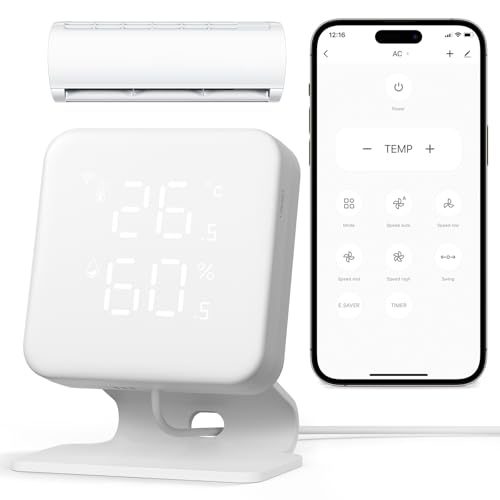
In case you’ve got a mini-split, window, or portable AC (but not a central system), the WOOX Smart WiFi IR Controller is a compact way to turn that single unit into a voice- and app-controlled smart device. You’ll replace bulky remotes with the Woox Home app, Alexa, or Google Home to set mode, fan speed, and temperature. IR learning copies most remotes, and the Swiss thermohygrometer gives ±0.3°C readings for intelligent triggers. Use 7-day schedules, geo-fencing, and Wi‑Fi status verification to cut energy use. It’s wall-mountable, 2.4GHz Wi‑Fi, Bluetooth and IR enabled, and easy to install.
Best For: homeowners or renters with a single mini-split, window, or portable AC/heat pump who want app- and voice-controlled convenience, scheduling, and energy-saving automation without replacing the unit.
Pros:
- Converts standalone ACs/heat pumps into smart devices with app, Alexa, and Google Home control.
- IR learning copies most remotes and Swiss thermohygrometer provides accurate ±0.3°C readings for intelligent triggers.
- Supports 7-day scheduling, geo-fencing, and Wi‑Fi status verification to improve comfort and reduce energy use.
Cons:
- Not compatible with central HVAC systems (only individual units).
- Requires 2.4 GHz Wi‑Fi and wired power; no battery operation.
- Setup and IR learning may require manual adjustments for less common remote models.
Smart WiFi Air Conditioner Controller with Temp/Humidity

Should you want a compact, budget-friendly way to make nearly any window, portable, or mini-split AC smart, this WiFi controller from SENCKIT is a great choice because it supports 229+ brands and 8,000+ models while adding built-in temperature and humidity sensing for automated climate control. You’ll convert traditional ACs and heat pumps to smart units, control them via Tuya Smart or Smart Life, and use Alexa or Google Assistant for voice commands. The large LCD touch screen shows real-time temp (-10–60°C ±0.3°C) and humidity (0–90% ±5% RH), supports schedules, group scenes, child lock, and 2.4GHz WiFi.
Best For: Budget-conscious homeowners or renters who want an easy way to add smart controls and temperature/humidity-based automation to window, portable, or mini-split air conditioners without replacing the unit.
Pros:
- Supports 229+ brands and 8,000+ models, making it widely compatible with most window, mini-split, and portable ACs.
- Built-in temperature and humidity sensors with real-time display and automation via Tuya Smart/Smart Life apps plus Alexa/Google voice control.
- Large LCD touch screen, child lock, scheduling, group scenes, and low standby current for convenient, energy-saving operation.
Cons:
- Requires 2.4GHz WiFi only, so it won’t work on 5GHz-only networks without configuration.
- Humidity accuracy is ±5% RH, which may be less precise than dedicated hygrometers for sensitive applications.
- Limited wireless range (45 meters) and dependence on app/cloud services may affect reliability in some setups.
Boldr Klima Smart Thermostat for AC & Heat Pumps

Should you want a compact, app-driven thermostat that works with window ACs, mini‑splits, and heat pumps, the Boldr Klima is a strong pick thanks to its Wi‑Fi/Bluetooth connectivity and geofence‑enabled Auto‑Away mode. You’ll mount its aluminum, glass and plastic body on the included magnetic plate, plug the 5V power brick into USB‑C, then pair via the Klima app. You can set weekly schedules, use Alexa or Google Assistant voice control, and monitor energy use remotely. The round LED display provides touch control for manual tweaks. It’s small, modern, and practical for saving energy with automated climate management.
Best For: Compact-homeowners and renters who want an app-driven, geofence-enabled thermostat for window ACs, mini‑splits, or heat pumps that supports voice control and energy monitoring.
Pros:
- Small, modern design with magnetic wall mount and LED touch display for easy installation and manual control.
- Wi‑Fi/Bluetooth connectivity, Klima app remote access, Alexa/Google Assistant voice support, and customizable weekly schedules.
- Energy-saving features like Auto-Away and geofence technology plus usage monitoring to track consumption and costs.
Cons:
- Requires a constant 5V corded power source and nearby outlet for operation.
- May have compatibility or setup limits with some HVAC systems despite broad support (check manufacturer details).
- Reliance on the app and cloud services could impact functionality if connectivity or service issues occur.
Factors to Consider When Choosing Smart AC Control
Before you pick a smart AC controller, I check compatibility with your unit and confirm power requirements so installation’s straightforward. I also compare sensor accuracy, connectivity range, and whether the device plays nicely with your smart-home ecosystem. These factors determine real-world performance, reliability, and convenience.
Compatibility With Units
At the moment I’m choosing a smart AC controller, I initially make certain it actually supports the type of unit I have—window, mini‑split, portable, or heat pump—because compatibility varies widely and affects basic functions. I then confirm the controller uses the same communication protocol my unit requires, whether infrared or RF, since mismatched protocols prevent reliable remote control. I check that the device recognizes my AC brand and model, either via pre‑configured codes or learning mode, to guarantee full feature access. I also verify integration with my smart home platform and voice assistants so routines and voice control work seamlessly. These steps save installation headaches and make sure the controller actually delivers the features I need.
Power Requirements
Now that you’ve checked unit compatibility and communication protocols, I’ll cover power needs because even a perfectly matched controller won’t work without the right electrical setup. Initially, confirm whether the smart AC controller expects a corded AC connection or a DC adapter; most use low-voltage DC around 5V for safety and efficiency. Check whether your HVAC requires a common wire (C-wire) to supply continuous power—many smart thermostats need one. In case you lack a C-wire, battery-powered models that run on AAA cells can simplify installation, though they might need periodic replacement. Match the controller’s voltage and connector type to your home wiring to avoid malfunctions or hazards. Verifying these power details upfront saves installation headaches and guarantees reliable operation.
Sensor Accuracy Levels
Because sensor performance dictates how well a smart AC system holds temperature and humidity, I look closely at accuracy specs whenever recommending controllers. Precise temperature sensors (around ±0.3°C) guarantee stable comfort and avoid constant cycling that wastes energy. Humidity sensors near ±5% RH let the system manage indoor air quality effectively, especially whenever dehumidification matters. I prioritize controllers that feed real-time sensor data into automation so adjustments happen immediately as conditions change. High accuracy also underpins smarter features like geo-fencing and scheduling—if readings are reliable, those automations trigger appropriately. At the time of comparing models, I focus on stated tolerances, how frequently they sample, and whether calibration or sensor placement affects their real-world performance.
Connectivity And Range
During the period I evaluate smart AC controllers, connectivity and range are top priorities because they determine whether your system responds instantly or drops out at the moment you need it most. I favor devices using 2.4GHz Wi‑Fi since it generally gives broader coverage and better compatibility than 5GHz, and it supports remote app control so you can operate the unit from anywhere. Typical indoor range hovers around 45 meters but walls and interference cut that down, so check real‑world performance for your layout. Bluetooth can be handy for quick, local setup or control but limits remote access. Before buying, I confirm the controller’s network compatibility and signal strength to guarantee reliable, low‑latency operation and stable automation.
Smart Home Integration
Good connectivity sets the stage, but I also look at how a controller fits into the rest of your smart home. I prioritize support for Alexa and Google Assistant so voice commands feel natural, and I favor devices that work with popular smart home apps for centralized control. Multi-protocol connectivity, like Wi‑Fi plus Bluetooth, gives you flexibility for local access and integration with hubs. I expect integration to let me create custom scenes that coordinate AC with lights, fans, and blinds, keeping comfort consistent across devices. Finally, geofencing and presence detection are key: they let the system adjust settings automatically upon your arrival or departure, helping save energy without extra effort on your part.
Scheduling And Automation
How should your AC know at what time to cool or warm a room without you touching a dial? I look for smart controls that let me set multiple time periods per day and distinct weekly schedules so temperature follows my routine automatically. I value geofencing and Auto Home/Away modes that use my phone or sensors to cut HVAC once I leave and restore comfort as I return, saving energy without fuss. Integration with smart scenes matters too: I want my AC to join Goodnight or Away routines with lights and locks, not act alone. In short, pick a system with flexible scheduling, reliable presence detection, and scene support so comfort and efficiency happen without constant tweaking.
Installation Complexity
You can set elaborate schedules and presence-based routines, but none of that matters provided the controller won’t fit your home or you can’t get it installed. I always check wiring requirements initially: some controllers require a C-wire while others support no C-wire setups, so compatibility with existing wiring is essential. Installation ranges from plug-and-play devices with quick guides to units that demand professional wiring or adapters. I favor models with built-in levelers, solid mounting hardware, and step-by-step app instructions because they make DIY straightforward. Also decide between wall-mount and plug-in styles—wall units might require drilling and extra steps. Before buying, I verify compatibility with my HVAC or AC system to avoid complex rewiring or unusable equipment.
Energy Saving Features
Because energy costs and comfort both matter, I prioritize smart AC controls that actually save power without making my home uncomfortable. I look for programmable scheduling so the system lowers output whenever I’m asleep or at work, cutting needless runtime. Geofencing is a must for me; it automatically shifts settings once I leave, then restores comfort when I return. Real-time temperature and humidity monitoring help the unit run only as long as needed, preventing overcooling. I also value integration with voice assistants and smart-home scenes so I can trigger energy-efficient modes without fiddling with apps. Features like auto-away and intelligent climate control consistently reduce HVAC energy use and shrink my environmental footprint.
