

You want comfort that’s effortless, control that’s precise, and savings that actually add up. You’ll find options that fit central HVAC, high‑voltage baseboard, hydronic floors, or smart‑home hubs, with features from remote sensors to learned schedules. I’ll walk you through six standout models and what to check before buying—so you can pick the one that won’t leave you guessing.
| Automated LCD Touchscreen Programmable Thermostat with Remote |

| Remote-Controlled Convenience | Display: LCD touchscreen | Programmable/Scheduling: Programmable with learned schedule (mobile app control) | Remote/App Control: Remote network control via mobile app | VIEW LATEST PRICE | Read Our Analysis |
| Programmable Digital Touchscreen Thermostat for Home Heating |
| Heating System Specialist | Display: Large digital LCD touchscreen (black panel, white backlight) | Programmable/Scheduling: Custom weekly programming (per-day settings, adaptive learning) | Remote/App Control: (Implied) automated control; primarily on-unit scheduling (no specific app stated) — but supports remote programming concepts via learning/automation | VIEW LATEST PRICE | Read Our Analysis |
| MoesGo Programmable WiFi Smart Thermostat (No C-Wire) |

| Wi‑Fi Smart Pick | Display: Digital backlight display | Programmable/Scheduling: 7-day scheduling, 4 modes | Remote/App Control: Wi‑Fi app control (Tuya/Smart Life) | VIEW LATEST PRICE | Read Our Analysis |
| Cielo Smart Thermostat Eco for Central HVAC (Black) |

| Energy‑Saving Pro | Display: On-unit display (app-integrated UI) — color touchscreen implied | Programmable/Scheduling: Intelligent weekly scheduling (custom or preset modes) | Remote/App Control: Global control via free iOS/Android app | VIEW LATEST PRICE | Read Our Analysis |
| Mysa Smart Thermostat for Electric Baseboard Heaters |

| High‑Voltage Expert | Display: LED backlit display (adaptive display) | Programmable/Scheduling: App scheduling (programmable) | Remote/App Control: Wi‑Fi app control (Android/iOS) | VIEW LATEST PRICE | Read Our Analysis |
| Honeywell Z-Wave T6 Pro Programmable Touchscreen Thermostat |
| Z‑Wave Advanced | Display: Touchscreen display | Programmable/Scheduling: Time-based programming (7-day, 5-1-1, 5-2) / non-programmable option | Remote/App Control: Z‑Wave remote control via hub/app | VIEW LATEST PRICE | Read Our Analysis |
More Details on Our Top Picks
Automated LCD Touchscreen Programmable Thermostat with Remote
In case you want hands‑off climate control with precise, remote access, the Automated LCD Touchscreen Programmable Thermostat with Remote is a smart choice—it’s built for homeowners, renters, and small offices who value accurate temperature management (±0.5°C) and the convenience of adjusting schedules or checking usage from anywhere via a mobile app. You’ll get a responsive LCD touchscreen, ABS housing that resists scratches, and universal compatibility for 95–240 V systems. It learns routines, reports usage, and supports 5–35°C setpoints with room sensing to 99°C. Lightweight and easy to mount, it includes screws and an English manual for quick setup.
- Display:LCD touchscreen
- Programmable/Scheduling:Programmable with learned schedule (mobile app control)
- Remote/App Control:Remote network control via mobile app
- Compatibility/Supported Systems:Universal compatibility with common systems (95–240V)
- Remote Voice/Smart Home Integration:(Not explicitly listed) remote network control — likely app integrations
- Energy/Performance Benefits:Precise control (±0.5°C), eliminates fluctuations; usage reports for efficiency
- Additional Feature:Scratch-proof ABS housing
- Additional Feature:Learns user schedule
- Additional Feature:Includes mounting hardware
Programmable Digital Touchscreen Thermostat for Home Heating
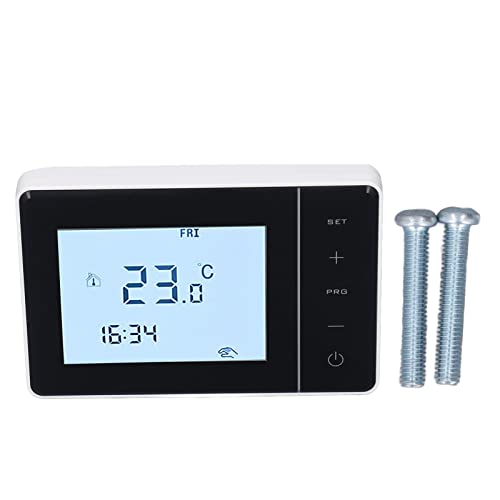
Choose the Programmable Digital Touchscreen Thermostat should you want precise, user-friendly control of home heating—its large responsive LCD and weekly programmable schedule make it ideal for owners of water or floor heating systems, radiators, and electrically actuated valves. You’ll set temperatures between 5–35°C (41–95°F) and read 0–40°C (32–104°F) on a clear black panel with white backlight. The Rhawuy8m23pebngu uses AC100–230V, a switching relay with 3A load, and ±0.5°C accuracy. Automated microcomputer control compares room and set temps to activate heating, improving comfort and cutting energy use. Package includes thermostat, screws, and manual.
- Display:Large digital LCD touchscreen (black panel, white backlight)
- Programmable/Scheduling:Custom weekly programming (per-day settings, adaptive learning)
- Remote/App Control:(Implied) automated control; primarily on-unit scheduling (no specific app stated) — but supports remote programming concepts via learning/automation
- Compatibility/Supported Systems:Water/floor heating, radiators, valves, heaters (AC100–230V)
- Remote Voice/Smart Home Integration:(Not explicitly listed) no specific voice platforms named
- Energy/Performance Benefits:Maintains consistent comfort, reduces electricity consumption (±0.5°C)
- Additional Feature:Switching relay output
- Additional Feature:Strong interference immunity
- Additional Feature:Per-day weekly programming
MoesGo Programmable WiFi Smart Thermostat (No C-Wire)
In case you want a smart thermostat that works without a dedicated C-wire, the MoesGo Programmable WiFi Smart Thermostat is built for homes where running new wiring isn’t practical—it ships with a C-wire adapter and a remote temperature sensor to keep zones accurate. You’ll get 7-day scheduling, four modes, and app control via Tuya/Smart Life on 2.4 GHz Wi‑Fi, plus Alexa and Google Assistant voice control. It supports conventional and heat pump systems (not heating-only no C-wire or high-voltage). A digital backlight, wall mount design, and claimed 23% energy savings make it a compact, affordable choice.
- Display:Digital backlight display
- Programmable/Scheduling:7-day scheduling, 4 modes
- Remote/App Control:Wi‑Fi app control (Tuya/Smart Life)
- Compatibility/Supported Systems:Conventional and heat‑pump HVAC (no C‑wire required with adapter; 24VAC systems; 2.4GHz Wi‑Fi)
- Remote Voice/Smart Home Integration:Alexa and Google Assistant; Tuya/Smart Life
- Energy/Performance Benefits:Claims >23% energy savings; programmable for efficiency
- Additional Feature:Includes C-wire adapter
- Additional Feature:Free remote temperature sensor
- Additional Feature:2.4 GHz Wi‑Fi only
Cielo Smart Thermostat Eco for Central HVAC (Black)
Should you want an ENERGY STAR-certified, app-driven thermostat that works with most 24V central HVAC systems, the Cielo Smart Thermostat Eco is a strong pick. You’ll get verified energy savings, broad compatibility with gas, electric, oil, hot water, heat pump and geothermal systems, plus support for up to two heat and two cool stages. DIY installation’s easy with a free C‑Wire adapter and a sleek black finish. Use the free iOS/Android app for global control, weekly intelligent schedules, vacation mode and energy consumption findings. It integrates with Alexa, Google, Siri, SmartThings and IFTTT, and offers responsive weekday phone/email support.
- Display:On-unit display (app-integrated UI) — color touchscreen implied
- Programmable/Scheduling:Intelligent weekly scheduling (custom or preset modes)
- Remote/App Control:Global control via free iOS/Android app
- Compatibility/Supported Systems:Most 24V HVAC systems (gas/electric/oil/heat pump/geothermal)
- Remote Voice/Smart Home Integration:Alexa, Google Assistant, Siri, SmartThings, IFTTT, Cielo Linked
- Energy/Performance Benefits:ENERGY STAR certified; tested heating/cooling bill savings; energy insights
- Additional Feature:ENERGY STAR certified
- Additional Feature:Free C‑Wire adapter
- Additional Feature:Detailed energy insights
Mysa Smart Thermostat for Electric Baseboard Heaters
Should you use high‑voltage electric baseboard or radiant ceiling heating, the Mysa Smart Thermostat gives you app-based control, voice assistant integration, and energy analytics while handling up to 240 V (3800 W), so you might modernize older systems without rewiring for low-voltage controls. You’ll control schedules, geofencing, and receive temperature and humidity alerts via Wi‑Fi, HomeKit, Alexa, or Google Assistant. The V2 fits 120–240 V systems, needs at least four wires (neutral or second live), and supports up to 1900 W at 120 V. Its LED display, adaptive brightness, NFC, and mounting hardware simplify installation and daily use.
- Display:LED backlit display (adaptive display)
- Programmable/Scheduling:App scheduling (programmable)
- Remote/App Control:Wi‑Fi app control (Android/iOS)
- Compatibility/Supported Systems:High/line‑voltage electric baseboard & similar (120–240V)
- Remote Voice/Smart Home Integration:Apple HomeKit, Amazon Alexa, Google Assistant
- Energy/Performance Benefits:Energy insights, adaptive control for efficient baseboard heating
- Additional Feature:High-voltage support (120–240V)
- Additional Feature:Adaptive brightness display
- Additional Feature:Supports up to 3800 W
Honeywell Z-Wave T6 Pro Programmable Touchscreen Thermostat
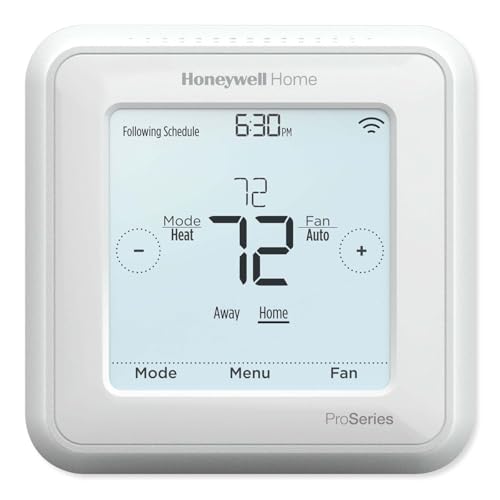
Should you want a Z-Wave thermostat that balances smart home integration with simple touchscreen control, the Honeywell Z-Wave T6 Pro is a solid pick; it offers Z-Wave Plus connectivity for reliable mesh networking and SmartStart inclusion while still letting you program schedules directly on its white touchscreen or run it battery-powered with 3 AA cells. You’ll get a clean white touchscreen with included cover plate and UWP mounting for easy installation. It supports up to 3H/2C heat pump or 2H/2C conventional low-voltage systems, offers 7-day/5-1-1/5-2 scheduling, non-program and occupancy modes via Z-Wave app, and can be hardwired with a C-wire.
- Display:Touchscreen display
- Programmable/Scheduling:Time-based programming (7-day, 5-1-1, 5-2) / non-programmable option
- Remote/App Control:Z‑Wave remote control via hub/app
- Compatibility/Supported Systems:Low‑voltage HVAC (supports up to 3H/2C heat pump, 2H/2C conventional; Z‑Wave)
- Remote Voice/Smart Home Integration:Z‑Wave ecosystem (works with Z‑Wave smart home controllers; Occupancy control)
- Energy/Performance Benefits:Programmable scheduling and occupancy control to save energy
- Additional Feature:Z‑Wave Plus certified
- Additional Feature:Battery-powered (3×AA)
- Additional Feature:SmartStart network inclusion
Factors to Consider When Choosing an Automated Thermostat
Upon choosing an automated thermostat, you’ll initially check compatibility with your HVAC system and confirm power and wiring requirements. You’ll also weigh programmable scheduling, remote app control, and whether it integrates with your smart home ecosystem. These factors determine ease of installation, daily convenience, and long-term savings.
Compatibility With HVAC Systems
Because thermostats handle power, signals, and control logic differently across systems, you should confirm compatibility with your HVAC type and wiring before buying. Check that the model explicitly supports your system—forced‑air, heat pump, hydronic/floor heating, or high‑voltage electric baseboard—since control logic varies. Match the thermostat’s output type (relay, solid‑state, or control signal) to your equipment and load. Verify it handles the number of heat/cool stages your system uses (typical 1–2, more complex up to 3 heat/2 cool). Make certain it accepts ancillary components and terminals you use (G, Y, W, O/B, R/C) and supports external sensors, zone valves, or actuators. Even when a model looks smart, incompatibility can limit features or damage components—confirm before purchase.
Power And Wiring Requirements
Compatibility checks lead naturally to the wiring and power details you’ll need to confirm before buying or installing a thermostat. To begin, verify required supply voltage—low‑voltage (~24VAC) versus line‑voltage (120–240VAC)—so it matches your HVAC or heater. Confirm whether a common (C) wire is required for constant power; many smart Wi‑Fi models need a C‑wire or adapter instead of batteries. Check supported wiring configurations and terminal counts for single‑stage, multi‑stage, heat pump, fan, and auxiliary circuits to make certain full compatibility. Match relay/load ratings and switching type (low‑voltage relay vs. high‑voltage solid‑state) to the devices and maximum current or wattage they’ll drive. Lastly, plan safe installation: isolate power, verify wire gauge and conductor counts meet code, and hire a pro when appropriate.
Programmable Scheduling Options
Provided you want tight comfort control and real savings, pick a thermostat that lets you program distinct weekly schedules (like full 7‑day profiles) and multiple daily periods—morning, away, home, sleep—with at least four events per day so setpoints match your routine. Also choose devices that let each day have its own profile so weekdays, weekends, or specific days behave differently. Look for adaptive or learning scheduling that fine-tunes setpoints over time to cut manual edits. Make sure overrides are simple—temporary and permanent—so you can change conditions without losing your baseline program. Verify Vacation/Holiday modes and configurable setback temperatures to protect your home while minimizing energy use during extended absences. Prioritize clear schedule editing on-device and via the companion app.
Remote And App Control
Once you’ve locked in a schedule that matches your routine, remote and app control lets you keep those programs working wherever you are. You’ll want a thermostat with a secure mobile app, compatible with 2.4 GHz or dual‑band Wi‑Fi, that gives full programming and scheduling (7‑day, per‑day, or custom profiles) plus real‑time status and usage reports. Check for features beyond basic setpoint changes—geofencing, vacation mode, alerts, and support for remote sensors—to fine‑tune comfort and save energy. Confirm secure connectivity: encrypted communications, two‑factor authentication, and regular firmware updates. Should you want hands‑free control, verify voice assistant and third‑party support, but don’t rely on that alone for core remote functionality.
Smart Home Integrations
Because your thermostat will live inside a broader smart-home ecosystem, confirm it speaks the platforms and protocols you actually use—voice assistants, hubs, Wi‑Fi, Z‑Wave, Zigbee, or a vendor’s cloud API—so it can participate in routines and scenes without workarounds. Check network requirements (2.4 GHz vs 5 GHz) and whether a C‑wire or adapter is required for cloud features; those affect setup and reliability. Prefer models offering local control (LAN/HTTP/RTSP) so automations keep working during internet outages and latency stays low. Review automation and data access: scheduling, geofencing, presence sensing, energy reports, and open APIs or webhooks enable complex workflows. Finally, verify integrations support the specific capabilities you need—remote sensors, multi‑zone coordination, voice commands, or third‑party scene triggers—beyond basic setpoint changes.
Temperature Accuracy And Sensors
Integration and reliable networking matter, but your thermostat still needs to measure temperature accurately to control comfort and efficiency. Aim for models with accuracy of ±0.5°C (±1°F) or better so you get tight control and fewer comfort swings. Verify the supported measurement range—choose one that covers your climate and installation spot (for example, 0–40°C / 32–104°F). Prefer units that include or support external/remote sensors to avoid bias from nearby heat sources or poor airflow. Check sensor placement flexibility and sampling rate; frequent, well-placed readings cut overshoot and short cycling. Finally, review immunity to interference and timing error specs (look for <1% or similar) to make certain consistent, long-term measurements.
Energy Savings And Reporting
Savings come from smarter control: automated thermostats that learn schedules, support precise setpoints, and enable remote or geofencing control can cut heating and cooling energy use roughly 10–23% through avoiding unnecessary runtime and matching comfort to occupancy. You should pick a model that delivers detailed energy reports—hourly, daily, and weekly—with usage breakdowns so you can quantify savings, spot anomalies, and track trends. Remote access and geofencing automate setbacks when nobody’s home, producing larger savings than manual changes. Prioritize units with ±0.5°C accuracy to prevent short cycling and overshoot, which improves efficiency. Should available, integrate with utility time-of-use rates or demand-response programs so the thermostat can shift consumption to cheaper periods and enhance bill savings whenever guided via report-driven optimization.
Installation And Support Options
After you’ve evaluated energy reports and control features, turn to how the thermostat will actually get installed and supported over time. Check whether your HVAC needs a C‑wire or line‑voltage connection—some smart models require a C‑wire or adapter, whereas others work with high‑voltage baseboard wiring or include C‑wire solutions. Verify power requirements (24VAC vs. 120–240VAC) and confirm your wiring and breaker capacity can safely handle the device. Decide whether professional installation is recommended or required for multi‑stage systems, heat pumps, or hydronic/floor heating, and factor in cost and scheduling. Look for clear documentation, regular firmware updates, reachable customer support, and solid warranty/return policies. Finally, confirm mounting hardware, wall cavity depth, bracket compatibility, and included screws to avoid extra parts.
Frequently Asked Questions
Do These Thermostats Support Multi-Stage Heating and Cooling Systems?
Yes — many do; you’ll find models that support multi-stage heating and cooling, and they’ll detect system stages, configure wiring, and manage staging automatically, though you’ll want to verify compatibility with your specific furnace and AC.
Can I Integrate These Thermostats With Smart Home Voice Assistants?
Yes — you can integrate most modern automated thermostats with Alexa, Google Assistant, and Siri (HomeKit). You’ll pair accounts, grant permissions, and use voice commands to adjust temperature, set schedules, and check current indoor conditions.
How Do These Thermostats Affect Indoor Humidity Control?
They’ll help manage humidity via running HVAC cycles more efficiently and coordinating with dehumidifiers or humidifiers; you’ll get sensor-driven adjustments, but effectiveness depends on model capabilities, sensor placement, and whether you pair dedicated humidity control.
Are There Rebate Programs or Utility Incentives Available?
Yes—many utilities and governments offer rebates or incentives for smart thermostats and energy-efficient upgrades; you’ll need to check local programs, meet eligibility requirements, and submit receipts or rebate forms to claim the savings.
What Maintenance Is Required to Keep These Thermostats Functioning?
Consider your thermostat as a garden: you’ll tend it. You’ll clean sensors, update firmware, change batteries, check wiring, and recalibrate schedules seasonally. Should problems persist, you’ll contact support or a pro to inspect and repair.
Final Thoughts
You’ve got great options that make comfort effortless—pick the one that fits your wiring, systems, and desire for local control. Don’t forget: measure twice, cut once—checking compatibility and power needs up front saves headaches. Whether you want touchscreen simplicity, remote sensors, energy reports, or Z‑Wave mesh, prioritize reliability and ease of use. Choose a model that matches your home and habits, and you’ll enjoy smarter, more efficient comfort every day.
