

Should you want to cut lighting costs without sacrificing brightness or color, focus on A19 LEDs that pair high lumens-per-watt with long lifespans and proper certifications. You’ll want 8–9W bulbs that deliver about 800 lumens, the right color temperature for each room, dimmable options that match your dimmer, and models rated for enclosed fixtures—keep scrolling to see top packs and what to watch for.
| 6-Pack A19 9W LED Bulbs 5000K Daylight |

| Bright Daylight Pick | Bulb Shape: A19 | Base Type: E26 medium | Brightness (Lumens): 800 lumens | VIEW LATEST PRICE | Read Our Analysis |
| Linkind A19 60W Equivalent Soft White LED Bulbs (6-Pack) |
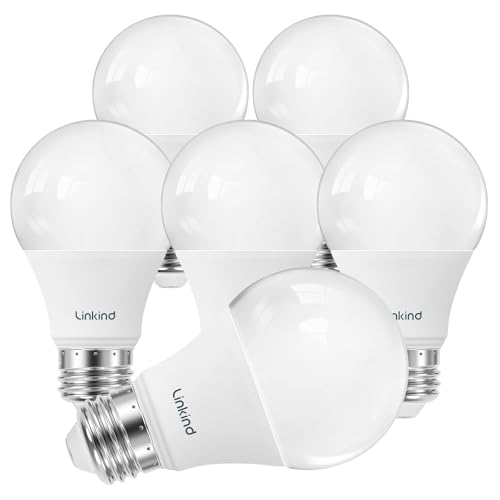
| Warm Comfort Choice | Bulb Shape: A19 | Base Type: E26 medium | Brightness (Lumens): 800 lumens | VIEW LATEST PRICE | Read Our Analysis |
| 24-Pack A19 5000K Daylight LED Bulbs 60W Eq |

| Bulk Daylight Value | Bulb Shape: A19 | Base Type: E26 medium | Brightness (Lumens): 800 lumens | VIEW LATEST PRICE | Read Our Analysis |
| Dalattin 24-Pack A19 LED Bulbs 5000K Daylight |

| High-Efficiency Pack | Bulb Shape: A19 | Base Type: E26 medium | Brightness (Lumens): 800 lumens | VIEW LATEST PRICE | Read Our Analysis |
| TJOY A19 9W LED Bulbs 2700K (6-Pack) |

| Cozy Warm Pack | Bulb Shape: A19 | Base Type: E26 standard | Brightness (Lumens): 800 lumens | VIEW LATEST PRICE | Read Our Analysis |
More Details on Our Top Picks
6-Pack A19 9W LED Bulbs 5000K Daylight
Should you want bright, daylight-quality lighting that cuts energy use without frequent replacements, these 6-pack A19 9W LED bulbs are ideal—each delivers 800 lumens at 5000K while using just 9W (a 60W incandescent equivalent) and lasts over 15,000 hours. You’ll cut up to 90% energy compared to incandescents, plug into standard E26 fixtures at 110–130 VAC, and enjoy CRI 80+ color rendering with no-flicker LEDs. They’re non-dimmable, A19-shaped, and suit indoor and covered outdoor spaces plus commercial settings. Confirm base and fixture compatibility before installation; they also make a practical gift.
- Bulb Shape:A19
- Base Type:E26 medium
- Brightness (Lumens):800 lumens
- Incandescent Equivalent:60W equivalent
- Color Rendering (CRI):CRI 80+
- Dimmability:Non-dimmable
- Additional Feature:15,000+ hour lifespan
- Additional Feature:No-flicker LED beads
- Additional Feature:Indoor/outdoor covered use
Linkind A19 60W Equivalent Soft White LED Bulbs (6-Pack)
Should you want warm, comfortable lighting that cuts energy use without changing fixtures, the Linkind A19 60W equivalent soft white bulbs are a solid pick — they deliver 800 lumens at just 8.5 watts and fit standard E26 sockets. You’ll get 2700K soft white light with CRI 80+ for natural color, instant-on, and stable, non-flickering output that reduces glare and eye fatigue. These non-dimmable A19 bulbs save up to 85% energy versus incandescent and last about 15,000 hours. They emit no UV/IR, install easily in bedrooms, lounge rooms, kitchens, and offices, but confirm base type before use.
- Bulb Shape:A19
- Base Type:E26 medium
- Brightness (Lumens):800 lumens
- Incandescent Equivalent:60W equivalent
- Color Rendering (CRI):CRI 80+
- Dimmability:Non-dimmable
- Additional Feature:Instant-on, no delay
- Additional Feature:No UV or IR
- Additional Feature:Reduces glare/eye fatigue
24-Pack A19 5000K Daylight LED Bulbs 60W Eq
Should you want bright, daylight-quality light across many rooms without frequent bulb changes, this 24-pack of A19 5000K LED bulbs is a great choice — it gives 800 lumens per bulb while using just 8.5W, lasts about 15,000 hours, and fits standard E26 sockets for easy, direct replacement of 60W incandescents. You’ll get crisp 5000K daylight with a 230° beam and CRI 80+ for natural color rendering. These frosted, non-dimmable bulbs turn on instantly, are flicker-free, and cut energy use approximately 85.8%. They’re ETL/UL listed, contain no lead or mercury, and avoid toxic chemicals.
- Bulb Shape:A19
- Base Type:E26 medium
- Brightness (Lumens):800 lumens
- Incandescent Equivalent:60W equivalent
- Color Rendering (CRI):CRI 80+
- Dimmability:Non-dimmable
- Additional Feature:ETL/UL listed
- Additional Feature:230° wide beam angle
- Additional Feature:No toxic chemicals
Dalattin 24-Pack A19 LED Bulbs 5000K Daylight
Ideal for homeowners and small businesses wanting bright, consistent daylight without high energy bills, the Dalattin 24-pack A19 LEDs deliver 800 lumens at just 9W each (60W equivalent), cutting energy use up to 85% while fitting standard E26 sockets. You’ll get crisp 5000K daylight with CRI 80+ for truer colors, making these bulbs good for residential rooms, offices, art displays, and hospitality spaces. They’re UL listed, non-dimmable, and run on 120V. Lifespan claims vary—up to 13.7 years or alternatively up to 7 years at 3 hours daily. They’re cool-running, mercury-free, non-flicker, and save about $1.08 per bulb yearly.
- Bulb Shape:A19
- Base Type:E26 medium
- Brightness (Lumens):800 lumens
- Incandescent Equivalent:60W equivalent
- Color Rendering (CRI):CRI 80+
- Dimmability:Non-dimmable
- Additional Feature:Estimated $1.08 annual savings
- Additional Feature:UL listed, 120V operation
- Additional Feature:Cooler operation for safety
TJOY A19 9W LED Bulbs 2700K (6-Pack)
Should you want warm, reliable lighting that cuts energy use without sacrificing brightness, the TJOY A19 9W LED six-pack is a smart pick—each bulb equals a 60W incandescent at 800 lumens whilst using just 9W, providing about an 85% energy reduction and up to 13.7 years of life. You’ll get soft 2700K light with 80 CRI, instant-on performance, and no flicker. These E26 A19 bulbs run on 120V, aren’t dimmable, and cost roughly $1.08 per year (3 hours/day). They’re UL, RoHS, and FCC certified, mercury-free, and backed by a 1-year replacement/refund service.Ideal for homes and small businesses.
- Bulb Shape:A19
- Base Type:E26 standard
- Brightness (Lumens):800 lumens
- Incandescent Equivalent:60W equivalent
- Color Rendering (CRI):CRI 80
- Dimmability:Non-dimmable
- Additional Feature:UL, RoHS, FCC certified
- Additional Feature:1-year after-sales support
- Additional Feature:Estimated 13.7-year life
Factors to Consider When Choosing Energy Efficient Light Bulbs
At the time you’re picking energy-efficient bulbs, pay attention to wattage versus lumen output so you get the brightness you need with low energy consumption. Consider color temperature and color rendering to make sure light looks natural for each room. Also check rated lifespan so you balance upfront cost with how long the bulb will actually last.
Energy Consumption Rates
Because lighting makes up a big slice of home energy use, you’ll want to compare wattage to lumen output and pick bulbs that deliver the lumens you need (for example, ~800 lumens for a 60W-equivalent) while using far less power—LEDs often draw 8–9W instead of 60W. Calculate savings through percentage: LEDs typically use 80–90% less power than incandescents, so switching cuts lighting energy substantially. Check the bulb’s voltage and fixture compatibility (e.g., 110–130VAC or 120V household) to avoid inefficiency or shortened life. Estimate annual cost by multiplying wattage × hours per day × electricity rate to see payback time. Finally, factor rated lifespan—longer-life LEDs (~15,000 hours) spread embodied and operating energy over more hours, lowering per-hour energy impact.
Light Color Temperature
Color temperature (measured in Kelvins) tells you whether a bulb will look warm and cozy or crisp and daylight-like, and it’s one of the initial things to match to a room’s purpose. Choose warm white (≈2700K–3000K) for bedrooms and inhabited areas to create a relaxing, flattering glow that softens skin tones. Use cool white (3500K–4100K) or daylight (≈5000K+) in kitchens, offices, and workspaces where you need alertness and clearer detail. Higher Kelvin bulbs (4000K–5000K) enhance contrast for tasks, while lower ones feel more comfortable in the evening. Keep color consistency — pick bulbs within about ±100K in the same room to avoid mismatches. Also consider circadian impact: favor bluer light during the day and warmer light toward bedtime.
Lumen Output Needs
After you’ve picked the right color temperature for comfort and circadian needs, consider how much light you actually need in each space. Match lumens to task: aim for about 800 lumens per general fixture and 1,000–1,600 lumens for reading, cooking, or detailed work. Multiply lumens per bulb via fixture count to get total output—four 800-lumen bulbs give 3,200 lumens. Factor room size and target lux (living areas ~100–300 lux; kitchens/offices ~300–500 lux) to decide total lumens needed. Compare bulbs via lumens-per-watt: higher lm/W delivers more visible light per energy used. Finally, account for beam angle and placement—narrow beams concentrate brightness, wide beams distribute light, so choose angles that match tasks and fixture layouts.
Color Rendering Quality
Good color rendering helps you see true hues and fine details, so check a bulb’s CRI before buying. You’ll want CRI ≥80 for most rooms—kitchens, residential areas, and offices—so colors look natural. For photography, art studios, medical tasks, or retail displays pick CRI ≥90 to avoid washed-out or distorted tones. Keep in mind color temperature (warm vs. cool) doesn’t determine fidelity; CRI does. Also watch R9 if skin tones or saturated reds matter, since some LEDs score high overall but miss deep reds. Manufacturers might offer TM-30 scores for more subtlety, but CRI and R9 usually suffice for consumer choices. Prioritize bulbs with documented CRI/R9 values to guarantee accurate color where it counts.
Bulb Lifespan Expectancy
Longevity matters as you’re picking energy-efficient bulbs, so look beyond the headline hours to how real-world factors affect lifespan. LED bulbs commonly list 10,000–25,000 hours (often around 15,000), vastly outlasting incandescents at ~1,000 hours. Convert hours into years based on your daily use: a 15,000-hour bulb used three hours daily lasts roughly 13.7 years.
Pay attention to operating conditions: higher temperatures, frequent on/off cycling, and poor ventilation shorten life, while stable voltage and good airflow prolong it. Manufacturers use L70 ratings to indicate at which point light output drops to 70%; a longer L70 signifies slower lumen depreciation and a longer useful life. LEDs rarely burn out suddenly—expect gradual dimming and color shifts as end-of-life signals rather than catastrophic failure.
Fixture And Base Compatibility
A bulb has to physically and electrically match your fixture, so check the base type (E26, GU10, bayonet) and the fixture’s voltage rating before you buy to guarantee proper fit and safe operation. Match the socket so you get solid electrical contact and avoid loose fits. Confirm the fixture’s voltage (typically 110–130 VAC/120V residential) and buy bulbs rated for that AC voltage to prevent damage or poor performance. Measure physical size and shape (A19, PAR, BR) so the bulb and beam angle don’t clash with diffusers or block airflow. For enclosed or recessed housings, use bulbs rated for enclosed fixtures to protect lifespan. Should you use dimmers or smart controls, pick bulbs labeled compatible with your dimmer type.
Dimmability And Controls
Whenever you want smooth, reliable dimming, make sure the bulb is labeled dimmable and matches your dimmer type—using a non‑dimmable LED with a dimmer often causes flicker, humming, or shortened life. Check whether the bulb lists TRIAC/leading‑edge or ELV/trailing‑edge compatibility and match that to your existing dimmer to avoid noise or instability. Confirm your dimmer’s minimum and maximum load; older units might not work with low‑wattage LEDs unless they’re LED‑compatible. Prefer bulbs that specify a dimming range (for example, 100% down to 5–10%) and call out no‑flicker performance or stable color temperature during dimming. Should you be planning smart integration, choose bulbs or drivers that support phase‑cut, 0–10V, or common digital control protocols for reliable multi‑zone control.
Safety And Certifications
Because safety standards reduce risk and improve performance, you should check for recognized listings like UL, ETL, or CSA before buying a bulb. Those marks mean the product was independently tested for electrical safety and fire risk. Also verify RoHS or similar compliance so bulbs are free of hazardous materials like mercury and lead, protecting health and the environment. Match the bulb’s voltage and base type to your fixture (for example, 120 VAC and an E26 medium base) to avoid poor fit, overheating, or electrical faults. For bathrooms, outdoor fixtures, or enclosed luminaires, look for damp- or wet-location ratings. Finally, prefer bulbs with documented ripple/flicker and EMI/EMC performance or certifications to reduce visible flicker and interference.
