

Should you want to protect your sleep while still enjoying a good book at night, pick a low‑blue amber LED around 1800–2000K with CRI ≥80 and 200–400 lumens. Aim for a 30–60° beam to get ~150–300 lux on the page, dimmable or USB‑rechargeable, and verify the bulb blocks >99% of 400–500 nm light. I’ll show which models meet those specs and why they matter—keep reading.
| Neporal 7W 670nm Red Night Light Bulbs (2-Pack) |
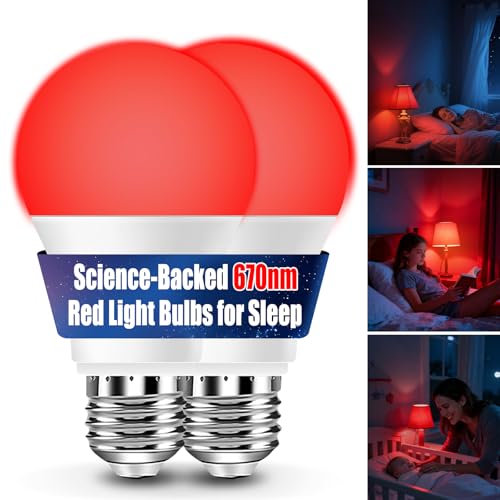
| Best for Sleep Support | Light Source Type: LED | Blue‑light Blocking: 100% blocks blue & green wavelengths (670 nm red) | Recharge / Power Type (portable vs mains): Mains (AC 110 V) — plug‑in E26/E27 bulb | VIEW LATEST PRICE | Read Our Analysis |
| DEWENWILS USB Rechargeable Clip-On Book Light (Pink) |

| Portable Reading Light | Light Source Type: LED | Blue‑light Blocking: Amber mode blocks ~99.95% blue light | Recharge / Power Type (portable vs mains): Built‑in rechargeable battery (USB rechargeable) | VIEW LATEST PRICE | Read Our Analysis |
| hooga Amber Dual-Mode Rechargeable Blue-Light Blocking Book Light |

| Best Nighttime Reader | Light Source Type: LED | Blue‑light Blocking: Amber 1600K (99.94% blue‑free) and red 625nm (100% blue‑free) | Recharge / Power Type (portable vs mains): Built‑in rechargeable battery (1200 mAh, USB‑C) | VIEW LATEST PRICE | Read Our Analysis |
| Amber 1800K Blue-Light Blocking Sleep Light Bulbs (2-Pack) |

| Coziest Ambient Glow | Light Source Type: LED | Blue‑light Blocking: Blocks 99.99% of blue‑light spectral components (1800K amber) | Recharge / Power Type (portable vs mains): Mains (AC 100–120 V) — E26 bulb, no battery | VIEW LATEST PRICE | Read Our Analysis |
| E26 2000K Amber A19 Soft Yellow Light Bulbs (2-Pack) |

| Bright Amber Alternative | Light Source Type: LED | Blue‑light Blocking: Blue‑free spectrum (2000K amber) | Recharge / Power Type (portable vs mains): Mains (AC 100–120 V) — E26 bulb, no battery | VIEW LATEST PRICE | Read Our Analysis |
More Details on Our Top Picks
Neporal 7W 670nm Red Night Light Bulbs (2-Pack)
Should you want a bedside bulb that preserves your sleep cycle while still giving enough light to read, the Neporal 7W 670nm red LED is a strong choice — its pure 670 nm output blocks blue and green wavelengths, produces a soft, low‑glare glow, and supports evening melatonin production so you can wind down without sabotaging sleep. You’ll get 7W power and up to 700 lumens—ample for night reading—plus instant‑on, flicker‑free light and a wide 240° beam. The A19/E26 fits most lamps, lasts about 30,000 hours, isn’t dimmable, and comes as an energy‑efficient two‑pack ideal for bedrooms and nurseries.
- Light Source Type:LED
- Blue‑light Blocking:100% blocks blue & green wavelengths (670 nm red)
- Recharge / Power Type (portable vs mains):Mains (AC 110 V) — plug‑in E26/E27 bulb
- Intended Use / Primary Application:Night light / bedside / nursery / relaxation reading
- Adjustability / Form Factor:A19 bulb, fixed output (not dimmable), wide 240° beam
- Lifetime / Battery Life:LED life ~30,000 hours
- Additional Feature:Pure 670 nm output
- Additional Feature:High lumen (700 lm)
- Additional Feature:Universal A19 E26/E27
DEWENWILS USB Rechargeable Clip-On Book Light (Pink)
Should you want a lightweight, portable reading light that blocks blue light for late-night reading, the DEWENWILS USB Rechargeable Clip‑On Book Light (Pink) fits the bill. You’ll clip its slim 4.32×1.8×0.3-inch body to a paperback, pillow, or tray; the 1.38-ounce lamp folds flat and swivels for precise beam placement. Two LED beads offer four modes—50%/100% amber and 50%/100% warm white—letting you cut 99.95% of blue light while providing up to 16 lumens. A 200 mA rechargeable battery runs about eight hours, recharges in 1.5 hours via built‑in USB, and carries a one‑year warranty.
- Light Source Type:LED
- Blue‑light Blocking:Amber mode blocks ~99.95% blue light
- Recharge / Power Type (portable vs mains):Built‑in rechargeable battery (USB rechargeable)
- Intended Use / Primary Application:Clip‑on book light / bedside reading / travel
- Adjustability / Form Factor:Clip‑on with 315° flexible holder and swiveling lens (adjustable)
- Lifetime / Battery Life:Battery runtime up to ~8 hours (200 mAh)
- Additional Feature:Built-in USB plug
- Additional Feature:315° flexible holder
- Additional Feature:Fold-flat slim profile
hooga Amber Dual-Mode Rechargeable Blue-Light Blocking Book Light
Should you want a bedside reading light that protects your sleep—and anyone else sleeping nearby—the hooga Amber Dual-Mode does the job with its amber 1600K and red 625nm settings that effectively eliminate blue light. You’ll get two true blue-free modes to support melatonin and faster sleep onset while letting you read without disturbing nearby sleepers. At 2.5 oz with a sturdy clip and 360° gooseneck, it clips to books, e-readers, or headrests and travels easily. The rechargeable 1200 mAh battery and included USB‑C cable deliver long runtime without disposables. Hooga offers U.S. support and a 30‑day return window.
- Light Source Type:LED
- Blue‑light Blocking:Amber 1600K (99.94% blue‑free) and red 625nm (100% blue‑free)
- Recharge / Power Type (portable vs mains):Built‑in rechargeable battery (1200 mAh, USB‑C)
- Intended Use / Primary Application:Clip‑on/book light for night reading, travel, caregiving
- Adjustability / Form Factor:Clip with 360° gooseneck (fully adjustable)
- Lifetime / Battery Life:Rechargeable 1200 mAh battery — described as long battery life (multi‑hour)
- Additional Feature:360° flexible gooseneck
- Additional Feature:1200 mAh battery
- Additional Feature:Includes USB-C cable
Amber 1800K Blue-Light Blocking Sleep Light Bulbs (2-Pack)
Ideal for readers who want to protect sleep while still seeing the page, the Elmoyle Amber 1800K bulbs block virtually all blue light and emit a soft, 300-lumen amber glow that’s gentle on your eyes before bed. You’ll get two A15 bulbs (E26 base) that draw 3W each, last up to 25,000 hours, and replace 25–40W incandescents. They’re non-dimmable, ceramic-bodied LEDs with 360° beam, CRI 85, no UV, and claim 99.99% blue-light blocking to support melatonin and circadian rhythm. Confirm E26 fit and 1.77″×2.95–3.22″ sizing before buying for bedside or nursery use.
- Light Source Type:LED
- Blue‑light Blocking:Blocks 99.99% of blue‑light spectral components (1800K amber)
- Recharge / Power Type (portable vs mains):Mains (AC 100–120 V) — E26 bulb, no battery
- Intended Use / Primary Application:Bedside/night light, nursery, bedtime reading
- Adjustability / Form Factor:A15 bulb, fixed output (non‑dimmable), 360° beam
- Lifetime / Battery Life:LED life ~25,000 hours
- Additional Feature:A15 compact size
- Additional Feature:300 lumens output
- Additional Feature:Ceramic body construction
E26 2000K Amber A19 Soft Yellow Light Bulbs (2-Pack)
Provided that you want a bulb that preserves sleep while still giving enough light to read, the Elmoyle E26 2000K Amber A19 is made for late‑night readers and nursery use. You get two A19 bulbs with E26 bases, each 9W LED (60W equivalent) supplying 800 lumens of warm amber light at 2000K. The blue‑free range and CRI 85 support melatonin production and reduce eye fatigue, with a wide 230° beam for bedside or porch use. They’re non‑dimmable, long‑lasting (25,000 hours), energy efficient, plastic‑bodied, and compatible with most E26 fixtures; check base size before buying.
- Light Source Type:LED
- Blue‑light Blocking:Blue‑free spectrum (2000K amber)
- Recharge / Power Type (portable vs mains):Mains (AC 100–120 V) — E26 bulb, no battery
- Intended Use / Primary Application:Bedside/night light, bedtime reading, nursery
- Adjustability / Form Factor:A19 bulb, fixed output (non‑dimmable), 230° beam
- Lifetime / Battery Life:LED life ~25,000 hours
- Additional Feature:High output (800 lm)
- Additional Feature:9W (60W equiv.)
- Additional Feature:230° beam angle
Factors to Consider When Choosing a Light Bulb for Reading at Night
At the moment you pick a reading bulb at night, focus on a warm color temperature range and whether it blocks blue light to protect your sleep. Check brightness in lumens and a high color rendering index so text looks clear and natural. Also consider beam angle coverage to make sure the light reaches your page without glare.
Color Temperature Range
Because the warmth of a bulb affects both your reading comfort and sleep, choose a color temperature that balances contrast with low blue light—around 1800–3000K for most nighttime reading. Aim lower, 1800–2000K, should you want minimal blue and easier melatonin production; these amber/soft yellow tones reduce sleep disruption. In case you prefer clearer contrast while keeping a relaxing feel, pick 2000–3000K. Avoid cool whites above 4000K near bedtime, since their blue‑rich output raises alertness and can shift your circadian rhythm. For ultimate sleep protection, consider very low values (1600–1800K) that yield deep amber/red hues. Finally, match Kelvin with sufficient lumens (roughly 300–800 lm) so you get readable contrast without increasing color temperature.
Blue Light Blocking
Often you’ll want to prioritize a bulb’s blue‑light blocking ability for nighttime reading, since light in the 400–500 nm band suppresses melatonin and can delay sleep even at low intensity. Choose bulbs or filters that remove that band—effective night models commonly eliminate >99% of blue wavelengths—to minimize circadian disruption. Amber or red sources (around 625–670 nm or very low color temps near 1800–2000 K) emit little to no blue light and better preserve melatonin than typical white or cool LEDs. Keep in mind that lowering brightness alone won’t substitute for range control: even low‑intensity blue peaks can delay sleep. For bedside reading, pick warm/amber/red spectra combined with just enough lumen output for comfortable reading so the spectrum, not sheer wattage, protects your sleep.
Brightness And Lumens
A good bedside reading bulb will give you enough light to see text clearly without blasting the room—aim for roughly 200–800 lumens depending on how close you hold the book and how big the space is. For close, dim bedside reading, 200–300 lm is usually enough; for larger rooms or reading at a distance, target 500–800 lm. Modern LEDs deliver about 80–120 lm per watt, so a 5–10 W LED covers this range efficiently. Avoid blasting light well above 800 lm—glare will bother your eyes—while too few lumens forces strain. Check fixture beam angle and placement since a wide beam spreads light and lowers lux on the page; aim for roughly 150–300 lux at the reading surface. In case sharing, choose lower lumens or directional fixtures to limit spill.
Color Rendering Index
Clarity matters as you’re picking a bedside bulb, and Color Rendering Index (CRI) tells you how faithfully a light source shows colors compared to natural light. CRI is a 0–100 scale; aim for CRI ≥ 80 so text, cover art, and subtle contrasts look natural and comfortable during night reading. Bear in mind CRI doesn’t tell you about warmth or blue‑light content—a high‑CRI bulb can still be cool or emit more blue wavelengths that affect sleep. At the low illuminance of bedside reading, lower CRI makes color differences and eye strain more noticeable. While choosing a lamp, pair CRI with correlated color temperature (CCT) and, should it be available, the spectral power distribution (SPD) to judge both color fidelity and nighttime suitability.
Beam Angle Coverage
Besides color fidelity and warmth, you should also consider how the light spreads across your book—beam angle dictates whether light is concentrated on the page or fills the room. Beam angle, measured in degrees, controls spread: narrow beams (20–40°) create focused reading spots; wide beams (180–360°) give broad ambient light. For bedside or book reading, aim for roughly 30–60° to concentrate illumination on pages without spilling into the room or waking a partner. Recall lamp height and distance: a 40° beam from 18–24 inches above the book yields a 12–18 inch lighting circle ideal for one reader. Pair angle with lumen output and diffuser design—narrow beams need fewer lumens, wide beams require more to match page brightness.
Dimmability And Control
Whenever you want comfortable, sleep‑friendly light at night, choose bulbs and controls that actually dim smoothly and reliably: dimmable LEDs let you lower lumen output into the 10–50 lm range to reduce retinal stimulation and support melatonin, but only provided the bulb, fixture, and dimmer type are compatible. Check that the LED is explicitly labeled dimmable and note its minimum/maximum wattage and percent dimming to avoid limited ranges. Match dimmers—leading‑edge (triac) or trailing‑edge (ELV)—to prevent flicker or buzzing. For bedside reading, use warm/amber bulbs with multi‑level controls (smooth rotary, stepped, or multi‑tap) so you can set comfortable illuminance fast. In case house wiring or dimmer compatibility is uncertain, pick remote or rechargeable lamps with built‑in multi‑step brightness and color modes for precise, flicker‑free control.
Fixture Compatibility
After you’ve picked a dimmable, warm bulb and a control that won’t flicker, make certain the lamp itself can accept and safely use that bulb. Check the base type (E26/E27, A15, A19) and physical shape so the bulb fits the socket and shade without blocking the beam. Verify the fixture’s max wattage and voltage (commonly 100–120V) to avoid overheating or electrical faults. Confirm the bulb’s size and beam angle will clear the housing and give the spread you want—narrow beams can create hotspots, wide beams offer even illumination. Make sure the fixture and any dimmer support the bulb’s electrical type (LED vs. incandescent) and driver. For clip-on or gooseneck lamps, check mounting clearance, weight limits, and flexibility for comfortable positioning.
Eye Comfort Features
Upon selecting a reading bulb for night use, concentrate on reducing blue light, avoiding flicker, and choosing warm, well‑rendered illumination that’s bright enough for text but not so strong it disrupts sleep; aim for 1800–3000K, >99% attenuation around 450–495 nm assuming possible, a CRI of about 80–90, stable LED drivers (instant‑on, non‑flickering), and roughly 200–800 lumens with glare-controlled beam distribution. Beyond specs, choose bulbs labeled “low blue” or “amber” for the least melatonin disruption. Inspect manufacturer data or spectrograms for blue attenuation and confirm CRI to avoid washed or overly contrasty pages. Try fixtures for glare — use shades, diffusers, or directional lamps to concentrate 200–800 lumens on your book. Prioritize LEDs with verified flicker indices or driver warranties.
