

A concise selection of five versatile bulbs can convert home lighting with accurate color, adjustable warmth, and reliable performance. The choices prioritize high CRI, tunable white smart options, bright daylight task lamps, and warm economy A19s for comfort. Practical features like long rated life and secure firmware updates are highlighted. More specifics follow to help match each bulb to typical rooms and needs.
| Linkind Matter Smart RGBW Music Sync LED Bulbs (2-Pack) |

| Best Smart Bulb | Bulb Shape/Base: A19 shape, E26 base | Incandescent Equivalent: 60W equivalent | Lumens (Brightness): 800 lumens | VIEW LATEST PRICE | Read Our Analysis |
| Linkind Smart Color Changing A19 Wi‑Fi LED Bulbs (4-Pack) |

| Best for Custom Scenes | Bulb Shape/Base: A19 shape, E26 base | Incandescent Equivalent: 60W equivalent | Lumens (Brightness): 800 lumens | VIEW LATEST PRICE | Read Our Analysis |
| 24-Pack A19 5000K Daylight LED Bulbs (E26) |

| Best Bulk Buy | Bulb Shape/Base: A19 shape, E26 base | Incandescent Equivalent: 60W equivalent | Lumens (Brightness): 800 lumens | VIEW LATEST PRICE | Read Our Analysis |
| Sylvania ECO A19 60W Equivalent LED Bulbs (8-Pack) |
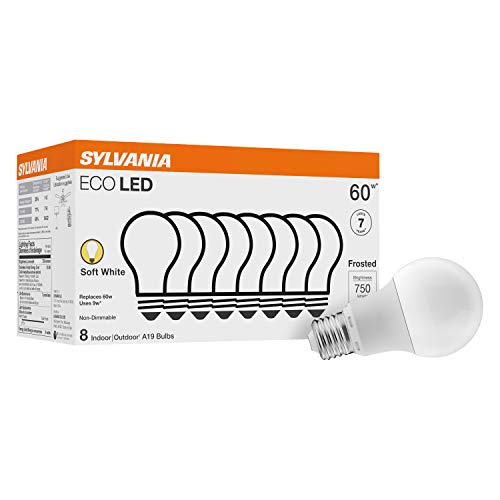
| Best Reliable Standard | Bulb Shape/Base: A19 shape, E26 (medium) base | Incandescent Equivalent: 60W equivalent | Lumens (Brightness): 750 lumens | VIEW LATEST PRICE | Read Our Analysis |
| 12-Pack A19 LED Bulbs 100W Equivalent 5000K |

| Best High-Brightness Option | Bulb Shape/Base: A19 shape, E26 base | Incandescent Equivalent: 100W equivalent | Lumens (Brightness): 1500 lumens | VIEW LATEST PRICE | Read Our Analysis |
More Details on Our Top Picks
Linkind Matter Smart RGBW Music Sync LED Bulbs (2-Pack)
Should you want smart bulbs that sync with your music and work across major smart-home platforms, the Linkind Matter Smart RGBW Music Sync LED 2-pack is a strong pick — it’s Matter-certified for wide compatibility and can flash, fade, or pulse to the beat while giving you millions of colors and tunable whites. You’ll control them via Matter hubs (HomePod, Echo, Nest, SmartThings) or directly with the AiDot app over 2.4 GHz Wi‑Fi. Each A19 E26 LED puts out 800 lumens at 9 W, CRI 90, 1800–6500K white, 25,000‑hour life, music sync, scenes, scheduling, and a two‑year warranty.
- Bulb Shape/Base:A19 shape, E26 base
- Incandescent Equivalent:60W equivalent
- Lumens (Brightness):800 lumens
- Wattage (Power Consumption):9 W
- Color Temperature / Color Options:Tunable white 1800K–6500K + millions of colors (RGBW)
- Dimmable / Smart Control:Dimmable; Matter‑certified smart control (app, voice, hub or AiDot)
- Additional Feature:Matter-certified compatibility
- Additional Feature:Music-sync microphone
- Additional Feature:2-year warranty
Linkind Smart Color Changing A19 Wi‑Fi LED Bulbs (4-Pack)
Should you want easy smart lighting with full color control and no hub, the Linkind Smart Color Changing A19 bulbs are a strong choice — they give you 16 million colors and tunable whites (1800–6500K) plus Wi‑Fi and Bluetooth so you can control scenes and schedules from the AiDot app or with Alexa/Google voice commands. You’ll get 800 lumens (60W equivalent), high color rendering, and a 25,000‑hour lifespan while saving up to 85% energy. Use AiDot for groups, schedules, Light Lab scenes, DIY light shows, and music sync. Requires 2.4 GHz Wi‑Fi; avoid traditional dimmer switches to prevent flicker.
- Bulb Shape/Base:A19 shape, E26 base
- Incandescent Equivalent:60W equivalent
- Lumens (Brightness):800 lumens
- Wattage (Power Consumption):(not explicitly stated) ~9 W (60W-equivalent)
- Color Temperature / Color Options:Tunable white 1800K–6500K + 16 million colors (RGB)
- Dimmable / Smart Control:Dimmable via app/voice; Wi‑Fi + Bluetooth smart control (AiDot)
- Additional Feature:Bluetooth backup control
- Additional Feature:104 preset scenes
- Additional Feature:Light Lab community
24-Pack A19 5000K Daylight LED Bulbs (E26)
At the time you want bright, daylight‑white illumination for workspaces or rooms where color accuracy matters, these 24-pack A19 5000K LEDs are a smart pick — each 8.5W bulb delivers 800 lumens (a 60W incandescent equivalent) with a crisp 5000K tint and a wide 230° beam. You’ll get consistent, instant‑on light with natural colors (CRI 80+), flicker‑free performance, and a frosted finish that avoids glare. They fit standard E26 sockets and replace incandescent A19s directly. Non‑dimmable and ETL/UL listed, they cut energy use up to 85.8% and last about 15,000 hours without mercury or breakable parts.
- Bulb Shape/Base:A19 shape, E26 base
- Incandescent Equivalent:60W equivalent
- Lumens (Brightness):800 lumens
- Wattage (Power Consumption):8.5 W
- Color Temperature / Color Options:Fixed 5000K (daylight)
- Dimmable / Smart Control:Non‑dimmable (manual)
- Additional Feature:ETL/UL listed
- Additional Feature:Frosted, non-breakable finish
- Additional Feature:230° wide beam
Sylvania ECO A19 60W Equivalent LED Bulbs (8-Pack)
Choose the Sylvania ECO A19 60W Equivalent LED (8-pack) should you want reliable, warm white lighting that cuts energy use without sacrificing brightness. You’ll get A19, E26-base bulbs that consume 9W and deliver 750 lumens—equivalent to a 60W incandescent—at a cozy 2700K with a CRI of 80. They’re non-dimmable, frosted, and suit indoor or outdoor use except fully enclosed fixtures. Rated for 120V operation, about 7,700 hours (roughly seven years) and an estimated $1.08 annual energy cost, these mercury-free LEDs don’t overheat or need warm-up. Pack contains eight bulbs; warranty lasts one year.
- Bulb Shape/Base:A19 shape, E26 (medium) base
- Incandescent Equivalent:60W equivalent
- Lumens (Brightness):750 lumens
- Wattage (Power Consumption):9 W
- Color Temperature / Color Options:Fixed 2700K (soft white)
- Dimmable / Smart Control:Non‑dimmable
- Additional Feature:Suitable for outdoor use
- Additional Feature:Rated annual energy cost
- Additional Feature:1-year warranty
12-Pack A19 LED Bulbs 100W Equivalent 5000K
In case you need bright, daylight-quality light for workspaces or large rooms, this 12-pack of A19 LED bulbs delivers 1,500 lumens each at a crisp 5000K, so you’ll get consistent, high-output illumination across multiple fixtures. You’ll screw these E26-base bulbs into standard sockets and enjoy instant-on, flicker-free light with a wide 280° beam and CRI 85+. At 15 watts they replace 100W incandescents, cutting energy use up to 90% and costing about $1.81 yearly. Built from aluminum and polycarbonate for better heat dissipation, they’re non-dimmable, UL-listed, last 15,000+ hours, and include a manufacturer warranty.
- Bulb Shape/Base:A19 shape, E26 base
- Incandescent Equivalent:100W equivalent
- Lumens (Brightness):1500 lumens
- Wattage (Power Consumption):15 W
- Color Temperature / Color Options:Fixed 5000K (daylight)
- Dimmable / Smart Control:Non‑dimmable
- Additional Feature:280° wide beam
- Additional Feature:UL listed
- Additional Feature:30-day return guarantee
Factors to Consider When Choosing Light Bulbs for Home
Upon selecting bulbs for the home, attention should be paid to brightness (lumens), color temperature, and color rendering index to make certain appropriate light quality for each room. Energy efficiency ratings indicate long-term cost and environmental impact, while smart features and connectivity determine convenience and control options. These factors together guide a practical choice rather than relying solely on wattage or brand.
Brightness And Lumens
A clear way to compare bulbs is via their lumen output, which measures total visible light and directly indicates how bright a fixture will be. Lumens replace wattage as the primary brightness metric: roughly 800 lumens equals a 60W-equivalent bulb and 1,500 lumens a 100W-equivalent. Required lumens depend on room function—ambient residential areas often need 1,500–3,000 lumens total, while kitchens and desks benefit from 3,000–4,000 lumens distributed across fixtures. Efficiency is judged per lumens per watt; higher values deliver more light for less energy. Effective lighting combines appropriate lumens per fixture with layering (ambient, task, accent) to avoid glare and dark spots. For dimmable options, select bulbs with sufficient maximum lumens since dimming reduces output.
Color Temperature Choice
How warm or cool should home lighting feel? Color temperature, measured in Kelvins (K), guides that choice: lower values (2700–3000K) yield warm, yellowish light; higher values (5000–6500K) produce cool, bluish daylight. For living rooms and bedrooms, warm white (2700–3000K) supports relaxation and coziness. Kitchens, bathrooms, and work areas benefit from neutral to cool white (3500–5000K) for clearer task visibility. Very high temperatures (5000K+) enhance alertness and perceived brightness but increase blue light exposure, potentially disrupting circadian rhythms provided used at night. Whenever replacing multiple bulbs in one space, match color temperature within ±300K to maintain uniformity. Finally, pair an appropriate temperature with suitable color rendering to preserve natural hues for activities like cooking or makeup.
Color Rendering Index
After choosing an appropriate color temperature, attention should turn to how accurately a bulb renders color—its Color Rendering Index (CRI). CRI is a 0–100 scale comparing a light source to natural reference light; higher values mean truer, more natural color appearance. For general home use, bulbs with CRI 80+ provide acceptable color accuracy; choose CRI 90+ for kitchens, bathrooms, art areas, and workspaces where color fidelity matters. CRI is independent of color temperature and brightness, so pair the chosen CRI with the correct Kelvin rating and lumen output for the room’s function. Higher CRI makes whites cleaner and colors more saturated, aiding tasks like cooking, grooming, and clothing selection. For precise color-critical work, consider extended metrics such as TM-30.
Energy Efficiency Ratings
Why does energy efficiency matter while selecting bulbs for the home? Energy efficiency directly reduces operating costs and environmental impact. Assess lumens per watt (lm/W) to compare performance—LEDs commonly deliver 80–100+ lm/W versus about 10–17 lm/W for incandescent bulbs. Evaluate wattage together with lumen output: a 60 W‑equivalent LED typically uses ~8–15 W to produce ~800–1500 lumens, demonstrating substantial savings. Consider rated lifespan; higher‑efficiency bulbs often list 15,000–25,000+ hours, cutting replacements and lifecycle impacts. Use energy cost estimates or annual usage calculations (wattage × hours/day) to quantify savings for specific fixtures. Finally, check efficiency certifications or metrics (for example ENERGY STAR and reported lm/W) and balance those against CRI to make certain acceptable light quality while maximizing efficiency.
Smart Features & Connectivity
While energy efficiency guides long‑term savings and performance, smart features and connectivity determine how conveniently and flexibly those bulbs are used. Buyers should verify ecosystem compatibility—Matter, native Wi‑Fi, or hub‑based—and confirm voice assistant integration. Wireless requirements matter: many bulbs need 2.4 GHz Wi‑Fi; some include Bluetooth for local control whenever Wi‑Fi drops. Inspect supported control methods (app, voice, local Bluetooth, hub) and app capabilities such as grouping, scheduling, and remote access. Assess latency and responsiveness, since music sync, scenes, and dynamic effects can depend on phone microphones or cloud processing that introduce lag. Finally, review firmware update policies and security: reliable OTA updates and vendor support maintain compatibility, fix bugs, and protect against vulnerabilities over time.
Lifespan And Durability
Lifespan and durability are key practical considerations while choosing home light bulbs: rated lifespans (commonly 10,000–25,000+ hours) give a baseline expectation, but actual service life depends on usage patterns, lumen maintenance (L70/L80), build quality, and operating conditions. Buyers should compare hour ratings against daily use—25,000 hours equals roughly 22–23 years at 3 hours/day but only about 7 years at 10 hours/day. Lumen-maintenance metrics (L70/L80) indicate at which point light output falls noticeably. Construction matters: LEDs with aluminum housings and proper vents dissipate heat better and resist premature failure. Finally, account for environment and usage: frequent on/off cycling, enclosed fixtures, and high ambient temperatures accelerate degradation, reducing real-world lifespan compared with laboratory ratings.
Fixture Compatibility
In choosing bulbs that work reliably and safely, compatibility with the fixture is as vital as brightness and color. The base type (E26, GU10, bayonet, etc.) must match the socket and mounting to guarantee a secure physical fit. Observe the fixture’s maximum wattage rating and pick LED replacements whose equivalent output does not exceed that limit to prevent overheating and hazards. Determine whether the fixture is enclosed; many LEDs require an “enclosed fixture” rating to avoid shortened life from heat buildup. For dimmed circuits, use bulbs labeled dimmable and verified compatible with the specific dimmer technology (leading or trailing edge, electronic) to avoid flicker or buzzing. For outdoor or damp locations, choose bulbs rated for damp/wet environments and matching voltage and weatherproofing.
