

Most people don’t realize many “smart” AC adapters still rely on IR blasters and need line‑of‑sight to work. You’ll want to know which controllers give reliable local control, accurate temp/humidity sensing, and simple power and mounting options before you pick one. I’ll compare universal IR hubs, dedicated wired solutions, compact remotes, and built‑in Wi‑Fi units so you can spot the best fit for your setup and connectivity needs.
| WiFi Smart IR Remote AC Controller with Sensors |
| Best for Automation | Connectivity: 2.4 GHz Wi‑Fi (Bluetooth used in setup) | Remote Control Capability: Remote control IR appliances via app/IR learning | Works with IR‑Controlled ACs (or AC control): Controls IR appliances (ACs, heaters, fans) | VIEW LATEST PRICE | Read Our Analysis |
| AIRZONE Aidoo WiFi AC Controller for Fujitsu (AZAI6WSCFUJ) |
| Best for Fujitsu Units | Connectivity: Wi‑Fi (cloud) with Bluetooth and smartphone app | Remote Control Capability: Remote control of AC functions via Airzone Cloud app | Works with IR‑Controlled ACs (or AC control): Wired control to specific FUJITSU AC (direct wired interface) | VIEW LATEST PRICE | Read Our Analysis |
| GYKQ-71E Universal Window AC Remote Control |

| Best Replacement Remote | Connectivity: (no Wi‑Fi) — infrared remote (replacement handheld remote) | Remote Control Capability: Handheld IR remote for window AC units | Works with IR‑Controlled ACs (or AC control): Direct IR remote for window AC models | VIEW LATEST PRICE | Read Our Analysis |
| Breez Max Smart AC Controller for Mini-Split & Window |

| Best Smart Thermostat | Connectivity: 2.4 GHz Wi‑Fi (app) + optional integrations (Alexa/Google/Siri/SmartThings) | Remote Control Capability: App and local touch control; remote app control of IR ACs | Works with IR‑Controlled ACs (or AC control): Controls IR‑based mini‑split/window/portable units (IR remote required) | VIEW LATEST PRICE | Read Our Analysis |
| SereneLife 10,000 BTU WiFi Portable Air Conditioner |
| Best Portable AC | Connectivity: Built‑in Wi‑Fi for remote control | Remote Control Capability: Remote control included (physical) + Wi‑Fi remote via app | Works with IR‑Controlled ACs (or AC control): Portable AC unit (built‑in) — direct device control (not IR hub) | VIEW LATEST PRICE | Read Our Analysis |
| Smart WiFi Air Conditioner Controller with Temp/Humidity |

| Best Universal Controller | Connectivity: 2.4 GHz Wi‑Fi (Tuya/Smart Life) | Remote Control Capability: App-based remote control (Tuya/Smart Life) | Works with IR‑Controlled ACs (or AC control): Converts IR ACs/heat pumps to smart control (IR) | VIEW LATEST PRICE | Read Our Analysis |
| LG 10,000 BTU Window Air Conditioner with WiFi |

| Best Integrated Smart AC | Connectivity: Wi‑Fi (LG ThinQ) + voice assistant support | Remote Control Capability: Remote control via LG ThinQ app + physical remote included | Works with IR‑Controlled ACs (or AC control): Window AC with built‑in smart control (integrated, not IR hub) | VIEW LATEST PRICE | Read Our Analysis |
More Details on Our Top Picks
WiFi Smart IR Remote AC Controller with Sensors
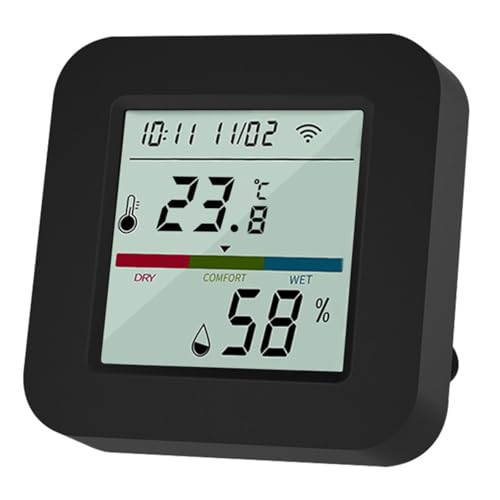
Provided you want automatic climate control that responds to real conditions, the WiFi Smart IR Remote AC Controller with Sensors is ideal: it measures temperature and humidity in real time and triggers your IR air conditioner, heater, fan, or humidifier to keep settings within your thresholds, all while you control or monitor it remotely via the Smart Life app and voice assistants. You’ll get precise T&H tracking, a clear LCD with time and date, and continuous Type‑C power. It uses 2.4 GHz Wi‑Fi (Bluetooth for setup), supports DIY IR learning for unsupported remotes, and lets you create automations to save energy in homes or specialty spaces.
- Connectivity:2.4 GHz Wi‑Fi (Bluetooth used in setup)
- Remote Control Capability:Remote control IR appliances via app/IR learning
- Works with IR‑Controlled ACs (or AC control):Controls IR appliances (ACs, heaters, fans)
- App Integration / Smart Home Support:Smart Life app; Alexa & Google Home
- Temperature Sensing / Display:Built‑in temperature & humidity sensors; LCD shows temp/humidity/time/date
- Voice Assistant Compatibility:Works with Alexa and Google Home
- Additional Feature:Continuous Type-C power
- Additional Feature:DIY IR learning
- Additional Feature:LCD time/date display
AIRZONE Aidoo WiFi AC Controller for Fujitsu (AZAI6WSCFUJ)
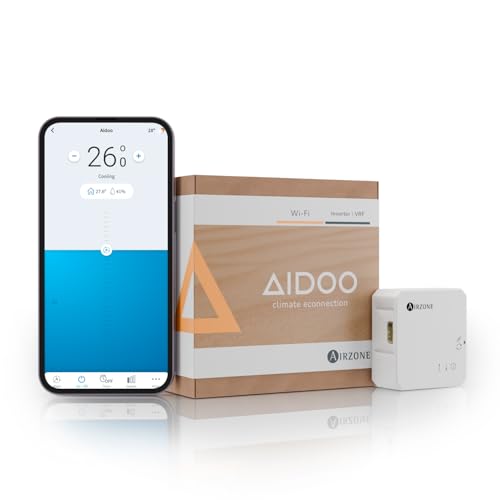
Provided you want precise, single-unit control for a Fujitsu 3‑wire split or cassette system, the AIRZONE Aidoo WiFi Controller (AZAI6WSCFUJ) is a compact, easy-to-install option that lets you change temperature, fan speed and louver direction from the Airzone Cloud app or with Google Home/Alexa voice commands. You’ll plug the wired Aidoo into one Fujitsu unit to avoid comms errors, then use Bluetooth and location services on your phone to add it onto WiFi via the app. You can schedule routines, group zones, share access across accounts, and name devices. It’s small, lightweight, and backed by the manufacturer warranty.
- Connectivity:Wi‑Fi (cloud) with Bluetooth and smartphone app
- Remote Control Capability:Remote control of AC functions via Airzone Cloud app
- Works with IR‑Controlled ACs (or AC control):Wired control to specific FUJITSU AC (direct wired interface)
- App Integration / Smart Home Support:Airzone Cloud app; Google Home & Alexa
- Temperature Sensing / Display:Controls temperature (wired); app shows/set temperature (no standalone sensor specified)
- Voice Assistant Compatibility:Compatible with Google Home and Alexa
- Additional Feature:Wired AC connection
- Additional Feature:Single-unit control
- Additional Feature:Zone grouping support
GYKQ-71E Universal Window AC Remote Control
In case you want a simple, no-frills replacement remote that works across many window AC brands and models, the GYKQ-71E is a solid pick — it’s designed for broad compatibility (TCL, BLACK+DECKER, Della, Crosley, Amana, Emerson, Honeywell, and more) and fits most standard hand-held setups. You’ll get a brand-new, wear-resistant ABS plastic remote that feels durable and comfortable in hand. It supports numerous specific models (examples preserved for verification) including TCL TAW series, BLACK+DECKER BWAC models, Della and Amana units, Emerson Quiet Kool, and others. Contact the seller for support before leaving feedback.
- Connectivity:(no Wi‑Fi) — infrared remote (replacement handheld remote)
- Remote Control Capability:Handheld IR remote for window AC units
- Works with IR‑Controlled ACs (or AC control):Direct IR remote for window AC models
- App Integration / Smart Home Support:No app integration (physical remote only)
- Temperature Sensing / Display:No built‑in temperature sensor (replacement remote only)
- Voice Assistant Compatibility:No voice assistant compatibility (physical remote only)
- Additional Feature:Broad brand compatibility
- Additional Feature:Durable ABS construction
- Additional Feature:Hand‑held replacement form
Breez Max Smart AC Controller for Mini-Split & Window
Should you want simple, universal smart control for a mini‑split, window, or portable AC that uses an IR remote, the Cielo Breez Max (BM102WA) is a strong choice—its auto‑detection supports over 20,000 models and its 2.4 GHz Wi‑Fi plus Alexa, Google, Siri Shortcuts, SmartThings and IFTTT integrations let you automate or voice‑control units across zones. You’ll get an LCD, touch controls, wall or table mounting, and built‑in temp/humidity sensors. Use Comfy Max for thermostat‑like comfort, set schedules, geofence, monitor energy and filter status, and group units for zoning. Setup’s DIY; place it within 6–12 ft line‑of‑sight.
- Connectivity:2.4 GHz Wi‑Fi (app) + optional integrations (Alexa/Google/Siri/SmartThings)
- Remote Control Capability:App and local touch control; remote app control of IR ACs
- Works with IR‑Controlled ACs (or AC control):Controls IR‑based mini‑split/window/portable units (IR remote required)
- App Integration / Smart Home Support:Cielo app; Alexa, Google Assistant, Siri Shortcuts, SmartThings, IFTTT
- Temperature Sensing / Display:Built‑in temperature & humidity sensors; LCD and app monitoring
- Voice Assistant Compatibility:Alexa, Google Assistant, Siri Shortcuts, SmartThings, IFTTT
- Additional Feature:AI Comfy Max
- Additional Feature:Geofencing support
- Additional Feature:Energy Star certified
SereneLife 10,000 BTU WiFi Portable Air Conditioner
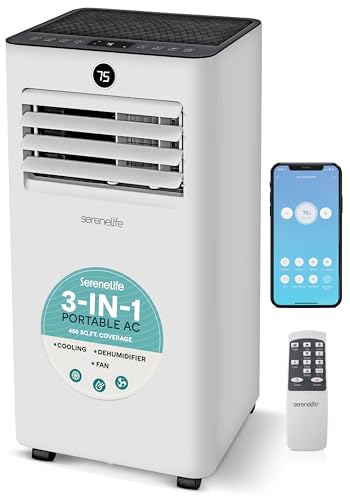
Should you want a compact, portable unit that you can control from your phone, the SereneLife 10,000 BTU WiFi Portable Air Conditioner is a solid pick—its built‑in WiFi and remote let you change mode, temperature, and fan speed without getting up. You get 3‑in‑1 cooling, dehumidifying, and fan modes, an LED display, timer, and washable filter. The 10,000 BTU capacity cools up to 450 sq. ft. with a rotary compressor and ~55 dBA motor. It’s 11.9 x 11.4 x 27.3 inches, 46.3 lbs, on castor wheels, includes a universal exhaust kit, drain pipe, and carries a one‑year warranty.
- Connectivity:Built‑in Wi‑Fi for remote control
- Remote Control Capability:Remote control included (physical) + Wi‑Fi remote via app
- Works with IR‑Controlled ACs (or AC control):Portable AC unit (built‑in) — direct device control (not IR hub)
- App Integration / Smart Home Support:Manufacturer app for Wi‑Fi control (works with included remote)
- Temperature Sensing / Display:Unit displays temperature (LED panel); built‑in thermostat/control
- Voice Assistant Compatibility:Voice support implied via Wi‑Fi (manufacturer app) — typically works with voice assistants (not explicitly listed)
- Additional Feature:Rolling castor wheels
- Additional Feature:Self-evaporating system
- Additional Feature:Universal window kit
Smart WiFi Air Conditioner Controller with Temp/Humidity
In case you want precise, remote control of an IR-based air conditioner plus built-in environmental feedback, the Smart WiFi Air Conditioner Controller with Temp/Humidity is a great fit — it adds Wi‑Fi control, Alexa/Google voice support, and real-time temperature and humidity readings to legacy window, portable, and mini‑split units. You’ll convert 8,000+ AC models from 229+ brands, including heat pumps, using Tuya Smart or Smart Life apps. Set schedules, automations, and scenes (like Goodnight Mode) to save energy. Built-in sensors report temp ±0.5°C and humidity ±5%RH for accurate remote monitoring and programmable thermostat convenience.
- Connectivity:2.4 GHz Wi‑Fi (Tuya/Smart Life)
- Remote Control Capability:App-based remote control (Tuya/Smart Life)
- Works with IR‑Controlled ACs (or AC control):Converts IR ACs/heat pumps to smart control (IR)
- App Integration / Smart Home Support:Tuya Smart / Smart Life apps; Alexa & Google Home
- Temperature Sensing / Display:Built‑in temperature & humidity sensor; real‑time display
- Voice Assistant Compatibility:Compatible with Alexa and Google Home
- Additional Feature:±0.5°C accuracy
- Additional Feature:±5%RH humidity accuracy
- Additional Feature:Group scenes integration
LG 10,000 BTU Window Air Conditioner with WiFi
Provided you want a window unit that’s easy to control from anywhere, the LG 12,000 BTU Wi‑Fi model is a strong pick—its ThinQ app and voice compatibility with Google Assistant and Alexa let you adjust temperature, fan speed, and schedules without walking to the window. You’ll get powerful cooling for about 450–550 sq ft, three cooling and fan speeds, 4‑way air deflection, and a 24‑hour timer. Installation uses an EZ Mount kit for double‑hung windows; filter is slide‑out washable with a clean alert. It runs on eco‑friendly R32, auto‑restarts after outages, includes remote, and carries a one‑year warranty.
- Connectivity:Wi‑Fi (LG ThinQ) + voice assistant support
- Remote Control Capability:Remote control via LG ThinQ app + physical remote included
- Works with IR‑Controlled ACs (or AC control):Window AC with built‑in smart control (integrated, not IR hub)
- App Integration / Smart Home Support:LG ThinQ app; Google Assistant & Alexa
- Temperature Sensing / Display:Built‑in thermostat in AC; display and app report temperature
- Voice Assistant Compatibility:Works with Google Assistant and Amazon Alexa
- Additional Feature:Slide-in chassis installation
- Additional Feature:R32 eco refrigerant
- Additional Feature:Clean Filter Alert
Factors to Consider When Choosing a Wifi Air Conditioner Controller
While choosing a Wi‑Fi air conditioner controller, you’ll want to check compatibility with your AC model and whether the controller’s connectivity and range suit your home layout. Consider sensor accuracy and placement, plus whether the unit supports automation and scheduling for energy savings. Also confirm smart home integration so it works with your existing apps, voice assistants, and routines.
Compatibility With ACs
Because air conditioners use different control methods, you’ll need to confirm a Wi‑Fi controller actually speaks your unit’s language—IR, a wired 3‑wire/serial connection, or a proprietary wired protocol—since many controllers only support IR or only hardwired systems. Check the manufacturer’s compatibility list or model claims for major brands and specific types (window, portable, mini‑split, ducted). Should you have an older or uncommon remote, make certain the controller can learn or emulate its IR signals via learning mode or a database match. Verify whether each indoor unit needs its own controller (common for mini‑splits/single‑zone) or whether one hub can group multiple units for multi‑zone control. Finally, make certain required setup links (2.4 GHz vs 5 GHz, Bluetooth pairing, or wired connections) match your installation.
Connectivity And Range
Although a smart AC controller can be a great convenience, it won’t work well unless it can’t reliably connect to your network—so check that it supports 2.4 GHz Wi‑Fi, the security protocols your router uses (WPA/WPA2), and the stated indoor range (typically ~30–50 ft/9–15 m line‑of‑sight), and confirm whether it depends on continuous internet/cloud access or can operate locally via Bluetooth/IR. Beyond that, verify concealed SSID handling, channel/bandwidth compatibility, and whether setup uses Wi‑Fi only or falls back to Bluetooth/IR. Account for walls and interference reducing range, and plan mesh Wi‑Fi or extenders for multi‑room installs. Also confirm the manufacturer allows multiple controllers on one network so each AC gets stable, low‑latency control.
Sensor Accuracy And Placement
Provided you want reliable automated control, pick a controller with precise sensors—about ±0.5°C (±0.9°F) for temperature and ±5% RH for humidity—so setpoint changes and on/off events trigger as intended. Place the sensor 1–3 meters (3–10 feet) from the AC outlet and out of direct airflow so it measures ambient conditions, not the unit’s plume. Mount it at breathing height (≈1.1–1.5 m / 3.5–5 ft) and keep it away from heat sources, windows, doors, and sunlight to avoid biased readings. For multi‑zone rooms, use one sensor per zone or per indoor unit and either average or prioritize readings to prevent conflicting commands. Periodically check with a calibrated thermometer/hygrometer and recalibrate or reposition when errors exceed the spec.
Automation And Scheduling
At the moment choosing a Wi‑Fi AC controller, prioritize flexible automation and reliable scheduling so your system runs the way you live — different setpoints for weekdays versus weekends, wake/away/sleep periods, and temperature‑ or humidity‑triggered actions. You should make certain daily and weekly schedules let you program distinct setpoints and scenes for routines. Pick controllers that run schedules locally during internet outages so automation doesn’t stop. Prefer temperature‑based triggers (auto on/off at thresholds) and humidity triggers for de/humidifying. Geofencing or presence automation helps pre‑cool or shut off the unit as occupants arrive or leave, saving energy. Finally, confirm the scheduler links multiple scenes or devices so the AC coordinates with lights, fans, or ventilation for cohesive home routines.
Smart Home Integration
Having set up reliable schedules and triggers, you’ll want a controller that plays nicely with the rest of your smart home so those routines actually happen. Verify compatibility with your ecosystem—Alexa, Google Assistant, Siri/Shortcuts, HomeKit, or whether—so voice control and routines work without hacks. Confirm whether the device offers cloud and local LAN APIs; cloud‑only units can limit custom hubs or scripts. Check multi‑device grouping and scene support to coordinate AC with thermostats, vents, fans, and sensors for zone automation. Look for built‑in automation like geofencing and sensor‑driven triggers you can tie into broader routines. Finally, review account/sharing controls and security: per‑user permissions, encrypted comms, and a clear firmware‑update policy to protect access and data.
Power And Installation Requirements
Because power type and installation shape how you’ll place and power the controller, verify voltage and connector (for example 5 V DC via USB‑C versus a mains input) and whether it needs continuous wired power or can run on batteries; also check whether it uses a direct wired interface to the AC or only IR/RF so you know whether you must open the unit or run cables. You should also confirm Wi‑Fi band support (most controllers need 2.4 GHz) and any Bluetooth requirement for setup. Plan placement for line‑of‑sight and distance to the AC—note recommended meters/feet—and whether sensors need specific orientation. Finally, check included mounting hardware and whether the install is DIY or needs a professional to avoid signal loss or safety issues.
Frequently Asked Questions
Can These Controllers Integrate With Whole-Home HVAC Systems?
Yes, many controllers can integrate with whole-home HVAC systems via compatible thermostats, smart hubs, or HVAC relays; you’ll need to confirm protocol support (Zigbee, Z-Wave, Wi‑Fi, BACnet) and wiring compatibility before installing.
Do Any Controllers Support Multi-User Access Permissions?
Yes — many do. You’ll find models that let you invite users, assign roles, and limit controls; test each app’s granular permissions, because some only offer basic sharing while others let you restrict temperature, scheduling, or admin rights per user.
Are There Firmware Rollback Options for Safety?
Yes — many controllers offer firmware rollback features for safety; you’ll find options to revert to prior stable releases, lock update versions, or delay updates, so you can prevent faulty firmware from disrupting your connected air conditioner.
How Do Controllers Handle Power Outages and Recovery?
Controllers typically restart automatically after power returns; you’ll see them reconnect, resume schedules, and often restore last settings. They’ll retry cloud links, log events, and let you manually adjust in case automatic recovery doesn’t complete.
Do Any Controllers Offer Local-Only Operation Without Cloud?
Yes — some controllers offer local-only operation without cloud dependency, so your AC runs via LAN, Bluetooth, or hub integration; you can control schedules and IR/IR learning locally, avoiding remote servers and preserving privacy.
