

Like choosing the right compass for a long voyage, picking a thermostat sets the course for comfort and savings. You’ll want options that handle simple schedules, protect your compressor, and play nice with modern smart homes — without costing a fortune. I’ll show seven solid choices for 2026 that balance features, compatibility, and reliability, and point out the tradeoffs that matter most so you can pick what fits your system.
| Programmable 5-1-1 Day Thermostat for Single-Stage Systems |

| Budget-Friendly Programmable | Power Type: 24 VAC (corded) with 2×AAA battery backup | Compatibility Type: Single‑stage conventional HVAC systems (1H/1C) | Mounting: Wall mount | VIEW LATEST PRICE | Read Our Analysis |
| ecobee Smart Thermostat Premium with Air Quality Monitor |

| Smart Home Premium | Power Type: 24 VAC (wired) with internal Lithium‑ion battery included | Compatibility Type: Most 24 VAC HVAC systems (2H/2C, heat pumps, 95% compatible) | Mounting: Wall mount | VIEW LATEST PRICE | Read Our Analysis |
| Day Programmable Thermostat for Single-Stage Home Systems |

| Simple & Reliable | Power Type: 24 VAC or 2×AAA batteries (dual‑powered) | Compatibility Type: Single‑stage conventional HVAC systems (1H/1C) | Mounting: Wall mount | VIEW LATEST PRICE | Read Our Analysis |
| Honeywell T4 PRO Programmable Thermostat 2-Pack |

| Best For Multi‑Room Savings | Power Type: Hardwire (AC) — wall powered (no batteries required) | Compatibility Type: 1 heat / 1 cool systems (AC, boiler, furnace, heat pump) | Mounting: Wall mount | VIEW LATEST PRICE | Read Our Analysis |
| meross Smart Wi‑Fi Thermostat (Matter Alexa HomeKit) |

| Matter‑Ready Smart | Power Type: 24 VAC (wired; C‑wire required in some setups) | Compatibility Type: Most 24 VAC HVAC systems (heat pump, AC, furnace, boiler) | Mounting: Wall mount | VIEW LATEST PRICE | Read Our Analysis |
| Honeywell Lyric T6 Pro Wi‑Fi Programmable Thermostat |
| Wi‑Fi Pro Control | Power Type: AC (requires 2×AA batteries) | Compatibility Type: Conventional and heat pump systems (up to 2H/2C or 2H/1C heat pump) | Mounting: Wall mount (UWP mounting system included) | VIEW LATEST PRICE | Read Our Analysis |
| Google Nest Thermostat Smart Wi‑Fi Thermostat (Charcoal) |
| Best Energy Saver | Power Type: 24 VAC (battery powered; 2×A batteries included) | Compatibility Type: Most 24 VAC HVAC systems; designed to work without C‑wire in many homes | Mounting: Wall mount | VIEW LATEST PRICE | Read Our Analysis |
More Details on Our Top Picks
Programmable 5-1-1 Day Thermostat for Single-Stage Systems
In case you run a conventional single-stage heating or cooling system and want straightforward, energy-saving scheduling, the Miuputake STN605’s 5-1-1 day programmability and factory pre-set energy program make it an ideal choice—its clear backlit LCD, simple push-button/touch controls, and universal sub-base let you set weekday and two distinct weekend schedules quickly without fuss. You’ll install it on a 24V single-stage system in about 30 minutes using the large terminal blocks and included screws. It accepts 2 AAA batteries, offers compressor delay protection and temperature calibration, and supports common heating/cooling types—check compatibility before buying.
- Power Type:24 VAC (corded) with 2×AAA battery backup
- Compatibility Type:Single‑stage conventional HVAC systems (1H/1C)
- Mounting:Wall mount
- Display:Backlit LCD
- Programmability / Scheduling:5‑1‑1 day programmable (pre‑set)
- Included Installation Hardware / Documentation:Screws & anchors, installation manual, operating manual, cable label
- Additional Feature:Compressor delay protection
- Additional Feature:Temperature display calibration
- Additional Feature:Front-load battery compartment
ecobee Smart Thermostat Premium with Air Quality Monitor
Should you want precise home comfort plus built‑in air quality tracking, the ecobee Smart Thermostat Premium with Air Quality Monitor is a top pick — it combines SmartSensor zoning, radar occupancy sensing, and a real‑time air quality monitor so you’ll stay comfortable and breathe easier. You’ll get ENERGY STAR efficiency, geofencing, SmartSensor to eliminate hot and cold spots, and smoke alarm and door/window alerts (with sensors and subscription). It supports Alexa, Siri (Home hub), Google Assistant, HomeKit and SmartThings. Package includes SmartSensor, PEK for no C‑wire, and a vivid LCD; expect easy DIY install, broad 24 VAC system compatibility, and a three‑year warranty.
- Power Type:24 VAC (wired) with internal Lithium‑ion battery included
- Compatibility Type:Most 24 VAC HVAC systems (2H/2C, heat pumps, 95% compatible)
- Mounting:Wall mount
- Display:Large vibrant backlit LCD
- Programmability / Scheduling:Programmable with smart scheduling (app; occupancy/geofencing)
- Included Installation Hardware / Documentation:Backplate, SmartSensor, screws & drywall plugs, wire labels, PEK, quick start guide, battery
- Additional Feature:Built-in air quality monitor
- Additional Feature:Radar occupancy sensing
- Additional Feature:SmartSensor included
Day Programmable Thermostat for Single-Stage Home Systems
Should you want a straightforward, budget-friendly thermostat that’s ideal for single-stage homes, the Heagstat H705 5-1-1 delivers—its simple button/touch controls and 5-1-1 scheduling let you set four daily comfort periods without needing a C-wire on most systems. You get a compact white rectangular unit with a 3-inch backlit LCD, accurate ±1°F control, and dual power (24VAC or 2×AAA). It supports 1H/1C conventional systems, some single-stage heat pumps and cooling-only setups, but not multistage, line-voltage, or many mini-splits. Features include compressor delay, adjustable cycle rates, filter alerts, and a two-year warranty.
- Power Type:24 VAC or 2×AAA batteries (dual‑powered)
- Compatibility Type:Single‑stage conventional HVAC systems (1H/1C)
- Mounting:Wall mount
- Display:3‑inch backlit LCD
- Programmability / Scheduling:5‑1‑1 day programmable (4 periods/day)
- Included Installation Hardware / Documentation:Two screws & anchors, installation manual, cable labels
- Additional Feature:Air filter change reminder
- Additional Feature:Adjustable separate swing
- Additional Feature:Large 3″ backlight
Honeywell T4 PRO Programmable Thermostat 2-Pack
Should you want a straightforward, hardwired programmable thermostat that lets you set distinct weekday and weekend schedules, the Honeywell T4 PRO 2-pack is a strong option—its 5-day to 2-day scheduling makes it ideal for households or small offices with different weekday routines and shared weekend hours. You’ll get two 1-heat/1-cool units (model RTH4110U2000-2PK) that support furnaces, boilers, heat pumps and AC. The digital, touch-and-app control works with Alexa, Google Assistant, HomeKit and SmartThings. It comes in solid black, includes tools, requires no batteries, and carries Honeywell’s warranty and a voluntary 30-day Amazon return.
- Power Type:Hardwire (AC) — wall powered (no batteries required)
- Compatibility Type:1 heat / 1 cool systems (AC, boiler, furnace, heat pump)
- Mounting:Wall mount
- Display:Digital display (backlight implied)
- Programmability / Scheduling:5‑day to 2‑day programmable
- Included Installation Hardware / Documentation:Tools (included per listing) — screws/installation hardware implied
- Additional Feature:2-pack value bundle
- Additional Feature:5‑Day to 2‑Day scheduling
- Additional Feature:App and touch control
meross Smart Wi‑Fi Thermostat (Matter Alexa HomeKit)
Looking for a smart, Matter‑ready thermostat that plays nicely with HomeKit, Alexa, and Google? You’ll like the meross Smart Thermostat for Home (MTS300). It’s a compact 3.6″ square unit with LED display, available in white or black glass, and it weighs 8.8 ounces. Designed for 24V HVAC systems, it supports heat pumps, furnaces, AC, boilers, humidifiers and more—about 95% compatibility—but not line‑voltage baseboard or millivolt setups. It uses Wi‑Fi and Matter for local control, offers 24/7 scheduling, remote access, alerts, and HVAC usage tracking. C‑wire might be required; installation guidance and warranty included.
- Power Type:24 VAC (wired; C‑wire required in some setups)
- Compatibility Type:Most 24 VAC HVAC systems (heat pump, AC, furnace, boiler)
- Mounting:Wall mount
- Display:LED display
- Programmability / Scheduling:24/7 flexible scheduling (app)
- Included Installation Hardware / Documentation:Backplate, trim plate, screws & anchors, wiring sticker, user manual
- Additional Feature:Matter protocol support
- Additional Feature:HVAC usage tracking
- Additional Feature:Lockable display/settings
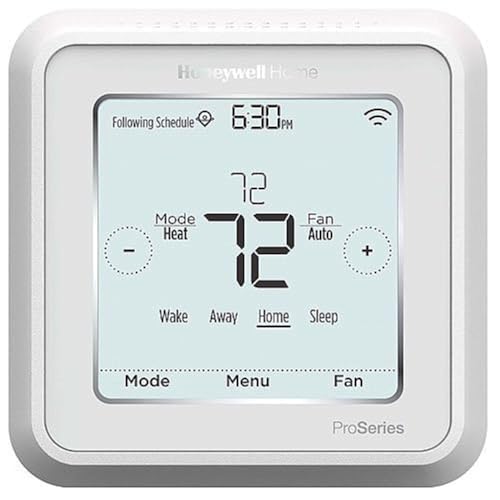
Honeywell Lyric T6 Pro Wi‑Fi Programmable Thermostat
Should you want a reliable smart thermostat that works with Apple HomeKit and Alexa and supports both heat‑pump and conventional two‑stage systems, the Honeywell Lyric T6 Pro is a compact, easy‑to‑install choice that gives you app control plus a simple manual display. You’ll mount the square, matte unit using the included UWP system, anchors, screws, and adapter. It connects over Wi‑Fi, runs on AC/DC with two AA batteries, and handles up to 2 heat/1 cool heat‑pump or 2 heat/2 cool conventional setups. The backlit clock display and app control make everyday scheduling and adjustments straightforward and reliable.
- Power Type:AC (requires 2×AA batteries)
- Compatibility Type:Conventional and heat pump systems (up to 2H/2C or 2H/1C heat pump)
- Mounting:Wall mount (UWP mounting system included)
- Display:Backlit display
- Programmability / Scheduling:Programmable via app (smart scheduling features)
- Included Installation Hardware / Documentation:Anchors, screws, decorative cover plate, UWP mounting system, installation guide, user guide
- Additional Feature:UWP mounting system
- Additional Feature:Clock display feature
- Additional Feature:Wi‑Fi app control
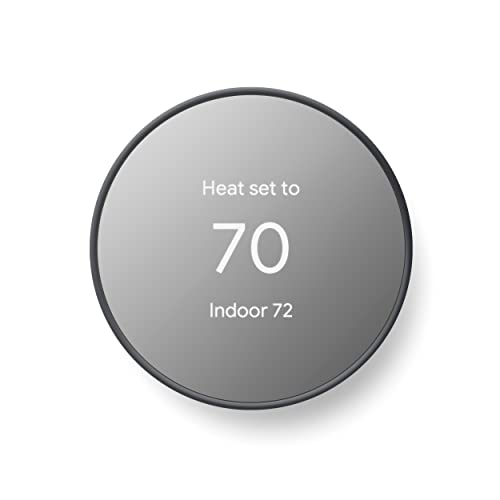
Google Nest Thermostat Smart Wi‑Fi Thermostat (Charcoal)
Provided that you want a compact, budget‑friendly smart thermostat that still supports app and voice control, the Google Nest Thermostat (Charcoal) fits the bill — it’s ENERGY STAR certified, installs in about 30 minutes, and works with Google Home, Alexa, and Matter‑certified assistants. You’ll get a slim rectangular unit with a 2″ backlit LCD, battery power (two A batteries included), and optional C‑wire support for trickier HVAC setups. Use the Google Home app or voice to set schedules, enable Auto‑Away, receive HVAC and maintenance alerts, and try Savings Finder or Nest Renew where available. One‑year warranty included.
- Power Type:24 VAC (battery powered; 2×A batteries included)
- Compatibility Type:Most 24 VAC HVAC systems; designed to work without C‑wire in many homes
- Mounting:Wall mount
- Display:2″ backlit LCD
- Programmability / Scheduling:Programmable schedule via Google Home app
- Included Installation Hardware / Documentation:Steel plate, mounting screws, documentation bundle
- Additional Feature:Auto‑Away energy feature
- Additional Feature:Savings Finder suggestions
- Additional Feature:Works without C‑wire (most)
Factors to Consider When Choosing a Value Programmable Thermostat
When choosing a value programmable thermostat, you’ll want to check compatibility with your HVAC system and whether your home wiring supports the unit’s power needs. Consider how flexible the scheduling is, in case it can integrate with your smart home, and which energy-saving features it offers. These factors will determine both ease of installation and long-term savings.
Compatibility With HVAC
Because your home’s HVAC wiring and control type determine what a thermostat can actually operate, double‑check voltage, terminal layout, and system compatibility before buying a value programmable thermostat. Start at verifying control voltage—most expect 24 VAC; don’t try to use one on line‑voltage or 110–240V systems unless explicitly supported. Match the thermostat to your system type and stages (single‑stage, 2H/2C, heat pump with/without auxiliary) so sequencing works correctly. Check whether a C‑wire is required or whether the model supports batteries or a power‑extender kit for stable 24V power, especially for Wi‑Fi features. Confirm terminals and wire count correspond to R, C, W, Y, G, O/B, AUX, etc. Finally, make certain special systems (millivolt, baseboard, multi‑stage heat pumps, proprietary mini‑splits) are explicitly supported.
Programmability And Schedules
Should you want to squeeze the most energy savings and comfort from a value programmable thermostat, pay close attention to how it handles schedules and overrides. Pick 5‑1‑1 or 5‑2 programming provided you need separate weekday and weekend routines so you can set one weekday program and distinct weekend patterns without daily tweaks. Make sure the unit supports at least four daily periods—wake, leave, return, sleep—so you can lower setpoints whenever you’re away or asleep. Look for factory presets and easy on‑unit editing (buttons or touch) so nontechnical users can start and adjust quickly. Assuming your occupancy is irregular, choose 24/7 flexible scheduling or simple temporary holds that change one period without altering the week. Consider presence-based features only assuming you want automatic adjustments.
Smart Home Integration
Once you’ve picked a schedule setup that matches your routine, check how the thermostat will fit into your broader smart‑home system. Confirm support for the protocols you use—Wi‑Fi, Bluetooth, Matter—or native integrations so it talks reliably with your hub or voice assistants. Verify compatibility with platforms like HomeKit, Google Home, Alexa, or SmartThings and make certain key features (scheduling, setpoints, away/home) are exposed to those platforms. Prefer devices offering local control (on‑device, LAN, or Matter) over cloud‑only options to keep automations responsive during outages. Check sensor and occupancy options—built‑in motion, remote sensors, geofencing—and whether those inputs integrate into your routines. Finally, review privacy, encryption, account needs, and firmware update policies for secure long‑term use.
Power And Wiring Needs
A few straightforward wiring checks will save you time and prevent costly returns: confirm whether your HVAC uses 24 VAC low‑voltage or line‑voltage (120–240 V), verify presence or need for a C‑wire or power‑stealing workaround, and match the thermostat’s terminals and sub‑base to your system’s wire count and control type (single‑stage, multi‑stage, or heat pump). You’ll want to confirm C‑wire availability because many modern programmable units need continuous power; should you not have one, look for models with a proven power‑stealing/PEK solution. Check battery requirements and access—front‑load AAA/AA or internal rechargeable cells—for backup and easy maintenance. Finally, choose thermostats with compressor delay and voltage tolerance/surge protection to safeguard equipment and make certain reliable operation.
Energy Saving Features
Often you’ll get the most savings through choosing a programmable thermostat that actually lets you reduce setpoints while you’re away or asleep—look for 5‑1‑1 or 7‑day scheduling and wide setback ranges (7–10°F) so you can cut runtime without sacrificing comfort. Choose models with adjustable temperature differentials (swing) and compressor delay protection to prevent short cycling, which increases efficiency and extends HVAC life. Make sure the display and calibration are accurate to about ±1°F so the system runs only as long as needed. Prefer units that log or remind you about filter changes and routine maintenance—clean filters and timely service preserve performance and lower energy use. Together, these features let you automate savings without constant oversight.
Installation And Usability
Before you buy, verify the thermostat will actually hook up to your system: most value models expect a 24 VAC control system (not line‑voltage or 120–240V electric baseboard), and many still need a C‑wire or reliable battery backup for full functionality. Check wiring requirements and whether your setup is heating‑only, cooling‑only, or both, since some budget units still require a common wire. Inspect terminal layout and labeling — larger blocks and clear labels speed DIY installs and cut mistakes. Confirm mounting size, wall cutout fit, and that screws, anchors and a trim plate are included to cover old holes. Finally, consider tools and time: a simple 24V single‑stage install can take about 30 minutes; complex or unfamiliar systems might need a pro.
Price Versus Warranty
Once you’ve confirmed fit and wiring, consider how long the thermostat will actually last versus what you pay for it. Cheaper programmable models often carry 1–2 year warranties, so factor possible replacement costs should a unit fail soon after purchase. A longer warranty (3+ years) can justify a higher upfront price through lowering expected lifetime ownership costs and repair risk. Check whether coverage includes labor and shipping or only parts, since out-of-pocket service charges can erase savings. Confirm conditions like required professional installation or C‑wire usage; voided warranties turn low prices into false economy. While comparing options, calculate total cost of ownership by adding expected failure risk (influenced via warranty length) to the purchase price to pick true value.
Frequently Asked Questions
Do Programmable Thermostats Void HVAC Warranties?
Yes, they usually won’t void warranties provided you install a compatible, professionally wired thermostat; manufacturers often require that. You’ll want to check your manual, keep receipts, and have a pro verify compatibility to avoid surprises.
Can Multiple Thermostats Share a Single HVAC Zone?
Yes — you can have multiple thermostats control one HVAC zone, but you’ll need a coordinating controller or logic to prevent conflicts. Otherwise they’ll fight each other, causing short cycles, incorrect setpoints, or equipment strain.
How Do Thermostats Handle Power Outages and Resets?
They’ll survive like heroic survivors: battery-backed or C-wire powered units keep time and settings during outages, while smart thermostats often reboot and reconnect, but you’ll sometimes need to manual restore schedules or reauthorize cloud features afterward.
Are Replacement Batteries Required for Smart Thermostats?
Yes — many smart thermostats need replacement batteries for backup or in case they’re battery-powered; others draw C-wire power and rarely need batteries except for backup. You’ll check the manual, replace as recommended, and test periodically.
Do Programmable Thermostats Support Accessory Humidifiers?
Yes — many programmable thermostats support accessory humidifiers provided they have a dedicated humidifier output or relay; you’ll check compatibility and wiring, configure humidity setpoints, and might need a common wire or installer to complete hookups.
