

You’ll want a thermostat schedule that fits how you actually live, not some default setting. Pick a 7‑day or 5/1/1 format, set distinct wake/leave/return/sleep periods, and use smart setbacks and pre‑heat/pre‑cool to save energy and stay comfortable. Also consider heat‑pump limits, vacation protection, and utility time‑of‑use programs—keep going to see how each tip applies to specific thermostats and setups.
| Honeywell Home Programmable Thermostat RTH20B |

| Simple & Reliable | Compatibility: Single-stage (1H/1C), hot water, forced air; not for electric baseboard | Power Requirement: 2 AA batteries | Scheduling: 5‑2 day programmable (with non‑programmable option) | VIEW LATEST PRICE | Read Our Analysis |
| Honeywell Home RTH9585WF Wi‑Fi Smart Color Thermostat |
| Smart Home Powerhouse | Compatibility: Forced air, hot water, steam, heat pumps with electric backup; not for electric baseboard | Power Requirement: Requires C‑wire (may need adapter) — hard‑wired Wi‑Fi thermostat | Scheduling: 7‑day programmable (flexible programming) | VIEW LATEST PRICE | Read Our Analysis |
| Honeywell Home RTH2300B1038 5-2 Day Programmable Thermostat White |
| Easy Programmable Pick | Compatibility: Gas/oil/electric furnaces, central A/C, hot water (with/without pump), millivolt; not for multistage or line-voltage | Power Requirement: Battery powered (retains memory during outage) — typical battery operation | Scheduling: 5‑2 day scheduling (4 periods/day) | VIEW LATEST PRICE | Read Our Analysis |
| Emerson Sensi Touch Smart Thermostat (ST75S) |

| Privacy-Focused Smart | Compatibility: Most home HVAC equipment (requires common wire) | Power Requirement: Common wire (c‑wire) required (hard‑wired) | Scheduling: Flexible scheduling via app (smart scheduling) | VIEW LATEST PRICE | Read Our Analysis |
| Honeywell Home RTH8560D 7 Day Programmable Touchscreen Thermostat |

| Advanced Scheduling Pro | Compatibility: Single-stage and multistage heating/cooling, heat pumps, hot water, steam, 750 mV, gas fireplaces | Power Requirement: Battery or hard‑wire operation (dual options) | Scheduling: 7‑day scheduling (program per day, Smart Response Learning) | VIEW LATEST PRICE | Read Our Analysis |
| Non-Programmable 1 Heat/1 Cool Thermostat with LCD |

| No-Fuss Simplicity | Compatibility: 24V single-stage heating & A/C (1H/1C); not for multistage, heat pumps, line-voltage | Power Requirement: 24 VAC or 2 AAA batteries (dual‑powered) | Scheduling: Nonprogrammable (no schedule) — manual setpoint only | VIEW LATEST PRICE | Read Our Analysis |
| Programmable 2H/2C Multi-Stage Home HVAC Thermostat |

| Multi-Stage Specialist | Compatibility: Single- and some multi-stage (up to 2H/2C), forced air, electric furnace, hot water, steam; not for line-voltage or certain heat pumps | Power Requirement: 24 VAC (requires power) and lists 2 AA batteries (both referenced) | Scheduling: 7‑day and 5/1/1 programming menus (flexible scheduling) | VIEW LATEST PRICE | Read Our Analysis |
More Details on Our Top Picks
Honeywell Home Programmable Thermostat RTH20B
Assuming you want a straightforward, budget-friendly programmable thermostat that’s easy to install and use, the Honeywell Home RTH20B fits the bill — it’s ideal for single-stage heating/cooling systems and replaces older RTH models. You’ll program a 5-2 weekday/weekend schedule or use the non-programmable option provided you prefer simplicity. It runs on two AA batteries, works with forced-air and hot-water systems, and isn’t compatible with electric baseboard heat. The large backlit display makes setpoint changes clear, and you can adjust custom display settings and maintenance alerts. Install via the UWP wall plate for an easier swap and future upgrades.
- Compatibility:Single-stage (1H/1C), hot water, forced air; not for electric baseboard
- Power Requirement:2 AA batteries
- Scheduling:5‑2 day programmable (with non‑programmable option)
- Display Type:Large backlit digital display (clear font)
- Alerts / Reminders:Air filter reminders; custom display settings
- Warranty / Support:1‑year warranty
- Additional Feature:Large backlit display
- Additional Feature:UWP wall plate
- Additional Feature:Extended 32°F setpoint
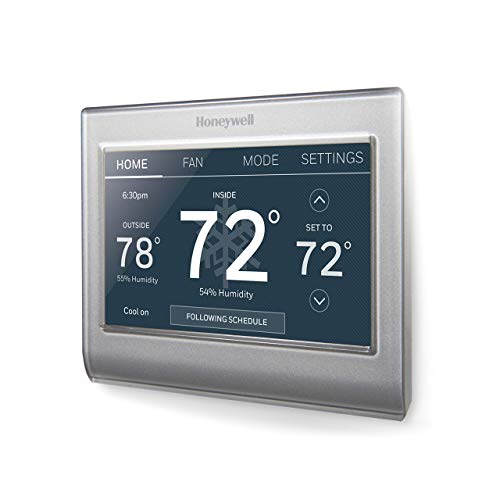
Honeywell Home RTH9585WF Wi‑Fi Smart Color Thermostat
Should you want a Wi‑Fi thermostat that lets you build detailed 7‑day schedules and get monthly energy reports, the Honeywell Home RTH9585WF is a strong choice. You’ll use the bright color touchscreen to set flexible weekday/weekend or unique daily programs, and the app lets you tweak temps remotely. It’s ENERGY STAR certified and sends monthly reports plus personalized tips; some utilities might offer rebates or demand‑response enrollment. It works with Alexa and Google Home, supports forced‑air, hot‑water, steam, and heat pumps with backup, but needs a C‑wire and won’t support electric baseboard or certain heating‑only furnaces without C‑wire.
- Compatibility:Forced air, hot water, steam, heat pumps with electric backup; not for electric baseboard
- Power Requirement:Requires C‑wire (may need adapter) — hard‑wired Wi‑Fi thermostat
- Scheduling:7‑day programmable (flexible programming)
- Display Type:Touchscreen color display
- Alerts / Reminders:Monthly reports and energy tips (app notifications)
- Warranty / Support:Manufacturer support via Honeywell (standard product support; check warranty with vendor)
- Additional Feature:Color touchscreen display
- Additional Feature:Wi‑Fi + voice control
- Additional Feature:ENERGY STAR certified
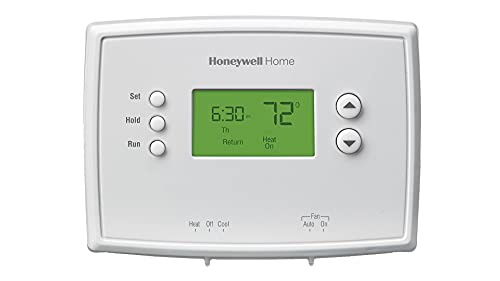
Honeywell Home RTH2300B1038 5-2 Day Programmable Thermostat White
Should you want a straightforward programmable thermostat that’s easy to set up and keeps weekday/weekend schedules separate, the Honeywell Home RTH2300B1038 is a solid pick — it offers 5-2 day scheduling with four daily periods (wake, leave, arrive, sleep) so you can dial in comfort and savings without fuss. You’ll get ±1°F accuracy, temperature limits for cooling/heating, and memory that survives power outages. The backlit display gives one-touch setpoint access and built-in alerts for batteries and filters. It’s simple to self-install and supports many common systems, though it won’t work with multistage, line-voltage, radiant, or heat-pump backup setups.
- Compatibility:Gas/oil/electric furnaces, central A/C, hot water (with/without pump), millivolt; not for multistage or line-voltage
- Power Requirement:Battery powered (retains memory during outage) — typical battery operation
- Scheduling:5‑2 day scheduling (4 periods/day)
- Display Type:Backlit digital display
- Alerts / Reminders:Battery change and filter change reminders
- Warranty / Support:Standard Honeywell support (retains memory; typical manufacturer warranty/support)
- Additional Feature:±1°F accuracy
- Additional Feature:Four periods daily
- Additional Feature:Retains memory on outage
Emerson Sensi Touch Smart Thermostat (ST75S)
Should you want a user‑friendly smart thermostat that’s easy to install and gives clear, at‑a‑glance controls, the Emerson Sensi Touch ST75S is a strong pick — especially for DIYers who need a c‑wire and want ENERGY STAR‑rated energy savings. You’ll get a sleek touchscreen in black, white, or silver, large readable temps, and intuitive menus. Wi‑Fi lets you control schedules from Android or iOS, view usage reports, and receive equipment and filter alerts. It works with most HVAC systems and Alexa. Sensi stresses data privacy and won’t sell your personal information, while flexible scheduling can cut HVAC energy about 23%.
- Compatibility:Most home HVAC equipment (requires common wire)
- Power Requirement:Common wire (c‑wire) required (hard‑wired)
- Scheduling:Flexible scheduling via app (smart scheduling)
- Display Type:Touchscreen color display (modern touchscreen)
- Alerts / Reminders:Filter‑replacement reminders and equipment alerts
- Warranty / Support:Sensi (Emerson) support and privacy policy (manufacturer support; warranty through Emerson)
- Additional Feature:Privacy protection policy
- Additional Feature:Built-in installation level
- Additional Feature:Usage/equipment alerts
Honeywell Home RTH8560D 7 Day Programmable Touchscreen Thermostat
Provided that you want a thermostat that reliably learns your system’s cycle times and lets you set a distinct schedule for each day, the Honeywell RTH8560D is a strong choice. You’ll get a crystal-clear touchscreen with bright blue backlight showing indoor temperature and humidity, plus on-screen filter alerts. Program seven separate daily schedules or apply a weekend or full-week plan. Smart Response Learning adapts heating and cooling cycles so your target temperature’s met whenever you desire it. You can power it with batteries or hard-wire, and permanent day/time backup preserves settings. It’s compatible with a wide range of systems, including heat pumps and gas fireplaces.
- Compatibility:Single-stage and multistage heating/cooling, heat pumps, hot water, steam, 750 mV, gas fireplaces
- Power Requirement:Battery or hard‑wire operation (dual options)
- Scheduling:7‑day scheduling (program per day, Smart Response Learning)
- Display Type:Touchscreen with bright blue backlight
- Alerts / Reminders:On‑screen air filter change reminders; equipment alerts/usage reports
- Warranty / Support:Manufacturer support included (package; check warranty details)
- Additional Feature:Smart Response Learning
- Additional Feature:Indoor humidity readout
- Additional Feature:Includes receiver
Non-Programmable 1 Heat/1 Cool Thermostat with LCD
Provided you want a simple, no-fuss thermostat for a basic 1 heat/1 cool system, the Aowel AW701 delivers a clear, easy-to-read blue LCD and straightforward button controls that make daily adjustments effortless. You’ll get a compact rectangular unit (4.92 x 3.74 x 0.98 in, 5.8 oz) with a 3.5-inch screen, battery or 24 VAC power, and no programming to learn. It supports single-stage 24V systems, shows 32–99°F, and controls 44–90°F with ±2°F accuracy and adjustable swing. Features include humidity display, compressor delay option, °C/°F calibration, battery alerts, and a 2-year warranty.
- Compatibility:24V single-stage heating & A/C (1H/1C); not for multistage, heat pumps, line-voltage
- Power Requirement:24 VAC or 2 AAA batteries (dual‑powered)
- Scheduling:Nonprogrammable (no schedule) — manual setpoint only
- Display Type:Blue backlit LCD (button control)
- Alerts / Reminders:Battery replacement reminder; humidity monitor
- Warranty / Support:2‑year limited warranty; 24‑hour customer service
- Additional Feature:Large 3.5″ screen
- Additional Feature:Dual-power 24VAC/AAA
- Additional Feature:Humidity monitor included
Programmable 2H/2C Multi-Stage Home HVAC Thermostat
Provided you’re running a multi-stage HVAC system and want flexible, day-by-day control, this 2H/2C programmable thermostat is a great fit — it supports two heat and two cool stages and offers 7-day or 5/1/1 scheduling so you can tailor temperatures for every day of the week. You’ll get a clear blue-backlit LCD, push-button controls, and large terminal blocks with wiring labels for quick wall-mount installation under 30 minutes. It works with many forced-air and hydronic systems but not with heat pumps that use auxiliary/emergency heat or line-voltage electric baseboards. Customer rating averages 4.3/5 from 65 reviews.
- Compatibility:Single- and some multi-stage (up to 2H/2C), forced air, electric furnace, hot water, steam; not for line-voltage or certain heat pumps
- Power Requirement:24 VAC (requires power) and lists 2 AA batteries (both referenced)
- Scheduling:7‑day and 5/1/1 programming menus (flexible scheduling)
- Display Type:Blue backlit LCD display (button control)
- Alerts / Reminders:On‑screen reminders implied (large display with labels/wiring; typical reminders listed in product features)
- Warranty / Support:Manufacturer warranty referenced (see manufacturer for warranty information)
- Additional Feature:Multi-stage 2H/2C support
- Additional Feature:Pre-set energy program
- Additional Feature:Universal sub-base included
Factors to Consider When Choosing a Thermostat Schedule
At the time you set a thermostat schedule, start using matching it to your household’s daily patterns and sleep/wake timing so the system runs while people are home and comfortable. Consider what type of HVAC you have and the practical temperature setpoint ranges it can hold efficiently. Also check energy pricing periods so you can shift heating or cooling away from costly peak hours.
Home Occupant Patterns
Comfort and convenience depend a lot on who’s in the house and at what times, so map out daily occupancy patterns—workdays during which the home’s empty for 8–9 hours, evenings and nights when people return, and any regular variations like shift work or school schedules—to set setback periods that save energy without sacrificing comfort. Then create multiple program periods (morning, away, evening, night) and separate weekday/weekend profiles to match variable routines and guests. Should your system recover slowly, start pre‑heat/pre‑cool earlier so rooms reach comfort when people arrive. For infants, elderly, or medical needs, limit setback depth and duration or keep a higher minimum setpoint to maintain safety. Track seasonal changes, vacations, and holidays and use temporary schedules or remote controls to adjust without rewriting weeks.
HVAC System Type
Match your thermostat schedule to the type of HVAC system you have, because cycle behavior and recovery times vary widely and affect how aggressively you can setback temperatures. In case you’ve got a heat pump, use longer, fewer cycles and set modest setbacks to avoid excessive compressor cycling or triggering costly auxiliary heat. For multi‑stage systems, program gradual setpoint changes and allow longer recovery so lower stages handle most demand before higher stages kick in. Hydronic and steam systems respond slowly, so build in lead time and avoid short, frequent setbacks that cause overshoot or discomfort. With line‑voltage electric baseboards or other high on/off systems, minimize frequent setbacks—rapid swings waste energy and reduce comfort. Tailor setbacks to each system’s control and response traits.
Energy Pricing Periods
Your system’s response and recovery affect not just comfort but cost, so you’ll also want to align your schedule with your utility’s pricing periods. Many utilities use time-of-use rates with peak, mid-peak, and off-peak windows—shifting heating or cooling to off-peak hours lowers bills. Peak pricing often hits on hot summer afternoons and early-evening weekdays, so schedule setbacks to avoid heavy HVAC use then. Some providers declare critical peak events with much higher rates; set a more energy-saving setpoint and enable remote or automated responses for those hours. Overnight and pre-morning off-peak periods are ideal for pre-cooling or pre-heating so comfort is ready before higher-rate windows. Confirm your utility’s rate calendar and program separate weekday/weekend and seasonal schedules.
Temperature Setpoint Ranges
Whenever you pick setpoint ranges, balance comfort, equipment limits, and energy goals so the system can actually meet your schedule without strain. Set daytime and nighttime setpoints inside the HVAC’s safe operating range (commonly 44–90°F) so the system won’t call for impossible heating or cooling. Use larger differentials—about 5–10°F—between occupied and unoccupied periods to save energy while keeping comfort acceptable. Observe minimum heating limits (often no lower than 32°F) and follow manufacturer maximum cooling recommendations to protect pipes and equipment. If available, enable setpoint ramping (1–2°F per hour) to reduce short-cycling and smooth transitions. For heat pumps or sensitive systems, maintain small overlaps/deadbands (roughly 1–3°F) to prevent rapid mode switching.
Sleep And Wake Timing
Because sleep quality ties closely to temperature, set a distinct nighttime setback about 6–10°F below your daytime comfort and start it 1–2 hours before bed so the system has time to reach the target; then raise the temperature 15–30 minutes before your wake time so the house is comfortable without wasting energy overnight. You should keep consistent sleep and wake times on weekdays and weekends to support circadian rhythm, unless your lifestyle forces exceptions. In household members have differing schedules, use zoning or compromise setpoints within ±2–3°F to balance comfort and savings. Program the thermostat so the sleep setback begins with enough lead time for central systems, and schedule the wake enhance shortly before you rise to avoid heating or cooling the empty house all night.
Vacation And Away Modes
On vacation or during short absences, set your thermostat to an Away mode that shifts temperatures 5–10°F from your normal schedule to save energy while avoiding extremes. Choose minimum heating (around 50–55°F) to prevent frozen pipes and cap cooling at about 85°F to protect electronics and plants. Use programmable Vacation settings for a specific return date or an indefinite mode that resumes your normal schedule at a preset time, avoiding manual reprogramming. For extended absences, enable frost/overheat protection and humidity-related safeguards to cut mold and moisture risk while still conserving energy. Should your utility or HVAC offers demand-response or rebates, align your Away offsets with those programs to increase savings during peak events and make certain your home stays safe and efficient.
Humidity And Ventilation
Balancing humidity and ventilation in your thermostat schedule keeps indoor air comfortable and prevents moisture problems, so plan runtime and fresh-air cycles around activities that raise moisture like cooking or lots of occupants. Increase ventilation during high-occupancy or cooking times—run fans or bring in fresh air—to cut humidity spikes. Coordinate HVAC runtime with dehumidification or whole-home ventilation, for example running fans 10–30 minutes after humid activities to target 30–50% relative humidity. Lower setpoints slightly at night or whenever away to reduce dew point and condensation risk, but keep temperatures above 55–60°F to avoid mold. Use gradual setbacks to prevent rapid temperature swings that shift relative humidity and cause window condensation. During warm, humid seasons amplify ventilation selectively; avoid fresh-air intake when outdoor humidity is very high.
Frequently Asked Questions
How Do Thermostat Schedules Affect Indoor Humidity Levels?
Thermostat schedules impact indoor humidity through changing runtime: whenever you run HVAC longer, it removes more moisture; if you cut runtime or raise setpoints, humidity rises. You’ll balance comfort and energy via adjusting runtimes and fan use.
Can Pets’ Comfort Be Prioritized in Schedule Programming?
Yes — you can prioritize pets’ comfort in schedule programming through setting consistent temperatures, avoiding wide overnight swings, using pet-safe zones or smart vents, and integrating sensors or pet activity patterns so your system keeps them comfortable reliably.
Will Scheduling Reduce HVAC System Wear and Tear?
Yes — you’ll reduce HVAC wear through avoiding constant full-throttle runs; smart scheduling eases cycles, but don’t obsessively short-cycle. Balance setpoints and run times so the system works steadily, preventing stress while saving energy.
How Do Vacations or Irregular Routines Impact Energy Savings?
Vacations and irregular routines cut energy use provided you set setbacks or use smart modes; you’ll save more through raising cooling or lowering heating while away, preconditioning before return, and avoiding unnecessary full-temperature operation during absences.
Are There Health Concerns From Large Day-To-Night Temperature Swings?
Studies show up to 60% of people sleep worse with big temperature swings. Yes, large day-to-night shifts can aggravate allergies, asthma, heart issues, and sleep quality; you’ll want gradual changes and stable humidity to protect health.
