

I’ve tested and compared the seven best wireless switches for 2026 so you can find a reliable, secure option that fits your setup. I focus on certifications, wireless tech, and real-world performance—things that matter whenever you want hassle-free control. Some models shine for smart-home integration, others for ruggedness or range. Keep going and I’ll point out which one suits your needs best.
SURAIELEC Wireless Remote Control Outlet Rocker Switch

Should you need a no-fuss way to add switches without rewiring or Wi‑Fi, the SURAIELEC Wireless Remote Control Outlet Rocker Switch is ideal—its plug-in receiver and Decora-style rocker let you control lamps and small appliances up to 15A/1875W from anywhere in the house, and its pre‑programmed, rolling‑code system supports multiple independent sets and easy expansion for 3‑ or 4‑way wireless configurations. You’ll plug the compact receiver into an outlet, mount the black rocker where you want, and start controlling lights immediately. The RF signal reaches about 100 feet through walls, and you can add transmitters or receivers to scale.
Best For: homeowners or renters who want an easy, no-wiring way to add remote-controlled switches for lamps and small appliances, especially those with mobility constraints.
Pros:
- Pre‑programmed, plug‑and‑play setup for immediate use without Wi‑Fi or electrical rewiring.
- Rolling‑code RF system supports multiple independent sets and expandable 3‑/4‑way wireless configurations.
- Strong RF range (about 100 ft) through walls and doors, suitable for varied home spaces.
Cons:
- Receiver occupies a full outlet socket, potentially blocking access to the second receptacle.
- Rated for lamps and small appliances only (up to 15A/1875W); not suitable for hardwired fixtures or high‑load devices.
- Battery or power requirements for the wireless rocker not specified (may need occasional replacement/maintenance).
LoraTap Wireless Wall-Switch Outlet 3-Pack (656ft)
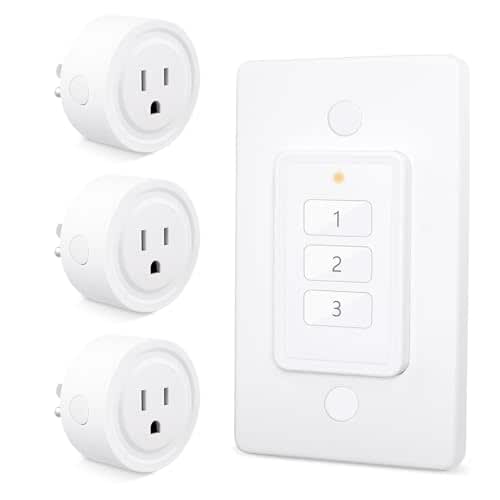
In case you want a simple, app-free remote that works across a house and yard, the LoraTap Wireless Wall-Switch Outlet 3-Pack is ideal — it gives you three grounded, plug-and-play outlets controlled through a single 3‑channel remote with up to 656 ft outdoor range, magnetic portability, and a memory function so your devices return to their last state after power loss. You’ll get easy on/off control for lamps, fans, routers, and small appliances without wiring. The remote’s blue LED and pre-paired setup make it senior- and kid-friendly, each unit has a unique ID to avoid interference, and FCC/CE/RoHS-certified hardware includes a two-year warranty.
Best For: anyone who wants a simple, app-free, remote-controlled solution for lights and small appliances across a house and yard, especially seniors or users who prefer plug-and-play convenience.
Pros:
- Long range (up to 656 ft outdoors / 100 ft indoors) with through-wall transmission and unique IDs to prevent interference.
- Pre-paired, magnetic, portable remote with simple on/off buttons and blue LED—easy for seniors and kids to use.
- Memory function, grounded plug, certifications (FCC/CE/RoHS), and a 2-year warranty for reliability and safety.
Cons:
- Not suitable for high-power appliances—designed for lamps, fans, routers, and small devices only.
- No smart home app or integration—limited to basic remote control without automation or voice assistant support.
- Indoor range (100 ft) may be insufficient in large homes with many walls or interference.
Kasa Matter Smart Light Switch 3-Pack

In case you want a straightforward, standards-first smart switch that plays nicely with every major platform, the Kasa Matter Smart Light Switch 3-Pack is a solid choice. You’ll get Matter-based cross-platform compatibility with Apple Home, Alexa, Google Home, and SmartThings, plus Multi-Admin so multiple systems can control the same switches. It needs a neutral wire and 2.4GHz Wi‑Fi, and the app guides you through standard wall plate installation. Use voice commands or the Kasa App remotely, monitor status, and set advanced schedules, timers, countdowns, and Away Mode. The pack includes three UL‑certified single-pole switches that operate via LAN should offline.
Best For: homeowners or renters who want a standards-first, multi-platform smart light switch pack that’s easy to install (with a neutral wire) and works with Apple Home, Alexa, Google Home, and SmartThings.
Pros:
- Matter-based cross-platform compatibility with Multi-Admin for seamless control across ecosystems.
- Remote voice and app control plus advanced scheduling (timers, countdowns, Away Mode) and LAN operation for offline use.
- Three UL-certified single-pole switches included with app-guided installation and standard wall plate fit.
Cons:
- Requires a neutral wire, which some older homes may lack or require electrician work to add.
- Only supports 2.4GHz Wi‑Fi (no 5GHz), which may limit network flexibility.
- Single-pole design—not suitable for 3-way/multi-location switch setups without additional hardware.
Wireless Remote Control Wall Outlet – 3-Outlet, 15A
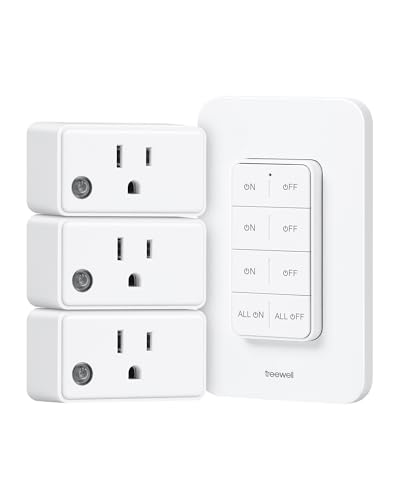
Should you want a compact, no-fuss way to control multiple lamps or appliances from across the room, the treewell 3-outlet wireless wall outlet is a great fit thanks to its three independently controlled sockets and a 200-foot RF remote range that works through walls without line-of-sight. You plug the mini unit into a single socket, then pair the detachable remote—wall-mounted or handheld—to switch outlets independently or together. It’s rated 15A/125V (1,875W per outlet), ETL and FCC listed, and housed in fire-resistant casing. Expandable pairing supports additional treewell kits for broader, interference-free control around your home.
Best For: Homeowners or renters who want an easy, compact solution to remotely control multiple lamps or small appliances without rewiring.
Pros:
- Three independently controlled outlets let you switch multiple devices separately or simultaneously.
- 200-foot RF range works through walls and doors; remote is wall-mountable or handheld for flexible placement.
- Compact plug doesn’t block adjacent sockets and supports up to 15A/1,875W per outlet with ETL/FCC safety listings.
Cons:
- Not suitable for high-current whole-home devices or continuous heavy-duty loads beyond individual outlet ratings.
- Requires keeping CR2032 batteries in the remote (though included) and occasional re-pairing if expanding the system.
- Only 1-way control (no status feedback) and limited to compatibility with treewell wireless accessories for expansion.
Thinkbee Wireless Waterproof Remote Light Switch Kit

Should you need a rugged, no-fuss wireless switch for outdoor or utility spaces, the Thinkbee kit is ideal because it’s IP66-rated, needs no wiring or Wi‑Fi, and connects in about five seconds—so you can operate lights or fans quickly even through walls. You install the receiver between power and fixture; it fits ceiling, junction, or switch boxes and accepts AC 80–275V. The 433MHz remote reaches 328 ft indoors (1,969 ft outdoors), supports up to eight remotes per receiver for multi-way control, and handles loads to 1000W LED (10A). It’s V0 fire-resistant, offers over-current protection, long battery life, and a five-year warranty.
Best For: Homeowners, contractors, or outdoor enthusiasts who need a rugged, easy-to-install, no-wires wireless switch solution for outdoor/utility lighting and fans.
Pros:
- IP66 waterproof, V0 fire-resistant, and wide temperature range for reliable outdoor/utility use.
- No wiring or Wi‑Fi required; receiver installs between power and fixture and pairs with the remote in ~5 seconds.
- Long-range 433MHz RF (328 ft indoors, 1,969 ft outdoors), supports up to 8 remotes per receiver, and handles up to 1000W LED (10A).
Cons:
- Remote provides only basic on/off control (no dimming or advanced features).
- Receiver dimensions and installation space may be tight for some fixture or switch boxes.
- Operating voltage and current specs (listed as 150V/10A in tech sheet) may confuse users—ensure compatibility with your specific electrical setup.
SURAIELEC Wireless Remote Light Switch Kit (Black)

Should you need a no-fuss, high-power remote solution for lamps, fans, or sockets, the SURAIELEC Wireless Remote Light Switch Kit is a smart pick — it handles up to 15A/1875W and installs without in-wall wiring. You’ll plug the compact receiver between power and fixture (neutral required), mount the bracket, and use the pre-programmed portable remote—no WiFi or fixture replacement. It supports ON/OFF control, expands to multi-way setups, and pairs multiple remotes or receivers. With rolling codes, a 100 ft RF range through walls, weatherproof receiver, and simple clamp/screw connections, it’s practical for many rooms and outdoor spots.
Best For: Homeowners or renters who want an easy, high-power, no-wiring remote control solution for lamps, fans, or outdoor fixtures up to 15A/1875W.
Pros:
- No in-wall wiring or WiFi required; plug-in receiver and pre-programmed remote for quick setup.
- High power capacity (15A/1875W) and expandable to multi-way or multi-device configurations.
- Strong RF range (up to 100 ft) with rolling/dynamic codes and weatherproof receiver for varied locations.
Cons:
- Requires a neutral wire at the fixture, which may limit compatibility with some existing lamps or outlets.
- IP20 rating and upper temp limit 40°C — not suitable for fully exposed outdoor installations or high-heat environments.
- Remote offers only basic ON/OFF control (no dimming or advanced smart-home features).
DEWENWILS Wireless Remote Control Outlet Power Switch

Should you want a simple, no-wiring solution that works through walls, the DEWENWILS Wireless Remote Control Outlet Power Switch is a strong choice thanks to its 100 ft RF range and detachable wall-mounted remote—so you can control lamps, fans, and other indoor appliances without rewiring or fuss. You’ll get a compact, ETL-certified receiver that leaves the upper outlet free and mounts without in-wall work. The white remote snaps to a bracket or detaches for handheld use. It’s pre-programmed for immediate operation, lets you add extra remotes and outlets of the same model, and also offers manual control on the receiver itself.
Best For: those who want an easy, no-wiring way to remotely control lamps, fans, and other indoor appliances in multiple rooms with a compact, wall-mountable remote.
Pros:
- 100 ft RF range that penetrates walls and doors for reliable remote control across rooms.
- Compact ETL-certified receiver that leaves the upper outlet usable and requires no in-wall wiring.
- Detachable wall-mounted remote, pre-programmed for immediate use and expandable with additional remotes/outlets.
Cons:
- Only compatible with the same DEWENWILS model family for adding remotes and outlets.
- May occupy the lower outlet (depending on setup) despite compact size, limiting outlet availability.
- Lacks smart-home hub integration (no Wi‑Fi/voice control) for advanced automation.
Factors to Consider When Choosing a Wireless Switch
Once I select a wireless switch I check device compatibility initially so it actually works with my lights, appliances, or hub. I also consider installation, signal range, and the switch’s power/load rating to make sure it’s safe and reliable. Finally, I consider how easy it is to pair and expand into a larger system so it grows with my setup.
Compatibility With Devices
Because a wireless switch is only as useful as the devices it controls, I check compatibility initially: make sure the switch’s voltage and current ratings match your lamps, fans, or small appliances (commonly around 120–125V and up to 15A/1875W), confirm it supports your bulb types (LED, CFL, halogen, incandescent), and verify any multi-way or expandable features you need so you don’t end up with an overloaded circuit or a feature gap later. I also look for clear specifications on voltage and amperage to avoid overheating or tripped breakers. In the event that you plan to control multiple fixtures, pick switches that explicitly support multi-way setups and can be expanded with extra transmitters or receivers for seamless integration.
Installation Requirements
Although I prefer wireless switches for their simplicity, I still check installation requirements upfront so I don’t run into surprises. Many models need no in-wall wiring, which makes installation quick and avoids electrical modifications. Still, some require a neutral wire—confirm that at the fixture before buying. Others use a receiver you plug between the power source and the device; that’s handy whenever you don’t want to replace a fixture. A lot of switches arrive pre-programmed and are truly plug-and-play, so you can use them immediately without extra setup. Finally, consider mounting: some are fixed for wall mounting, while others are portable remotes or include magnetic bases for flexible placement. Assess these points to match your setup.
Range And Signal
In case you’re counting on a wireless switch to work through walls and floors, pay close attention to its RF range and signal strength. I look for systems that advertise indoor ranges from about 100 to over 300 feet — outdoors can reach several hundred feet farther — and I favor units that explicitly highlight non–line-of-sight performance. Strong RF makes multi-room setups reliable, but I also consider building materials, nearby electronics, and placement since they all affect effectiveness. For homes with several switches, I prioritize systems using unique IDs or rolling codes to avoid interference whenever multiple devices operate nearby. In short, match rated range to your layout, test placement provided possible, and choose interference-resistant protocols for dependable control.
Power And Load Rating
When I pick a wireless switch, I always check its current and power ratings to make sure it can handle the devices I’ll connect; I look for the maximum current in amps and the load rating in watts so nothing is undersized. Matching or exceeding the total wattage of your lights or appliances prevents overheating and failure. For single high-power items or multiple fixtures on one switch, I choose higher ratings—common examples are 15A/1875W—to avoid overload. Ignoring these specs risks electrical hazards, shortened device life, or switch malfunction. Don’t guess: add up expected wattage, confirm the switch’s amp and watt ratings, and leave a safety margin for reliability and longevity.
Expandability And Pairing
Now that you’ve confirmed the switch can handle your load, consider how you’ll expand and pair it with other devices. I look for systems that let me add multiple transmitters and receivers so one remote can control several lights or several remotes can control one fixture — essential for 3-way or 4-way setups. Programmable pairing matters: I want to freely pair, re-pair, and integrate new devices without breaking existing links. Good kits use adaptive or rolling codes to avoid interference whenever multiple systems operate nearby, and they typically maintain interference-free performance even in dense installations. Ultimately, expandability lets me centralize control across appliances and lights, keeping setups flexible and easy to modify as needs change.
Safety And Certifications
Because safety standards vary across regions and applications, I always check a wireless switch’s certifications before buying. I look for ETL, FCC, CE, or RoHS marks since they show compliance with electrical safety, emissions, and material restrictions. I also verify fire resistance ratings—V0, for example—because resistant materials cut fire risk. Over-current protection matters to me; built-in safeguards prevent overloads that could damage devices or start hazards. For outdoor or damp areas I demand an IP66 or similar waterproof rating so moisture won’t cause failures. Certified switches usually undergo rigorous testing for electrical safety, durability, and reliable operation, and that testing protects both users and connected equipment. Certifications aren’t optional—they’re essential.
