

You could not know that many smart switches still rely on 2.4 GHz Wi‑Fi and a neutral wire, which can trip up installations more often than you’d expect. I’ve tested and compared the top options for Google Home in 2026, considering ease of setup, local control (Matter where available), and real‑world reliability. I’ll walk you through the switches that balance features and practicality so you can pick the right one for your home.
TREATLIFE Smart WiFi Light Switch 4-Pack (Neutral)

Should you want a reliable, budget-friendly smart switch that works seamlessly with Google Home and other voice assistants, the TREATLIFE Smart WiFi Light Switch 4‑Pack is a solid pick — especially for homes with neutral wiring. You’ll need a neutral wire and 2.4GHz WiFi; it won’t work on 5GHz or in 3‑way circuits. It supports standard non‑dimmable bulbs, handles up to 1250W/10A, and comes with a screwless snap‑on plate. You control lights via Smart Life or voice (Alexa, Google, SmartThings), set schedules, timers, occupancy simulations, share access, and rely on FCC certification plus responsive support.
Best For: homeowners with neutral‑wired single‑pole circuits who want an affordable, voice‑compatible smart switch controlled via Smart Life and 2.4GHz Wi‑Fi.
Pros:
- Affordable, reliable smart switch that integrates with Alexa, Google Assistant, and SmartThings.
- Remote control, schedules, timers, occupancy simulation, and group/share features via the Smart Life app.
- FCC certified, supports standard non‑dimmable bulbs up to 1250W/10A, includes screwless snap‑on plate.
Cons:
- Requires a neutral wire and only works on 2.4GHz Wi‑Fi (no 5GHz support).
- Not compatible with 3‑way circuits and does not support dimming.
- Limited to standard non‑smart bulb features (no advanced dim or scene control for non‑dimmable bulbs).
MOES 3-Gang WiFi Smart Light Switch (Neutral)

In case you’ve got a neutral wire and want reliable multi-switch control, the MOES 3‑Gang WiFi Smart Switch is a solid pick—its three independent rocker modules let you control three circuits from one wall plate while supporting multi-control setups so multiple switches can operate the same light. You’ll get Smart Life/TUYA app compatibility, Alexa and Google Assistant voice control, and scheduling with timers, countdowns, and an Away Mode for random activations. It needs a neutral wire and 2.4GHz Wi‑Fi, handles up to 10A per gang, and is meant for standard, non-dimmable lighting; it won’t work with smart bulbs or dimmers.
Best For: homeowners or renters with an existing neutral wire who want reliable, app- and voice-controlled multi-gang control for standard (non-dimmable) lighting circuits.
Pros:
- Supports three independent switches in one plate with multi-control capability so multiple switches can operate the same light.
- Works with Smart Life/TUYA apps plus Alexa and Google Assistant for remote and voice control; includes scheduling, countdowns, and Away Mode.
- Durable PVC design with a soft star-shaped ring glow for subtle nighttime pathway lighting and added ambiance.
Cons:
- Requires a neutral wire and only works on 2.4GHz Wi‑Fi, limiting installation locations and networks.
- Not compatible with smart bulbs or dimmers, so it only controls standard non-dimmable fixtures.
- Maximum current 10A per gang may be insufficient for some high-load lighting circuits.
BN-LINK WiFi Smart In-Wall Light Switch (White)
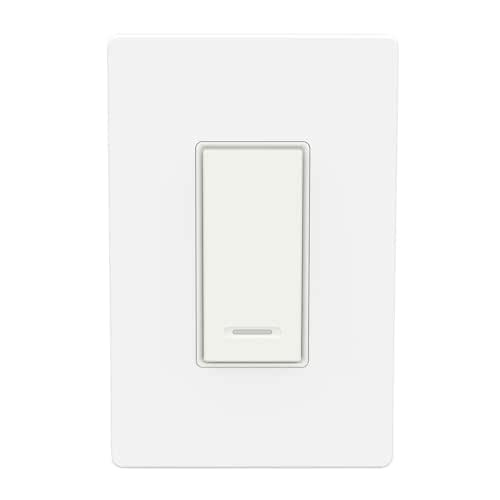
In case you want a straightforward, hub-free smart switch that works with Google Assistant and Alexa, the BN-LINK WiFi Smart In-Wall Light Switch is a solid pick—especially provided your home has a neutral wire and 2.4 GHz WiFi. You’ll control lights via voice or the free Smart Life app from anywhere, set daily schedules, and simulate occupancy for added security. Installation requires a neutral wire and supports single-pole setups only. It won’t work on 5 GHz networks, but AP mode can help resolve connectivity issues on 2.4 GHz. All in all, it’s convenient, secure, and energy-friendly for compatible homes.
Best For: homeowners with a neutral wire and 2.4 GHz WiFi who want a hub-free, voice- and app-controlled smart in-wall switch compatible with Google Assistant and Alexa.
Pros:
- Easy hub-free setup with voice control via Google Assistant and Alexa and remote control through the free Smart Life app.
- Scheduling and automation features (including occupancy simulation) improve convenience, security, and energy savings.
- AP mode and 2.4 GHz support aid connectivity for compatible home networks.
Cons:
- Requires a neutral wire and supports only single-pole wiring, limiting compatibility in some homes.
- Incompatible with 5 GHz WiFi networks, which can be a dealbreaker for some routers.
- Setup and reliability depend on the 2.4 GHz network quality; may require troubleshooting for stable performance.
2-Gang WiFi Smart Light Switch (Alexa, Google Compatible)

Should you want simple, reliable dual-zone control without a hub, the 2-Gang WiFi Smart Light Switch is ideal for users who need to manage two circuits from one plate. You’ll get Alexa and Google Assistant voice control, IFTTT integration, and remote access via the Smart Life app (Android 4.1/iOS 8+). It’s Wi‑Fi powered, fits one‑way circuits, and requires a neutral wire for installation. Rated 120V, 15A, 1800W with IP44 protection and ETL/CE/FCC certifications, it supports scheduling and timers to cut standby waste. The micmi switch measures 5×2×3 inches, weighs 11.2 oz, and comes in white.
Best For: Homeowners or renters who want hub-free, voice- and app-controlled dual-zone lighting with scheduling for one-way circuits and have an available neutral wire.
Pros:
- Compatible with Alexa, Google Assistant, IFTTT and Smart Life app for voice, remote, and automated control.
- Good electrical capacity (120V, 15A, 1800W) with ETL/CE/FCC certifications and IP44 protection.
- No hub required and compact 2‑gang form factor allowing control of two circuits from one plate.
Cons:
- Requires a neutral wire, so it may not be compatible with older homes lacking neutral at the switch.
- Only supports one-way circuits (not compatible with 3-way/ multi-way wiring setups).
- Contact material is plastic and actuator is push-button, which may feel less durable than metal-contact, rocker-style switches.
TP-Link Tapo Matter Smart Light Switch (2-Pack)

In case you want seamless, local control and broad platform compatibility, the TP-Link Tapo Matter Smart Light Switch (2-pack) is a great choice because it uses the Matter standard to let devices talk directly over your LAN—even without internet—while working with Google Home, Alexa, Apple Home, and SmartThings. You’ll manage lighting from one app, enable Multi-Admin control across platforms, and let Matter devices interact directly on your network. Setup uses the Tapo app and requires neutral wiring plus 2.4 GHz Wi‑Fi; employ an electrician should you be unsure. It’s UL certified, single‑pole, sold as the Tapo S505 2‑pack.
Best For: Homeowners or renters who want reliable, local smart light control with broad platform compatibility (Apple, Google, Alexa, SmartThings) and are comfortable with or can hire help for neutral‑wired installation.
Pros:
- Supports Matter for direct LAN device-to-device communication and Multi‑Admin control across platforms.
- Works offline via smooth LAN control, reducing reliance on cloud services or forwarding devices.
- Simple guided setup in the Tapo app and sold as a convenient UL‑certified 2‑pack (Tapo S505).
Cons:
- Requires neutral wiring and 2.4 GHz Wi‑Fi, which may not be available in all homes.
- Single‑pole design may not suit multi‑way switch setups without additional hardware.
- Some users may need a professional electrician for safe installation.
TREATLIFE Wi‑Fi Smart Dimmer Switch (Neutral Required)
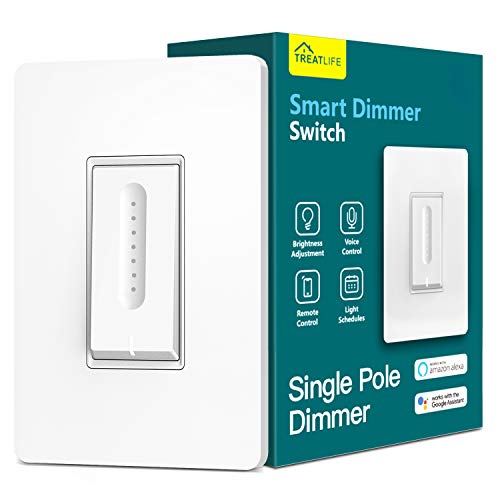
Should you need a reliable, budget-friendly dimmer that works directly with Google Home and Alexa, the TREATLIFE Wi‑Fi Smart Dimmer is a solid choice for homes with a neutral wire and single‑pole wiring. You’ll get stepless touch, app, and voice dimming, memory after power loss, schedules, group control, and app sharing without a hub. It runs on 2.4GHz Wi‑Fi only and supports dimmable LEDs/CFLs up to 150W and halogen/incandescent up to 400W; it won’t work with non-dimmable, smart, or remote‑built bulbs. It’s FCC certified, fits standard 1‑gang boxes, and lacks HomeKit support.
Best For: homeowners with existing neutral wiring and single‑pole fixtures who want an affordable, hub‑free dimmer that works with Alexa and Google Home.
Pros:
- Stepless touch, app, and voice dimming with memory after power loss for convenient, precise control.
- Hub‑free Wi‑Fi integration (2.4GHz) with Alexa, Google Assistant, and SmartThings compatibility.
- Scheduling, group control, and app sharing for multi‑user home automation.
Cons:
- Requires a neutral wire and only supports single‑pole wiring, excluding many older homes and 3‑way circuits.
- No HomeKit support and incompatible with 5GHz networks.
- Not compatible with non‑dimmable, smart, or bulbs with built‑in remotes; limited wattage for LED/CFL (150W).
TP-Link Tapo Smart Light Switch 4-Pack (S500)

Should you want a reliable, no-hub solution for standard homes that already have a neutral wire, the TP-Link Tapo S500 4-pack is a smart pick—its 2.4 GHz Wi‑Fi connectivity and Google Home/Alexa compatibility let you control lights and fans through app, touch, or voice right away. You’ll get four single-pole switches (white, 5.04 x 3.33 x 1.4 in) that handle 15 A / 600 W on 100–120 VAC circuits. Setup uses the free Tapo app with guided instructions; still consult an electrician should you be unsure about wiring. Features include scheduling, Away Mode, UL certification, and a two-year warranty.
Best For: homeowners with existing neutral wiring who want a reliable, no-hub smart switch solution controllable via app, touch, or voice for lights and fans.
Pros:
- Affordable 4-pack that supports 2.4 GHz Wi‑Fi and works with Alexa and Google Home for easy voice control.
- App-guided installation, advanced scheduling, and Away Mode for convenience and home security.
- UL certified, handles up to 15 A / 600 W per switch, and includes a 2-year warranty.
Cons:
- Requires a neutral wire, so it’s not compatible with older homes without neutral wiring.
- Only supports 2.4 GHz Wi‑Fi (no 5 GHz or Zigbee/Z-Wave), which may limit network options.
- Single-pole (1-way) switches only—cannot be used for 3-way/multi-location switch setups.
Factors to Consider When Choosing a Smart Light Switch For Google Home
Before you pick a smart switch, I want you to check a few key factors that affect compatibility and usability with Google Home. Make sure the switch works with Google Assistant, supports your home’s Wi‑Fi frequency (2.4GHz vs 5GHz), and fits your wiring and installation setup. Also look at voice and app control options plus scheduling and automation features so the switch actually meets your daily needs.
Google Home Compatibility
When I pick a smart light switch for my Google Home setup, I initially make sure it explicitly supports Google Assistant so voice control just works; I then confirm it supports key Google Home features like on/off voice commands, scheduling, and automation. I prefer switches that list integration with Smart Life or Tuya since those platforms often streamline linking to Google Home. I also check whether the device requires an extra hub — hubless models simplify setup and reduce points of failure. Practical compatibility means the manufacturer documents Google Home integration and offers clear setup steps. Finally, I verify user reviews or support forums to confirm real-world Google Home reliability before buying, ensuring a smooth, predictable smart lighting experience.
Network Frequency Support
How do I know a smart switch will actually stay connected to my Google Home? I check network frequency support initially. Most smart switches only work on 2.4 GHz Wi‑Fi, not 5 GHz, and that matters because 2.4 GHz gives better range and wall penetration for whole‑home lighting control. In case a switch lists 2.4 GHz compatibility, it’s more likely to maintain a stable Google Home link; using 5 GHz or the wrong band can cause failed connections or intermittent behavior. I also look for switches with AP mode or built‑in troubleshooting tools that simplify setup on the supported frequency and recover connectivity. Bottom line: confirm 2.4 GHz support and helpful network features prior to buying to avoid integration headaches.
Wiring And Installation
Since network compatibility matters, I also check how a switch will actually get wired into my home and whether I can install it myself. Most smart switches for Google Home need a neutral wire to maintain continuous power, so I verify the box for that conductor before buying. I also confirm the switch supports the common single-pole setup; many aren’t suitable for 3-way or multi-way circuits. During installation I look at connector type — screw terminals or push-button connectors — and the device’s physical size to guarantee it fits my one-gang or multi-gang box. Recall these switches typically use 2.4 GHz Wi‑Fi. In case I’m unsure about wiring, I hire a licensed electrician to avoid safety issues.
Voice And App Control
Once I pick a smart switch for Google Home, I prioritize how well voice and app control fit my daily habits: voice control offers hands-free convenience and accessibility, while the companion app gives me remote access to turn lights on or off, set schedules, and check status from anywhere. I check that the switch reliably responds to Google Assistant voice commands and supports device sharing so family members can use voice control too. I confirm the switch uses 2.4 GHz Wi‑Fi, since many don’t work on 5 GHz. In the app I want remote on/off, real‑time status, timers and countdowns for quick tasks, and clear device-sharing management. A polished app plus strong voice responses means fewer daily frustrations.
Scheduling And Automations
Voice and app control get me through daily tasks, but scheduling and automations are what make a smart switch feel truly hands‑off. I look for switches that let me set personalized daily schedules so lights follow my routines without considering about them. Timers and countdowns handle short-term needs—great for kitchens or closets—while Away Mode or occupancy simulation adds a layer of security through randomly activating lights once I’m gone. Remote app access is essential: I adjust schedules from anywhere should plans change. I also value group control and multi-device automations so whole rooms or the entire house switch together, saving energy and simplifying scenes. In short, flexible, remote‑editable scheduling plus smart automations are must-haves.
Safety And Certifications
Although smart features sell the convenience, I always check safety certifications initially because they prove a switch was tested to meet electrical and quality standards like UL, FCC, CE, or ETL. I look for those marks primarily — they mean the device endured rigorous testing for safe operation and lower risk of electrical hazards. Certified switches tend to use better construction, proper insulation, and fire-resistant materials, which reduces overheating or short-circuit risks. Certifications also force adherence to installation rules, such as neutral-wire requirements, so installations follow safe practices. Beyond safety, certified products usually align with local electrical codes and insurance expectations, making them easier to approve in the long term. I won’t pick a switch without recognizable certification.
