

Suppose you swapped Suddenlink’s rental gateway for an ARRIS SB8200 and cut latency on your streaming sessions almost instantly. You’ll want gear that actually handles gigabit plans, supports DOCSIS 3.1, and avoids bottlenecks at the WAN port. I’ll walk you through reliable modem and modem‑router picks for 2026, what features matter, and how to make certain compatibility so you don’t end up with slowdowns whenever you expect speed.
| ARRIS SURFboard SB8200 DOCSIS 3.1 Cable Modem |
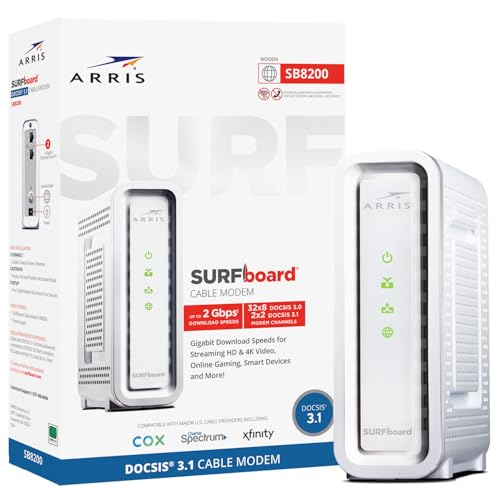
| Reliable Modem | DOCSIS / DSL Type: DOCSIS 3.1 cable modem | Wi‑Fi Capability: None (modem only; requires separate router for Wi‑Fi) | ISP Compatibility / Approval: Certified for major US cable ISPs (Cox, Xfinity, Spectrum) | VIEW LATEST PRICE | Our Analysis |
| C4000BG CenturyLink Bonded Line Wi Fi DSL Router |

| DSL Alternative | DOCSIS / DSL Type: DSL (ADSL/VDSL bonded) router | Wi‑Fi Capability: Built‑in Wi‑Fi (802.11ac) | ISP Compatibility / Approval: Optimized for CenturyLink DSL service | VIEW LATEST PRICE | Our Analysis |
| ARRIS G54 DOCSIS 3.1 WiFi 7 Cable Modem-Router |

| Top Performance | DOCSIS / DSL Type: DOCSIS 3.1 cable modem‑router (combo) | Wi‑Fi Capability: Built‑in Wi‑Fi 7 (BE18000 quad‑band) | ISP Compatibility / Approval: Compatible with major cable ISPs (Xfinity, Spectrum, Cox) | VIEW LATEST PRICE | Our Analysis |
| NETGEAR Nighthawk CAX30 DOCSIS 3.1 WiFi 6 Modem-Router |

| Best All‑In‑One | DOCSIS / DSL Type: DOCSIS 3.1 cable modem‑router (combo) | Wi‑Fi Capability: Built‑in Wi‑Fi 6 (AX2700 dual‑band) | ISP Compatibility / Approval: Compatible with major cable ISPs (Xfinity, Spectrum, Cox); not compatible with DSL providers | VIEW LATEST PRICE | Our Analysis |
| Arris G18 DOCSIS 3.1 Wi‑Fi 6 Modem Router |

| Value Combo | DOCSIS / DSL Type: DOCSIS 3.1 cable modem‑router (combo) | Wi‑Fi Capability: Built‑in Wi‑Fi 6 (AX1800 dual‑band) | ISP Compatibility / Approval: Approved for major cable ISPs (Comcast Xfinity, Cox, Spectrum) | VIEW LATEST PRICE | Our Analysis |
More Details on Our Top Picks
ARRIS SURFboard SB8200 DOCSIS 3.1 Cable Modem
Should you want multi‑gig performance for streaming, gaming, or huge downloads, the ARRIS SURFboard SB8200 is a solid pick — it’s a DOCSIS 3.1 modem that supports cable plans up to 2 Gbps, so it’ll future‑proof your Suddenlink connection while you pair it with a separate router for Wi‑Fi. You’ll get two 1 Gbps Ethernet ports to link a router or wired devices, a compact design with clear LEDs, and CableLabs certification for major US ISPs. It’s easy to set up: coax, power, activate with Suddenlink. Confirm model support and activation steps before buying.
- DOCSIS / DSL Type:DOCSIS 3.1 cable modem
- Wi‑Fi Capability:None (modem only; requires separate router for Wi‑Fi)
- ISP Compatibility / Approval:Certified for major US cable ISPs (Cox, Xfinity, Spectrum)
- Multi‑Gig / High Throughput:Multi‑gig DOCSIS 3.1 supporting up to 2 Gbps cable plans
- Ethernet Ports:2 × 1 Gigabit Ethernet ports
- Intended Use / Form Factor:Modem only — replace rental modem for cable internet
- Additional Feature:Compact modern design
- Additional Feature:Discrete LED indicators
- Additional Feature:Provider activation required
C4000BG CenturyLink Bonded Line Wi Fi DSL Router
Should you need gigabit-capable wireless for multiple 4K streams and heavy mobile use, the C4000BG CenturyLink Bonded Line Wi‑Fi DSL Router delivers—with up to 3 Gbps aggregate throughput (600 + 2400 Mbps) and 160 MHz channel support to double compatible device speeds. You’ll get ultra-fast wireless optimized for 4K streaming and heavy device loads, plus 1024‑QAM that enhances data rates about 38% over 256‑QAM. It uses 802.11ac, supports all ADSL and VDSL profiles up to 17a, and offers one SSID for whole‑home coverage. Should you require gigabit wireless for mobiles and laptops, this router fits high‑bandwidth households.
- DOCSIS / DSL Type:DSL (ADSL/VDSL bonded) router
- Wi‑Fi Capability:Built‑in Wi‑Fi (802.11ac)
- ISP Compatibility / Approval:Optimized for CenturyLink DSL service
- Multi‑Gig / High Throughput:Up to 3 Gbps aggregate wireless throughput (600 + 2400 Mbps)
- Ethernet Ports:(Not explicitly numbered) includes Gigabit Ethernet for wired devices/routing (router device)
- Intended Use / Form Factor:Router for DSL (bonded line) with integrated Wi‑Fi for home use
- Additional Feature:160 MHz channel support
- Additional Feature:1024‑QAM modulation
- Additional Feature:Single SSID whole‑home
ARRIS G54 DOCSIS 3.1 WiFi 7 Cable Modem-Router
Should you’re after top-tier speeds and wide coverage, the ARRIS G54 (BE18000) is aimed at power users who stream, game, and run multiple smart devices simultaneously. You’ll get DOCSIS 3.1 and Wi‑Fi 7 with up to 18 Gbps aggregated throughput and quad‑band Wi‑Fi covering about 5,000 sq ft. It includes four 1‑Gigabit Ethernet ports plus a 10‑Gigabit port for ultra‑fast wired links. It’s compatible with major ISPs like Xfinity, Spectrum, and Cox, and fits residential deployments. Choosing this unit can eliminate rental fees and employ a brand present in over 260 million homes worldwide.
- DOCSIS / DSL Type:DOCSIS 3.1 cable modem‑router (combo)
- Wi‑Fi Capability:Built‑in Wi‑Fi 7 (BE18000 quad‑band)
- ISP Compatibility / Approval:Compatible with major cable ISPs (Xfinity, Spectrum, Cox)
- Multi‑Gig / High Throughput:Up to 18 Gbps aggregated throughput (Wi‑Fi 7 + DOCSIS 3.1)
- Ethernet Ports:4 × 1 Gigabit ports + 1 × 10 Gigabit Ethernet port
- Intended Use / Form Factor:Modem‑router combo for whole‑home coverage (residential)
- Additional Feature:Quad‑band Wi‑Fi
- Additional Feature:10‑Gigabit Ethernet port
- Additional Feature:5,000 sq ft coverage
NETGEAR Nighthawk CAX30 DOCSIS 3.1 WiFi 6 Modem-Router
Should you want a single device that replaces both your modem and router while providing DOCSIS 3.1 speeds, the NETGEAR Nighthawk CAX30 is a strong pick for Suddenlink customers who need reliable gigabit-capable Wi‑Fi across a home up to about 2,000 sq. ft. You’ll get DOCSIS 3.1 with 32×8 channel bonding, dual-band WiFi 6 (AX2700) up to 2.7 Gbps, and support for about 25 devices. Four gigabit Ethernet ports (with aggregation), a USB 3.0 port, NETGEAR Armor security trial, and Nighthawk app management simplify setup. It isn’t compatible with DSL or fiber providers like Verizon or AT&T.
- DOCSIS / DSL Type:DOCSIS 3.1 cable modem‑router (combo)
- Wi‑Fi Capability:Built‑in Wi‑Fi 6 (AX2700 dual‑band)
- ISP Compatibility / Approval:Compatible with major cable ISPs (Xfinity, Spectrum, Cox); not compatible with DSL providers
- Multi‑Gig / High Throughput:Up to ~2.7 Gbps Wi‑Fi (AX2700) with DOCSIS 3.1; supports channel bonding (32×8)
- Ethernet Ports:4 × 1 Gigabit Ethernet ports (supports port aggregation)
- Intended Use / Form Factor:Modem‑router combo (replaces separate modem and router)
- Additional Feature:NETGEAR Armor security
- Additional Feature:USB 3.0 port
- Additional Feature:Port aggregation support
Arris G18 DOCSIS 3.1 Wi‑Fi 6 Modem Router
Should you want a compact all‑in‑one that delivers DOCSIS 3.1 speeds and Wi‑Fi 6 performance without juggling separate devices, the Arris G18 is a smart pick for Suddenlink customers who stream, game, or run multiple smart-home devices. You’ll get a cable modem/router combo from a trusted brand found in over 260 million homes, offering DOCSIS 3.1 for faster, more secure connections and smoother gaming. Dual‑band Wi‑Fi 6 (AX1800) provides wider whole‑home coverage and multi‑gigabit capability for high-demand users. It’s approved among major ISPs, and buying one helps you avoid rental fees and save annually.
- DOCSIS / DSL Type:DOCSIS 3.1 cable modem‑router (combo)
- Wi‑Fi Capability:Built‑in Wi‑Fi 6 (AX1800 dual‑band)
- ISP Compatibility / Approval:Approved for major cable ISPs (Comcast Xfinity, Cox, Spectrum)
- Multi‑Gig / High Throughput:Multi‑gig capable (DOCSIS 3.1; AX1800 Wi‑Fi) for high speeds
- Ethernet Ports:Multi‑Gigabit Ethernet (exact port count not specified in summary; supports multi‑gig)
- Intended Use / Form Factor:Modem‑router combo for whole‑home Wi‑Fi and to avoid rental fees
- Additional Feature:Dual‑band Wi‑Fi 6
- Additional Feature:AX1800 performance tier
- Additional Feature:Ownership cost savings
Factors to Consider When Choosing a Modem for Suddenlink
Before you buy, check that the modem is approved through Suddenlink and supports the speeds on your plan. Make sure it uses the right DOCSIS version, has the ports and features you need, and decide whether you want a combined modem‑router or separate devices. Matching these factors will keep your connection fast and compatible.
ISP Compatibility Check
Upon selecting a modem for Suddenlink, make sure it’s DOCSIS‑compatible (ideally 3.1, or at least 3.0 for lower‑end plans), supports the channel bonding and speed tiers your plan requires, and appears on Suddenlink’s approved list or is confirmed through their support so activation won’t be blocked. Next, verify the exact model and firmware version with Suddenlink—some models are allowed only on specific firmware. Check for required features like IP provisioning and voice passthrough provided you have bundled VoIP, and confirm support for any provisioning protocols Suddenlink mandates. Finally, confirm warranty, return policy, and activation steps; some customer‑owned modems need online registration or a technician visit to complete activation.
Required Speeds Match
Assuming you pick a modem, match its rated throughput and channel‑bonding capabilities to your Suddenlink plan so the device won’t become the speed bottleneck. Start checking your plan’s stated max download and upload (100 Mbps, 300 Mbps, 1 Gbps, etc.) and choose a modem that supports at least that throughput. Confirm downstream/upstream channel bonding and aggregated throughput meet or exceed peak plan speeds to avoid slowdowns during congestion. For plans above 1 Gbps or heavy simultaneous use, select a modem with multi‑gig Ethernet or link aggregation for wired backhaul. Factor in real‑world overhead by choosing a modem with roughly 10–20% headroom so protocol overhead, Wi‑Fi limits, and occasional ISP bursts don’t push you past capacity.
DOCSIS Version Importance
Matching your modem’s throughput to your Suddenlink plan is only part of the equation — the DOCSIS version determines how efficiently those speeds are delivered and how future‑proof your setup will be. You’ll want DOCSIS 3.1 provided you plan to use multi‑gig service, need lower latency, or expect long‑term use. DOCSIS 3.1 adds OFDM/LDPC features that improve noise resilience and enhance upstream/downstream throughput on congested networks. DOCSIS 3.0, with channel bonding (commonly 16×4 or 32×8), handles most plans up to about 1 Gbps reliably but lacks the spectral efficiency of 3.1. Because 3.1 modems are backward compatible with 3.0/2.0, choosing 3.1 gives you current compatibility plus upgrade headroom.
Router Versus Modem
While the modem gets you online through handling DOCSIS and channel bonding, you’ll need a router to actually share that connection, manage devices, and provide Wi‑Fi — or you can pick a modem‑router combo that does both but reduces flexibility. Decide whether you want separate devices: a standalone modem plus a third‑party router gives superior Wi‑Fi, mesh or VPN support, easier upgrades, and lets you replace only one component. Combos simplify setup and reduce clutter but can limit advanced customization and force full replacement whenever tech changes. For gigabit or multi‑gig Suddenlink plans, match modem DOCSIS spec and channel capacity, and make certain the router or combo’s Wi‑Fi can handle the same throughput to avoid bottlenecks.
Port And Features
Now that you’ve decided between a standalone modem and a combo, check the modem’s ports and feature set to make sure it won’t bottleneck your Suddenlink plan or limit what your network can do. Confirm at least one Gigabit Ethernet port, or 2.5/10 Gbps when your plan exceeds 1 Gbps, so wired speeds aren’t capped. Prefer DOCSIS 3.1 with ample channel bonding for multi‑gig downstream and future upgrades. In case you want built‑in Wi‑Fi, pick a combo with Wi‑Fi 6 (or newer) and enough bands/antennas for your home. Look for Ethernet aggregation, multi‑gig uplink, or a 10‑GbE port for NAS, gaming, or device clusters. Also evaluate management and security (guest networks, parental controls, auto updates, firewall) plus USB/NAS support for storage.
